
Most gym owners pour money into Facebook posts, branded content, and local sponsorships expecting a flood of new members. Months pass, the budget drains, and the membership numbers barely budge. The frustrating part? The problem isn't the gym. It's the marketing model. Performance marketing flips the script entirely by tying every dollar to a measurable action, whether that's a click, a booked consultation, or a paid sign-up. This article breaks down exactly how CrossFit and boutique fitness brands can build a performance marketing system that generates predictable member growth and real, trackable revenue.
Table of Contents
- Why performance marketing beats brand-only advertising for gyms
- Building your fitness marketing system: Acquisition, conversion, and retention
- Channel optimization and the impact on gym ROI
- Measurement, attribution, and the quest for real growth
- Post-click optimization: The overlooked driver of gym growth
- What most gym owners miss about performance marketing
- Ready to scale your CrossFit gym?
- Frequently asked questions
Key Takeaways
| Point | Details |
|---|---|
| Pay-for-results advantage | Performance marketing lets gyms pay only for real, trackable conversions—maximizing ROI. |
| System matters most | Acquisition, conversion, and retention infrastructure must work together for lasting growth. |
| Channel optimization crucial | Choosing the right channels and aligning optimization goals can boost revenue and membership. |
| Measure actual impact | Incrementality testing uncovers true ad effectiveness, preventing over-crediting ad spend. |
| Post-click lifts revenue | Landing page and post-click improvement can drive dramatic gains in new memberships. |
Why performance marketing beats brand-only advertising for gyms
Brand advertising has its place, but it's a poor fit for most independent gym owners working with limited budgets and real monthly targets. When you run a brand campaign, you're paying for impressions and awareness with no direct line back to a membership sold. Performance marketing works differently.
Performance marketing is a pay-for-results model focused on measurable actions like clicks, sign-ups, and sales, which enables tighter feedback loops than brand-only marketing. For a CrossFit gym running on razor-thin margins, that feedback loop matters enormously. You know within days if a campaign is working, not quarters.
"You only pay when a specific action is completed. That accountability changes everything about how you allocate your budget."
Here's a side-by-side comparison that gym owners should internalize:
| Feature | Performance marketing | Brand advertising |
|---|---|---|
| Payment model | Pay per action (click, lead, sale) | Pay per impression |
| Measurability | Direct: CPA, ROAS, leads | Indirect: awareness, recall |
| Feedback speed | Days to weeks | Months |
| Best for | Membership growth campaigns | Long-term brand equity |
| Budget flexibility | Start small, scale on results | Requires sustained commitment |
| Risk level | Lower (tied to outcomes) | Higher (no guaranteed results) |
For boutique gyms and CrossFit boxes, the advantages compound quickly. You can launch a campaign with a modest budget, test which offer converts, kill what doesn't work, and double down on what does. Your fitness advertising strategies can evolve based on actual data rather than guesswork.
Key benefits worth noting for CrossFit and boutique gym operators:
- Rapid iteration: See what ad creative, offer, or audience performs best within a week
- Tighter ROI control: Set a target cost per lead and optimize toward it
- Scalability: Proven campaigns can scale budgets without proportional risk
- Audience precision: Target local zip codes, age ranges, fitness interest segments
The shift from brand-only spending to gym membership marketing built on performance principles is not just strategic, it's essential for sustainable growth.
Building your fitness marketing system: Acquisition, conversion, and retention
Understanding performance marketing conceptually is one thing. Building a system that actually produces members is another. The critical mistake most gym owners make is treating paid ads as the entire solution. Ads are just the first door. What happens after someone clicks determines whether you grow or burn through budget.
Paid acquisition needs conversion infrastructure such as landing pages and booking flows, plus retention systems running in parallel. Without those, your customer acquisition cost (CAC) rises and new-member growth stalls, even when ads are technically performing.
Think of it this way: a well-optimized ad that drives someone to a broken landing page, a slow website, or a confusing sign-up process is worse than no ad at all. You've paid for the click, but the lead disappears. Here's what a complete gym marketing system looks like:
- Compelling offer: Free trial class, 7-day pass, or introductory pricing that removes the barrier to entry
- Dedicated landing page: Built specifically for the campaign, not your homepage
- Frictionless booking flow: One-click scheduling with confirmation emails or SMS
- Lead nurture emails: Automated sequences that warm up prospects who didn't book immediately
- Review generation: Social proof from real members displayed at key decision points
- Onboarding sequence: A structured process that converts trial members into paying members
- Retention touchpoints: Check-ins, milestone celebrations, and re-engagement campaigns
Your fitness retention systems are not a bonus feature. They're a core driver of performance marketing ROI because every member you keep reduces the pressure to acquire a new one.
Pro Tip: The moment between a free trial and a paid membership is your highest-leverage conversion window. Build a 48 to 72-hour follow-up sequence that includes a personal message, a testimonial from a long-term member, and a clear call to join. This simple step can dramatically improve your trial-to-member rate.
Optimizing your lead conversion best practices at every stage of the funnel means your ad spend works harder without increasing your budget. That's the real power of treating performance marketing as a system rather than a campaign.
Channel optimization and the impact on gym ROI
Once your system is built, the next lever is channel selection and optimization settings. Not all ad platforms deliver the same return, and within each platform, how you configure your campaign goal can dramatically change your results.

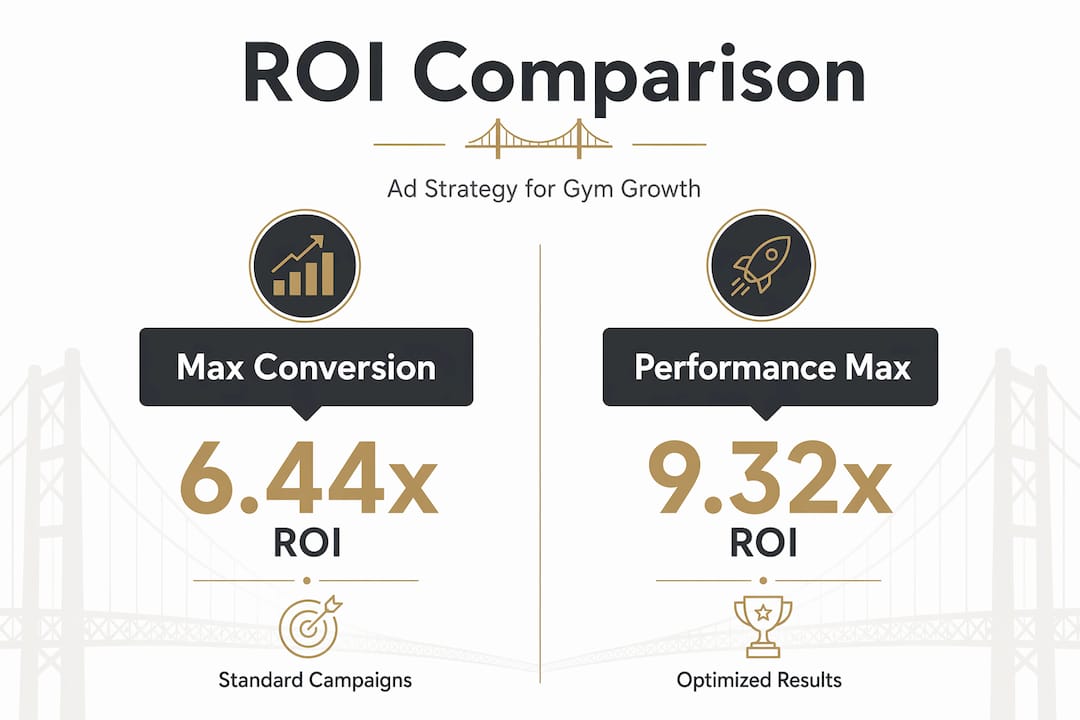
Real-world data makes this concrete. Google Ads campaigns optimized for Max Conversion Value delivered 6.44x return on ad spend (ROAS), while Performance Max campaigns reached 9.32x ROAS on the same accounts. That's not a minor difference. That's the difference between a campaign that marginally pays for itself and one that funds serious membership growth.
Performance Max delivered 9.32x ROAS compared to 6.44x for standard Max Conversion Value campaigns.
Here's how different channels and optimization goals typically compare for fitness gyms:
| Channel | Optimization goal | Typical ROAS | Best use case |
|---|---|---|---|
| Google Performance Max | Conversion value | 9.32x | Broad local member acquisition |
| Google Search | Max conversions | 6.44x | High-intent keyword targeting |
| Meta Ads | Lead generation | 3x to 5x | Awareness to trial campaigns |
| Meta Ads | Conversion | 4x to 7x | Retargeting warm audiences |
| YouTube Ads | Brand reach | 1x to 3x | Awareness for new markets |
Steps to select and optimize the right channels for your gym:
- Define your primary goal first. Are you optimizing for raw leads, booked trials, or paid memberships? Each requires a different campaign setup.
- Start with Google Search for high-intent prospects. People searching "CrossFit gym near me" are already motivated buyers.
- Layer Meta Ads for reach and retargeting. Use Meta to stay visible to people who visited your site but didn't convert.
- Test Performance Max once you have conversion data. It requires historical signals to optimize effectively, so don't start cold.
- Align your bidding strategy with business value. Optimize for the action closest to revenue, not just traffic or impressions.
- Review channel performance weekly during ramp-up. Cut underperforming ad sets quickly and reallocate budget toward winners.
Your social media for gym growth efforts on Meta can complement paid campaigns significantly when the content and targeting are aligned. And scaling gym advertising becomes far more predictable once you've validated the channel and optimization combination that drives your lowest CAC.
Measurement, attribution, and the quest for real growth
Optimizing channels is only half the equation. If you're measuring results incorrectly, you'll make decisions based on data that actively misleads you. This is one of the most underappreciated problems in fitness marketing.
Platform attribution reports have a fundamental bias. Meta's incremental attribution estimates were tested against GA4 cross-checks and showed 87% incremental on Meta's own reporting versus 67% incremental when independently verified. That gap means Meta was claiming credit for conversions that would have happened anyway. For gym owners, that's real budget being misallocated.
"Incrementality testing measures causal lift. Attribution tells you correlation. You need holdout testing to know the true impact of your ad spend."
Common measurement pitfalls that hurt gym owners:
- Over-relying on last-click attribution, which ignores the full customer journey from awareness to sign-up
- Trusting platform dashboards without cross-referencing against CRM or actual membership data
- Ignoring view-through conversions that inflate results without reflecting real intent
- Failing to separate organic growth from paid growth in overall membership reports
- Not accounting for seasonality when comparing month-over-month campaign results
Pro Tip: Once your monthly ad spend exceeds $3,000 to $5,000, run a conversion lift holdout test. Withhold ads from a small random segment of your audience for two to four weeks and compare their conversion rate against the exposed group. This tells you exactly how much incremental membership growth your ads are actually driving.
Incrementality testing in practice involves comparing exposed versus non-exposed groups to isolate causal lift from your ads. And structured holdout testing methods give you a controlled methodology to do this without sacrificing campaign volume entirely.
Your advertising incrementality work and campaign attribution examples from real fitness brands can help you calibrate what good measurement looks like in practice. The goal is confident spending, knowing that each dollar is producing real, additional members, not just credited ones.
Post-click optimization: The overlooked driver of gym growth
Here's where most gym owners leave enormous value on the table. They invest heavily in ads, obsess over click-through rates, and then send traffic to a generic webpage that was never designed to convert. Post-click optimization is the discipline of maximizing what happens after the click, and the revenue impact can be staggering.
A real-world case showed that post-click landing page redesigns generated nearly $12 million in incremental revenue in just 69 days. That figure comes from actual post-click optimization results in the health and fitness space, and it illustrates a clear principle: your ad spend ceiling is determined by how well your post-click experience converts.
Key levers in post-click optimization for fitness gyms:
- Page speed: A landing page that loads in under two seconds converts significantly better than one that takes four or more seconds. Mobile load speed is especially critical since most fitness searches happen on phones.
- Trial offer clarity: The offer on your landing page must match exactly what your ad promised. Any mismatch kills trust and conversions instantly.
- Frictionless booking: Reduce the number of form fields to the absolute minimum. Name, email, and phone number is usually enough to initiate a trial booking.
- Social proof placement: Position member testimonials, before-and-after stories, and Google review scores directly on the landing page, not buried in a separate section.
- Onboarding flow: Once someone signs up for a trial, what happens next? A clear, warm onboarding sequence increases the chance they show up and ultimately convert to a paid member.
Revenue growth depends on both acquiring members and optimizing the conversion funnel all the way through the trial-to-paid stage. Your post-click conversion strategy and the offers that drive leads into your funnel must work together as a unified experience, not as separate disconnected pieces.
What most gym owners miss about performance marketing
After working with CrossFit boxes and boutique gyms across the country, the pattern we see most is this: gym owners expect paid ads to do all the heavy lifting, then feel burned when they don't see instant membership growth. The assumption is that better ads equal more members. That's only partially true.
The bigger truth is that the most significant ROI often comes from what happens after the click. A gym that spends $3,000 a month on ads but has a poorly optimized landing page and no follow-up system will consistently underperform a gym spending $1,500 a month with a tight funnel and strong onboarding. The system multiplies the ad spend's effectiveness, not the other way around.
Most gym owners also skip incrementality testing entirely. They see 50 conversions attributed to Meta and assume all 50 came because of the ads. In reality, a meaningful portion of those members might have found the gym through organic search, word of mouth, or a Google Maps listing. Overpaying for "results" that would have happened anyway is a quiet budget drain that compounds over time.
The gyms that consistently grow are the ones treating content strategies for gyms, paid media, landing pages, and retention as a single connected engine, not separate efforts managed by different people with no shared goal. Evidence-based programs, not just ad spending, are what separate gyms that plateau from those that scale.
Ready to scale your CrossFit gym?
If this article clarified what performance marketing can actually do for your gym, the natural next step is applying these strategies with the right partner behind you.
At Enoch Marketing, we build performance marketing systems specifically for CrossFit gyms and fitness brands across the U.S. From paid media and lead funnels to post-click optimization and retention systems, everything we do is designed to grow your membership numbers and your revenue. Check out our CrossFit gym marketing services to see exactly what a full-stack performance program looks like, and visit our agency pricing page to find the right fit for your gym's growth goals. Book a free strategy session and we'll audit your current marketing and show you exactly where the biggest gains are hiding.
Frequently asked questions
What is the main benefit of performance marketing for gyms?
Performance marketing lets gyms pay only for measurable results like clicks, sign-ups, and sales, creating faster feedback loops than traditional brand advertising so you can adjust campaigns before wasting significant budget.
How should gyms measure ad impact beyond platform attribution?
Gyms should use incrementality testing with controlled holdouts comparing exposed versus non-exposed user groups to identify true conversion lift, rather than relying solely on platform-reported results that often overclaim credit.
Why does paid acquisition need conversion and retention infrastructure?
Paid ads alone raise CAC and stall growth because leads without a strong landing page, booking flow, and retention system simply don't convert at rates that make ad spend sustainable over time.
Which marketing channels deliver the best ROI for fitness gyms?
Performance Max on Google delivered 9.32x ROAS compared to lower returns on standard Search campaigns, making value-optimized campaigns generally stronger for gyms focused on membership growth.
What role does post-click optimization play in fitness marketing?
Post-click landing page redesigns can generate millions in incremental revenue by dramatically improving conversion rates, proving that where prospects land after clicking your ad is just as important as the ad itself.