
Spending nearly $500 to acquire a single member and watching them quit after 60 days is one of the most painful cycles in the gym business. CrossFit boxes average $492 in CAC, and without a data strategy behind your marketing, that number can quietly bleed your profit every quarter. The good news is that a structured, data-driven approach changes this equation entirely. This article walks you through the metrics that matter most, how to integrate your systems, and how to turn raw numbers into a steady stream of new and loyal members in your local market.
Table of Contents
- Why data matters for CrossFit gym marketing
- The essential data every CrossFit gym should track
- Integrating data from marketing and membership systems
- Applying data-driven strategies: Outperforming the local market
- The smart owner's view: What experts miss about gym data
- Grow your CrossFit gym with expert data-driven strategies
- Frequently asked questions
Key Takeaways
| Point | Details |
|---|---|
| Data enables targeted growth | Analyzing member and market data helps gyms run more effective local campaigns. |
| Track essential KPIs | Monitoring CAC, conversion rates, and ARPM gives owners clear marketing benchmarks. |
| Integrate systems for insights | Combining membership and marketing data in dashboards empowers rapid optimization. |
| Apply geo-targeted strategies | Segmenting by demographics and location maximizes ad impact and early retention. |
| Balance acquisition and retention | Top gyms use data to attract new members and prevent churn with human outreach. |
Why data matters for CrossFit gym marketing
CrossFit gym owners face a genuinely tough local landscape. New boutique fitness studios, big-box gyms slashing membership prices, and an increasingly distracted consumer base all compete for the same attention. Spending more on ads without understanding where your leads come from is like adding more fuel to a leaking engine. The money disappears, and you're left wondering why the needle isn't moving.
Data changes the conversation. Instead of guessing which Facebook post landed best or which zip code produced your most loyal members, you can know. Business intelligence in CrossFit allows gym owners to analyze member demographics, seasonality, and local trends so that marketing campaigns reach the right people at the right moment. That kind of precision targeting is the difference between a campaign that produces 40 leads and one that produces 40 qualified leads who are genuinely likely to join.
Here is why data-driven marketing produces measurable advantages for CrossFit gyms:
- Better audience targeting: You stop broadcasting to everyone and start reaching people who match your existing best-member profile.
- Smarter budget allocation: You see exactly which channels deliver the lowest cost per lead, so you can shift spend accordingly.
- Seasonal campaign planning: Enrollment spikes in January and September. Data lets you anticipate those windows and double down before competitors do.
- Faster iteration: When a campaign underperforms, you catch it in days, not months, and adjust before wasting the full budget.
Explore CrossFit ad campaign examples to see what successful data-informed campaigns look like in practice. The common thread across every strong example is a clear connection between audience data and ad creative, nothing is left to guesswork.
The essential data every CrossFit gym should track
Knowing that data matters is one thing. Knowing which data to track is where gym owners often stall. There are dozens of numbers floating around any marketing platform or membership software, and chasing all of them simultaneously leads to paralysis. Instead, focus on three core KPIs (key performance indicators) that directly connect your marketing spend to membership revenue.
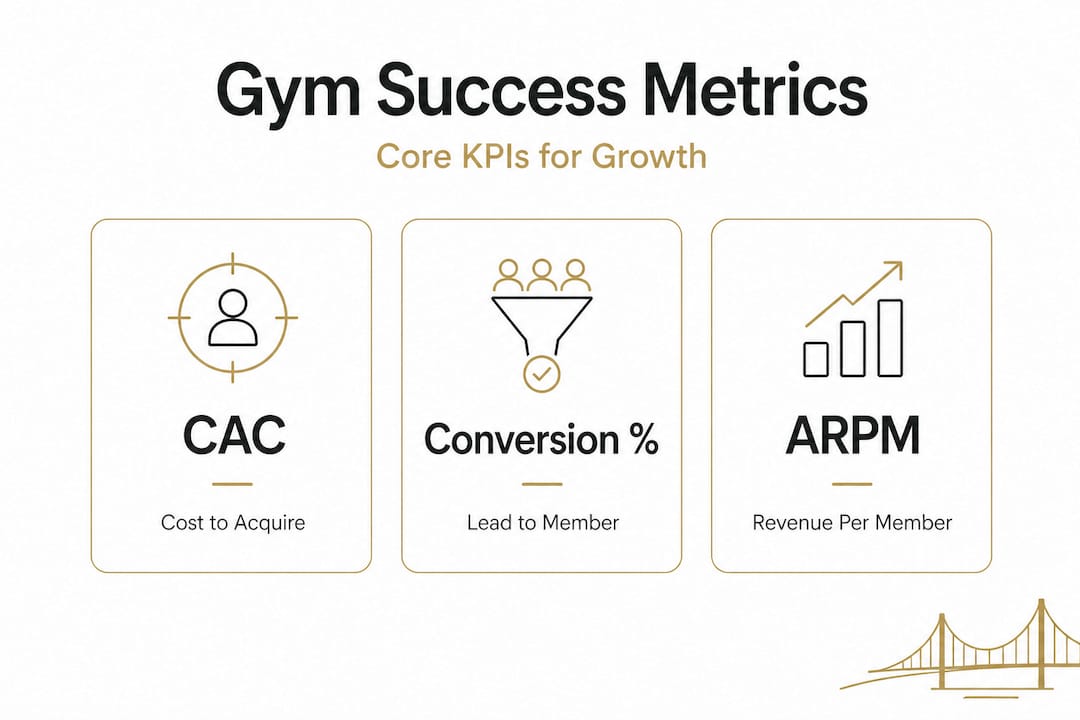
Customer Acquisition Cost (CAC): This is how much you spend, on average, to turn a stranger into a paying member. Divide total marketing spend by the number of new members acquired in any given period. For CrossFit boxes, the industry CAC benchmark sits around $492, though well-optimized gyms consistently push this below $300.
Lead-to-Member Conversion Rate: This metric tells you how effectively your team converts interested prospects into paying members. Industry data shows a healthy conversion rate lands around 45.7%. If your gym is sitting at 20%, the problem may not be your ads but your follow-up process.
Average Revenue Per Member (ARPM): This is the average monthly revenue each active member generates. Industry benchmarks put ARPM in the $150 to $200 per month range. Tracking ARPM alongside CAC tells you how quickly a new member recoups their acquisition cost.
Here is a quick reference table to benchmark your gym's current performance:
| KPI | Industry average | Strong performance |
|---|---|---|
| Customer Acquisition Cost (CAC) | $492 | Below $300 |
| Lead-to-Member Conversion Rate | 45.7% | Above 55% |
| Average Revenue Per Member (ARPM) | $150 to $200/month | Above $200/month |
| LTV:CAC Ratio | 3:1 | Above 5:1 |
To build consistent tracking habits, follow these steps:
- Set a tracking cadence. Pull your CAC and conversion rate numbers weekly, not monthly. Fast feedback loops let you course-correct before a failing campaign drains your entire budget.
- Connect your ad platforms to your CRM. Every lead that comes through Meta or Google Ads should flow directly into your membership CRM so you can track their full journey from click to paying member.
- Calculate LTV:CAC monthly. Lifetime Value (LTV) divided by CAC is a ratio that signals overall marketing health. A ratio of 5:1 means every dollar spent on acquisition returns five dollars in member revenue over their average membership life.
- Review ARPM by member cohort. Members acquired through referrals often have a higher ARPM than members acquired through cold ads. Knowing this shapes where you invest next.
Pro Tip: If your LTV:CAC ratio drops below 3:1, stop scaling your ad spend and focus on fixing your conversion process or improving retention first. Scaling a broken funnel only magnifies the problem.
Explore how CrossFit gym KPIs connect to real revenue outcomes, and check current marketing performance benchmarks to understand where your gym stacks up against similar operations.
Integrating data from marketing and membership systems
Tracking individual metrics is valuable. But the real power comes when your data sources talk to each other. Most gym owners operate with at least three separate platforms: a membership management system like Mindbody or Wodify, a CRM or email tool, and ad platforms like Meta and Google. When these systems live in silos, you lose the ability to connect marketing spend to member outcomes.

BI tools (business intelligence tools) solve this by pulling data from all your platforms into a single visual dashboard. Instead of logging into four systems and manually comparing spreadsheets, you see one unified view showing your cost per lead, show rate for intro classes, and LTV:CAC ratio in real time.
Here is a comparison of managing data manually versus using an automated BI setup:
| Factor | Manual tracking | Automated BI dashboard |
|---|---|---|
| Time required | 5 to 10 hours per week | Under 1 hour per week |
| Data freshness | Weekly or monthly | Real time |
| Error risk | High (manual entry errors) | Low (automated syncing) |
| Trend detection | Slow | Immediate |
| Decision speed | Delayed | Fast |
The benefits of integration go beyond saving time. When your data is unified, you can:
- Spot a drop in show rate for intro classes within 24 hours and immediately test a new reminder sequence.
- Identify which ad campaign produced members who stayed 12 months or longer, then replicate it.
- Catch a spike in CPL (cost per lead) before it doubles your acquisition costs.
- Attribute revenue accurately so you know which campaign deserves more budget.
Pro Tip: If you are just starting out with data integration, pick two metrics to track first: CPL and show rate. CPL (cost per lead) tells you if your targeting is efficient. Show rate tells you if your lead nurture process is working. Fixing these two metrics alone can cut your CAC by 30% or more before you even build a full dashboard.
Learn how BI integration for gyms works in a real-world context, and see data-driven ad strategies that lean on unified data to produce repeatable results.
Applying data-driven strategies: Outperforming the local market
Once your data is organized, the next step is putting it to work in the market. Three tactics consistently separate growing CrossFit gyms from stagnant ones: geo-targeted advertising, member segmentation, and early retention intervention.
Geo-targeted ads: Your best-performing members almost certainly live within a 5-mile radius of your gym. Geo-targeted ad strategies use your current member data to identify the neighborhoods, zip codes, and even apartment complexes where your ideal prospects cluster. Running Meta ads to a custom radius around those areas dramatically improves lead quality compared to broad city-wide targeting.
Member segmentation: Not every prospect responds to the same message. CrossFit demographic data shows clear behavioral differences between segments. Competition-ready males in their 30s prioritize performance programming and community status. Women focused on flexibility and longevity respond better to messaging around sustainable fitness and stress relief. When your ad creative and offer match the specific motivations of each segment, conversion rates climb fast.
Here are the key geo-targeting and segmentation tactics that high-performing gyms use:
- Build lookalike audiences in Meta Ads based on your top 20% of members by LTV.
- Layer interest targeting (CrossFit, functional fitness, Olympic lifting) on top of geographic radius for higher intent signals.
- Create separate ad sets for new-to-CrossFit audiences versus ex-members you want to win back.
- Use Google Local Services Ads to capture high-intent searches like "CrossFit gym near me" in your specific zip code.
- Test different creative messages per demographic segment and let data pick the winner within 72 hours.
Early retention intervention: Most gyms wait until a member cancels before acting. By then it is too late. Data tells a different story well in advance. A member who attended fewer than four times in their first 30 days is statistically far more likely to cancel than someone who attended eight or more times. Monitoring first-month attendance and intervening early with a personal check-in call or a targeted email sequence significantly improves 90-day retention.
"The gyms that win long-term are the ones that use data not just to attract members but to keep them. Balancing acquisition and retention KPIs is where real competitive advantage lives."
The smart owner's view: What experts miss about gym data
Most marketing conversations for CrossFit gyms orbit around one question: how do we get more leads? It is the wrong starting point. We have worked with gyms that were generating 80 to 100 leads per month through paid media and still losing money because their churn rate was eating every new member they acquired. The data was there. Nobody was reading it correctly.
The mainstream advice says: optimize your ads, lower your CPL, scale your budget. All of that is valid. But it skips the harder truth. Churn is a marketing problem too. Every member who leaves takes their LTV with them and raises your effective CAC for the next cycle. Top-performing CrossFit gyms understand this. They use AI-powered tools to flag early churn signals, but they do not let the dashboard handle the response. A human coach makes the call. A real connection saves the membership. Technology surfaces the problem. People solve it.
The trap most gym owners fall into is treating their BI dashboard as the finish line. It is not. It is the starting gun. Data tells you who is at risk of leaving and when a campaign is underperforming. It cannot tell you why a member feels disconnected or how to make them feel like the gym would miss them if they left. That requires community, culture, and human attention.
Balancing acquisition and retention KPIs is not just a financial strategy. It is a philosophy about what kind of gym you want to run. The numbers support it. The best CrossFit boxes we have seen grow consistently year over year are not the ones with the flashiest ad budgets. They are the ones where coaches know every member's name and the data team flags when someone has not shown up in two weeks.
Pro Tip: Schedule a monthly data review that includes both your marketing metrics and your retention metrics in the same conversation. When you see both together, the connection between acquisition quality and long-term revenue becomes impossible to ignore.
Grow your CrossFit gym with expert data-driven strategies
Understanding the metrics is step one. Turning them into a system that consistently fills your gym with the right members is where most gym owners need a real partner.
At Enoch Marketing, we specialize exclusively in CrossFit gyms and fitness brands across the U.S. We build the full marketing infrastructure that connects your ad data, CRM, and membership system into a growth engine you can actually read and act on. From paid media and CrossFit gym marketing services to lead funnels and local SEO, every strategy we build is rooted in the kind of data this article covers. If you are ready to stop guessing and start growing, reach out to our team and book a free strategy session. We will show you exactly where your current marketing is leaking and how to fix it fast.
Frequently asked questions
Which data is most important for CrossFit gym marketing?
Customer Acquisition Cost, Lead-to-Member Conversion Rate, and ARPM are the three core KPIs that directly connect your marketing spend to revenue outcomes, making them the starting point for any data-driven strategy.
How can gym owners use member demographics and trends?
Analyzing demographics and local seasonality lets you build campaigns that speak directly to specific member motivations, improving both lead quality and long-term retention.
What tools help unify gym and marketing data?
Business intelligence dashboards that integrate membership and ad data give you a real-time, unified view of your funnel so you can optimize campaigns and reduce wasted ad spend quickly.
How do top CrossFit gyms boost retention?
They monitor early behavioral signals like first-month attendance, and when the data flags a churn risk, a coach or staff member reaches out personally to reconnect before the member cancels.