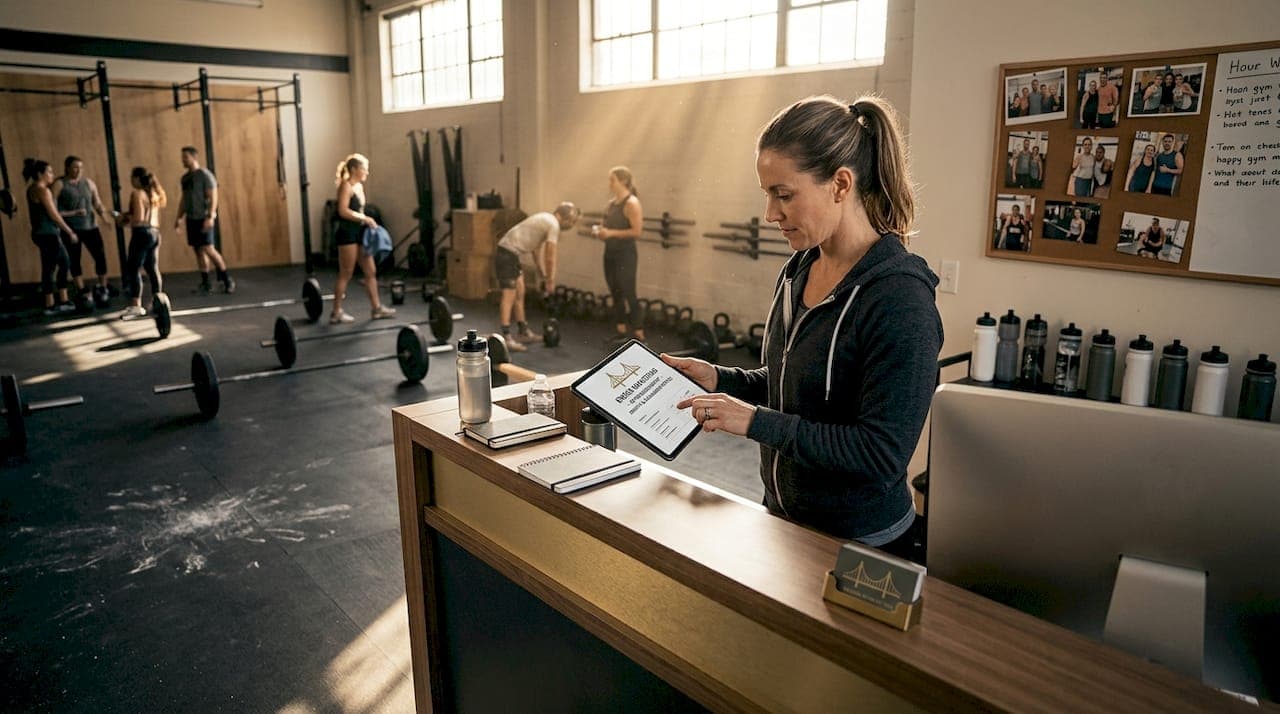
Running a CrossFit gym means you're constantly competing for the same local members as every other fitness option in town. Referrals only go so far, and word-of-mouth growth has a ceiling. The gym owners who consistently fill their rosters and grow memberships month over month are the ones who master paid media. But choosing the right campaign type, platform, and message is where most owners get stuck. This article breaks down proven paid media campaign examples built specifically for CrossFit gyms, so you can stop guessing and start attracting the right members in your local market.
Table of Contents
- How to evaluate paid media campaigns for CrossFit gyms
- Transformation story ads: Real member results
- Busy parent campaigns: Time-saving fitness solutions
- Beginner-friendly ads: Breaking barriers to entry
- Summary comparison: Which campaign fits your CrossFit gym?
- From our experience: What most gyms get wrong about paid campaigns
- Partner with experts to boost your campaign results
- Frequently asked questions
Key Takeaways
| Point | Details |
|---|---|
| Use storytelling | Transformation stories with real results increase conversion rates for local CrossFit campaigns. |
| Target busy parents | Ads offering flexible routines and time-saving solutions successfully drive sign-ups. |
| Beginner-friendly messaging | Inclusive ads that highlight starter offers and coaching help break barriers for newcomers. |
| Match platform to goals | Choose Facebook, Instagram, or Google Ads based on your campaign’s target audience and objectives. |
How to evaluate paid media campaigns for CrossFit gyms
Before you spend a dollar on ads, you need a clear framework for deciding what campaign is worth running. Not every ad format works for every gym, and understanding how to match your campaign to your audience is what separates profitable marketing from wasted budget.
Start by identifying your target audience segments. CrossFit gyms typically attract three broad groups:
- Busy parents who want results without sacrificing hours of their week
- Beginners who are intimidated by traditional gyms and want a more guided experience
- Transformation seekers who are motivated by visible results and community accountability
Each group responds to different messages, different platforms, and different offers. A transformation seeker scrolling Instagram at 10 PM needs a completely different ad than a parent searching Google for "quick morning workouts near me."
Next, define your campaign goal before building anything. Are you driving free trial sign-ups, collecting leads for a consultation, or building brand awareness in a new zip code? Your goal determines your funnel. Free trial campaigns typically use direct response ad copy with a simple landing page. Awareness campaigns are better suited to video content and broader reach targeting.
Platform selection matters more than most gym owners realize. Facebook and Instagram work best for social proof campaigns, because users are already in a browsing mindset and respond to images, testimonials, and community content. Google Ads capture active intent, meaning people who are already searching for a gym in your area. Combining both gives you full-funnel coverage. You can learn more about paid media campaign services that cover both platforms in one coordinated strategy.
According to proven ad copy templates, the CrossFit ads that convert best feature transformation stories like "Sarah deadlifted 200lbs," busy parent angles like "get fit in just 3 hours a week," and beginner-friendly hooks, all deployed across Facebook, Instagram, and Google for trial offers.
Pro Tip: Free trial campaigns consistently outperform general awareness campaigns when the ad copy uses specific, relatable member achievements rather than generic fitness claims. "Sarah added 30lbs to her deadlift in 60 days" will always beat "Join our amazing community today."
Transformation story ads: Real member results
Once you understand how to evaluate campaign types, the first example worth studying is the transformation story ad. This format is one of the most powerful tools in CrossFit marketing because it does something no stock photo ever can: it proves results are real.
Transformation ads center on real members. A specific name, a specific achievement, and a specific timeframe. The example that appears consistently in high-converting CrossFit campaigns is the "Sarah deadlifted 200lbs" format. It works because it is concrete. Prospects do not connect with vague claims like "get stronger." They connect with a real person who had a goal, showed up, and hit a number.
Here is what makes transformation ads perform well:
- Relatability: The featured member should look and sound like your target prospect, not a professional athlete
- Visual proof: Before and after images or short video clips of actual workouts drive higher engagement than staged photos
- Emotional connection: The story should highlight a struggle that resonates, whether that is low energy, lack of confidence, or years of inconsistency
- Specific outcome: Numbers matter. Weight lifted, pounds lost, or time improved gives prospects a concrete picture of what is possible
Strong personal fitness ad messaging focuses on personal milestones rather than generalized gym benefits, and that principle applies directly to CrossFit paid campaigns.
"Ads featuring real member transformation stories can drive conversion rates up to 60% higher than generic fitness messaging, because they replace skepticism with proof."
That statistic tells you something important. The gap between a good ad and a great ad is authenticity. When a prospect sees a real face, a real name, and a real number, they stop scrolling. They start imagining their own result.
For beginner-focused ad approaches, transformation stories can be adapted to show low starting points, which makes them especially powerful for prospects who feel like CrossFit is "not for someone like me." A story about a member who had never touched a barbell before joining is more persuasive to a beginner than a story about someone hitting a personal record snatch.
Run transformation ads on Facebook and Instagram using carousel formats or 30-second video clips. Pair them with a free trial offer and a landing page that reinforces the same story with additional testimonials. That consistency between the ad and the landing page is what keeps conversion rates high.
Busy parent campaigns: Time-saving fitness solutions
Transformation ads speak to aspiration. Busy parent campaigns speak to reality. And for a huge portion of your local market, the reality is that time is the number one barrier to joining a gym.
The "get fit in just 3 hours a week" campaign framework is specifically designed to remove that barrier. It works because it reframes the ask. Instead of telling a parent they need to commit to a lifestyle overhaul, you are telling them they can get real results with a schedule that actually fits their life.
What makes busy parent campaigns effective:
- Schedule flexibility: Ads that mention morning, noon, and evening class options immediately eliminate the "I can not make it work" objection
- Quick, measurable results: Messaging that focuses on efficiency ("45-minute sessions, full body, done") speaks directly to someone who values their time
- Family-friendly framing: Some gyms have found success with ads that position CrossFit as something parents do for themselves, making them better for their family
The proven ad copy templates confirm that busy parent angles are among the top-performing CrossFit ad categories, especially when paired with Facebook's interest and behavioral targeting that allows you to reach parents in specific age ranges and zip codes.
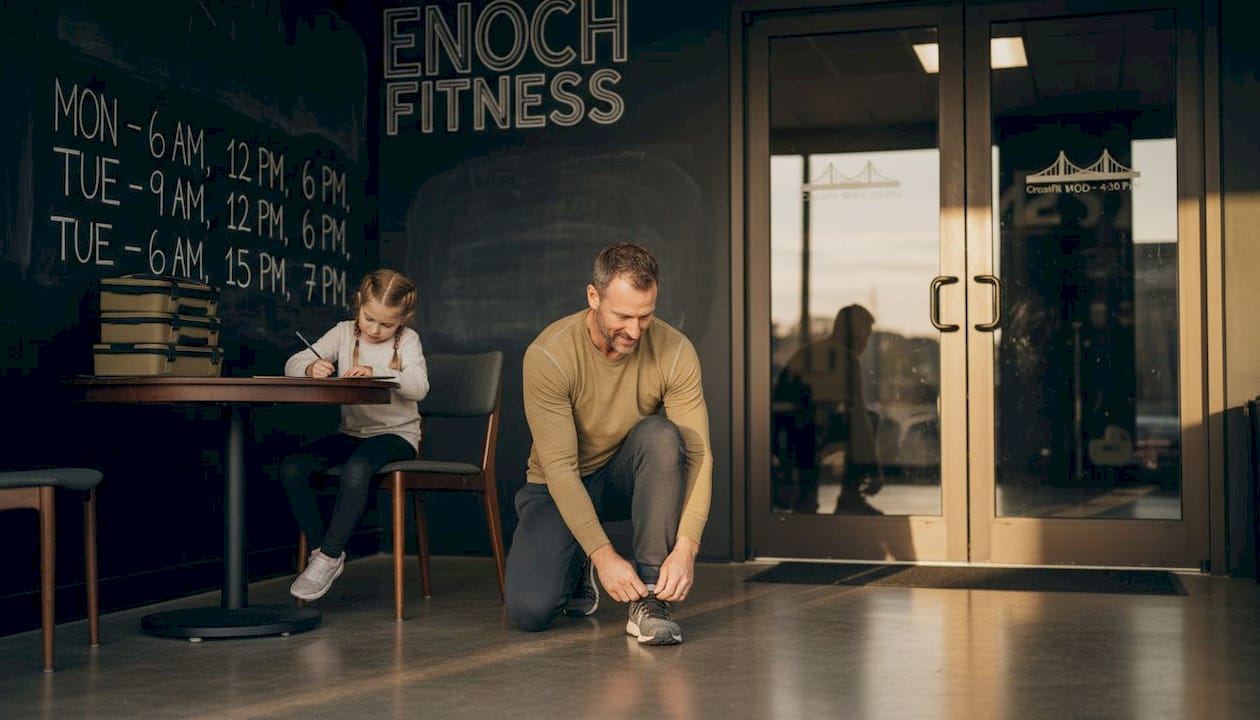
Understanding fitness goal campaigns that align with personal motivations also reinforces why the parent angle works so well. When the ad speaks to a real goal, time-efficient fitness, parents do not feel like they are being sold a gym membership. They feel like they found a solution.
Pro Tip: Use scheduling-focused calls to action like "Reserve your morning spot" or "Book your 5:30 PM class" instead of generic "Sign up now" buttons. Specific CTAs trigger a mental simulation of actually attending, which increases click-through rates significantly.
For maximum local reach, layer busy parent campaigns with geo-targeting that focuses on neighborhoods within a 10-minute drive of your gym. Parents are not going to commute. But if your gym is five minutes from a school drop-off zone, that is a powerful message to deliver at 7:45 AM on a Tuesday.
Use beginner-focused messaging principles even within parent campaigns. Many parents have been out of the gym for years and share the same beginner hesitations about fitness level and belonging. Addressing both "you have time for this" and "you belong here" in a single ad is a winning combination.
Beginner-friendly ads: Breaking barriers to entry
CrossFit has a reputation problem with beginners. Many people assume it is only for elite athletes. Beginner-friendly paid campaigns exist specifically to dismantle that assumption and open the door to a massive, underserved segment of your local market.
The best beginner ads do not just say "all fitness levels welcome." That phrase is so common it has lost all meaning. Instead, effective beginner campaigns show what a first day actually looks like. They use accessible language, welcoming visuals of diverse members, and offers that lower the risk of trying something new.
Key features of high-converting beginner ads:
- Starter class offers: A free foundations class or beginners-only intro session removes the fear of being the only newcomer in a room full of experienced athletes
- Plain language copy: Avoid CrossFit jargon like WOD, AMRAP, or Rx in beginner ads. Use plain English that anyone can understand immediately
- Welcoming visuals: Show real members at different fitness levels, different body types, and different ages. Representation matters more than production quality
The beginner fitness ad strategies that work across fitness verticals consistently focus on lowering perceived risk and building emotional safety before asking for a commitment.
Proven ad copy templates show that beginner-friendly hooks drive strong trial sign-up rates, particularly when paired with a no-pressure offer and beginner messaging that emphasizes coaching and community support rather than performance expectations.
Here is a data comparison showing how different campaign types perform on key metrics:
| Campaign type | Avg. click-through rate | Trial conversion rate | Best platform |
|---|---|---|---|
| Transformation story | 3.8% | 60% | Facebook, Instagram |
| Busy parent | 3.2% | 52% | Facebook (interest targeting) |
| Beginner-friendly | 4.1% | 55% | Instagram, Google Ads |
| General awareness | 1.4% | 18% | Google Display |
The data is clear. Niche-targeted campaigns outperform general ads by a wide margin, and beginner-focused ads often lead on click-through rate because the message hits a large, underserved audience.
Summary comparison: Which campaign fits your CrossFit gym?
Now that you have seen each campaign type in detail, the real question is which one is right for your gym. The answer depends on your current member mix, your local competition, and where your growth opportunities are.
Here is a full comparison of the three primary campaign types:
| Factor | Transformation story | Busy parent | Beginner-friendly |
|---|---|---|---|
| Best audience | Motivated athletes | Working parents, 30-45 | First-time gym members |
| Conversion strength | Very high | High | High |
| Budget requirement | Medium | Medium | Low to medium |
| Primary platform | Facebook, Instagram | Instagram, Google | |
| Key strength | Social proof and aspiration | Time-efficiency positioning | Inclusivity and low barrier |
| Biggest risk | Requires authentic stories | Needs precise scheduling info | Must avoid jargon |
Top gym owners featured in ad strategies at top gyms consistently run multiple campaign types simultaneously rather than choosing just one, segmenting their audience and matching each person to the most relevant message.
Use this numbered process to choose the right starting campaign for your gym:
- Audit your current member base. Who are your happiest, most loyal members? Their profile tells you who your ads should target first.
- Identify your biggest growth gap. If you have no beginners, run a beginner campaign. If parents are underrepresented, start there.
- Check your local competition. If every gym nearby is running generic ads, a transformation story campaign will stand out immediately.
- Set a clear conversion goal. Pick one metric to optimize, free trial sign-ups, consultations, or class bookings, and build everything around it.
- Start with one campaign type, test it for 30 days, then layer in a second. Multi-campaign strategies work best when each one is individually optimized first.
The proven ad copy templates reinforce this approach, showing that gyms who segment their campaigns by audience type consistently outperform those running a single generalized message. Explore media campaign options that allow for this kind of audience segmentation from the start.
From our experience: What most gyms get wrong about paid campaigns
Here is the uncomfortable truth we see repeatedly when working with CrossFit gym owners across the country. Most of them are not losing because their gym is bad. They are losing because their ads are generic.
The biggest mistake is treating paid campaigns like a megaphone instead of a conversation. Gym owners will spend $1,000 on Facebook Ads with copy that says "Join our CrossFit community!" and wonder why nothing converts. The problem is not the budget. It is the message.
Personalization is the actual lever. The moment you replace a stock photo with a real member's face, and replace "get fit" with "Maria added 40lbs to her back squat in eight weeks," you are having a different conversation entirely.
We have also seen gyms blow through their budget in the first two weeks because they scaled too fast. The smarter move is to test a $300 to $500 campaign for 30 days, find what message resonates, and then put serious money behind what works. Our agency's campaign insights are built on exactly this kind of iterative testing.
And never use stock images. Ever. Real member photos, even taken on a phone, convert better than polished stock imagery because they feel real. Prospects are sophisticated enough to know the difference.
The best paid campaign is the one that speaks directly to your gym's unique community.
Partner with experts to boost your campaign results
Understanding campaign types is a strong start, but building and managing them profitably takes experience, testing, and constant optimization.
At Enoch Marketing, we specialize exclusively in CrossFit gyms and fitness brands. Our marketing services for gyms cover everything from Meta and Google Ads to lead funnels, local SEO, and brand strategy, all built around the specific growth challenges gym owners face. Whether you are launching your first campaign or scaling an existing one, our team builds strategies that drive real memberships, not just clicks. Check out our CrossFit marketing pricing to see what fits your budget, or get expert advice through a free strategy session and walk away with a clear action plan.
Frequently asked questions
What paid media platform works best for CrossFit gyms?
Facebook and Instagram consistently deliver the strongest results for local CrossFit trial campaigns, as proven ad templates confirm, though Google Ads adds valuable intent-based reach for people actively searching for gyms near them.
How can I track the success of my paid media campaigns?
Track trial sign-up conversions and new member enrollments directly tied to your ads, and compare performance across campaign types monthly to identify which messaging drives the lowest cost per acquisition.
Which ad messaging resonates with beginners?
Inclusivity-focused copy with starter offers and plain language performs best for beginners, and beginner-friendly templates confirm that removing intimidation through welcoming visuals and no-jargon copy drives strong first-time sign-up rates.
How much should CrossFit gyms spend on paid media campaigns?
Start with a test budget of $300 to $500 per month to find what messaging connects with your local audience before scaling up, which keeps your risk low while generating useful data to optimize future spending.