
Most gym owners play it safe with advertising, spending just enough to feel like they're "doing marketing" without committing to real growth. That caution quietly kills momentum. While you hold back, competitors are flooding your local market with targeted ads, capturing leads you never see. The truth is, scaling gym advertising strategically is one of the most powerful levers you have for sustainable membership growth and revenue, but most owners either underinvest, scale too fast, or miss the financial benchmarks that separate profitable expansion from expensive mistakes. This guide gives you the frameworks to do it right.
Table of Contents
- Why scaling gym advertising matters
- The financial framework: How much should you spend?
- How to scale advertising efficiently: Step-by-step
- Case studies: What successful scaling looks like
- The uncomfortable truth most gyms miss about scaling advertising
- Grow your gym with expert advertising support
- Frequently asked questions
Key Takeaways
| Point | Details |
|---|---|
| Scaling drives growth | Strategic advertising increases memberships and revenue for gyms. |
| Follow clear financial benchmarks | Keep CAC under 35% of LTV and check operational margins before increasing spend. |
| Scale incrementally | Increase ad budgets in small steps and refresh creatives weekly to avoid efficiency decay. |
| Success stories avoid heavy discounting | Top performing gyms scale using SEO, CRM, and creativity—not big discounts. |
| Margin compression is a real risk | Watch software and payroll costs so growth doesn't undercut profitability. |
Why scaling gym advertising matters
Let's start with the core reality: gyms that grow consistently are not growing by accident. They invest in advertising, track results, and scale what works. Traits of top gyms across major markets share a common thread: they treat marketing as a growth engine, not a cost center.
The fitness industry has grown more competitive every year. New boutique studios, franchise boxes, and big-box chains are all competing for the same local leads. If your advertising stays flat while your competitors increase their spend, you lose market share even when you're standing still. That's the quiet danger most owners don't recognize until it's too late.
Here's what scaling strategies actually do for a gym business:
- Increase your local brand visibility consistently, so prospects think of you first when they're ready to join
- Generate a steady pipeline of warm leads instead of relying on word-of-mouth bursts
- Allow you to test, learn, and optimize messaging before committing major budget
- Create compounding returns when paired with strong retention and upsell systems
- Enable predictable revenue forecasting based on cost-per-lead and conversion data
"Gym owners scale advertising to drive membership growth and revenue amid rising competition and ad costs, leveraging data-driven strategies for sustainable expansion."
The key phrase here is sustainable expansion. Scaling is not about throwing money at Facebook ads and hoping for the best. It's about building a structured system where every dollar you add to your ad spend has a predictable return. That only happens when you understand the financial mechanics behind your campaigns before you increase budget.
Now that you see how gyms benefit from scaling advertising, let's clarify the financial benchmarks that ensure scaling is profitable and sustainable.
The financial framework: How much should you spend?
Numbers matter more than strategy when it comes to scaling. You can have the best creative in your city, but if your economics are off, you'll bleed cash and burn out before results arrive.
Two metrics define whether scaling is worth it: Customer Acquisition Cost (CAC) and Lifetime Value (LTV).
CAC is what you spend in advertising and sales effort to bring in one new member. LTV is the total revenue that member generates over their time with you. The relationship between these two numbers determines whether scaling your ads is a winning bet or a losing one.

| Metric | Conservative | Target | Aggressive |
|---|---|---|---|
| Member LTV | $700 | $900 | $1,200+ |
| Max CAC (25% of LTV) | $175 | $225 | $300 |
| Max CAC (35% of LTV) | $245 | $315 | $420 |
| Breakeven Timeline | 3 months | 2 months | 6 weeks |
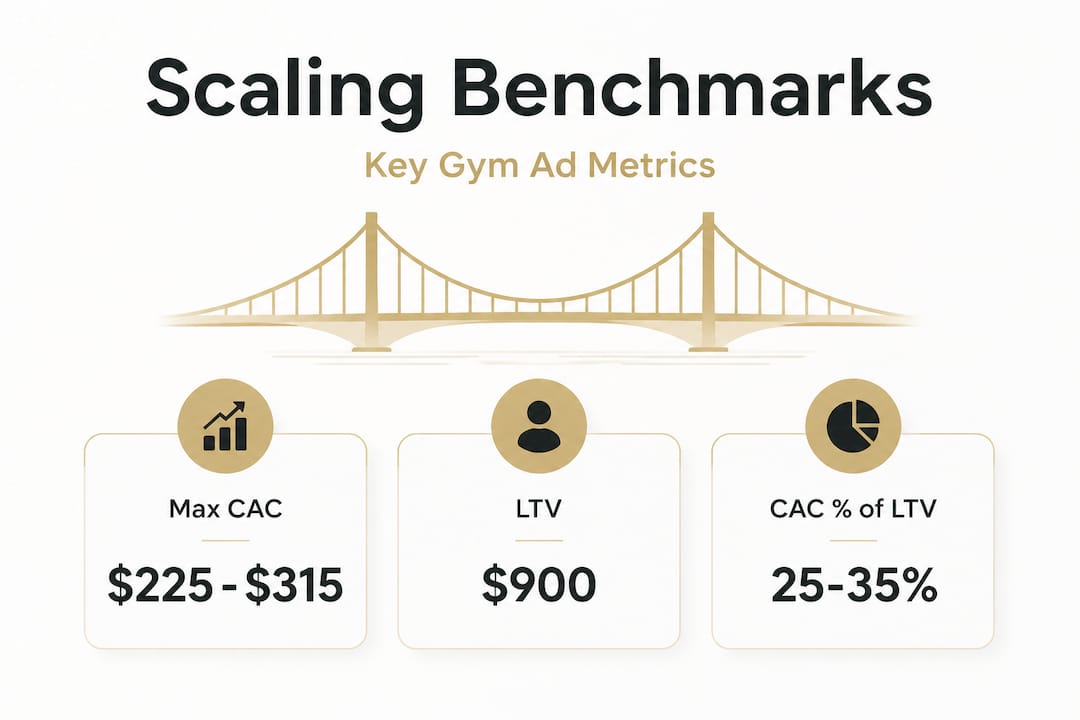
The benchmark is clear: keep CAC between 25 and 35% of LTV, such as $225 to $315 for a $900 LTV, so ad spend stays profitable. That range gives you room to pay for ads, cover your sales process, and still generate margin.
Here's how intro offers change the math. A $1 trial or a discounted first-month membership reduces the friction to join, which lowers your CAC by increasing conversion rates. A new member who joins on a $99 intro offer is not a loss leader if your follow-up process converts them to a full-price membership within 30 days. When paired with upsells like personal training packages, nutrition coaching, or merchandise, you can recover your acquisition cost in weeks rather than months.
Before you scale up spend, one critical check gets skipped more often than any other. You must verify contribution margin stability before adding budget, because operational costs like payroll and software often compress margins at scale. In practical terms: if you're already running thin on coach pay, rent, and software subscriptions, adding $3,000 a month in ad spend may generate new members but destroy your net margin at the same time.
Pro Tip: Before increasing your monthly ad budget, pull your last 90 days of numbers and calculate contribution margin: total revenue minus variable costs (coach pay, cleaning, consumables). If that number is shrinking month over month, fix your operations before you scale ads. More leads into a broken margin structure just accelerates losses.
Look at local gym marketing patterns and you'll notice that the most profitable gyms focus on margin health before volume growth. Understanding your pricing benchmarks alongside your ad spend is the clearest signal of whether scaling is ready to happen.
You've now got financial targets, so what does actual scaling look like? Let's break down step-by-step methods and pacing.
How to scale advertising efficiently: Step-by-step
Knowing when and how to scale your ads is as important as knowing how much to spend. The single most common mistake gym owners make is increasing budgets too quickly. A sudden spike in your daily budget does not just cost more. It resets the platform's learning phase, which means Facebook or Google's algorithm has to start optimizing from scratch, often producing worse results at higher cost for days or even weeks.
Here's the proven sequence for scaling without blowing up performance:
- Establish a baseline. Run your initial campaigns for at least two weeks at a fixed budget. Let the algorithm collect enough data to optimize delivery before touching anything.
- Increase by 10 to 20% every 3 days. This is the core rule of incremental budget scaling. Small, consistent increases preserve the learning phase and keep efficiency stable.
- Activate the four-campaign system. Once your baseline is solid, structure your account with four campaign types: test campaigns for new creative concepts, scale campaigns for proven winners, incremental campaigns for controlled budget growth, and aggressive campaigns for your highest-performing ad sets.
- Monitor frequency aggressively. When the same person sees your ad more than three to five times, creative fatigue sets in. Engagement drops, costs rise, and conversions dry up.
- Refresh creatives weekly. New images, new video hooks, new headlines. This is not optional when scaling. It is mandatory.
| Scaling Approach | Budget Change | Learning Phase Impact | Recommended? |
|---|---|---|---|
| Sudden spike (50%+ at once) | High | Resets, efficiency drops | No |
| Moderate jump (25-50%) | Medium | Partial reset, risky | Use rarely |
| Incremental (10-20% per 3 days) | Controlled | Preserved, stable | Yes |
| Flat budget hold | None | Fully optimized | Use for testing only |
Pro Tip: Never increase your ad budget more than 20% in a single day. Even if performance looks great, sudden spikes force the algorithm to recalibrate. Your CPL (cost per lead) will spike temporarily, and many owners panic and pull back, losing all the progress they built.
The four-campaign system works because it separates your experimental spend from your proven spend. You're not gambling your entire budget on untested creative. You're running controlled experiments on a small slice while your proven campaigns keep generating leads reliably. This structure gives you scaling support data to make confident decisions, not guesses.
The ad spend tactics that work at the gym level are disciplined, not flashy. Steady pacing beats aggressive leaps every single time.
With a scaling framework in hand, let's see what happens when it's implemented, with real success stories and lessons learned.
Case studies: What successful scaling looks like
Theory is useful. Proof is better. Here are real patterns from gyms that scaled advertising effectively.
One high-end gym in the South Atlantic region doubled revenue year over year through a combination of SEO/SEM, CRM automation, and strong local rankings, with no discounting involved. That last part is critical. Discounting to fill membership spots is a trap that trains your community to wait for deals and erodes your brand positioning over time. This gym grew by investing in visibility and systematizing its follow-up process, not by cutting prices.
Key takeaways from that approach:
- Local SEO matters more than most gym owners realize. Ranking in the top three Google map results for "CrossFit gym near me" or "fitness classes in [city]" drives warm inbound leads who are already looking to join.
- CRM automation closes gaps. Leads who don't convert immediately don't disappear. They need follow-up. A CRM with automated sequences can nurture a cold lead for 60 to 90 days and convert them when the timing is right.
- Local rankings compound. Every review you earn, every piece of local content you publish, and every Google Business Profile update strengthens your long-term position in local search without requiring constant ad spend.
"Gyms that scale through digital ad strategy and local authority don't just grow faster. They grow in ways that competitors can't easily copy."
Boutique and specialty gyms present a different challenge. Their cost per lead is typically higher than a standard box gym because their audiences are smaller and more specific. A Pilates studio or a high-end strength training facility cannot use the same broad targeting that works for a 24-hour gym. What they can do is scale spend within tighter audience parameters and rely heavily on advanced gym models that prioritize retention and community over sheer volume.
The lesson across all these cases is consistent: scaling advertising without a retention strategy underneath it is like filling a bucket with a hole in the bottom. Your ad spend brings people in, but your member experience and follow-up systems keep them. Both sides need to be strong before you pour significant budget into growth.
Now let's break down what most gym owners miss, and the hard truths about scaling advertising.
The uncomfortable truth most gyms miss about scaling advertising
Here's what years of working with fitness brands teaches you: most gym owners either wait too long to scale or move too fast when they finally commit. Both extremes destroy profitability in different ways, and neither gets talked about honestly enough.
The owners who wait too long are running on referrals, hoping organic word-of-mouth will carry them. It won't scale. It never does. At some point, your growth stalls because you've tapped your existing network and there's no system bringing in cold leads. By the time you decide to advertise aggressively, your competitors have already captured the local market and your ad costs are higher because you're entering a more crowded auction.
The owners who move too fast see early results and double their budget overnight. Then performance tanks, they blame the platform, and they give up. What actually happened is they triggered efficiency decay by resetting the learning phase, letting creative fatigue hit at high frequency, and ignoring margin compression while chasing lead volume.
Creative fatigue is the most underestimated problem in gym advertising. When your ad frequency passes three to five impressions per person, your click-through rate drops and your cost per lead climbs. Most owners see higher costs and assume the market is saturated. The real issue is that your audience is bored of seeing the same image or video. Weekly creative refreshes are not a nice-to-have at scale. They are the mechanism that keeps your cost per lead stable as you push more budget through the system.
Contribution margin is the silent killer. You can be generating more leads than ever, converting at a healthy rate, and still losing money if your operational costs have grown alongside your ad spend without a corresponding jump in profit. Before every budget increase, check your margin. If it's compressing, understand why before you add more fuel. Deeper scaling insights almost always point back to this single discipline as the dividing line between gyms that scale successfully and those that burn out trying.
The uncomfortable truth is this: disciplined incremental scaling, with constant creative refreshes and margin monitoring, is not exciting. It doesn't make for a good story at a mastermind event. But it's the approach that actually builds a gym business that grows year after year without blowing up in a single bad quarter.
Grow your gym with expert advertising support
Scaling gym advertising is not just a marketing challenge. It's a business operations challenge, and getting it right requires more than boosting posts or running a generic lead generation ad. The frameworks in this article work, but implementation details make the difference between a gym that breaks even on ads and one that builds a predictable, scalable revenue machine.
At Enoch Marketing, we specialize exclusively in CrossFit gyms and fitness brands across the United States. Our growth and lead generation services are built around the exact frameworks covered in this guide: incremental scaling, creative refresh systems, CAC/LTV modeling, and local SEO. We handle the strategy, the creative, and the campaign management so you can focus on running your gym. See pricing for transparent, fitness-specific packages, or get in touch to book a free strategy session and find out exactly what scaling looks like for your market.
Frequently asked questions
What is the ideal ad budget increase rate for scaling gym advertising?
Increase ad budgets by 10 to 20% every three days to avoid learning phase resets and efficiency drops. This pacing keeps the algorithm optimized while gradually increasing your lead volume.
What benchmarks should gyms use for CAC and LTV?
Keep CAC between 25 and 35% of LTV, such as $225 to $315 for a $900 LTV, to ensure ad spend stays profitable. Intro offers and upsells help you hit breakeven within two to three months.
How can gyms avoid creative fatigue in online ads?
Refresh ad creatives weekly and monitor ad frequency to avoid efficiency loss from creative fatigue. When frequency exceeds three to five impressions per person, expect engagement to drop and costs to rise.
Why do so many gyms fail to scale advertising profitably?
Many gyms miss key benchmarks, ignore margin compression from operational costs, or scale too suddenly, resulting in inefficient spend. Fixing the financial foundation before increasing budget is what separates profitable scaling from costly trial and error.