
Most CrossFit gym owners think paid media means throwing money at Facebook and hoping new members show up. That's not a strategy, it's a gamble. Real paid media is a system: hyper-local targeting, compelling creative, airtight follow-up, and conversion tracking that tells you exactly where your new members came from. Done right, local gym lead generation can cost less than $6 per lead, turning a modest monthly ad budget into a steady stream of trial class bookings and long-term memberships. This article walks you through the exact tactics that work.
Table of Contents
- What is paid media and how does it work for CrossFit gyms?
- Proven paid media tactics for local gym growth
- Creative strategies: Standing out and scaling results
- Scaling up and avoiding costly paid media mistakes
- A smarter way to approach paid media for CrossFit gyms
- Grow your CrossFit gym with expert paid media strategy
- Frequently asked questions
Key Takeaways
| Point | Details |
|---|---|
| Hyper-local targeting wins | Focusing ads within a limited radius keeps costs low and results high for CrossFit gyms. |
| UGC creative drives signups | Authentic gym member stories in ads cut cost per acquisition by nearly half. |
| Rapid follow-up is crucial | Contacting leads fast boosts member conversion and prevents wasted ad spend. |
| Track lifetime value | Measure outcomes by member value, not just lead cost, for long-term gym growth. |
What is paid media and how does it work for CrossFit gyms?
Paid media is simple: it's any advertising channel you pay for to reach new people outside your existing audience. For CrossFit gyms, that means Facebook Ads, Instagram Ads, Google Ads, YouTube pre-roll, and Google Local Service Ads (LSAs). Each one puts your gym in front of local people who've never heard of you, or who visited your website and left without signing up.
This is fundamentally different from organic media, which includes word-of-mouth referrals, your Google Business Profile, and free posts on social media. Organic is slow and unpredictable. It's valuable, but you can't scale it on demand. Owned media is your website, your email list, your SMS subscribers. You control it, but it only reaches people already connected to you.
Paid media fills the gap. It reaches cold audiences at scale, fast. And for CrossFit gyms specifically, hyper-local paid campaigns perform especially well because your customer radius is tight. Most members drive no more than 10 to 15 minutes to their gym. You're not competing nationally. You're competing for the people in a 5-mile bubble around your box.
CrossFit-focused paid ads campaigns that prioritize ZIP code targeting and high-intent Google search keywords like "CrossFit near me" or "CrossFit [your city]" put your gym directly in front of people already searching for what you offer. Google Local Service Ads are particularly powerful for personal training offers inside a CrossFit gym, since they show at the very top of search results and only charge you per verified lead.
Here's a quick comparison to put it all in perspective:
| Media type | Speed to results | Cost control | Scale potential | Best use case |
|---|---|---|---|---|
| Paid media | Fast (days) | Full control | High | Cold audience acquisition |
| Organic media | Slow (months) | No direct cost | Limited | Brand trust, referrals |
| Owned media | Immediate | No ad cost | Limited | Retaining existing audience |
Key paid channels for CrossFit gyms:
- Facebook and Instagram Ads: Best for awareness, video, and lead generation with detailed interest and location targeting
- Google Search Ads: Captures high-intent local searches from people actively looking for a gym
- Google Local Service Ads: Great for personal training or intro class offers, pay per lead only
- YouTube Ads: Video-first storytelling for community culture and transformation content
- Retargeting Ads: Re-engages website visitors or video viewers who showed interest but didn't convert
Understanding which channel matches which goal is the foundation. Once that's clear, the tactics get a lot sharper.
Proven paid media tactics for local gym growth
Now that the channels are clear, let's drill down into what actually works for getting CrossFit members in the door.
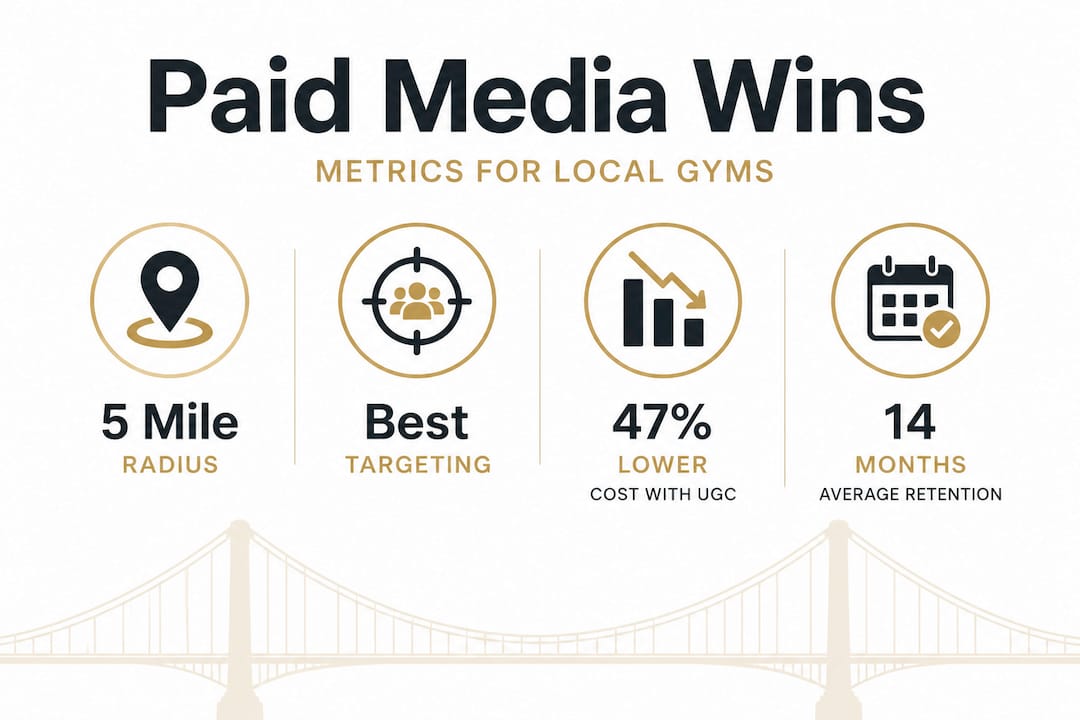
The single biggest lever for reducing your cost per lead is hyper-local targeting. Gyms that limit their ad radius to 5 miles from their location, then layer on interests like weightlifting, HIIT, obstacle racing, or bootcamp fitness, consistently outperform gyms running broad city-wide campaigns. According to a real Facebook Ads case study, local gym campaigns using this exact method achieved a cost per lead (CPL) under $6, combining a 5-mile radius with interest stacking and retargeting.

That number matters. If your membership is worth $150 per month and the average member stays 14 months, your lifetime value (LTV) per member is over $2,000. Paying $6 for a lead, even with a 10% close rate, means you're spending $60 to acquire a $2,000 customer. That's a business model, not an expense.
Here's a breakdown of what strong CrossFit gym campaigns typically look like:
| Campaign element | Benchmark to aim for | Why it matters |
|---|---|---|
| Cost per lead (CPL) | Under $10 | Keeps acquisition profitable |
| Click-through rate (CTR) | 1.5% or higher | Signals creative is connecting |
| Lead-to-trial conversion | 30 to 50% | Depends on follow-up speed |
| Trial-to-member conversion | 40 to 60% | Reflects coaching and sales quality |
Here's the step-by-step process that drives those results:
- Define your radius. Set your ad targeting to a 5-mile radius around your gym, then cross-reference with ZIP codes where your current members live. This creates a warm zone you know converts.
- Layer your interest targeting. Stack interests like CrossFit, functional fitness, weightlifting, nutrition, and HIIT. This narrows your audience to people already passionate about the type of training you offer.
- Lead with a free trial offer. A free week or a first class free removes all risk for the prospect. It's the easiest yes they can say, and it gets them through your door where your community does the selling.
- Use a simple lead form or landing page. Don't send paid traffic to your homepage. Use a dedicated landing page or Meta's native lead form with just a name, email, and phone field.
- Retarget everyone who doesn't convert. Website visitors, video viewers who watched 50% or more of your ad, and lead form openers who didn't finish all go into a retargeting audience. These people already know you. They just need one more push.
Pro Tip: Layer ZIP code targeting with commuter corridors near your gym. People who work nearby but live slightly outside your radius are high-value prospects who often make gym decisions based on proximity to their office, not their home.
Creative strategies: Standing out and scaling results
Beyond targeting and channels, winning in paid media is about what people actually see. Here's how creative can make or break your campaigns.
Most CrossFit gym owners default to one of two extremes: highly polished branded videos that look professional but feel cold, or random phone footage with zero strategy. Neither one is the answer on its own. What actually converts in 2026 is user-generated content (UGC), and the data backs this up hard.
UGC ads perform significantly better, averaging 47% lower cost per acquisition compared to polished brand videos. Why? Because when a real member talks about how your gym changed their life, prospects see themselves in that story. It feels authentic, not like a commercial. Post-iOS 14 privacy updates shrank the targeting data advertisers used to rely on, which shifted the performance advantage squarely to creative quality. Your ad creative is now doing more of the heavy lifting that targeting used to do.
The first 3 seconds of any video ad are everything. If your hook doesn't stop the scroll immediately, your targeting and budget are wasted. Strong hooks for CrossFit gyms include unexpected transformation clips, a bold text overlay like "You don't have to be fit to start CrossFit," or a coach speaking directly to camera with a specific call-out like "If you've been putting off joining a gym for months, this is for you."
Every high-performing CrossFit gym ad should include:
- A pattern-interrupting hook in the first 3 seconds (movement, bold text, direct address)
- A real member or coach speaking naturally, not reading from a script
- Visible community energy: group classes, high-fives, celebration moments
- A single clear offer, typically a free trial or intro class
- A direct call to action: "Claim your free week" or "Book your first class today"
- Short form is your friend. Aim for 30 to 60 seconds for video ads in feeds and Reels
Before you spend a single dollar scaling a new ad concept, test it organically. Post the video as an Instagram Story or Reel and see how it performs with your existing audience. If it gets strong saves, shares, or comments, it's ready to fuel with paid budget.
Pro Tip: Record 5 to 10 short testimonial clips with your best members and build a library of UGC content. Rotate these into your ad campaigns monthly. Fresh creative prevents ad fatigue and keeps your cost per result low as you scale.
Creative best practices for gym ads go beyond just what looks good. The creative has to align with your offer, your audience's emotional state, and the specific platform where it's running.
Scaling up and avoiding costly paid media mistakes
If you want to outpace the competition, you need to not just run ads, but set up for real gym growth and avoid the pitfalls so many others fall into.
The first thing you need before you spend a dollar on ads is proper conversion tracking. Install the Meta Pixel on your website and set up Google Tag Manager for your Google campaigns. Without tracking, you're flying blind. You won't know which ad drove a signup, which landing page is converting, or where you're losing people.
Landing page speed is also non-negotiable. Fast landing pages under 800ms load time significantly improve conversion rates. Every second of delay costs you leads. Use simple, mobile-first pages with one clear offer, minimal form fields, and no distractions. If your homepage takes 4 seconds to load on mobile, you're losing half your paid traffic before they even read your headline.
Follow-up speed is where most gyms leak the most money. If someone submits a lead form and doesn't hear back for 24 hours, they've already signed up at a competitor. Set up automated text and email follow-up that fires within 5 minutes of a form submission. The goal is to get a conversation started while your gym is still top of mind.
The most common and costly paid media mistakes CrossFit gyms make:
- Running ads without the Meta Pixel or Google Tag installed
- Sending paid traffic to a slow homepage instead of a dedicated landing page
- Using broad, untargeted audiences without interest or location filters
- Never testing creative before scaling budget
- Ignoring retargeting entirely and only targeting cold audiences
- Making false or exaggerated health claims in ad copy (this violates platform policies and can get your ad account banned)
- Measuring only cost per lead instead of tracking member lifetime value
"Measure LTV:CAC, not just how cheap your leads are."
That quote should be on your wall. A $4 lead that never shows up is worth less than a $20 lead who joins, stays for two years, and refers three friends. Understanding your real paid marketing costs means looking at the full picture: what you spend to acquire a member vs. what that member is worth over their lifetime with your gym.
A smarter way to approach paid media for CrossFit gyms
Here's a perspective that most marketing content won't tell you: the gym owners obsessing over the cheapest possible cost per lead are often the ones losing the membership game.
Low CPL is a vanity metric if it's not connected to actual revenue. We've seen gyms celebrate $4 leads while their conversion rate was under 5%, which means they were actually spending $80+ to acquire each new member with no tracking to prove it. Meanwhile, gyms that accepted $12 leads but had rock-solid follow-up systems and a killer intro experience were converting at 50% and paying $24 per new member.
The math always favors the gym with better follow-through, not the gym with the lowest ad cost.
What genuinely moves the needle is a combination of three things: creative that authentically captures your gym's culture, targeting that reaches the right local people, and a follow-up system that turns inquiries into conversations within minutes. Most gym owners invest heavily in the targeting piece and almost nothing in the follow-up piece. That's where growth gets left on the table.
Showing gym culture in your ads is not just a nice-to-have. It's a filter that attracts your ideal member and repels people who aren't ready for the intensity and commitment CrossFit requires. When your ads show real people laughing, grinding, and celebrating together, you're not just marketing a workout. You're selling belonging. And that's what makes members stay for years, not months.
Our approach to gym marketing always starts with what happens after the click. Any agency can run ads. The ones that actually grow your gym track the full journey from first click to thriving, long-term member.
Grow your CrossFit gym with expert paid media strategy
If you've read this far, you already know more about paid media than most gym owners who are actively running ads right now. The tactics in this article, from hyper-local targeting and UGC creative to LTV-based measurement and rapid lead follow-up, are exactly what separates CrossFit gyms that grow predictably from the ones stuck in referral-only mode.
At Enoch Marketing, we build and manage expert paid media services designed exclusively for CrossFit gyms and fitness brands. We don't work with plumbers or e-commerce brands. We know your audience, your competitive landscape, and the creative that actually converts fitness prospects into committed members. Whether you want to see how we approach campaigns, review what full-service gym marketing costs, or just talk through your current ad performance, we're ready. Book a paid media strategy call today, or explore our transparent pricing for gym marketing before you reach out.
Frequently asked questions
How quickly can I see new member signups from paid media?
You can generate inquiries within a few days when your targeting, creative, and follow-up are properly set up. Well-optimized campaigns with a 5-mile radius and strong creative start delivering leads almost immediately after launch.
What's the average cost per lead for CrossFit gyms using Facebook ads?
Campaigns that are well-targeted and use strong creative can drive leads under $6 each, though $8 to $15 is a realistic range for most gyms in competitive markets.
What is the biggest mistake gyms make with paid media?
Launching without creative testing and skipping retargeting are the top errors, and both result in significant wasted spend with very few actual member conversions to show for it.
Which ad platforms work best for local CrossFit gyms?
Facebook and Instagram are the strongest for lead generation, while Google Local Service Ads are excellent for capturing high-intent local searches from people actively looking for a CrossFit gym or personal trainer right now.