
Most gym owners think the key to filling their roster is a bigger promotion, a louder ad, or a better discount. But the data tells a very different story. A gym chain that switched to a personalized wellness platform grew membership 52% and pushed retention from 52% to 78%. Meanwhile, gyms still blasting the same generic email to every prospect are leaving serious money on the table. If you own or operate a CrossFit gym, this guide will walk you through exactly why personalization works, how to make it practical, and what to measure so you can grow with confidence.
Table of Contents
- Why personalization outperforms generic gym marketing
- Making personalization practical: Tactics for busy gym owners
- Personalization pitfalls: Common mistakes and how to avoid them
- Measuring the ROI: Data-driven personalization for fitness business growth
- The real lesson: Personalization is a mindset, not just a tool
- Ready to personalize your gym's marketing?
- Frequently asked questions
Key Takeaways
| Point | Details |
|---|---|
| Real impact | Personalizing your fitness marketing results in higher member retention and substantial revenue growth. |
| Doable tactics | Simple steps like automated feedback and personalized messages quickly enhance member connection. |
| Avoid pitfalls | Overly generic or intrusive approaches can hurt engagement, so relevance is more important than volume. |
| Measure success | Track retention and referrals against industry benchmarks to see clear improvement from your personalization efforts. |
Why personalization outperforms generic gym marketing
With the context in mind, let's break down what makes personalized outreach so powerful and measurable.
Generic marketing means sending the same message to everyone on your list, running the same Facebook ad to a broad local audience, or offering a "Join Now" discount that treats a 55-year-old newcomer the same as a 25-year-old competitive athlete. Personalized marketing, on the other hand, speaks directly to where a person is in their fitness journey, what they've already achieved, and what they're likely to need next.
The difference isn't just philosophical. It shows up in your numbers.
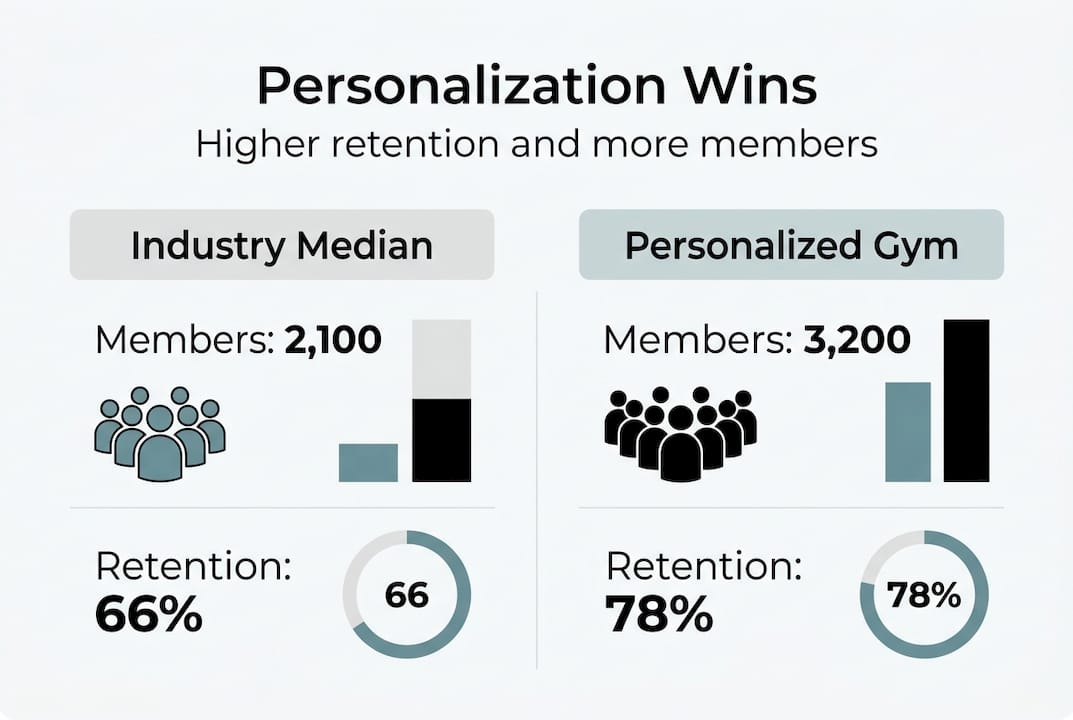
One gym chain documented growing from 2,100 to 3,200 members, a 52% membership increase, while retention climbed from 52% to 78% after implementing personalized tools. A boutique gym saw churn drop 40% by adding personalized compliment flows and micro-mentoring, lifting 90-day retention from 42% to 58%. These aren't outliers. They're what happens when you treat members as individuals rather than leads on a spreadsheet.
Compare those numbers to where most gyms actually sit. According to the 2025 Fitness Industry Benchmarking Report, the median gym sees revenue growth of just 9.9%, net membership growth of 5.5%, and a retention rate of 66.4%. That gap between the median and the top performers is largely explained by one thing: how intentional their communication is.
| Metric | Generic marketing (industry median) | Personalized marketing (documented cases) |
|---|---|---|
| Retention rate | 66.4% | Up to 78% |
| Net membership growth | 5.5% | Up to 52% |
| 90-day churn reduction | Baseline | Up to 40% drop |
| Revenue growth | 9.9% median | Significantly above median |
For CrossFit gyms specifically, the benefits go beyond raw numbers. Personalized outreach tends to:
- Increase class attendance because members feel seen and invested in
- Generate more referrals because people talk about experiences that feel tailored to them
- Improve ROI on paid ads because retargeting and lookalike audiences are sharper when built around specific member behaviors
- Reduce price sensitivity because members who feel a personal connection don't shop around based on monthly dues alone
When you invest in personalization strategies, you're not just marketing better. You're creating a member experience people want to stick with and share.
The foundation of building personalized programs starts with knowing your members deeply enough to speak to their actual goals, not just their zip code.
"Small moments of genuine connection drive big loyalty. A coach remembering a member's milestone is worth more than a month of broadcast emails."
Pro Tip: Keep a simple shared notes document where coaches can log member wins, frustrations, and milestones after each class. This gives your entire team the context needed to make every interaction feel personal, without requiring expensive software.

Making personalization practical: Tactics for busy gym owners
Now that the benefits are clear, here's how you can put personalization to work in your gym without huge investment.
The most common objection we hear from gym owners is this: "I don't have time to write individual messages for 200 members." That's fair. The good news is that effective personalization doesn't require 200 unique emails. It requires a few well-designed systems that create the feeling of individual attention at scale.
Here's a practical step-by-step framework to get started:
-
Segment your member list by behavior, not demographics. Instead of splitting by age or location, create three simple buckets: new members (under 60 days), active members (attending 8+ times per month), and at-risk members (attended fewer than twice in the last 30 days). Each group needs a different message and a different tone.
-
Automate milestone messages. Set up automated texts or emails that trigger on a member's 30-day, 90-day, and 1-year mark. Keep the message short and specific: "Hey [Name], you've been crushing it for 90 days. We've noticed your clean has gone up by 15 pounds. That's real progress." Automated doesn't have to feel robotic.
-
Personalize post-class feedback. After every trial class or foundations session, send a follow-up that references something specific from that session. A gym trial personalization approach that mentions the workout someone did on day one creates a dramatically better impression than a generic "Thanks for stopping by."
-
Create a coach-to-member check-in system. Once per week, have each coach reach out to two or three members they haven't seen recently. A simple text that says, "Hey Sarah, missed you this week. Everything okay?" has an outsized impact on retention. Research confirms this: a boutique gym that implemented personalized compliment flows and micro-mentoring cut churn by 40% without adding a single new class or changing pricing.
-
Surface small wins publicly. During class, call out progress loudly and specifically. "Marcus just hit his first unassisted pull-up after three months of work." That public acknowledgment reinforces that your gym pays attention to the individual. It also builds the kind of social proof that drives referrals.
-
Use intake forms as a personalization engine. When a prospect signs up for a free trial, ask three questions: What's your main fitness goal? What's held you back before? What would make you feel like this gym is the right fit? Then actually use those answers in your follow-up communication.
Understanding about CrossFit marketing in a specialized context will help you see where these personalization tactics plug into a broader growth strategy. And if you're wondering what investment looks like, reviewing personalized marketing pricing can help frame what's possible at different budget levels.
Pro Tip: The best personalization starts with active listening, not just data. Train your coaches to ask one follow-up question per member per week. "How's your shoulder feeling since that tweak?" or "Did you try that mobility drill I mentioned?" costs nothing and builds loyalty that no ad budget can replicate.
Personalization pitfalls: Common mistakes and how to avoid them
Of course, there's a right and wrong way to personalize. Here's how to get it right.
Not all personalization is created equal. Some attempts to get personal actually push members away, and the line between "they remembered me" and "this feels creepy" is thinner than most gym owners realize.
Here are the most common mistakes and how to sidestep them:
-
Retargeting without relevance. Running a Facebook retargeting ad to someone who visited your website once, using nothing but a generic "Join Now" message, is not personalization. It's surveillance without payoff. Retargeting only works when the ad reflects something genuinely connected to where that person is in their decision process.
-
Over-relying on automation. Automation is a tool, not a strategy. If a member just experienced a personal loss and your system auto-sends "You're crushing it this month!" that's not just ineffective, it's damaging. Build manual override rules into any automated sequence, and train your staff to flag these moments.
-
Treating all members the same within a segment. Just because two people are both 90-day members doesn't mean they have the same story. One may have hit a new PR every week. The other may be struggling with motivation. Generic "90-day congratulations" emails without checking actual progress data miss the opportunity entirely.
-
Creating a perception-reality gap. This is one of the most underestimated pitfalls. A 2026 marketing study warns that generic AI personalization risks creating homogeneity, where every gym's "personalized" message sounds identical, and that brands often overestimate how personalized their outreach actually feels to customers.
"The danger isn't trying to personalize. The danger is thinking you're personalizing when your members experience something completely generic. Authentic relevance is what separates trust-building from noise."
The fix is simple but requires discipline: regularly ask your members how your communications feel. A quick 5-question survey every quarter takes 10 minutes to build and can reveal whether your personalization is landing or falling flat.
Investing in effective personalization tactics means staying in the zone where relevance is high and intrusiveness is low. When in doubt, ask yourself: "Would this message make sense if a coach said it in person?" If the answer is no, rework it.
Measuring the ROI: Data-driven personalization for fitness business growth
So how do you know personalization is working? Let's make ROI measurement simple, visual, and actionable.
You don't need a data science background to measure whether your personalization efforts are paying off. You need four core metrics and a simple comparison system.
The four metrics that matter most:
-
Retention rate. Track the percentage of members who are still active 30, 60, and 90 days after joining. This is your single most important indicator of personalization effectiveness.
-
Referral rate. How many new members came in because an existing member recommended you? Personalized experiences drive referrals, so a rising referral rate is a strong signal that your approach is working.
-
Net membership growth. New joins minus cancellations per month. This shows whether personalization is producing a net-positive membership trend.
-
Net Promoter Score (NPS). Ask members quarterly: "On a scale of 1 to 10, how likely are you to recommend us to a friend?" A score above 50 is strong. Anything below 30 means your member experience, personalized or not, needs work.
Here's how personalized gyms stack up against industry benchmarks:
| Metric | Industry benchmark | Personalized gym results |
|---|---|---|
| Retention rate | 66.4% median | 72% to 78%+ |
| Revenue growth | 9.9% median | 20%+ reported in case studies |
| Net membership growth | 5.5% median | Up to 15%+ |
| Churn reduction | Baseline | Up to 40% improvement |
To run a simple A/B test, divide your next new-member cohort into two groups. Send Group A your standard onboarding sequence. Send Group B a personalized sequence with milestone messages, specific feedback, and check-ins. After 90 days, compare retention rates. This single experiment can justify your entire personalization investment.
Numbered steps for setting up your tracking system:
- Pull your current 30, 60, and 90-day retention numbers from your gym management software.
- Set a monthly reminder to log referral counts and new join sources.
- Run a short NPS survey every quarter and log the results in a simple spreadsheet.
- After any new personalization tactic is launched, wait 60 days before evaluating results. Changes rarely show up overnight.
For a deeper look at technology's membership impact and how tools complement personalization strategy, the research is clear: gyms that combine personalized communication with smart technology see the fastest growth.
Tying these metrics back to your budget is easier when you have a clear marketing ROI breakdown to work from, so you know what each improvement in retention is actually worth in annual revenue.
Stat to remember: A 1% improvement in retention at a gym with 300 members at $150/month is worth $5,400 in annual revenue. Personalization doesn't need a huge budget when the math works in your favor.
The real lesson: Personalization is a mindset, not just a tool
Here's something most marketing articles won't tell you: the gyms that see the biggest results from personalization aren't the ones with the fanciest software. They're the ones where the owner and coaches genuinely treat every member as a person with a unique story.
We've worked with gyms that bought expensive CRM platforms and saw almost no improvement in retention. And we've seen gyms with a basic spreadsheet and a team culture built around individual attention absolutely dominate their local market. The tool is neutral. The mindset is everything.
Personalization fails when it's treated as a campaign, something you run for a quarter and then move on from. It succeeds when it becomes how who we are as a gym is defined: an organization that notices when someone is struggling, celebrates progress loudly, and communicates in a way that makes each person feel like their journey matters.
The biggest wins we see come from small, consistent interactions that ownership models for the team. When the head coach knows every new member's goal by name after week one, the rest of the staff follows that standard. That's not a marketing tactic. It's a leadership decision that marketing then amplifies.
Ready to personalize your gym's marketing?
If you're ready to put these ideas into action, you don't have to figure it all out on your own.
At Enoch Marketing, we specialize exclusively in helping CrossFit gyms and fitness brands build personalized gym marketing solutions that drive real membership growth and retention. From custom lead funnels and targeted paid media to segmented email sequences built around your member journey, we build strategies that work for the way your gym actually operates. If you're ready to stop guessing and start growing, connect with our experts for a free strategy session and find out exactly what your gym's personalized marketing plan could look like.
Frequently asked questions
What is the ROI of personalized fitness marketing?
Personalized fitness marketing can push retention above 78%, far exceeding the industry average of 66.4%, while one gym chain documented a 52% membership increase after shifting to a personalized platform.
How does personalization help reduce gym member churn?
Personalized experiences, including tailored feedback and micro-mentoring, cut churn by up to 40% in documented boutique gym case studies, lifting 90-day retention from 42% to 58%.
Can personalization backfire if it feels intrusive?
Yes, overly generic or AI-driven personalization can frustrate members, and research warns that brands routinely overestimate how personal their outreach actually feels to customers, so authenticity and relevance are essential.
What are the first steps to start personalizing my fitness marketing?
Start with automated milestone messages at 30, 60, and 90 days, personalize follow-ups after trial classes, and train coaches to log individual member wins after each session for immediate, low-cost impact.
How can I measure the success of personalization in my gym?
Track retention, referral rates, and NPS scores quarterly, then compare your results to the industry benchmarks of 66.4% retention and 9.9% revenue growth to see how far ahead personalization is moving you.