
Most CrossFit gym owners are working hard to attract interest, running ads, posting on social media, and networking in their communities. But 80% of leads go cold without an effective nurture system in place. That means the vast majority of people who raise their hand and say "I'm interested" never hear from you again in a meaningful way. The problem isn't your gym, your coaches, or even your offer. It's your workflow. This guide breaks down exactly how to build a lead generation system that converts interested prospects into committed, paying members.
Table of Contents
- Understanding the lead generation bottleneck for gyms
- Essential tools and steps for a high-converting workflow
- Step-by-step: Building your gym's lead generation workflow
- Avoiding common pitfalls: Troubleshooting your lead generation process
- Tracking results and optimizing your lead generation workflow
- What most gyms get wrong about lead generation (and how to fix it)
- Boost your gym's growth with expert lead generation support
- Frequently asked questions
Key Takeaways
| Point | Details |
|---|---|
| Follow-up is crucial | Over 80% of leads go cold without a structured nurture process in place. |
| Quality trumps quantity | Focusing on serious, high-intent leads and personal follow-up converts more members than chasing lead volume. |
| Workflow beats guessing | A repeatable system with the right tools drives consistent revenue growth for CrossFit gyms. |
| Measure and iterate | Regularly tracking results and tweaking your process delivers better outcomes over time. |
Understanding the lead generation bottleneck for gyms
With so many leads slipping through the cracks, it's critical to recognize the real source of lost opportunities before you spend another dollar on advertising.
Most gym owners assume the answer to slow growth is more leads. Run more ads, boost more posts, and the members will follow. But the data tells a very different story. Gyms average 32 to 36 leads each month, yet only about two of those leads actually join. Many gyms never follow up with the rest at all. That's not a traffic problem. That's a workflow problem.
The real issue is the gap between lead volume and lead quality management. Getting 50 leads a month sounds exciting until you realize your team has no system to handle them. Lead generation is not the bottleneck for most gyms. Conversion and follow-up are. Understanding this distinction changes everything about where you invest your energy and budget.
Here's what the numbers look like at a typical gym:
| Metric | Average gym | High-performing gym |
|---|---|---|
| Leads per month | 32 to 36 | 40 to 60 |
| Leads followed up | Less than 50% | 95 to 100% |
| Conversion rate | 5 to 8% | 25 to 35% |
| Members gained per month | 2 to 3 | 10 to 18 |
The biggest myths holding gyms back include:
- More leads automatically mean more revenue. Not if you're not converting the ones you already have.
- People will reach out again if they're really interested. They won't. Life gets busy, and they move on.
- Paid ads alone will grow the gym. Ads generate interest. Your workflow generates members.
"The gym that responds fastest and follows up most consistently wins. Not the gym with the prettiest logo or the most followers." — Common pattern across top-performing CrossFit gyms
Building stronger lead generation strategies starts with admitting that follow-up, not ad spend, is the real lever for growth.
Essential tools and steps for a high-converting workflow
Now that we've identified the core bottleneck, it's time to assemble the pieces needed for a rock-solid workflow before your next lead comes in.
The foundation of any effective lead generation workflow is having the right structure in place before the phone rings or the form gets submitted. That means choosing your offer type, setting up your software, and assigning clear roles to your team.
Free trial vs. paid intro: Which works better?
This is one of the most debated topics in gym marketing. Free trials feel low-risk for prospects, but they tend to attract people who aren't fully committed. Paid introductions outperform free trials because they filter for serious intent from the start. Someone who pays even $19 or $29 for a fundamentals class is far more likely to show up, engage, and convert into a full member.
| Offer type | Barrier to entry | Show-up rate | Conversion rate |
|---|---|---|---|
| Free trial | Very low | 40 to 55% | 8 to 12% |
| Paid intro (fundamentals) | Low to moderate | 70 to 85% | 14 to 22% |
| Discounted first month | Moderate | 65 to 75% | 18 to 28% |
Software your gym needs:
- A CRM (customer relationship management) tool like GymLeads, PushPress, or HubSpot to track every lead's status.
- Automated text messaging through a tool like Twilio or your CRM's built-in feature.
- Email marketing software such as Mailchimp or ActiveCampaign for longer nurture sequences.
- A scheduling tool so leads can book their intro session instantly, without waiting for a callback.
Team roles at each stage:
- Front desk or admin: Responsible for confirming bookings and sending reminders.
- Head coach or sales lead: Handles personal follow-up calls and the actual intro session.
- Marketing coordinator or agency: Manages ad campaigns, landing pages, and lead flow into the CRM.
Pro Tip: Don't rely on your coaches to do sales follow-up. They're great at coaching, but following up on cold leads requires a completely different skill set. Assign that role to someone who can be accountable for it daily.
Our team at Enoch Marketing has built these systems specifically for CrossFit gyms, and the difference a defined role structure makes is massive. Gyms that clearly assign ownership of each workflow step convert significantly better than those where "everyone is responsible," which usually means no one is.
Step-by-step: Building your gym's lead generation workflow
Once tools and roles are defined, here's how to bring the system to life, one essential step at a time.
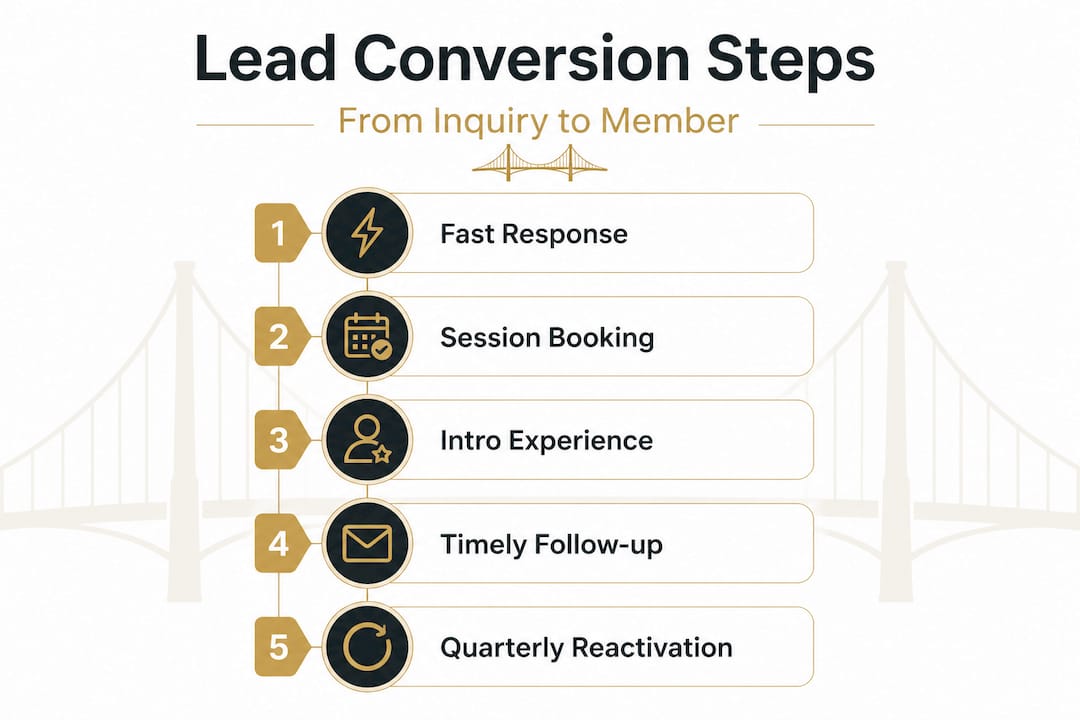
Step 1: Respond within five minutes
Speed-to-lead is arguably the single most important variable in your workflow. The faster you respond to a new inquiry, the higher your chance of booking them for an intro session. A response within five minutes is the gold standard. Anything over an hour and your odds drop dramatically. Set up an automated text the moment a lead submits a form. Something simple like: "Hey [Name], thanks for your interest in [Gym Name]. We'd love to get you started. Click here to grab your spot: [link]."
Step 2: Send a three-part automated nurture sequence
Not every lead will book immediately. That's normal. 80% of leads go cold without any nurture, and 14% of gyms never call their leads at all. Your automated sequence should run over the first five to seven days and include:
- Day one: Automated text plus email with a booking link.
- Day three: A follow-up email with a success story or testimonial from a current member.
- Day five or six: A personal phone call from your sales lead or head coach.
Step 3: Book and confirm the intro session
Once the lead books, immediately send a confirmation with what to expect, what to wear, and where to park. Send a reminder 24 hours before and again two hours before. Reduce friction at every point so there's no reason to ghost.
Step 4: Deliver an outstanding intro experience
The intro session is your real sales moment. The coach should ask genuine questions about the prospect's goals, listen carefully, and then present membership options that match what they just described. Don't pitch. Connect.

Step 5: Follow up after the intro
If they don't join on the spot, follow up the next day. A quick text like: "Great meeting you yesterday. Have any questions about getting started?" goes a long way. Most gyms skip this step entirely.
Step 6: Reactivate old leads quarterly
Reactivating old leads is often more cost-effective than acquiring new ones. Every quarter, pull a list of leads who never converted and send them a personal message. Life circumstances change. Someone who wasn't ready six months ago might be ready today. This one step alone can add two to four new members per month with zero ad spend.
If you need help setting up this kind of system, contact our team for a free strategy session.
Avoiding common pitfalls: Troubleshooting your lead generation process
Even a well-built workflow can go sideways. Here's how to keep your process sharp and mistake-free.
One of the most common and costly mistakes gym owners make is chasing cheap leads. Running ads on sketchy lead generation platforms or buying bulk contact lists might seem like a bargain, but gyms that rely on low-quality leads see conversion rates drop dramatically. A $3 lead that never converts costs more than a $15 lead that becomes a two-year member.
Watch for these warning signs in your workflow:
- No-show rate above 40%: Usually signals weak offer structure or poor pre-session communication.
- Leads not responding to texts or emails: Could mean your messaging doesn't speak to their real motivations.
- High booking rate but low attendance: Your confirmation and reminder sequence needs work.
- Conversion rate under 15%: The intro session itself may need a scripted framework or coaching.
"Automating everything sounds efficient until your leads feel like they're talking to a robot. Balance automation with human touchpoints at critical moments." — A hard lesson learned across dozens of gym campaigns
The danger of over-automation is real. Using automation for the first touch and reminders is smart. But using it as a replacement for genuine human connection will kill your conversion rate. The phone call on day five should always be a real person.
Evaluate your marketing ROI at every stage of the funnel, not just at the ad campaign level. Many gyms only look at cost per lead, not cost per member. Those are very different numbers, and confusing them leads to bad decisions.
Tracking results and optimizing your lead generation workflow
To finish, let's make sure your efforts are actually producing the revenue and growth you're after.
You can't improve what you don't measure. Tracking close rate, response time, and lead source value helps identify exactly where your gym is losing revenue. Most gym owners check their ad spend and lead count. The ones who grow consistently check a much deeper set of numbers.
| Metric | What it tells you | Target benchmark |
|---|---|---|
| Close rate | How well your workflow converts | 25 to 35% |
| Speed-to-lead response | How fast your team responds | Under 5 minutes |
| Cost per lead | Ad spend efficiency | $10 to $25 |
| Cost per member acquired | True acquisition cost | Under $150 |
| Member lifetime value (MLV) | Long-term revenue per member | $2,000 to $5,000+ |
| Lead source breakdown | Which channels produce the best ROI | Varies by market |
Here's how to analyze and act on this data every month:
- Pull your CRM report on leads, bookings, shows, and closes.
- Calculate your close rate (closes divided by total leads).
- Identify which lead source produced the most members, not just the most leads.
- Review response times. If average response is over 30 minutes, fix it immediately.
- Adjust your nurture sequence based on which messages get the most replies or bookings.
The lead generation analytics dashboard you use should give you a clear view of each of these metrics in real time. If you're running blind, you're not optimizing. You're guessing.
What most gyms get wrong about lead generation (and how to fix it)
Here's an uncomfortable truth we've seen play out dozens of times: most CrossFit gym owners treat lead generation like it's a math problem. More inputs should equal more outputs. So they increase ad spend, run more promotions, and chase higher lead volumes. And then they're confused when the members don't follow.
The gyms that actually grow consistently are the ones that stop obsessing over lead count and start obsessing over lead experience. Every touchpoint in your workflow, from the first automated text to the phone call to the intro session to the post-visit follow-up, is a moment where a real person is deciding whether to trust you with their fitness journey.
What sets truly high-performing CrossFit gyms apart isn't their Facebook ad creative or their landing page design. It's the fact that someone on their team genuinely follows up, speaks like a human, and creates a buying experience that feels personal. That's not scalable in the traditional sense, but it's enormously effective.
We've also seen gyms invest thousands in ads and generate 80 leads a month, only to close three or four. Then they blame the ads. But when we audit the actual follow-up process, we find leads sitting in a CRM untouched for 10 days, automated emails that sound like spam, and zero phone calls being made. The ads were fine. The workflow was broken.
Focusing on real lead quality over raw quantity means building a system where 30 well-nurtured leads outperform 100 ignored ones. That mindset shift is what separates gyms that plateau from gyms that scale.
Boost your gym's growth with expert lead generation support
Knowing what to build is one thing. Actually building it, testing it, and scaling it while running daily gym operations is another challenge entirely.
At Enoch Marketing, we specialize exclusively in helping CrossFit gyms and fitness brands across the United States build and refine exactly the kind of workflow we've described here. From paid media campaigns and lead funnel creation to CRM setup and ongoing analytics support, we handle the system so you can focus on coaching. Check out our full range of CrossFit gym marketing services to see what a custom strategy looks like for your market. When you're ready to stop guessing and start converting, talk to our team for a free strategy session. You can also review our pricing details to find the right fit for your budget and goals.
Frequently asked questions
How many leads per month should a CrossFit gym expect?
Most gyms can expect 32 to 36 leads per month on average, but only a small fraction will convert without a strong follow-up system in place.
What is the conversion rate from lead to member for gyms?
Paid intros convert at 14.7 to 22.1% compared to roughly 8.3% for free trials, making offer structure a key factor in your overall close rate.
Is follow-up really more important than getting more leads?
Yes. Conversion and follow-up are the true bottleneck for most gyms, not lead volume. Improving your response time and nurture sequence will outperform doubling your ad budget in most cases.
Should I focus on reactivating old leads or only seek new ones?
Reactivating old leads is often more cost-effective than new acquisition and can yield surprisingly strong conversion rates, especially when life circumstances have changed for the prospect.