Yes, Facebook and Instagram ads still work for gyms in 2026, but only when they're built as a local funnel: sharp creative, tight targeting, a real offer, and a landing page that books the trial. Skip any of those four and the campaign burns cash. The single move to make today is launching a short-form video lead-gen campaign with a specific, time-boxed offer that sends traffic to a booking page or instant form.
TL;DR:
- Focus on short-form video ads with clear hooks in the first three seconds, vertical format, and captions embedded directly into the videos.
- Use a combination of local cold audiences, warm retargeting, and lookalike audiences based on paying members to maximize lead quality and volume.
- Prioritize low-cost, specific offers with a start date and booking page over vague or free trials to improve trial bookings and ROI.
- Allocate monthly ad budgets between $600 and $3,500 based on your onboarding capacity, and track cost per lead, trial, and member conversion to ensure profitability.
- Fix campaign issues by using dedicated offer pages, rotating creative every two to three weeks, and giving campaigns at least a week with 50 conversions before judging results.
Table of Contents
- How Facebook Ads for Gyms Should Be Structured to Work
- What Creative Actually Converts, and How to Produce It Without a Studio
- How to Build Your Audience: Cold, Warm, and Lookalike
- Which Offers and Funnels Actually Get Trials Booked
- What Budget and Metrics Should You Actually Track
- How to Set Up, Test, and Scale Campaigns Without Wasting Spend
- Why Campaigns Fail and How to Fix Them Fast
- How Enoch Marketing Runs This Process for CrossFit Gyms
- The One Lever That Actually Moves the Needle
- Ready to Hand This Off? Here's What That Looks Like
- Sources
How Facebook Ads for Gyms Should Be Structured to Work
Most gym owners treat Facebook ads for gyms like a digital flyer: boost a post, hope for calls. That's not a campaign, that's a donation to Meta. The gyms that actually fill classes run a system with four connected parts, and each one has a job.
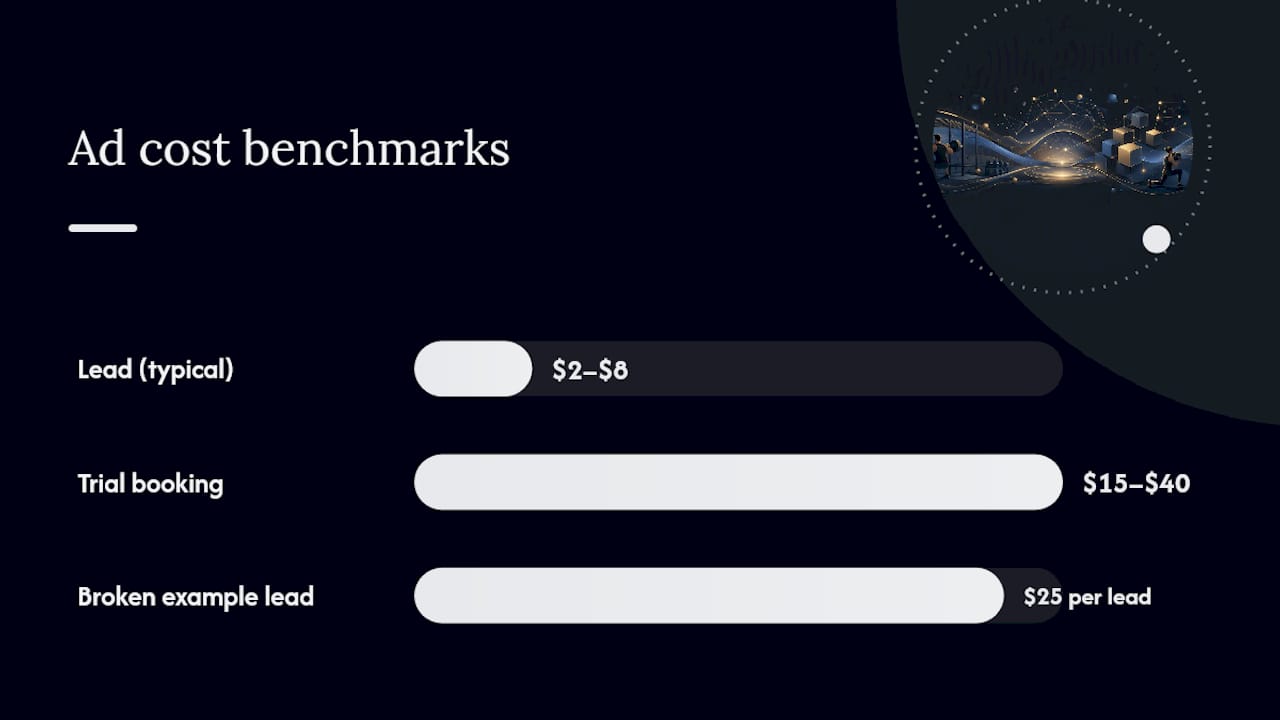
Following that kind of four-part system, creative, targeting, offer, and funnel together, gyms commonly see leads land in the $2 to $8 range and trial bookings between $15 and $40, according to Optimized Growth's operational data. Those numbers move depending on your market and competition, but they're a useful gut check. If you're paying $25 per lead with no bookings behind it, something in the chain is broken.
Here's the order to build in, from fastest to set up to highest converting:
- Lead gen instant forms for pure volume. These live inside Facebook, pre-fill with the user's name and phone number from their profile, and take seconds to submit. Best used when you don't yet have a dedicated landing page.
- Short-form Reels and Stories for awareness, built around an immediate hook in the first second. These work harder for cold audiences who've never heard of your gym.
- Carousel offers built around a challenge, like a 21-day kickoff or a $19 two-week trial, priced low enough to remove hesitation but structured to create urgency around a start date.
- Retargeting sequences aimed at anyone who watched a video, visited your site, or opened a form without finishing. This is consistently the highest-converting layer because you're talking to people who already raised a hand.
Instant forms create volume, but landing pages with calendar booking tend to produce higher show-up rates once someone actually books a time slot rather than just submitting contact info. That trade-off matters enough that it gets its own section later.
For gyms building a community angle alongside paid traffic, a Facebook group lead-gen strategy can feed warm leads into the same retargeting pool, giving your ads a second audience to draw from besides cold prospecting.
What Creative Actually Converts, and How to Produce It Without a Studio
The gym down the street with a $200 iPhone tripod is probably outperforming the gym that hired a videographer. Raw, in-gym footage consistently beats polished stock video for click-through rate and booking intent, because it reads as proof rather than an advertisement. People scrolling Facebook can tell the difference between a real class and a stock photo of someone smiling at a dumbbell.
The hook has to land in the first three seconds
Nobody reads captions before deciding whether to keep scrolling. Three hook patterns work reliably for gym ads:
- Trainer talks directly to camera with a specific call to action: "If you've canceled your gym membership three times this year, watch this."
- Before and after transformation, shown as a quick cut rather than a slideshow, paired with a real timeframe.
- Scarcity framing: "We're closing intro spots for our January strength cycle on Friday."
Format specs that matter more than people think
Shoot vertical, 15 to 30 seconds, and burn captions directly into the video since most viewers scroll with sound off. Add a text overlay in the first frame that restates the hook, because that frame is effectively your thumbnail even though Facebook doesn't call it that. Anchor every video with one clear line of text near the bottom third: your offer, not your gym's name.
A shot list you can film in one afternoon
Grab a phone, a $30 clip-on mic, and film five things: a class in progress, one member finishing a lift with visible effort, a coach explaining the workout in 20 seconds, someone racking weights and smiling, and a five-second shot of your front door or sign. Cut those into three or four different videos using CapCut or Instagram's built-in editor. You don't need color grading. You need footage that looks like a real Tuesday at your gym.
Pro Tip: Film in batches of ten videos every few weeks instead of one at a time. Meta rewards fresh creative, and having a backlog means you're never scrambling when an ad starts fatiguing.
Refresh your rotation every two to three weeks. Watch frequency in Ads Manager; once it climbs past 2.5 to 3 for an ad set, your audience has seen the creative enough times that performance starts sliding even if targeting hasn't changed. Test the hook first, since that's what determines whether anyone watches past second three, then test the offer, then test the visual style last.
How to Build Your Audience: Cold, Warm, and Lookalike
Targeted ads for gyms fail more often from bad audience structure than bad creative. The framework that holds up across most local gyms runs three audiences at once rather than picking one and hoping.
GymRoute's targeting research backs this up directly: combining a tight local cold audience, warm retargeting, and lookalikes built from paying members is the most consistent setup for single-location fitness businesses. Here's how to build each one.
Cold local radius. Start at 5 to 8 miles around your location for most suburban or mid-density areas. Drop to 3 miles in dense urban markets where drive time matters less than walkability, and widen to 10 miles in rural or sparse suburban areas where members are used to driving further. Narrow the radius if your cost per lead climbs; widen it if you've saturated the area and frequency is spiking.
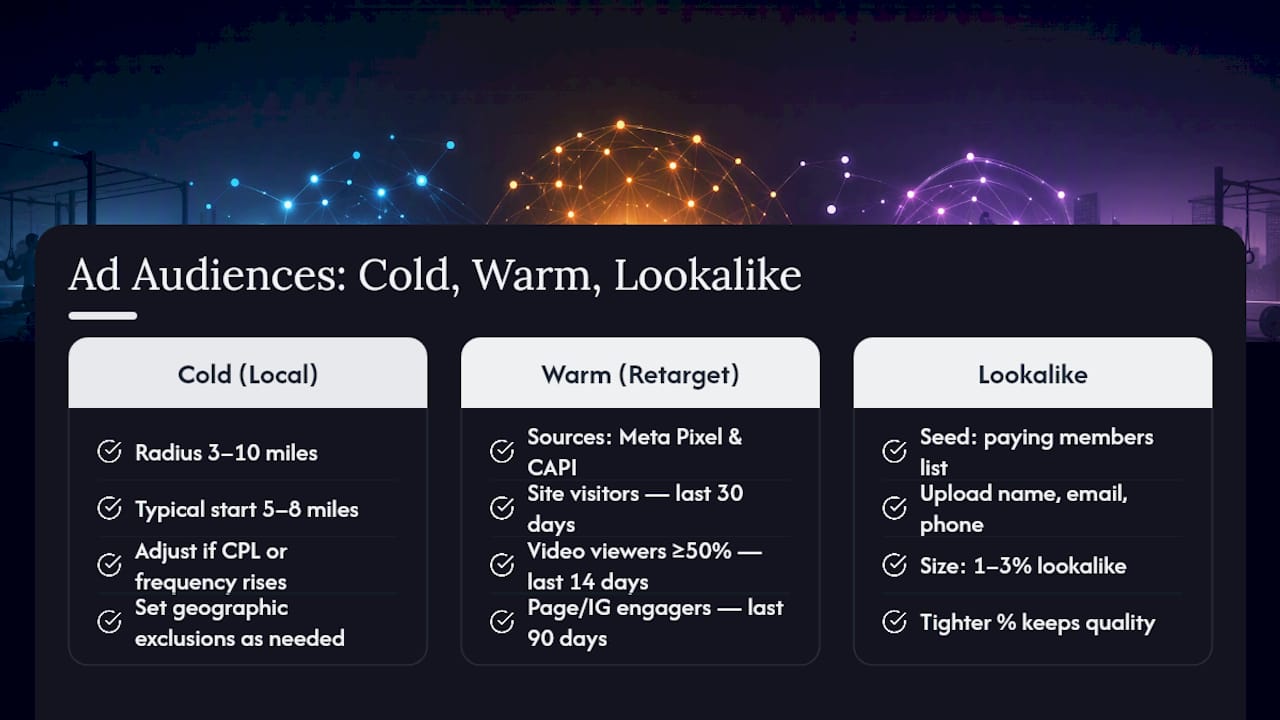
Warm audiences. Build these off your Meta Pixel and Conversions API events: website visitors from the last 30 days, anyone who watched 50% or more of a video ad in the last 14 days, and page or Instagram profile engagers over 90 days. Each window serves a different purpose, shorter windows for people who are still warm and ready to convert, longer ones for slower nurture sequences.
Lookalikes from your member list. Export your current paying members from your gym management or booking software, strip it to name, email, and phone, and upload it as a custom audience. Build a 1 to 3% lookalike from that seed list rather than a broader 5 to 10% version. Tighter percentages tend to hold quality better for a single-location business with a limited member base to model from.
If you're running Advantage+ audience expansion, monitor it closely for the first two weeks. It can pull in traffic well outside your service radius if left unconstrained, which inflates your lead volume while quietly wrecking your cost per booking. Set a hard geographic exclusion if you see leads coming in from towns you don't serve.
Which Offers and Funnels Actually Get Trials Booked
The offer is the single biggest lever most gym owners underuse. A vague "try us out" ad with no price and no deadline asks for a decision with zero incentive to make it now. A specific, low-commitment paid offer does the opposite.
- Price the offer low but not free. A $0 to $150 range works well: $19 for two weeks, $49 for a 21-day challenge, or $99 for a 30-day intro package. Charging something, even a small amount, filters out people who were never going to show up.
- Build urgency around a start date, not a discount deadline. "Our next 6-week strength cycle starts Monday, five spots left" performs better than "20% off this week," because it mirrors how real classes actually fill.
- Send serious traffic to a dedicated landing page, not your homepage. A page with your offer, a short video, and embedded calendar booking consistently outperforms a general homepage because there's nothing else to click. Calendar-integrated landing pages also tend to produce meaningfully higher show-up rates than form submissions alone.
- Use instant forms when you need volume fast or don't have landing page resources yet, then graduate to a full booking funnel once lead quality becomes the bottleneck rather than lead quantity.
- Build the follow-up sequence before you launch the ad. A confirmation page that sets expectations, an automated SMS reminder the morning of the session, and a no-show recovery text offering a second time slot recover a meaningful share of bookings that would otherwise vanish.
Instant forms are a reasonable starting point for owners without a developer on hand, and they can be upgraded to a full booking funnel later as your lead quality demands go up.
What Budget and Metrics Should You Actually Track
Every gym owner asks the same question first: how much do I need to spend? The honest answer is that it depends on how many new members you can actually onboard, not on some universal industry figure. Budget to capacity, not to a benchmark.
Realistic spend bands for a single-location gym: minimum viable budgets sit around $600 to $1,000 per month, a practical sweet spot lands between $1,200 and $3,500 per month, and gyms scaling aggressively push higher depending on onboarding capacity and coach availability.
Below $600 a month, Meta's algorithm rarely gets enough data to optimize delivery, so performance stays erratic. Above $3,500, most single-location gyms hit a ceiling determined by how many trials they can actually run per week, not by ad performance.
Cost per lead and cost per trial booking are the two numbers to watch daily, and both vary heavily by market competitiveness and cost of living. Track the full chain weekly: cost per lead, leads to booked trials, booked trials to shows, and shows to paying members. Review creative fatigue and frequency daily during an active campaign, review the full conversion chain weekly, and review overall cost per new member monthly to judge real profitability. A tracking setup guide can help you build this dashboard correctly the first time instead of guessing at it later.
How to Set Up, Test, and Scale Campaigns Without Wasting Spend
Before you spend a dollar, get the plumbing right. Install the Meta Pixel and Conversions API on your booking pages, set up standard events for lead and purchase, tag every ad with UTM parameters, and connect your calendar tool so bookings sync back into Ads Manager automatically.
Test in this order, because testing everything at once tells you nothing: offer first, since it has the biggest impact on conversion; creative second, since it determines who stops scrolling; audience third, since a good offer and hook usually outperform minor targeting tweaks. A simple test matrix might run two offers against three hooks across one audience, rather than changing five variables simultaneously and having no idea what actually moved the needle.
- Don't call a winner early. Most agencies wait for roughly 50 conversions per ad set before drawing conclusions, since anything below that is mostly noise.
- Scale spend in steps of 20 to 30%, not by doubling budgets overnight, which resets the algorithm's learning phase and tanks performance temporarily.
- Hold each budget increase for at least three to four days before judging results.
- Watch cost per booking closely after every scale step. It climbing sharply usually means you've saturated your local radius faster than your budget grew.
For a full walkthrough of setup order and testing structure, the paid ads strategy tutorial covers the checklist in more depth.
Pro Tip: Keep a running log of every test with the date, variable changed, and result. Six months in, that log becomes the most valuable asset in your ad account, more useful than any single winning ad.
Why Campaigns Fail and How to Fix Them Fast
Most underperforming gym campaigns trace back to one of five problems, and a quick audit usually finds the culprit within minutes.
- Sending traffic to your homepage instead of a dedicated offer page. Fix it by building a single-purpose landing page with one offer and one call to action.
- Creative fatigue from running the same three videos for two months. Fix it by rotating fresh footage every two to three weeks.
- A vague offer with no price or deadline. Fix it by naming a specific price and a specific start date.
- Budget spread across too many ad sets at once. Consolidate into fewer, better-funded ad sets so Meta's algorithm gets enough signal.
- Stopping a campaign after three days because it "isn't working." Give it at least a week and 50 conversions before judging.
If Meta genuinely isn't producing results after fixing all five, local SEO and Google Search campaigns are worth testing as a parallel channel, since intent-driven search traffic behaves differently than interruption-based social feeds. Owners hesitant about paid ads in general might find the common objections breakdown useful before writing off the channel entirely.
How Enoch Marketing Runs This Process for CrossFit Gyms
The process involves auditing the current funnel and tracking setup, building a custom creative and targeting strategy for the gym's specific market, launching campaigns with proper Pixel and Conversions API tracking, and scaling spend once the numbers prove out. Each phase produces a deliverable the owner can see, not a black box.
The focus stays exclusively on CrossFit gyms and fitness brands, which means the benchmarks and creative approaches are built around how fitness audiences actually behave rather than generic e-commerce playbooks. Collin, who writes the operational breakdowns on Enoch Marketing's blog, covers this process in more tactical detail for owners who want to run it themselves before deciding whether to hand it off.
The One Lever That Actually Moves the Needle
If you take one thing from this entire playbook, make it this: the offer and the funnel behind it matter more than the ad platform. I've watched owners agonize over interest targeting and video color grading while running a vague "come check us out" offer that was never going to convert regardless of who saw it.
A gym running a $29, 14-day kickoff with a real start date and a landing page that books directly into a calendar will out-convert a gym running polished testimonial ads to its homepage, every time. The platform rewards clarity. Facebook's targeting has gotten good enough that Advantage+ and broad audiences often outperform narrow manual targeting now, which means the audience side of the equation matters less than it did a few years back. The offer and the funnel are where owners still win or lose.
Start there before you touch anything else.
— Collin
Ready to Hand This Off? Here's What That Looks Like
Running this playbook yourself is entirely doable if you've got a few hours a week and someone willing to film footage. Where this service changes the math is speed: instead of spending your own month testing offers, hooks, and audience structures from scratch, you get a system built specifically for CrossFit gyms from day one, informed by what's already worked across other boxes in similar markets.
A free strategy call covers your current funnel, what's likely leaking leads, and a realistic budget range for your specific market and capacity. Enoch Marketing's paid media and funnel services handle creative production, campaign setup with proper tracking, and ongoing reporting so you're not guessing whether a campaign is working. If you've got the time and interest to run ads yourself, this guide gives you the framework. If you'd rather someone build and manage it while you focus on coaching, book a free strategy session and get a specific plan for your gym instead of a generic one.
Sources
The budget and conversion benchmarks referenced throughout this guide draw from operational data published by agencies working directly with fitness clients. Optimized Growth's 2026 guide provided the lead and trial booking cost ranges, along with the case for dedicated landing pages over homepage traffic. GymRoute's targeting research informed the three-audience framework covering cold radius, retargeting, and lookalike construction.
Budget bands for single-location gyms came from Adscreator's 2026 marketing guide, which converges with several other agency sources on similar spend ranges tied to onboarding capacity rather than fixed industry standards. Statista's ongoing data on Facebook's active user base supports the emphasis on video-first creative throughout the platform.
For gyms running any campaigns that touch health claims or sensitive audience data, ScanCompliant's playbook on health ad data privacy is worth a read before scaling tracking setups that pull health-adjacent signals. It's not a substitute for legal advice, but it flags the kind of tracking questions regulators have started paying closer attention to.
Owners wanting more tactical depth on retargeting sequences, tracking setup, or campaign examples can find operational breakdowns on Enoch Marketing's blog, including a collection of paid media examples built specifically around how CrossFit gyms have structured winning offers and funnels.