
Gym owners fear paid advertising because the real problem is rarely the ads themselves. It's a broken funnel underneath: no conversion tracking, a weak offer, slow follow-up, and a retention leak that turns every new member into a revolving door. Fix those first, and paid ads become predictable. Leave them broken, and no budget will save you.
TL;DR:
- Track cost per booked trial, not clicks or impressions
- Use a specific paid offer, not a free trial with no commitment
- Respond to every lead within 60 seconds — AI follow-up handles this automatically
- Run a minimum learning budget before judging results (roughly $1,200–$2,400 to stabilize the algorithm)
Your one action today: Log into your Meta or Google Ads account and confirm conversion tracking is firing on your booking confirmation page. If it isn't, that's the only thing that matters right now.
Table of Contents
- Why gym operators fear paid advertising — and what's really behind it
- Where gym ads actually break down
- What a working gym ad campaign actually looks like
- How obstacle-first messaging lifts show rates
- How to test paid ads without burning your budget
- Should you rely on paid ads alone?
- A 90-day pilot plan you can actually follow
- How to choose and manage an advertising agency without getting burned
- Troubleshooting your gym ad campaign step by step
- How to allocate your marketing budget across paid and owned channels
- Key Takeaways
- The part most gym marketing advice gets wrong
- Enochmarketing runs your pilot so you don't have to guess
- Useful sources and further reading
Why gym operators fear paid advertising — and what's really behind it
The fears are real, but they're usually symptoms of something fixable. Here's what gym owners actually say when you ask them why they avoid paid ads.

That's a common complaint, and it's almost never about the platform. It's about targeting a cold audience with a weak offer, sending them to a homepage, and then waiting 24 hours to follow up. The lead wasn't bad. The system was.
The specific fears break down like this:
- Wasted budget: Owners watch money leave their account with no visible return, usually because they're measuring clicks instead of booked trials
- Bad lead quality: Broad targeting and low-commitment offers attract people who were never going to join
- Tech complexity: Pixels, conversion events, ad sets, lookalike audiences — the setup alone feels like a second job
- Agency exploitation: Many agencies charge $1,500–$3,000 per month in management fees while optimizing for impressions rather than cost per booked trial
- Rapid churn: Owners who do get members from ads watch them leave in 90 days, making the acquisition cost feel even worse in hindsight
Each fear maps to a specific system failure. Bad leads point to targeting or offer problems. Rapid churn points to a retention gap. Tech overwhelm points to a setup that was never properly explained. The fear is the signal; the system failure is the actual problem.
Where gym ads actually break down
The failure isn't the channel. It's the path from ad to member, and there are six places it can collapse.
Here's the lead path every paid campaign runs through:
- Ad — prospect sees your creative on Meta or Google
- Landing page — they click and land somewhere (ideally not your homepage)
- Booked trial — they fill out a form or book a session
- Show — they actually walk through your door
- Sale — your staff closes them on a membership
- Onboarding — they stay past 90 days
Most gym campaigns fail at steps 2, 3, and 4. Around 80% of gym ad campaigns are losing money primarily because of missing conversion tracking and setup errors — not because Meta or Google Ads don't work.
The common failure modes at each step:
- No conversion tracking: You're flying blind. Clicks and impressions tell you nothing about cost per booked trial
- Broad targeting: Showing ads to everyone in a 25-mile radius instead of people who match your actual member profile
- Wrong offer: "Come try us free" with no structure attracts tire-kickers; a specific, low-barrier paid offer filters better
- Landing page mismatch: Ad promises a free intro class, landing page talks about your equipment and class schedule
- Slow follow-up: A lead that waits 2+ hours for a response has already moved on or cooled off completely
- Poor retention: If members churn in 90 days, every acquisition dollar is being wasted on a leaking bucket — fix retention before scaling spend
Pro Tip: Before you pause a campaign, check whether you've hit 30 conversions. Platform algorithms need roughly 30 conversions to exit the learning phase — cutting spend before that point is the single most common reason gym owners declare ads a failure prematurely.
Common paid media pitfalls for fitness marketers also include broad match keywords on Google, missing negative keyword lists, and sending search traffic to a generic homepage — all of which double or triple cost per conversion without any obvious warning sign in the dashboard.

What a working gym ad campaign actually looks like
A healthy campaign isn't complicated. It's a short checklist of things that are either in place or not.
Campaign readiness checklist:
- Conversion tracking fires on the booking confirmation page (not the form page)
- Offer is specific: a paid intro, a 2-week trial with a defined price, or a challenge with a clear outcome
- Landing page matches the ad's exact promise, word for word
- Creative shows real members, real coaches, real results — not stock photos
- Follow-up is automated and fires within 60 seconds of form submission
- CRM logs every lead and tracks show rate and close rate separately
- Retention onboarding exists for the first 90 days of membership
Ad-to-landing-page pairing example: An ad that says "Lose 10 lbs in 6 weeks or your money back — intro offer for new members" should land on a page with that exact headline, a single form, and nothing else. No navigation menu. No class schedule. No "about us" section. One promise, one action.
Metrics that matter for a healthy pilot:
| Metric | What it measures | Healthy range |
|---|---|---|
| Cost per booked trial | Efficiency of the full ad-to-booking path | $40–$80 |
| Show rate | Percentage of booked trials who actually show up | 50–70% |
| Close rate | Percentage of shows who buy a membership | 50–70% |
| Customer acquisition cost (CAC) | Total cost to acquire one paying member | Under 2x first-month revenue |
| Lead-to-tour conversion | How well follow-up converts leads to visits | 15–25% |
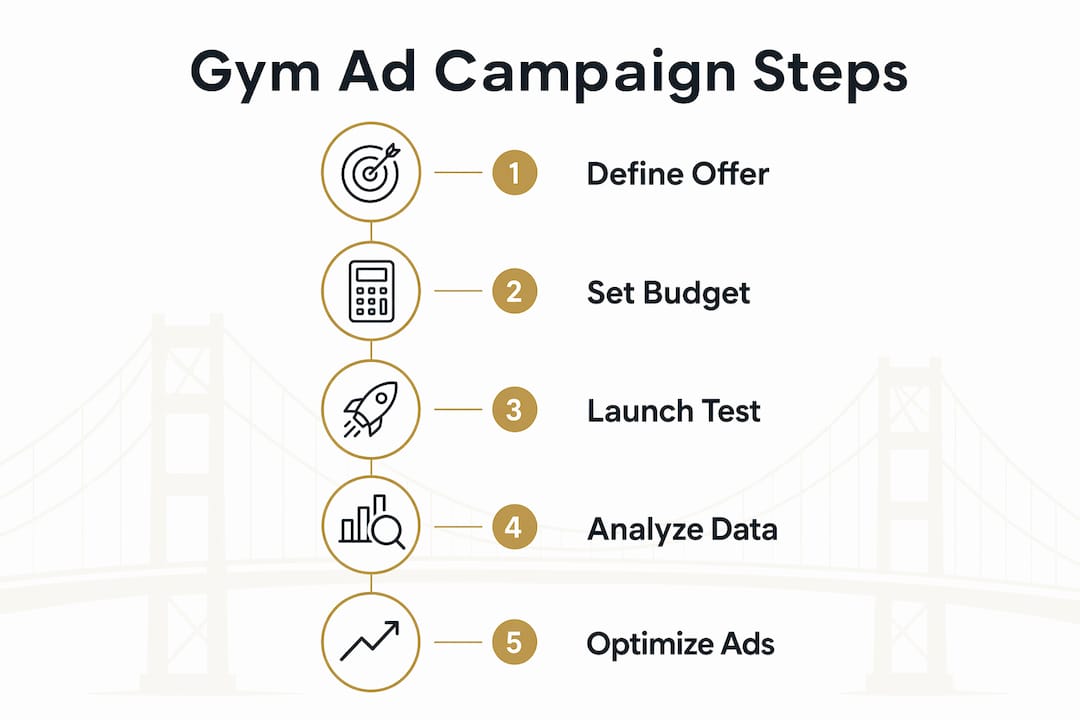
Tracking digital campaign ROI means watching these five numbers together, not just cost per click. A campaign with a $90 cost per booked trial but a 65% show rate and 60% close rate is profitable. A campaign with a $30 cost per lead and a 10% show rate is not.
How obstacle-first messaging lifts show rates
Most gym ads lead with the gym. "Join now." "Best CrossFit in Austin." "State-of-the-art equipment." The prospect's actual barrier — "I'm not fit enough," "I'll embarrass myself," "I don't know what to expect" — goes completely unaddressed.
Obstacle-first messaging flips that. You identify the barrier, address it in the hook, and lower friction in the call to action. The result is a prospect who feels understood before they've ever walked in.
The framework in practice:
- Identify the barrier: What stops your ideal prospect from booking? Intimidation, time, cost, past failure?
- Address it in the hook: Lead with the fear, not the feature. "Never done CrossFit before? Good. We built this for you."
- Lower friction in the CTA: "Book a free intro" is lower friction than "Join now." "Reserve your spot" is lower friction than "Sign up."
Example headlines by studio type:
- Intimidation barrier (CrossFit): "You don't need to be fit to start. You just need to start."
- Time barrier (HIIT studio): "45 minutes. Done. No wasted reps, no wasted time."
- Past failure barrier (general gym): "You've tried before. This time, you'll have a coach in your corner."
Creative tips that move the needle:
- Short-form video (15–30 seconds) outperforms static images for cold audiences on Meta
- User-generated content from real members consistently beats polished studio production
- Batch 5–8 creative variations at launch; platforms reward variety and fast-testing
- Winning paid media examples for CrossFit gyms show how matching creative tone to the landing page lifts conversion rates significantly
How to test paid ads without burning your budget
The goal of a pilot isn't to get members. It's to get data. Here's how to structure a low-risk test.
Sample budget and expected conversion ranges:
| Phase | Duration | Monthly budget | Expected cost per booked trial |
|---|---|---|---|
| Learning phase | Weeks 1–4 | $1,200–$2,400 | $60–$120 (algorithm stabilizing) |
| Optimization phase | Weeks 5–8 | $1,500–$3,000 | $40–$80 |
| Scale decision | Week 9+ | Based on CAC | Under $60 target |
Platform algorithms need roughly 30 conversions to stabilize, which means an initial learning spend adequate to generate those conversions at acceptable per-conversion cost. Cutting before that point is the most expensive mistake a gym owner can make.
The metric hierarchy — what to check at each stage:
- Week 1–2: Are impressions and clicks reasonable? (If CTR is under 1%, creative or targeting needs work)
- Week 2–4: Are leads coming in? Is conversion tracking firing correctly?
- Week 4–6: What is cost per booked trial? Is it under $80?
- Week 6–8: What is the show rate? Under 40% means follow-up or offer needs fixing
- Week 8+: What is the close rate and CAC? Now you can judge whether to scale
Decision thresholds:
- Pause and fix creative if CTR is below 1% after 7 days
- Pause and fix the offer or landing page if cost per booked trial exceeds $120
- Pause and fix follow-up if show rate drops below 40%
- Scale if CAC is under 2x first-month membership revenue
Pro Tip: Install AI-driven lead nurture before you launch. Responding to a lead within 60 seconds can lift lead-to-tour conversion by 30–50%. That improvement costs a fraction of what additional ad spend would cost to achieve the same result.
Should you rely on paid ads alone?
No. Paid ads work best as the fourth funnel — after referrals, organic social, and content. They amplify existing demand; they don't create it from scratch.
Pros and cons by channel:
- Meta (Facebook/Instagram) ads: High reach, strong targeting, best for cold audiences and retargeting. Con: requires creative refresh every 60–90 days; CPL rises with stale creative
- Google Ads (Search/Local Service Ads): Captures high-intent searchers actively looking for a gym. Con: more expensive per click; requires negative keyword management
- ClassPass: Fills off-peak slots and introduces new members. Con: lower revenue per visit; can attract price-sensitive members who never convert to full memberships
- Organic/owned channels: Google Business Profile, local content, email nurture, and referral programs. Con: slower to build. Pro: lowest long-term acquisition cost and zero platform dependency
Owned assets to build before scaling paid spend:
- Fully optimized Google Business Profile with recent reviews and photos
- Email and SMS nurture sequence for every lead, regardless of source
- A referral program with a specific ask after every positive member moment
- A social media strategy that generates organic proof before you pay to amplify it
Most independent gyms generate a majority of new members from drive-time-targeted paid channels, referrals, and organic local search combined — not from paid alone. Budget accordingly: a Year-1 gym in acquisition mode might run 60–70% of marketing spend through paid channels; a Year-2+ gym with strong word-of-mouth shifts toward 40–50% paid and more toward partnerships and content.
A 90-day pilot plan you can actually follow
This is the sequence that works. Don't skip steps.
Week-by-week breakdown:
- Week 1 — Audit: Confirm conversion tracking, check current lead response time, audit your offer and landing page
- Week 2 — Build: Create or refine your intro offer, build a dedicated landing page, set up AI follow-up automation
- Week 3 — Creative batch: Produce 5–8 ad variations (mix of video and static), write 3 headline variants per obstacle
- Week 4 — Launch: Start at $20–$40/day on Meta with a narrow local radius (5–8 miles), set up your CRM tracking
- Weeks 5–6 — Monitor: Check cost per booked trial daily, show rate weekly; do not change creative before 7 days of data
- Weeks 7–8 — Optimize: Kill the lowest-performing creative, double down on the top performer, test one new headline
- Weeks 9–12 — Scale or pivot: If CAC is healthy, increase budget 20% per week; if not, troubleshoot the specific metric that's off
Sample follow-up text (send within 60 seconds of form submission):
"Hey [Name], this is [Coach] from [Gym]. Just saw your request for the intro — awesome. I have a spot open [Day] at [Time]. Does that work for you?"
Sample call script (if no text response after 2 hours):
"Hi, is this [Name]? This is [Coach] from [Gym]. You filled out our form a little while ago — I just wanted to make sure you got connected. Do you have 2 minutes to talk about getting started?"
KPI targets and stop-points:
| KPI | Target | Stop-point action |
|---|---|---|
| Cost per booked trial | $40–$80 | Over $120: pause, fix offer or landing page |
| Show rate | 50–70% | Under 40%: fix follow-up speed and confirmation sequence |
| Close rate | 50–70% | Under 40%: fix sales process or intro experience |
Pro Tip: Lead generation mistakes for fitness gyms almost always include one thing: no structured follow-up sequence beyond the first text. Build a 5-touch sequence (text, call, text, email, call) over 72 hours before marking a lead as cold.
How to choose and manage an advertising agency without getting burned
Most gym owners who've had bad agency experiences share one thing: they hired a generalist who had never run a campaign for a fitness business. The agency optimized for what they could report — impressions, clicks, cost per click — rather than what the gym owner needed: cost per booked trial and new members.
What to look for when evaluating an agency:
- They ask about your current show rate and close rate before talking about ad spend
- They can show you gym-specific campaign results, not just general e-commerce or service business cases
- They track cost per booked trial as the primary KPI, not cost per lead or CTR
- They set up conversion tracking themselves and give you access to the account
- They charge a flat management fee, not a percentage of ad spend (percentage-of-spend creates an incentive to increase budget regardless of results)
Red flags that signal misalignment:
- They promise a specific number of leads without asking about your follow-up process
- They retain ownership of your ad account when the relationship ends
- Their reporting shows impressions and reach but not cost per booked trial or show rate
- They recommend scaling budget before the algorithm has hit 30 conversions
Questions to ask before signing:
- Who owns the ad account?
- What does your reporting dashboard show, and how often do I get access?
- What's your process if cost per booked trial exceeds our target?
- Have you run campaigns for gyms with a similar size and offer to mine?
Agency marketing for gyms works when the agency is accountable to business outcomes, not platform metrics. Get that accountability in writing before you hand over a budget.
Troubleshooting your gym ad campaign step by step
When results aren't there, work through this sequence before pausing everything.
Step 1 — Check conversion tracking first. If your tracking isn't firing on the booking confirmation page, every other metric is meaningless. Verify in Meta Events Manager or Google Tag Manager before drawing any conclusions.
Step 2 — Diagnose by metric. High impressions, low clicks: creative or hook is weak. High clicks, low booked trials: landing page or offer is the problem. High booked trials, low shows: follow-up speed or confirmation sequence needs work. High shows, low closes: sales process or intro experience needs attention.
Step 3 — Fix one variable at a time. Change the headline OR the image OR the offer — never all three simultaneously. You need to know what moved the needle.
Step 4 — Check audience overlap. If you're running multiple ad sets, overlapping audiences cause your ads to compete against each other and inflate costs. Use Meta's Audience Overlap tool to check.
Step 5 — Review your negative keyword list (Google Ads). Broad match keywords without negatives will burn budget on searches like "gym near me free" or "gym membership cancel." Add negatives weekly for the first month.
Step 6 — Audit your landing page on mobile. Most gym ad traffic arrives on a phone. If your landing page loads slowly or the form is hard to complete on mobile, you're losing leads before they even try.
Step 7 — Check creative fatigue. If frequency (average number of times one person sees your ad) exceeds 3–4 within a week, your audience is saturated. Rotate in new creative or expand your audience.
How to allocate your marketing budget across paid and owned channels
Budget allocation is where most gym owners either over-invest in paid too early or under-invest in it too long. Neither extreme works.
A practical framework based on gym stage:
Year-1 gyms (acquisition mode): Run 60–70% of marketing budget through paid channels (Meta and Google), with the remainder split between referral incentives, creative production, and email/SMS tools. The goal is to build a member base fast enough to generate organic word-of-mouth.
Year-2+ gyms (growth mode): Shift toward 40–50% paid, with more budget going to local partnerships, content, and retention marketing. At this stage, referrals and organic search should be carrying meaningful load.
A rough annual budget split for a gym spending around $24,000 per year on marketing:
| Channel | Budget share | Annual spend |
|---|---|---| | Meta paid ads (lead-gen + retargeting) | 40% | — | | Google Local Service Ads + Search | 15–25% | — | | Email + SMS + content production | 10–15% | $1,200–$2,400 | | Creative refresh (twice yearly) | 10–15% | $1,200–$2,400 | | Referral incentives | 5–10% | $1,200–$2,400 | | Local partnerships + sponsorships | 10–15% | $1,200–$2,400 |
The most common budget mistake isn't channel allocation — it's ignoring lead response time while debating percentages. A 60-second AI response to inbound leads lifts lead-to-tour conversion by 30–50% across every channel. That improvement is worth more than reallocating $5,000 between Meta and Google.
One more thing: stale creative degrades cost per lead over months. Refresh Meta and Google creative at least twice a year, or budget for it explicitly. Old ads don't just underperform — they actively raise your costs as the algorithm deprioritizes low-engagement creative.
Key Takeaways
Gym owners who fix their funnel first — tracking, offer, follow-up, and retention — consistently get better results from paid ads than those who increase budget without addressing the underlying system failures.
| Point | Details |
|---|---|
| Fix the funnel before scaling spend | Conversion tracking, fast follow-up, and a specific offer must be in place before increasing ad budget. |
| Respect the learning phase | Platform algorithms need roughly 30 conversions to stabilize; cutting spend before that point wastes the entire test. |
| Measure the right metrics | Track cost per booked trial, show rate, and close rate together — clicks and impressions tell you almost nothing about ROI. |
| Build owned assets in parallel | Google Business Profile, email nurture, and referral programs reduce long-term acquisition cost and eliminate platform dependency. |
| Enochmarketing runs the pilot for you | Enochmarketing handles tracking setup, creative, follow-up automation, and KPI reporting so gym owners keep the capability after the engagement ends. |
The part most gym marketing advice gets wrong
There's a version of this conversation that ends with "just run better ads." That's not what this is.
The deeper issue is that most gym owners come to paid advertising after referrals slow down, and they expect ads to replace the organic trust that referrals carry. They don't. Ads introduce strangers. Referrals introduce pre-sold prospects. The systems that convert a referral — a warm call, a personal intro, a coach who knows their name — don't automatically exist for a cold ad lead. That gap is where the money disappears.
What actually works is building the conversion infrastructure first: the follow-up automation, the specific offer, the landing page that matches the ad, the CRM that tracks every lead through the funnel. Then ads become a volume dial, not a gamble. You turn it up when the system is converting; you turn it down when something breaks.
The other thing worth saying plainly: Two-Brain Business has documented that gym owners who learn the basics of paid media and run modest daily budgets often outperform agency-managed accounts once you factor in management fees. That's not an argument against agencies — it's an argument for knowing enough to hold any agency accountable. An owner who can't read a cost-per-booked-trial report is an owner who will get sold on impressions forever.
Enochmarketing runs your pilot so you don't have to guess
Running a paid ad pilot the right way — tracking setup, offer development, creative batching, AI follow-up, and weekly KPI reporting — takes about 40 hours of focused work before you ever see a result. Most gym owners don't have 40 hours. That's the real barrier, not the fear of ads.
Enochmarketing is a digital marketing agency built exclusively for CrossFit gyms and fitness brands across the United States. Every pilot includes conversion tracking setup, a dedicated landing page, creative production, automated lead follow-up, and a weekly report showing cost per booked trial, show rate, and close rate. You keep the ad account, the creative, and the playbook when the engagement ends — nothing is locked away. If you want to see what a properly structured pilot looks like for your gym, book a free strategy session or review the available packages to find the right entry point.
Useful sources and further reading
- Why Ad Agencies Keep Failing Gym Owners — Two-Brain Business; backs the agency incentive misalignment claims in this article
- The Gym Owner's Guide to Paid Ads — Two-Brain Business; source for the "fourth funnel" framework and owned-asset sequencing
- Why Most Gym Ads Fail (And How to Fix Them) — Digital Edge Studio; primary source for the 80% failure rate, learning phase budget, and conversion tracking failures
- Gym Marketing Plan 2026 — Treetop Growth Strategy; source for budget allocation percentages and lead response time data
- Gym Lead Generation and AI Nurture — Treetop Growth Strategy; backs the 30–50% lift from 60-second AI follow-up
- Gym Marketing System 2026 — SearchPod; source for the leaking bucket / retention-first argument
- Paid Ads for Gyms: Why They Don't Always Work — Business for Unicorns; backs the setup mistake audit and common campaign errors