
Most gym owners believe a steady stream of referrals and a few Instagram posts will keep their membership numbers healthy. That assumption works until it doesn't. Growth eventually stalls, seasonal drops hit harder, and the leads you expected to show up simply don't. Specialized agencies that focus on CrossFit and boutique studios operate very differently from general marketing firms. They combine local targeting with paid media and conversion-focused website changes designed specifically to drive inquiries, trials, and sign-ups. This guide breaks down when that approach outperforms solo efforts, what the real results look like, and how to spot an agency worth your investment.
Table of Contents
- Understanding agency marketing for gyms
- Why gyms choose agencies: Key benefits and outcomes
- When agency marketing is (and isn't) right for your gym
- Beyond ads: Member referrals, automation, and engagement
- Our perspective: What most owners miss about agency marketing
- Ready to unlock growth with a specialized agency?
- Frequently asked questions
Key Takeaways
| Point | Details |
|---|---|
| Agencies drive measurable growth | Specialized marketing agencies help gyms increase leads, sign-ups, and local visibility far beyond DIY tactics. |
| Cost and expertise advantages | Outsourcing reduces staffing overhead and provides access to a wider range of effective marketing tools and trends. |
| Best fit requires clarity | Gyms must have a defined offer and solid brand for agencies to deliver custom, high-ROI marketing results. |
| Beyond ads: engagement matters | Agencies can build member referral, engagement, and automation systems that outperform paid ads alone. |
| Choose for partnerships, not just campaigns | The best results come from working with agencies that act as strategic partners—not just ad managers. |
Understanding agency marketing for gyms
Agency marketing in the gym context means handing off your growth work to professionals who specialize in fitness studio environments. Not generalists. Not the cousin who does social media on the side. Professionals who understand the CrossFit sales cycle, boutique studio seasonality, and the specific language that converts a curious prospect into a paying member.
Here's what a qualified fitness agency typically manages for you:
- Local SEO: Optimizing your Google Business Profile, building citations, and ensuring your gym appears at the top of "CrossFit near me" searches in your zip code.
- Paid media campaigns: Running Google Ads and Meta Ads targeted to your specific geographic radius, workout preferences, and demographic profile.
- Website conversion optimization (CRO): Redesigning or updating your site so that visitors actually fill out forms, book free trials, or call your front desk.
- Content marketing: Blog posts, email sequences, and social content that build authority and keep your brand visible between campaigns.
- Directory and listing management: Making sure your name, address, and phone number are consistent everywhere online, which Google rewards with higher rankings.
The combination of all these tactics is what separates agency marketing from simply running a few ads. CrossFit membership strategies require a full system, not a single tactic. When you hire a specialist, you get a team that has already made the costly mistakes at someone else's gym, so you don't have to make them at yours.
Pro Tip: Before signing any agency contract, ask specifically whether they have worked with CrossFit affiliates or boutique studios. A fitness specialist will know the difference between a drop-in rate and a membership conversion path. A generalist won't.
The paid media for CrossFit gyms landscape is also more nuanced than most owners realize. The audience for a functional fitness studio is different from a big-box gym, and ads that speak to community, coaching quality, and transformation outperform generic "join now" creative every single time.
Why gyms choose agencies: Key benefits and outcomes
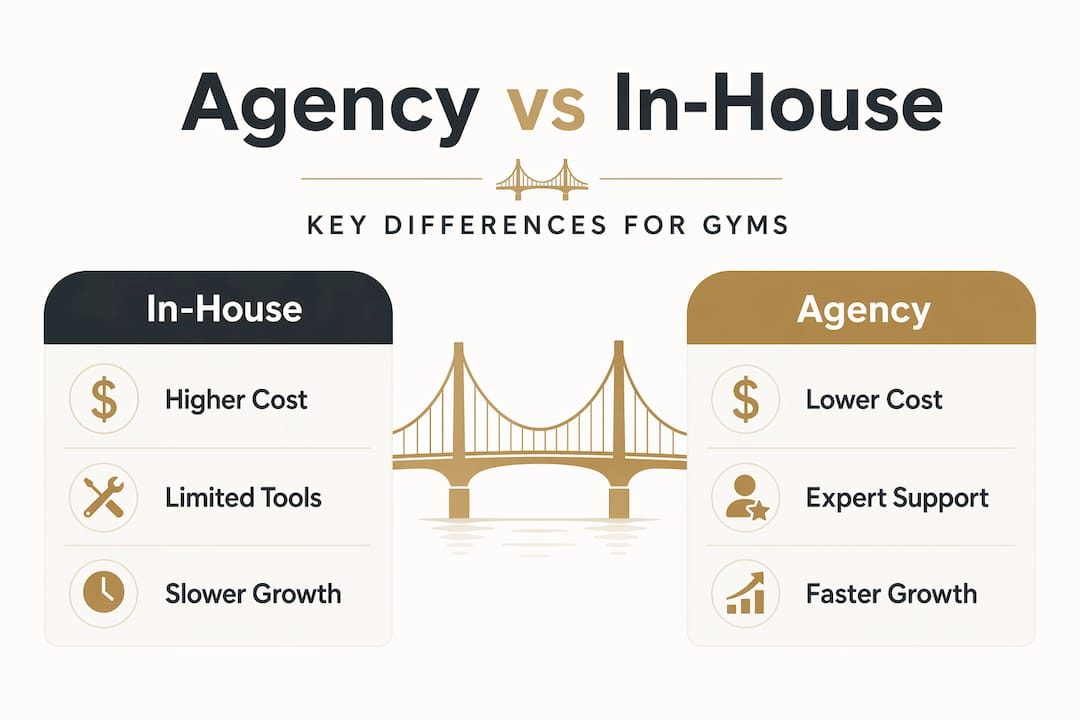
Switching from in-house or DIY marketing to an agency is fundamentally a business decision. The benefits of outsourcing gym marketing include converting fixed overhead costs like hiring, training, software licenses, and management time into a variable service cost that scales with your needs. You stop paying for a full-time salary with benefits and start paying for specific results.
Here's a quick comparison of what in-house versus agency marketing typically looks like for a gym with two to four locations:
| Factor | In-house team | Specialized agency |
|---|---|---|
| Monthly cost | $4,000 to $8,000+ (salary + tools) | $1,500 to $5,000 (service fee) |
| Skill coverage | Usually 1 to 2 disciplines | SEO, paid media, CRO, content |
| Fitness industry expertise | Depends on who you hire | Built-in specialization |
| Scalability | Requires new hires | Scales with your contract |
| Reporting and attribution | Often informal | Structured and measurable |
The financial math often surprises owners. When you factor in tools like a proper CRM, a landing page builder, an ads management platform, graphic design software, and email marketing, the DIY route adds up fast.
Beyond cost, the results speak loudly. One documented case showed a 45% increase in sign-ups alongside a 220% increase in organic local traffic for a health and fitness studio after a combination of website and mobile UX improvements, local SEO work, Google Business Profile optimization, and consistent social and local SEO content. Those numbers aren't outliers when the strategy is structured correctly.
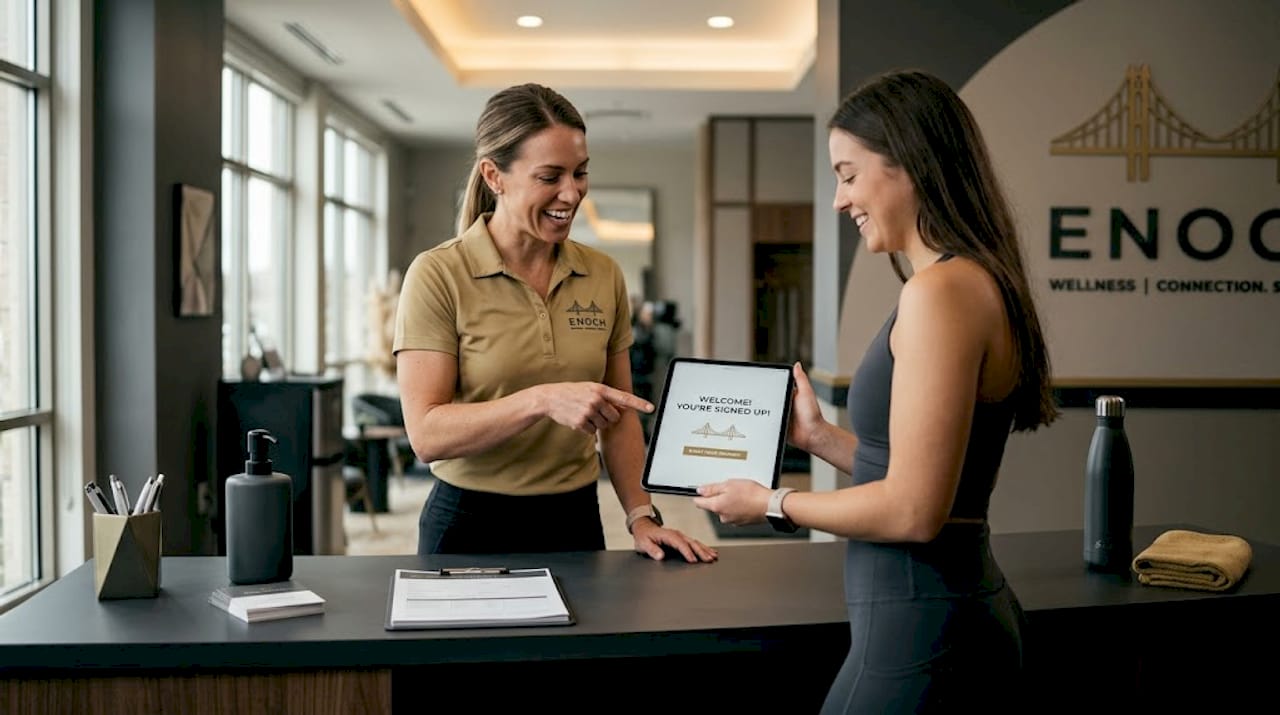
The fitness advertising strategies that produce those results are rarely simple. They involve A/B testing ad creative, refining landing page copy, and adjusting targeting based on real conversion data, not guesswork.
Key benefits gym owners consistently report after going agency:
- More qualified leads: Targeted campaigns bring people already interested in functional fitness, not random clicks.
- Freed-up owner time: You focus on coaching and culture while the agency handles demand generation.
- Faster learning curves: Agencies have already tested what works in your niche. You skip months of failed experiments.
- Predictable growth levers: Instead of hoping for referrals, you have a repeatable system you can turn up or down based on capacity.
Understanding marketing funnels for gym growth is also part of what makes agency support so valuable. The funnel from cold traffic to enrolled member involves multiple touchpoints, and agencies are trained to manage each stage intentionally.
Pro Tip: Ask any agency you're considering for end-to-end attribution data, not just top-of-funnel metrics. Impressions and clicks mean nothing if you can't trace them to actual sign-ups.
When agency marketing is (and isn't) right for your gym
Agency marketing works best in specific conditions. If your gym already has a clear offer, a defined brand identity, and a functional enrollment path, an agency can pour fuel on that fire. If those foundations are missing, you'll likely burn through budget without seeing meaningful results.
Signs your gym is a strong candidate for agency support:
- You've been open for at least six to twelve months and have validated your offer with real members.
- Your current marketing is inconsistent or you're spread too thin to execute regularly.
- You've hit a plateau after the initial wave of friend and family sign-ups.
- You have a budget between $1,500 and $5,000 per month to commit to growth.
- You want to expand to a second location and need predictable lead volume first.
Situations where agency marketing may not be the right fit yet:
- Unclear offer: If you haven't settled on your membership structure, pricing, or what makes your gym different, no agency can fix that for you.
- No intake process: If leads call and nobody follows up, ads will only amplify the problem.
- Budget constraints: Paying an agency while also cutting corners on the ad spend itself produces weak results.
WodGuru's analysis of gym marketing agencies points out that agencies can be a poor fit if the gym lacks foundational clarity around its offer, brand identity, and conversion path, or if the gym can already accomplish its needs with consistent internal execution and basic software tools. Some owners also note that agencies move slower on content changes than an in-house person would, which is a real consideration if your gym frequently changes promotions.
"The best CrossFit gym marketing depends on a solid foundation and a website that does the heavy lifting."
That quote captures the central idea. Your website is either a silent closer or a silent killer of leads. Most gym websites fall into the second category, with outdated class schedules, no clear call to action, and no way to capture contact information after hours. Before investing heavily in paid traffic, make sure your internal marketing strategies and conversion path are solid.
The numbered checklist for evaluating agency readiness:
- Confirm your core offer is clear, priced correctly, and converting at a reasonable rate.
- Make sure your website has a form, a phone number, and a clear next step above the fold.
- Define your ideal member so you can give the agency a real targeting brief.
- Set a minimum three-month commitment to see meaningful data from campaigns.
- Establish KPIs before day one: cost per lead, cost per sign-up, and monthly new member targets.
Beyond ads: Member referrals, automation, and engagement
Here's something the ad-first conversation often skips. Referrals remain the gold standard for lead quality in the fitness world. People who join because a friend vouched for your gym stay longer, complain less, and recruit more members in turn. The trust transfer is already done before they walk in.
What makes this relevant to agency marketing is that the best agencies don't just run ads and call it done. They help you build the systems that amplify your members' natural desire to share. That includes structured referral programs with real incentives, user-generated content (UGC) campaigns that turn member success stories into social proof, and automated follow-up sequences that keep former leads warm until they're ready to commit.
| Lead source | Average trust level | Typical close rate | Long-term retention |
|---|---|---|---|
| Paid ads (cold traffic) | Low to medium | 15% to 25% | Moderate |
| Organic search (local SEO) | Medium to high | 25% to 40% | Above average |
| Referral from member | Very high | 50% to 70% | Strong |
| Email re-engagement | Medium | 10% to 20% | Depends on offer |
Notice that referrals convert at nearly three times the rate of cold paid traffic. That's not a reason to ignore ads. It's a reason to build referral systems alongside them.
Modern fitness agencies also deliver client lifecycle automation that connects lead capture to follow-up to re-engagement in a single workflow. A prospect fills out a form, gets an immediate text, is enrolled in a five-day email sequence, and if they don't convert, gets a re-engagement offer 30 days later. Without automation, most gyms lose those leads entirely because the owner or front desk team doesn't have time to follow up manually.
Ways a strong agency builds your engagement ecosystem:
- Referral program setup: Structured incentives for current members who bring friends, including tracking and reward delivery.
- UGC campaigns: Encouraging members to post workouts, transformations, and community moments with your gym's hashtag.
- Email automation: Onboarding sequences for new members, win-back campaigns for lapsed members, and regular newsletters.
- SMS follow-up: Time-sensitive nudges for leads who haven't booked their free trial yet.
- Personalized fitness marketing: Segmented messaging based on where someone is in their fitness journey.
Pro Tip: When interviewing agencies, ask specifically about their re-engagement strategy for cold leads. This is where gyms leave the most money on the table. A strong email marketing for gyms sequence can revive leads that went quiet months ago.
Our perspective: What most owners miss about agency marketing
Most gym owners approach an agency looking for someone to just "handle the marketing." That mindset, while understandable, sets the relationship up for frustration. The agencies that deliver real, lasting growth aren't doing that. They're building a growth system with you, not for you.
The owners who get the biggest wins from agency partnerships do a few specific things differently. They show up to monthly reviews with questions. They share what's happening inside the gym, like retention problems, capacity constraints, new program launches, so the agency can adjust messaging in real time. They treat the agency like a strategic partner, not a vendor.
Here's the uncomfortable truth: quick wins are possible, and a good agency should be able to show early momentum within 60 to 90 days. But the gyms that build sustainable, compounding growth are the ones that stay committed past the honeymoon period. That means investing in content marketing for gym growth that builds authority over time, not just paid campaigns that stop producing the moment the budget goes dark.
The other thing most owners miss is the blended strategy. Paid ads bring volume. Local SEO builds long-term visibility. Referral systems create trust-based leads. Email and SMS automation convert leads that aren't ready yet. None of these channels works best in isolation. The gym owners who stop at "just run some Facebook ads" are leaving most of their potential growth on the table. The ones who build all four channels together, ideally with an experienced fitness specialist managing the integration, are the ones who consistently outgrow their competitors.
Hire for strategic partnership, not just campaign execution. That single shift in how you think about the agency relationship changes everything about how you evaluate, onboard, and work with them.
Ready to unlock growth with a specialized agency?
You've seen the data, the case studies, and the pitfalls. The question isn't whether agency marketing works for fitness studios. It's whether you're ready to use it the right way.
Enoch Marketing works exclusively with CrossFit gyms and boutique fitness studios across the United States. That means every strategy, every ad creative, and every funnel we build is designed specifically for the way your members think, search, and decide. Explore our agency solutions for gym growth to see exactly what a full-stack approach looks like, from paid media and local SEO to referral systems and lifecycle automation. If you're ready to stop guessing and start growing with a team that speaks your language, speak to a fitness marketing expert and let's map out what's possible for your gym.
Frequently asked questions
Can a gym owner handle marketing on their own instead of hiring an agency?
While some owners succeed with in-house efforts, most lack the time or expertise to scale local lead generation consistently. The benefits of outsourcing marketing include converting fixed overhead costs into variable service expenses while gaining access to a full breadth of tactics.
What makes agency marketing different from just running digital ads?
Agency marketing is a system, not a single tactic. Specialized fitness agencies combine paid media with local targeting, website optimization, and conversion improvements designed to drive inquiries and trials, not just impressions.
Are there risks or downsides to using an agency for gym marketing?
Yes, real risks exist. According to WodGuru's gym agency overview, agencies can be a poor fit if your brand, offer, or conversion path isn't clearly defined, and some owners also cite slower iteration speed and cost concerns.
How do agencies help gyms leverage referrals and member engagement?
Agencies build structured referral programs, UGC campaigns, and automated follow-up sequences that amplify member advocacy. As noted by CrossFit RRG, referrals often outperform paid ads in trust and lead quality, making these systems as valuable as any ad campaign.
What measurable results can gym owners expect from agency marketing?
Results vary by starting point and strategy, but documented outcomes include a 45% lift in member sign-ups and a 220% increase in organic local traffic for one fitness studio after website, local SEO, and content improvements. Always ask agencies to show you the full context behind their case study numbers.