
Most CrossFit gym owners believe marketing means running Facebook ads, posting flyers at local businesses, or waiting on word-of-mouth referrals. That approach keeps your membership numbers flat and unpredictable. Content marketing takes a fundamentally different path, building trust with potential members before they ever walk through your door. This guide explains exactly what content marketing is, why it works specifically for CrossFit gyms, and how to build a system that attracts new members while keeping the ones you already have.
Table of Contents
- Content marketing explained: What it is and why it matters
- How content marketing attracts and retains local gym members
- Frameworks and metrics: How to measure content performance
- Applying content marketing: Action steps for CrossFit gyms
- The uncomfortable truth most fitness marketing guides miss
- Boost your gym's growth with expert-driven marketing solutions
- Frequently asked questions
Key Takeaways
| Point | Details |
|---|---|
| Strategic, not random | Content marketing works best when rooted in a clear, documented plan, not scattered posts. |
| Member journey focus | The most effective gym content guides locals from interest to trust to long-term loyalty. |
| Personalization is key | Tailored messaging and local relevance drive higher engagement among members and prospects. |
| Measure what matters | Track member conversion and retention—not just likes or followers—to gauge true marketing ROI. |
| Expert support accelerates growth | A professional agency can help CrossFit gyms launch and optimize content marketing for faster results. |
Content marketing explained: What it is and why it matters
Content marketing is not just blogging or posting workout videos on Instagram. The Content Marketing Institute defines it clearly: "content marketing is a strategic marketing approach" focused on creating and distributing valuable, relevant, and consistent content to attract and retain a clearly defined audience, ultimately driving profitable customer action.
That definition matters because the word strategic is doing a lot of work. Random Instagram posts are not content marketing. A weekly member spotlight tied to a broader campaign that nurtures leads and drives trial sign-ups? That is content marketing.
"Content marketing outpaces traditional advertising because it earns attention instead of interrupting it. For CrossFit gyms, that means building a relationship with your local community long before someone searches for a gym membership."
A lot of gym owners confuse content marketing with PR or inbound marketing, but they are different. PR is about managing public perception. Inbound marketing traditionally focused on SEO-driven blog content to pull searchers in, whereas content marketing now emphasizes owned media syndicated across rented platforms like TikTok, Instagram, and YouTube. Content marketing is also not advertising, which interrupts audiences with paid messages. Content marketing earns attention by delivering real value.
For CrossFit gyms, the three core pillars of effective content are:
- Education: Teach prospects and members something useful, whether that is nutrition tips, movement breakdowns, or scaling advice for beginners.
- Inspiration: Show transformation stories, community moments, and milestone celebrations that make people feel the energy of your gym from a screen.
- Community: Highlight the humans inside your box. People join CrossFit gyms for the culture, not just the workouts.
When you build content around these three pillars consistently, you create an ecosystem of content ideas for fitness brands that serves every stage of the buyer journey. Consistency is not optional here. A gym that posts five times in January and disappears until March sends the wrong signal to potential members who are watching before they ever reach out.
It is also worth combining content marketing with strong fitness advertising strategies and email marketing for CrossFit to create a system that works across every channel your prospects use.
How content marketing attracts and retains local gym members
Understanding the definition is one thing. Seeing how it works inside a real gym is where most owners find their footing. Content marketing works by meeting potential members at each stage of their decision journey: awareness, consideration, and conversion.
Awareness content reaches people who do not know your gym exists yet. Think short-form workout highlight reels, transformation posts, or neighborhood-specific content like "5 best fitness tips for [your city] residents." The goal is visibility and relatability, not selling.
Consideration content serves people actively comparing gyms. This is where gym intro videos, detailed FAQ posts, and honest "what to expect in your first class" walkthroughs perform well. A well-produced intro video that shows your coaches, your vibe, and your community answers every hesitation a nervous newcomer has.
Conversion content pushes someone to act. Free trial offers paired with a member success story, challenge campaign landing pages, or time-limited sign-up incentives tied to a social post are all conversion-stage tools.
Here is a quick comparison of random posting versus a strategic content plan:
| Approach | Outcome | Risk |
|---|---|---|
| Random posting | Inconsistent engagement, low conversions | Audience confusion, wasted effort |
| Strategic content plan | Consistent growth, member pipeline | Requires upfront planning |
| Batch and repurpose model | High output with low time investment | Needs initial content library |
| Personalized local content | High community relevance, stronger trust | Requires audience insight |
One of the most actionable insights from content marketing best practices is that small teams should batch content and repurpose across channels to stay consistent without burning out. For a two-person gym operation, this is a game-changer. Record one member interview, turn the audio into a podcast clip, pull quotes for Instagram captions, and write a short blog post from the transcript. That is four pieces of content from one session.
Personalized fitness marketing is also critical for retention. When members see their own stories told, when content reflects the specific struggles of your local community, engagement spikes. Generic fitness content gets scrolled past. Content that says "hey, this is about people just like you" stops thumbs.

Pro Tip: Build a 30-day content calendar before you launch any campaign. Map each post to one of the three pillars (education, inspiration, community) and one stage of the member journey. This single step separates gyms that grow from gyms that stall.
A strong framework for CrossFit membership growth strategies always starts with knowing exactly what your content is supposed to accomplish at each touchpoint, and a documented calendar makes that visible. Pair this with a content measurement framework to make sure your effort translates to real results.
Frameworks and metrics: How to measure content performance
Here is where most gym owners fall off. They spend time creating content, see some likes roll in, and assume things are working. Likes are not memberships. Vanity metrics (followers, shares, impressions) feel good but rarely tell you whether your content is actually growing your gym.
The metrics that matter for CrossFit gym owners are:
- Website visits from content: Are people clicking through from your posts to your site?
- Lead form submissions: How many trial sign-ups or consultation requests originated from content?
- Member conversion rate: Of those leads, how many became paying members?
- Retention rate: Are current members engaging with your content, and are they staying longer as a result?
- Community engagement depth: Comments, shares, and saves outperform likes as signals of real connection.
A proper content measurement framework maps the full member journey through five stages: see, connect, trust, choose, and champion. Most gyms only measure at the "see" stage (impressions) and the "choose" stage (sign-ups), completely ignoring the middle where most of the real work happens.
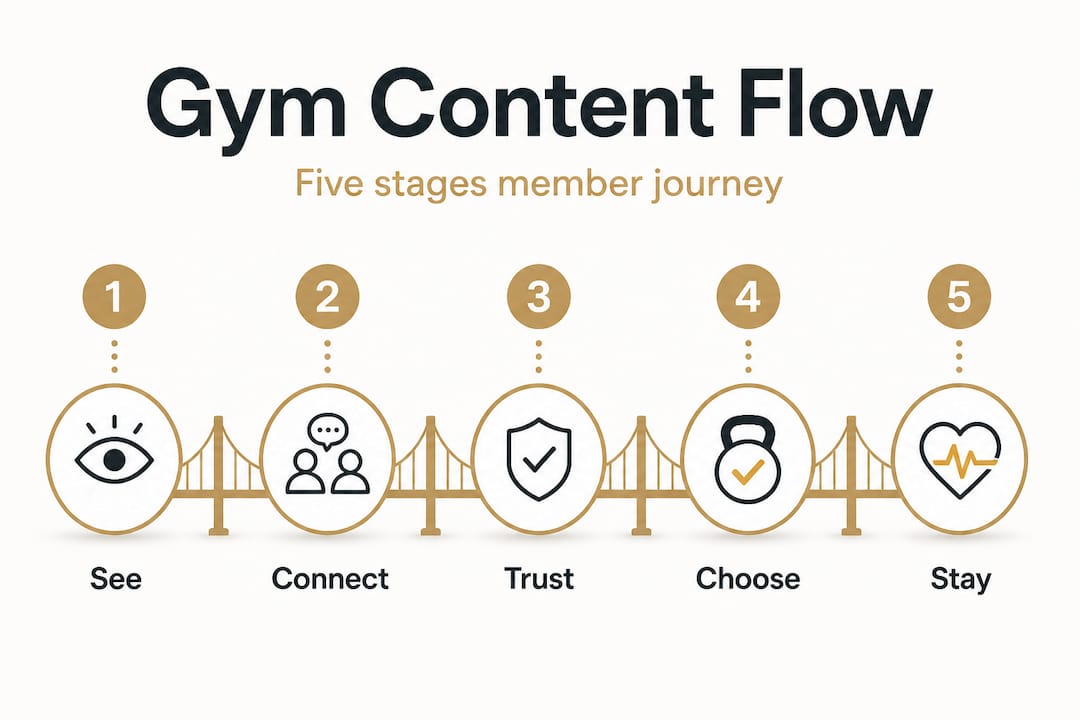
The "connect" stage is when a prospect engages with your content more than once. The "trust" stage is when they follow your account, subscribe to your email list, or attend a free event. These are measurable behaviors, and tracking them tells you far more than follower counts.
Here is an example of what a simple weekly content performance snapshot could look like for a CrossFit gym:
| Content piece | Channel | Clicks to site | Trial sign-ups | Stage targeted |
|---|---|---|---|---|
| Member spotlight video | 47 | 3 | Trust | |
| "First class" FAQ post | 29 | 5 | Consideration | |
| Transformation before/after | TikTok | 112 | 1 | Awareness |
| Email newsletter | 68 | 7 | Conversion | |
| Coach intro reel | 83 | 2 | Connect |
This table format forces you to connect every piece of content to actual business outcomes. When you track it this way, you quickly realize that the transformation post got tons of reach but very few sign-ups, while the email newsletter quietly drove more conversions. That insight changes how you allocate your time and budget. Data-driven gym marketing is not about being an analyst. It is about making smarter decisions faster.
Applying content marketing: Action steps for CrossFit gyms
With the frameworks in place, here is a practical launch sequence specifically built for CrossFit gym owners who are juggling coaching, operations, and marketing all at once.
-
Audit your current content. Look at the last 90 days of posts. Which pieces drove the most inquiries or sign-ups? Which pillars are underrepresented? Be honest. Most gyms find they post mostly about workouts (education) and neglect community storytelling entirely.
-
Define your three content pillars. Based on your audit, choose your mix. A gym with a strong community should lean heavily into member stories. A gym with expert coaches should prioritize educational content. Let your actual strengths drive your pillars.
-
Build a 30-day content calendar. Map out at least two posts per week across your top two channels. Assign each post a pillar, a stage (awareness, consideration, conversion), and a format (video, image, written post, story).
-
Batch your content production. Set aside one morning per month to shoot all your video content. Write all captions in one sitting. Schedule everything using a tool like Later or Buffer. This one habit saves most gym owners four to six hours per week.
-
Repurpose everything. Every piece of content should live in at least two formats. A coaching tip video becomes an Instagram reel, a Facebook post, and a paragraph in your monthly email. A social media growth guide for CrossFit will show you exactly how to map this across platforms.
-
Set a monthly review. Pull your performance data on the first of each month. Compare what drove the most website traffic and sign-ups. Kill underperforming formats and double down on what converts.
-
Personalize for your local market. Reference your city, your neighborhood, local events, and the specific people who train at your gym. Local relevance is one of the most underused advantages a small CrossFit gym has over large national chains.
According to content marketing best practices, personalization and differentiated content at each funnel stage are what separate gyms that generate consistent leads from those that rely entirely on referrals.
Pro Tip: Create a simple feedback loop by asking new members in their first-week check-in what content they saw before joining. This tells you exactly which content pieces are doing the heavy lifting for conversion, and where to invest more time.
The uncomfortable truth most fitness marketing guides miss
Most content marketing guides for gyms talk about consistency and quality, and they are not wrong, but they miss something more fundamental. The gyms we have seen grow fastest are not the ones with the slickest Reels or the most followers. They are the ones that tell the truth about who they are and commit to it repeatedly.
Flashy content can attract attention. But when that content does not reflect the actual culture inside your gym, the members who show up feel misled, and they leave. Authentic storytelling, the kind that shows real coaches, imperfect athletes, and honest progress, builds a community that retains members at dramatically higher rates than gyms chasing trend cycles.
The deeper issue is that many gym owners treat content as something separate from their identity. It is not. Your content is your brand to anyone who has not walked through your door yet. When content is disconnected from strategy, you end up with what the industry calls "random acts of content" that generate activity but no real growth. Content marketing strategy specifically warns against this approach, noting that sustainable results come from structured planning tied to real business goals, not sporadic posting driven by inspiration.
The gyms that really win are the ones who invest in creative content for fitness brands that is rooted in real community moments and honest transformation. Stop trying to look like a bigger gym. Your size is your advantage. Use it.
Boost your gym's growth with expert-driven marketing solutions
Building a content strategy from scratch while running daily classes, managing coaches, and handling operations is genuinely hard. You now understand the frameworks and the metrics that matter, but executing consistently is where most gym owners get stuck.
At Enoch Marketing, we work exclusively with CrossFit gyms and fitness brands across the United States. We build content strategies, run paid media on Meta and Google, develop social content, and handle local SEO so you can stay focused on coaching. Our process starts with a full marketing audit tailored to your gym's current position, then builds a custom growth plan designed to generate real memberships, not just impressions. If you are ready to stop guessing and start growing, book a free strategy session with our team today.
Frequently asked questions
How does content marketing help CrossFit gyms stand out locally?
Content marketing builds gym credibility by sharing authentic stories, expert tips, and real member results, giving your gym a distinct identity that generic paid ads simply cannot replicate. Strategic content consistently delivered to a local audience builds the kind of trust that turns browsers into members.
What types of content work best for gym member retention?
Videos, member spotlights, challenge recaps, and educational posts drive the deepest engagement because they make current members feel seen and valued. Differentiated content across awareness, consideration, and conversion stages keeps both prospects and existing members engaged at every point in their journey.
How can I measure content marketing effectiveness for my gym?
Track member conversions, retention rates, and community engagement depth using a documented strategy that maps behavior at every stage of the member journey. Moving beyond vanity metrics to measure real lead generation and sign-up rates reveals which content actually drives gym growth.
What's the first step for my gym to launch content marketing?
Start by auditing your last 90 days of content to identify which posts drove real inquiries, then define your three core pillars and build a 30-day calendar. Batching and personalizing posts for your local community from day one gives your strategy the best chance of producing results quickly.