
Digital campaigns are the most cost-effective method fitness businesses have to acquire new members, build local authority, and generate measurable revenue growth. The question of why invest in digital campaigns is no longer theoretical. 98% of Americans verify products or services online even after a friend's referral, which means your gym's digital presence directly determines whether a warm lead becomes a paying member. For CrossFit gyms and fitness brands competing in crowded local markets, the difference between growing and stagnating often comes down to one factor: whether you show up where your prospects are searching.
Why invest in digital campaigns for your fitness business
The core benefit of digital marketing, the industry's standard term for paid and organic online promotion, is precision. You can target a 28-year-old woman within three miles of your gym who has searched for "CrossFit classes near me" in the last 30 days. No billboard or local newspaper ad comes close to that specificity.

Marketers now allocate 57% of their budgets to digital activities, which signals that the businesses with the most resources have already made this shift. If your competitors are running Meta Ads and Google Ads while you rely on referrals, you are invisible to every prospect who has not already heard your name.
Here are the primary advantages of digital campaigns for gym owners:
- Precise local targeting. Platforms like Meta and Google let you define your audience by location, age, fitness interest, and income bracket. You pay only to reach people who match your ideal member profile.
- Measurable ROI. Every dollar spent on Google Ads, Meta Ads, or email sequences ties back to a trackable outcome, whether that is a form submission, a free trial booking, or a membership sale.
- Real-time optimization. Digital campaigns can be adjusted within hours, unlike print or radio. If an ad is underperforming on Tuesday, you can pause it by Wednesday and reallocate the budget.
- Brand authority. Consistent content on Google, Instagram, and YouTube positions your gym as the local expert in fitness, not just another option on a list.
- Scalability. A campaign generating 10 leads per week can be scaled to 40 leads per week by increasing spend and refining creative, without rebuilding the entire system.
Pro Tip: Before running paid ads, confirm your Google Business Profile is fully optimized with current hours, photos, and at least 20 reviews. Local SEO and paid search reinforce each other, and a weak profile wastes ad spend.
How do different digital channels compare for gyms?
Not every channel delivers the same result on the same timeline. Understanding the role of each channel helps you allocate budget without guessing.
| Channel | Timeline to ROI | Avg. ROI | Best use for gyms |
|---|---|---|---|
| SEO | 12 to 24 months | $22 per $1 spent | Long-term organic traffic and local authority |
| Google Ads (paid search) | Immediate | ~$2 per $1 spent | Fast lead volume for new member offers |
| Email marketing | 30 to 90 days | $6 per $1 spent | Member retention and reactivation campaigns |
| Meta Ads (Facebook/Instagram) | 2 to 8 weeks | Variable | Awareness, retargeting, and community building |
| Content marketing | 6 to 18 months | High (compounding) | Authority building and SEO support |
SEO generates the highest long-term return, but it requires patience. Organic search drives over 50% of website visits, which means a gym ranking on page one for "CrossFit gym [city]" collects free, high-intent traffic every single day. The catch is that results take 12 to 24 months to compound, so you need paid channels running in parallel during the growth phase.
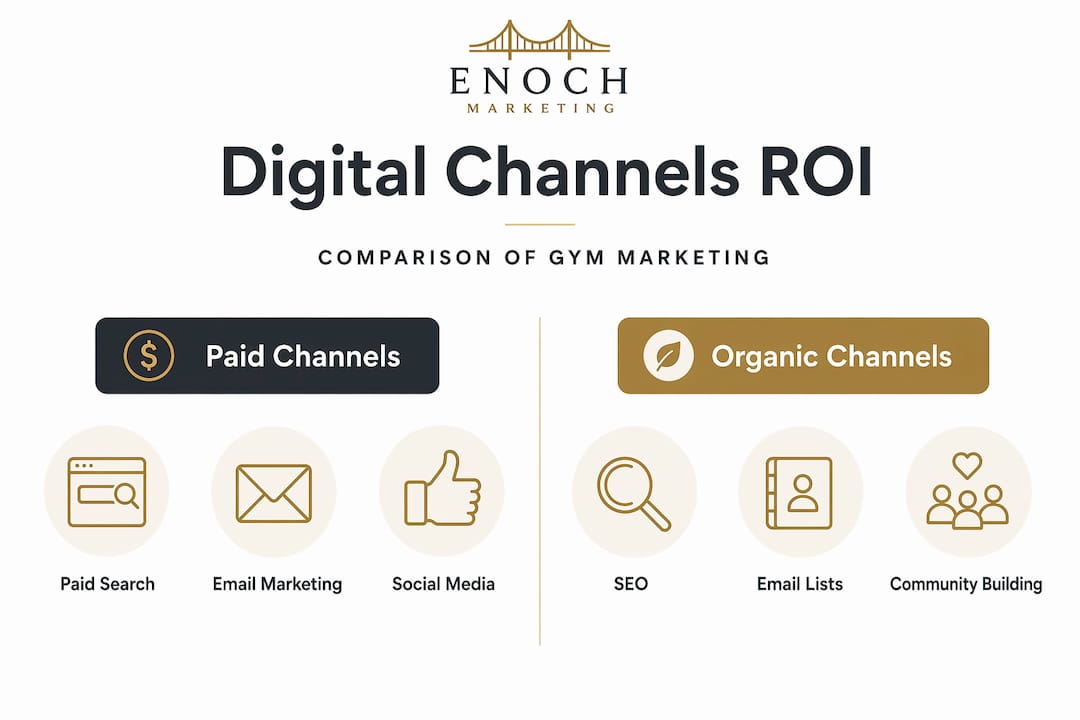
Email marketing is the channel most gym owners underestimate. Businesses own their email lists, unlike social media audiences where algorithm changes can cut your reach overnight. Automated email sequences for new leads, trial members, and lapsed members generate revenue without ongoing ad spend. For a deeper look at how this works in practice, Enochmarketing's guide on email marketing for gym growth breaks down the specific sequences that drive retention.
Social media, particularly short-form video on Instagram and TikTok, builds the community feel that makes CrossFit gyms attractive. Short videos under 60 seconds deliver 2.5 times more engagement per impression than static posts. Posting three to five times per week with a mix of member spotlights, workout clips, and coaching tips keeps your gym top of mind for both current and prospective members.
Pro Tip: Start with paid search and email marketing before adding social media ads. Paid search captures people already searching for a gym. Email converts and retains them. Social ads work best once you have a proven offer and creative assets to test.
What challenges should fitness businesses expect when investing in digital campaigns?
Digital marketing is not a switch you flip and walk away from. Gym owners who treat it that way consistently waste budget and conclude that "ads don't work." The real issue is almost always one of four problems.
-
The offer does not convert before ads. Marketing amplifies your offer. If a free trial offer is not converting organic referrals, paid traffic will only accelerate the losses. Test your offer on your existing audience before spending on ads.
-
The J-curve effect catches owners off guard. Upfront spending often shows negative returns before the data accumulates and campaigns optimize. Most gym owners quit during this phase, just before the curve turns positive. Budget for at least 90 days of sustained spend before evaluating a channel's true performance.
-
Channel dilution kills results. Running Google Ads, Meta Ads, TikTok, YouTube, and a podcast simultaneously with a limited budget spreads resources too thin. Businesses with the highest ROI focus on two to three channels rather than attempting to be everywhere at once.
-
No tracking means no learning. Spending on digital marketing without measurement leads to wasted budgets and frustration. Google Analytics 4, Meta Pixel, and a CRM like HubSpot or Mindbody are non-negotiable before you scale any campaign.
Pro Tip: Calculate your customer lifetime value before setting an ad budget. If a gym member stays for an average of 18 months at $150 per month, their lifetime value is $2,700. You can afford to spend $300 to $500 to acquire that member and still generate a strong return.
How can gym owners implement and optimize digital campaigns?
A structured approach prevents the most common mistakes and gives your investment the best chance of compounding over time. Follow this framework when building your first or next digital campaign.
Step 1: Define your numbers. Calculate your average member lifetime value, your current close rate on leads, and your acceptable cost per acquisition. These three numbers determine your entire budget strategy.
Step 2: Choose two to three channels. Based on your budget and timeline, select your primary channels. For most gyms, the highest-impact starting combination is Google Ads for immediate lead volume, email marketing for conversion and retention, and local SEO for long-term organic growth. Enochmarketing's step-by-step gym marketing plan provides a detailed framework for sequencing these channels.
Step 3: Build your tracking infrastructure. Install Google Analytics 4, set up Meta Pixel, and connect a CRM before spending a single dollar on ads. Without conversion tracking, you cannot tell which campaigns are generating members and which are generating noise.
Step 4: Test your offer organically. Post your membership offer on your existing social channels and email list. If it generates interest without paid amplification, it is ready to scale. If it generates silence, refine the offer first.
Step 5: Launch, measure, and reallocate. Run campaigns for a minimum of 30 days before drawing conclusions. Review cost per lead, cost per acquisition, and member retention rates monthly. Shift budget toward the channels and creatives producing the lowest cost per acquisition.
Here is what to track in your monthly review:
- Cost per lead by channel
- Lead-to-trial conversion rate
- Trial-to-member conversion rate
- Member retention rate at 30, 60, and 90 days
- Revenue attributed to each campaign
Pro Tip: Use UTM parameters on every link in your ads and emails. This lets Google Analytics 4 show you exactly which campaign, ad set, and creative generated each new member signup, so budget decisions are based on data rather than instinct.
Key takeaways
Digital campaigns deliver measurable, scalable member growth for fitness businesses when paired with a proven offer, proper tracking, and sustained investment across two to three focused channels.
| Point | Details |
|---|---|
| Digital presence is non-negotiable | 98% of consumers verify services online, making visibility a direct driver of member acquisition. |
| Channel selection determines ROI | SEO delivers the highest long-term return; paid search and email generate faster, trackable results. |
| The J-curve requires financial runway | Expect negative returns in the first 60 to 90 days before campaigns optimize and compound. |
| Offer quality precedes ad spend | Paid traffic amplifies your offer. Fix conversion issues before scaling any paid campaign. |
| Tracking is the foundation | Without Google Analytics 4, Meta Pixel, and a CRM, budget allocation is guesswork. |
The uncomfortable truth about gym marketing I've learned
Most gym owners I talk to have tried digital ads, gotten burned, and concluded the channel does not work. In almost every case, the problem was not the channel. It was the sequence. They ran ads before the offer was proven, quit before the J-curve turned positive, and had no tracking in place to understand what actually happened.
The fitness industry has a specific challenge that most general marketing advice ignores: the buying decision is emotional and local. A prospect is not just choosing a gym. They are choosing a community, a coach, and an identity. That means your digital campaigns need to do more than generate clicks. They need to communicate culture, results, and trust within the first few seconds of contact.
What I have seen work consistently for CrossFit gyms is a tight combination of Google Ads targeting high-intent local searches, a follow-up email sequence that tells the gym's story over five to seven touches, and a social media presence that shows real members getting real results. None of these channels work in isolation. Together, they create a system where a prospect finds you, trusts you, and books a trial without ever speaking to a salesperson.
The gyms that grow fastest are not the ones with the biggest ad budgets. They are the ones that commit to a focused strategy, measure everything, and stay patient long enough for the data to guide their decisions. If you are building a social media strategy alongside paid campaigns, the compounding effect accelerates significantly within six to twelve months.
— Collin
Ready to turn your gym's digital campaigns into a growth engine?
Enochmarketing works exclusively with CrossFit gyms and fitness brands across the United States, building the exact systems described in this article. From Meta and Google Ads to lead funnels, local SEO, and email sequences, every service is designed around one outcome: more members, lower acquisition costs, and sustainable gym growth.
If you are ready to stop guessing and start scaling, explore Enochmarketing's gym marketing services to see exactly how the agency builds campaigns for fitness businesses like yours. For gym owners evaluating investment levels, the marketing pricing page breaks down every option clearly. Book a free strategy session and get a custom audit of your current digital presence before spending another dollar on ads.
FAQ
Why invest in digital campaigns instead of traditional ads?
Digital campaigns deliver precise local targeting, real-time performance data, and measurable ROI that traditional ads cannot match. For fitness businesses, this means reaching prospects actively searching for a gym rather than broadcasting to an unqualified audience.
How much should a gym spend on digital marketing?
Budget is best calculated from your member lifetime value and acceptable cost per acquisition. A gym with a $2,700 member lifetime value can profitably spend $300 to $500 per acquired member, which guides total monthly ad spend based on your growth targets.
How long before digital campaigns generate new gym members?
Paid search campaigns can generate leads within the first week. Email marketing typically converts within 30 to 90 days. SEO requires 12 to 24 months to deliver significant organic traffic, which is why running paid and organic channels simultaneously produces the best results.
What is the highest ROI digital channel for fitness businesses?
SEO generates approximately $22 per $1 spent over a 24-month period, making it the highest long-term ROI channel. Email marketing delivers $6 per $1 spent and works faster, making the combination of SEO and email the most efficient pairing for gym growth.
What is the biggest mistake gym owners make with digital campaigns?
The most common mistake is scaling paid ads before testing the offer organically. If your free trial or membership offer does not convert referrals or organic social followers, paid traffic will only increase losses. Validate the offer first, then invest in paid amplification.