
Step by step gym marketing is a systematic, multi-channel process that combines monthly promotional campaigns, local digital advertising, lead management, and referral automation to grow gym memberships predictably. Most gym owners treat marketing as a series of one-off promotions. The ones who win treat it as a pipeline, where every stage from ad impression to signed membership has a defined owner, a metric, and a next step. This guide breaks down exactly how to build and run that pipeline, covering campaign calendars, Meta and Google ad targeting, sales conversion, referral automation, and the weekly metrics that tell you whether it's working.
How to create a step by step gym marketing calendar
A 12-month gym marketing plan built around monthly themed campaigns is the most reliable structure for sustaining membership growth. Each month gets a primary campaign, a channel mix, and a specific offer. Without that structure, most gyms default to posting on Instagram when they feel like it and running ads only when memberships drop.
The calendar logic is straightforward. High-intent months like January, September, and January again after summer get your biggest ad budgets and sharpest discounts, typically 15 to 25% off membership or a free first month. Lower-intent months like July and November shift focus to retention, referrals, and community events rather than aggressive acquisition.
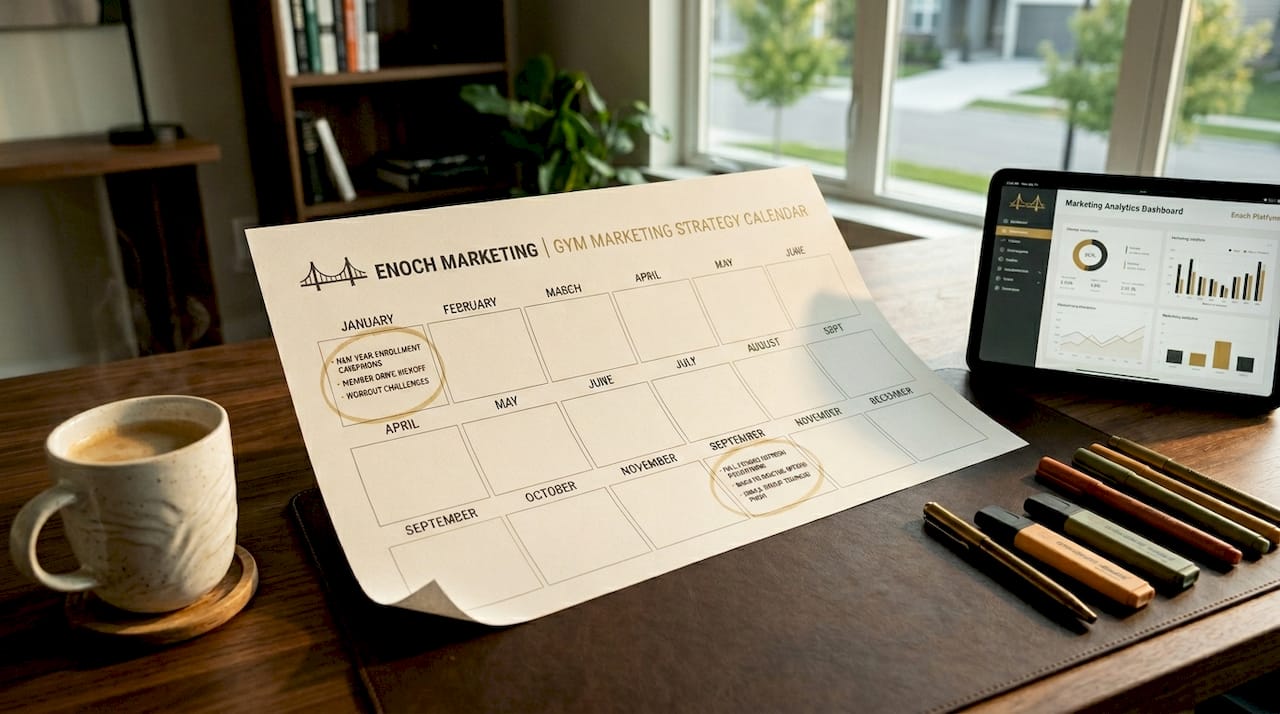
Here is a sample 12-month framework to build from:
| Month | Campaign theme | Primary channels | Offer example |
|---|---|---|---|
| January | New Year reset | Meta, Google, email | 20% off first 3 months |
| February | Valentine's couples | Meta, organic social | Bring a friend free week |
| March | Spring transformation | Meta, email | 7-day free trial |
| April | Spring momentum | Google, organic | Referral double points |
| May | Summer prep | Meta, Google | Free nutrition consult |
| June | Summer challenge | Email, in-gym events | 6-week challenge sign-up |
| July | Retention focus | Email, SMS | Member milestone rewards |
| August | Back to routine | Meta, Google | No enrollment fee |
| September | Fall reset | Meta, Google, email | 15% off annual membership |
| October | Community event | Organic, events | Free community workout |
| November | Gratitude campaign | Email, SMS | Referral bonus month |
| December | New Year preview | Meta, email | Early bird January deal |
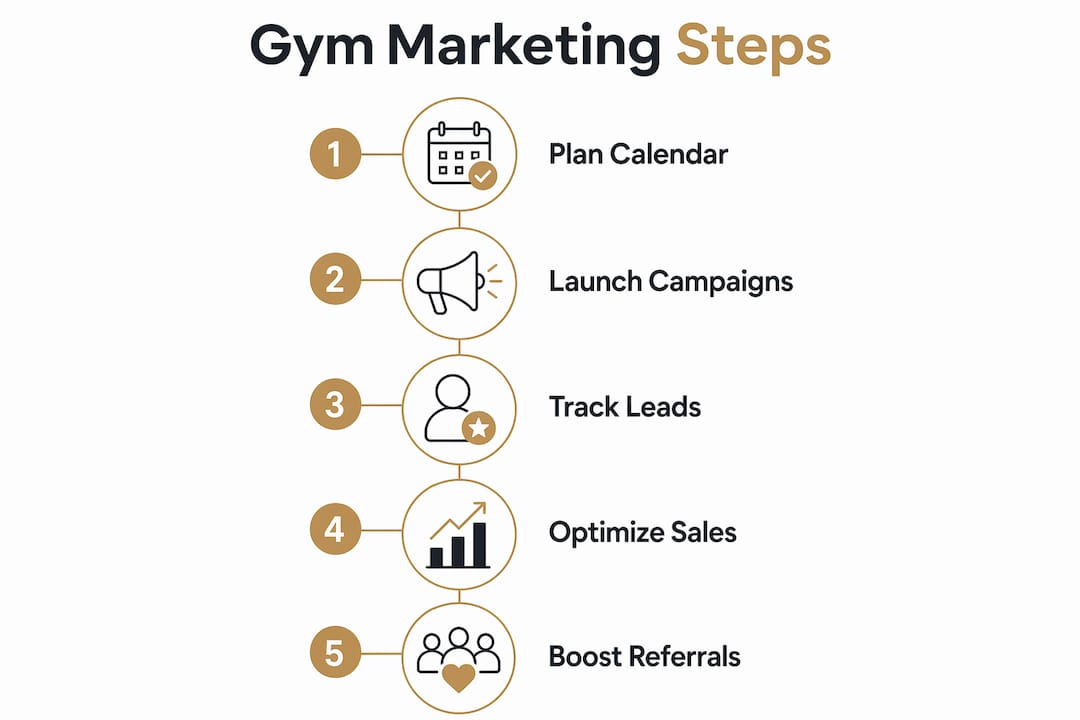
Track inbound leads weekly by channel. If a Meta campaign in March generates 40 leads but only 4 tours, the problem is not the ad. It is the follow-up process, and you fix that before spending more.
Pro Tip: Build your calendar in a shared Google Sheet with columns for campaign name, channel, offer, weekly lead target, and actual leads. Review it every Monday morning. Thirty minutes of review prevents months of wasted budget.
What are the best digital advertising strategies for local gym lead generation?
Local gym ads work best when they target a 5 to 8 mile radius using Meta lead-gen objectives with trial offers. People do not drive 20 minutes to a gym. Tight geographic targeting keeps your cost per lead low and your lead quality high.
Your lead form should capture four fields: name, email, phone number, and preferred visit time. That last field is the one most gyms skip, and it matters because it pre-qualifies intent. Someone who picks "Tuesday at 6pm" is far more likely to show up than someone who just submitted their email.
Cost per lead benchmarks vary by gym type. Budget gyms running high-volume campaigns typically see $10 to $20 CPL. Boutique and CrossFit gyms with higher price points and more selective audiences run $25 to $40 CPL. Neither number matters much if your follow-up is slow.
| Gym type | Typical CPL | Lead form friction | Expected lead-to-tour rate |
|---|---|---|---|
| Budget/big box | $10 to $20 | Low (2 fields) | 10 to 15% |
| Mid-market | $15 to $30 | Medium (4 fields) | 15 to 20% |
| Boutique/CrossFit | $25 to $40 | Higher (4 to 5 fields) | 20 to 30% |
Leads contacted within 5 minutes convert 9 times higher than leads contacted after an hour. That single data point should reshape how you think about your entire ad budget. Spending $2,000 a month on Meta ads and responding to leads the next morning is the same as throwing half that money away.
Creative best practices for gym ads are simpler than most agencies make them sound:
- Use real photos and videos from your actual gym floor, not stock images
- Show real members in action, ideally with a short testimonial overlay
- Lead with the offer in the first three seconds of any video
- Test one variable at a time: headline, image, or offer, never all three simultaneously
Pro Tip: Adding one intentional friction point to your Meta lead form, such as asking for preferred visit time, reduces form volume but improves lead quality significantly. A smaller list of serious prospects beats a large list of tire-kickers every time.
How to optimize your gym sales process for higher conversions
A repeatable gym sales process with fast response and clearly defined next steps is the single biggest lever for converting leads into paying members. Most gyms lose memberships not because their product is weak but because their sales process is inconsistent.
Here is the process that works:
- Respond within 5 minutes. Use an automated text or email that fires the moment a lead submits a form. The message should confirm their inquiry and offer two specific time slots for a tour or intro session.
- Design a welcoming arrival experience. The front desk should know the prospect's name before they walk in. A clean, organized sales area signals professionalism and reduces buyer anxiety.
- Show the workout plan before the price. Walk the prospect through what their first 30 days would look like. Specificity builds confidence. Pricing before program details creates sticker shock.
- Keep pricing simple. Two or three membership options maximum. Decision paralysis is real, and a confused prospect does not sign up.
- Define the next step explicitly. At the end of every conversation, name the exact action: "Let's book your first class right now." Not "feel free to think about it." Every stage of your funnel needs an explicit next step, from inquiry to first class and from signup to 30-day check-in.
Measure your funnel at each stage. If you get 50 leads, 20 tours, and 8 sign-ups, your lead-to-tour rate is 40% and your tour-to-sale rate is 40%. Both are strong. If your lead-to-tour rate drops to 20%, the problem is follow-up speed or messaging, not your gym.
Pro Tip: Record your sales conversations with permission and review one per week. You will spot the exact moment prospects go cold, and fixing that one moment is worth more than any ad optimization.
How to implement a referral program that boosts member acquisition
Referral programs are the lowest cost-per-acquisition channel available to gym owners, and most gyms run them badly. The fix is automation and dual-sided incentives.
Automated referrals generate 3.1 times more referral volume than manual programs. When you rely on staff to remember to ask for referrals, it happens inconsistently. When the system asks automatically at the right moment, it happens every time.
The structure of a high-performing referral program:
- Dual-sided incentives: Both the referring member and the new member get a reward. A one-sided reward feels transactional. A dual reward feels like sharing something good.
- Milestone-based triggers: Send referral prompts at moments of peak satisfaction, after a member hits their first 30 days, completes a challenge, or achieves a personal record.
- Unique referral URLs: Give every member a personal link they can share via text, Instagram, or email. Automated tracking removes the manual work for staff.
- Immediate reward fulfillment: Reward fulfillment within 48 hours increases redemption rates from 23% to 89%. Delayed rewards kill momentum.
Multi-channel referral prompts sent via email, SMS, and in-app achieve up to 27% referral action rates compared to 3% with cold, untimed prompts. The timing and channel combination matters as much as the incentive itself.
Pro Tip: Add a public leaderboard in your gym showing the top referrers each month. Recognition costs nothing and creates social proof that motivates other members to participate. Pair it with a small monthly prize, like a free month or branded gear.
How to measure and refine your gym marketing effectiveness
Gym marketing only improves when you measure the right things weekly. Tracking vanity metrics like social media followers tells you nothing about membership growth.
The metrics that matter:
- Inbound leads by channel: Know exactly which channel produced each lead. Meta, Google, referral, and organic should each have their own tracking.
- Lead response time: Target under 60 seconds for automated response, under 5 minutes for a personal follow-up call.
- Lead-to-tour conversion rate: Typical benchmark is 15 to 25%. Below 15% signals a follow-up problem.
- Customer acquisition cost (CAC): Divide total marketing spend by new members acquired. Your CAC should be recovered within 3 months of average member revenue.
- Member referral rate: Track what percentage of new members came from referrals each month. A healthy referral rate is 20 to 30% of new acquisitions.
Your Google Business Profile is a free lead source that most gyms underuse. Profiles with recent review velocity outrank older profiles with more total reviews. A profile with 80 recent reviews outranks one with 200 old reviews. Post weekly updates, upload new photos monthly, and respond to every review within 48 hours.
| Metric | Target | Action if below target |
|---|---|---|
| Lead response time | Under 5 minutes | Add automated SMS trigger |
| Lead-to-tour rate | 15 to 25% | Audit follow-up sequence |
| Tour-to-sale rate | 30 to 50% | Review sales process steps |
| CAC payback period | Under 3 months | Reduce CPL or improve close rate |
| Referral rate | 20 to 30% of new members | Launch or refresh referral program |
Refresh your ad creative every 4 to 6 weeks. Ad fatigue is real, and the same image shown to the same audience repeatedly produces diminishing returns. Rotate new member testimonials, seasonal offers, and challenge-based creative to keep engagement high.
Key takeaways
Effective gym marketing requires a structured monthly calendar, fast lead follow-up, a repeatable sales process, and automated referrals working together as a single pipeline.
| Point | Details |
|---|---|
| Monthly campaign calendar | Plan 12 themed campaigns with channel mix and offers defined before the month starts. |
| Lead follow-up speed | Contact leads within 5 minutes. Waiting an hour reduces conversion by 9x. |
| Sales process consistency | Define explicit next steps at every funnel stage from inquiry to first class. |
| Referral automation | Use dual-sided incentives and milestone triggers to generate 3x more referrals. |
| Weekly metric review | Track CPL, lead-to-tour rate, CAC, and referral rate every Monday without exception. |
What I've learned after working with dozens of gym owners
The gyms that grow fastest in 2026 are not the ones with the biggest ad budgets. They are the ones that treat advertising and sales as a single pipeline, not two separate departments. I have seen gyms spend $5,000 a month on Meta ads and sign up fewer members than a gym spending $1,500, purely because the expensive gym had a 24-hour lead response time.
The highest ROI move most gym owners can make right now is not a new ad campaign. It is fixing lead follow-up speed first. Set up an automated SMS that fires within 60 seconds of a form submission. That one change, before you touch your creative or your targeting, will move your numbers more than any ad optimization.
The second thing I keep seeing overlooked is referral automation. Gyms with strong communities already have the raw material for a referral engine. They just do not have the system to activate it. A well-timed automated prompt at the 30-day member milestone, paired with a dual-sided reward, costs almost nothing to set up and compounds over time.
The gyms that struggle are the ones chasing awareness. They want more followers, more reach, more impressions. The gyms that win are chasing appointments. Every dollar should be traceable to a lead, a tour, or a signed membership. If it is not, reallocate it until it is.
— Collin
Ready to build your gym's growth engine?
If you have read this far, you already know what your marketing plan needs. The harder part is building and running it while also coaching classes, managing staff, and keeping members happy.
Enochmarketing works exclusively with CrossFit gyms and fitness brands across the United States, handling paid media on Meta and Google, lead funnel creation, referral automation, local SEO, and brand strategy. The agency's process starts with a full audit of your current marketing and sales pipeline, then builds a custom plan designed to dominate your local market. If you want a team that knows the fitness industry and can execute the gym growth strategies described in this article, book a free strategy session with Enochmarketing and see exactly where your biggest growth opportunities are.
FAQ
How long does a step by step gym marketing plan take to show results?
Most gym owners see measurable lead volume increases within 30 to 60 days of launching a structured paid ad campaign with proper follow-up. Referral programs and local SEO improvements typically compound over 3 to 6 months.
What is a realistic cost per lead for gym advertising?
Budget gyms typically see $10 to $20 cost per lead on Meta, while boutique and CrossFit gyms run $25 to $40 CPL. The number that matters more is your lead-to-sale conversion rate, since a low CPL with poor follow-up still loses money.
How do I get more gym members through referrals?
Automated referral programs with dual-sided incentives and milestone-based triggers generate 3.1 times more referrals than manual programs. Reward fulfillment within 48 hours is the single biggest factor in referral redemption rates.
What metrics should gym owners track weekly?
Track inbound leads by channel, lead response time, lead-to-tour conversion rate, tour-to-sale rate, and customer acquisition cost every week. These five numbers tell you exactly where your marketing and sales pipeline is leaking.
How do I improve my gym's Google ranking locally?
Optimize your Google Business Profile by generating recent reviews consistently, posting weekly updates, uploading new photos monthly, and responding to every review within 48 hours. Recent review velocity outweighs total review count in local search rankings.