
If you've ever sat through a marketing report full of CAC, UTM parameters, and churn rates while nodding like you understand every word, you're not alone. The industry jargon for gym marketing is genuinely dense, and using these terms without truly understanding them costs you money, wastes ad spend, and produces campaigns that miss the mark. This guide cuts through the confusion. You'll walk away knowing exactly what these terms mean, how they connect to real marketing decisions, and how to use them to grow your gym's membership in your local market.
Table of Contents
- Key takeaways
- Core industry jargon for gym marketing
- Translating fitness lingo into marketing language
- Applying gym marketing phrases in local campaigns
- Common pitfalls in gym marketing data management
- Quick-reference glossary of gym marketing terms
- My honest take on mastering marketing jargon
- Let Enochmarketing turn your jargon into growth
- FAQ
Key takeaways
| Point | Details |
|---|---|
| Jargon fluency drives results | Understanding core gym marketing terms leads to smarter budget decisions and better campaign performance. |
| Fitness lingo needs translation | Terms like AMRAP and RPE alienate potential members; convert them to outcome language in your marketing copy. |
| UTM discipline matters | Consistent UTM tagging across every campaign is what makes your attribution data trustworthy. |
| Churn is your retention warning light | Tracking churn rate monthly gives you advance notice before revenue loss becomes serious. |
| Glossary as a team tool | A shared, plain-language glossary keeps your whole marketing team aligned on what each metric actually means. |
Core industry jargon for gym marketing
Every gym marketer eventually confronts a stack of terms that sound technical but are actually just precise labels for things you're already doing. The problem isn't the concepts. It's that nobody ever defines them clearly before expecting you to act on them.
Here are the foundational gym marketing terms you need to own:
-
CAC (Customer Acquisition Cost): The total amount you spend to bring in one new paying member. That includes ad spend, agency fees, creative costs, and any software used to run the campaign. If you spent $2,000 on Meta ads and signed up 10 members, your CAC is $200. This number only becomes useful when you compare it to LTV.
-
LTV (Lifetime Value): The total revenue a member generates over their entire relationship with your gym. A member paying $150/month who stays 18 months has an LTV of $2,700. When your LTV is 5x or more than your CAC, your economics are healthy. When that ratio flips, you have a problem.
-
Churn Rate: The percentage of members who cancel in a given period. Annual churn for gyms runs between 25% and 35%, and poorly managed gyms can lose 50% of new members within the first year. Monthly churn at 10% translates to $14,400 in annual revenue loss for a gym with just 40 clients. This is not a vanity metric.
-
Lead Source: Where a prospect first discovered your gym. Google search, a Facebook ad, a referral, an Instagram post. Knowing your lead source lets you double down on channels that work and cut the ones that drain budget.
-
UTM Parameters: Short tracking codes you add to the end of any URL you share online. They tell your analytics platform exactly which campaign, channel, and ad brought a visitor to your site. Marketing attribution for gyms depends entirely on this chain: click, lead, conversion, membership.
Pro Tip: Set a standard UTM naming convention for your entire team before launching any paid campaign. If one person labels the source "facebook" and another labels it "Facebook," your attribution data splits into two incomplete buckets and you can never see the full picture.
Translating fitness lingo into marketing language
CrossFit and functional fitness gyms operate in a world of acronyms that are second nature to coaches but completely opaque to the person driving past your building. Using this jargon in your marketing copy is one of the fastest ways to alienate the exact people you want to sign up.
Here is how common fitness terms translate, and how to position them in your messaging:
| Fitness term | What it means | How to say it in marketing |
|---|---|---|
| AMRAP | As Many Rounds As Possible in a set time | "A timed workout where you push at your own pace" |
| RPE (Rate of Perceived Exertion) | A subjective effort scale from 1 to 10 | "Workouts scaled to how you feel that day" |
| PR (Personal Record) | Your best ever performance on a specific movement | "Beat your own best, tracked and celebrated" |
| Deload | A planned week of reduced intensity for recovery | "Built-in recovery weeks to keep you progressing" |
| Progressive Overload | Systematically increasing demand over time to drive adaptation | "A structured plan that gets harder as you get stronger" |
Translating fitness jargon into outcome language does more than make copy readable. It signals to potential members that your gym actually understands how people feel when they walk through the door for the first time. Someone Googling "beginner fitness classes near me" does not know what AMRAP means. But they absolutely understand "30-minute workouts scaled for your fitness level."
Pro Tip: Run your marketing copy past someone who has never been inside a gym. If they stop at a word or phrase and ask "what does that mean," replace it with the outcome it produces instead.
Applying gym marketing phrases in local campaigns
Understanding the vocabulary is one thing. Applying it correctly in live campaigns is where most gym marketing efforts either gain traction or stall out. Local campaigns, in particular, demand precision because you are competing for the attention of people within a specific radius, not a national audience.
Here is a practical framework for applying gym advertising vocabulary in three core channels:
-
Local SEO content: Use retention language in your Google Business Profile and website copy. Phrases like "member progress tracking," "personalized coaching," and "results-based training" signal to both Google and prospects that your gym delivers outcomes, not just access to equipment. Members respond to outcomes and identity, not equipment specs.
-
Paid social ads: Meta campaigns should use your CAC benchmark as the ceiling for cost-per-lead targets. If your average member stays 14 months at $160/month, you have a $2,240 LTV. You can afford to spend $150 to $200 to acquire that member. Without knowing your LTV and CAC, you're just guessing at budgets. Check out local gym marketing strategies to see how these metrics connect to ad targeting decisions.
-
Member communications: Shift your language from generic motivation to specific momentum. Marketing messaging that highlights small, concrete wins keeps members engaged far longer than blanket "you've got this" copy. An email that says "You've hit 12 classes this month, your best streak yet" is retention marketing. An email that says "Keep pushing!" is noise.
Your session attendance rate, which measures how often active members actually show up, is a leading indicator of churn. Behavioral signals appear months before a cancellation. When attendance drops, your messaging needs to shift immediately to re-engagement, not new member acquisition.
Common pitfalls in gym marketing data management

The biggest mistake gym marketers make is not a lack of data. It's a lack of discipline in how that data gets labeled, tracked, and interpreted. Jargon overload and inconsistent terminology are the two primary culprits behind fragmented attribution and poor decision making.
Here is where things break down most often, and how to fix each issue:
-
Inconsistent UTM labeling: Consistent UTM tagging across every channel is the foundation of reliable attribution. One unnamed campaign can corrupt months of trend data. Build a shared spreadsheet that defines every UTM source, medium, and campaign name before any campaign goes live.
-
Inflated CAC calculations: Many gym owners only count ad spend when calculating CAC. The real number includes software, creative production, and time spent managing campaigns. Underestimating CAC leads to mispriced offers and unsustainable growth.
-
Unlabeled lead sources: When your CRM contains leads marked as "other" or "unknown," you lose the ability to optimize channel spend. Normalize every lead source against a fixed taxonomy. Options should include paid search, paid social, organic search, referral, and direct, with nothing falling into a catch-all.
-
Engagement score blind spots: Most gym management software can calculate an engagement score based on attendance, spend, and participation. When that score drops, it predicts churn before the cancellation request arrives. This is the kind of platform consolidation advantage that integrated management systems provide.
Pro Tip: Audit your CRM lead sources quarterly. If more than 10% of leads are labeled "other" or "unknown," your attribution is broken and your CAC figures are not reliable.
Quick-reference glossary of gym marketing terms
Use this glossary as a shared reference for your team. Bookmark it, paste it into your internal wiki, and review it when onboarding new staff.
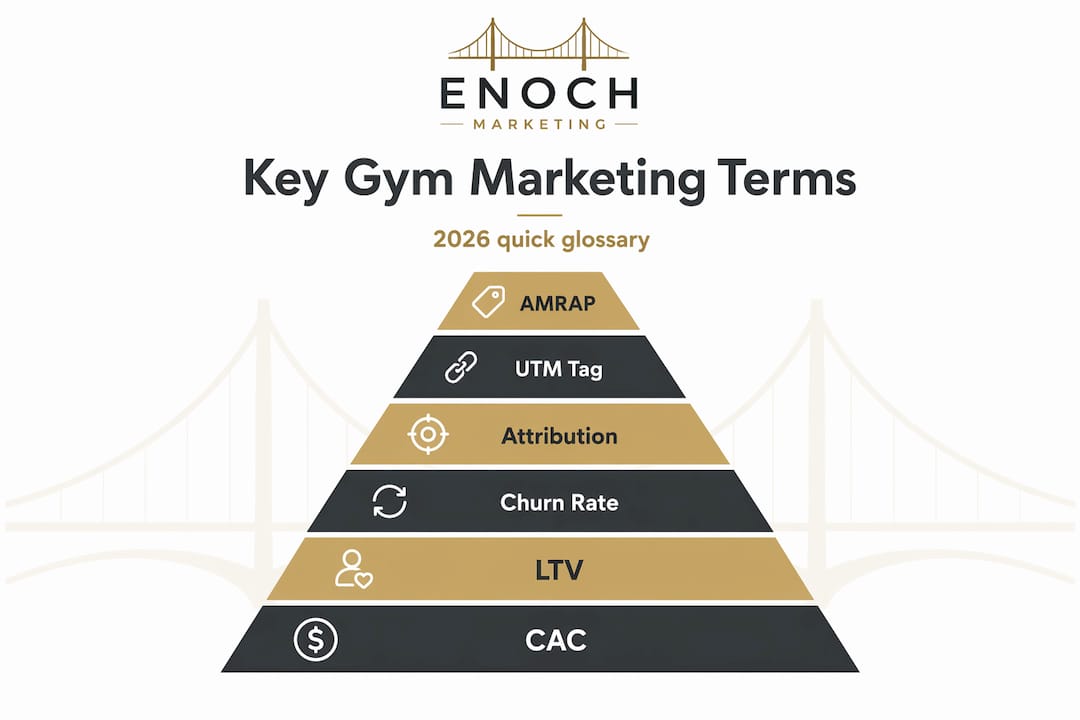
Marketing terms:
| Term | Plain-language definition |
|---|---|
| CAC | Total cost to acquire one paying member |
| LTV (Lifetime Value) | Total revenue from one member over their full membership |
| Churn Rate | Percentage of members who cancel in a given period |
| Retention Rate | Percentage of members who renew or stay active |
| Lead Source | The channel or touchpoint that first brought a prospect to your gym |
| UTM Parameters | URL tracking codes that identify which ad or campaign drove a visit |
| Attribution | Crediting the right marketing channel for a conversion |
| Conversion Rate | Percentage of leads who become paying members |
| CPL (Cost Per Lead) | Total ad spend divided by number of leads generated |
| Engagement Score | Composite metric measuring member activity and participation frequency |
| Session Attendance Rate | How often active members actually show up each week |
| Funnel | The full journey from prospect awareness to paid membership |
Fitness terms used in marketing context:
| Term | Marketing-relevant meaning |
|---|---|
| AMRAP | Scalable workout format; market it as "go at your own pace" |
| RPE | Effort-based scaling; market it as "workouts that adjust to you" |
| PR | Personal record; use it to frame member progress stories |
| Progressive Overload | Structured advancement; market it as "a plan that grows with you" |
| Deload | Planned recovery; market it as "smart training, not burnout" |
| WOD (Workout of the Day) | Daily programming; frame it as "a new challenge every day" |
| OnRamp / Foundations | Beginner program; market it as "your introduction to the gym" |
For a deeper look at how these terms connect to CrossFit gym growth, the relationship between fitness lingo and member acquisition becomes even clearer when you see it applied to full campaign structures.
My honest take on mastering marketing jargon
I've worked with dozens of gym owners who had solid instincts but were flying blind because nobody on their team could agree on what a "lead" actually meant. One person counted every email capture. Another only counted people who booked a free class. Their CAC was off by 40% because the denominator was wrong.
What I've learned is that jargon mastery is not about sounding smart in meetings. It's about precision. When your whole team means the same thing when they say "conversion," you make faster, better decisions. When your messaging strips away fitness buzzwords and speaks to what a member actually feels and wants, your ads perform better and your retention improves.
The gyms that win locally are not always the ones with the biggest ad budgets. They are the ones where the marketing language, internal and external, is tight, consistent, and connected to what members actually experience. Data-driven attribution builds that kind of trust. Get your terms straight before you scale anything.
— Collin
Let Enochmarketing turn your jargon into growth
You now have the vocabulary. The next step is putting it to work in campaigns that actually fill your gym.
At Enochmarketing, we work exclusively with CrossFit gyms and fitness brands across the United States. We build paid media campaigns, lead funnels, local SEO strategies, and member retention systems, all grounded in the exact metrics and terminology this guide covers. We don't hand you a generic marketing plan. We audit your current numbers, identify where jargon confusion is costing you attribution and budget, and build a custom strategy around your actual CAC, LTV, and churn data. Browse our gym marketing services to see how we apply this framework in practice, or check our service pricing to find the right fit for your gym's size and goals.
FAQ
What does CAC mean in gym marketing?
CAC stands for Customer Acquisition Cost. It is the total amount a gym spends to sign up one new paying member, including all ad spend, creative, and software costs.
Why should gyms avoid using AMRAP and RPE in ads?
Fitness acronyms like AMRAP and RPE are unfamiliar to prospective members who are not yet part of the fitness community. Replacing them with outcome language increases ad clarity and attracts a wider audience.
What is a good churn rate for a gym?
A healthy gym churn rate sits below 25% annually. Rates above 35% indicate retention problems that no amount of new member acquisition will fix sustainably.
How do UTM parameters help gym marketing attribution?
UTM parameters tag every link you share online so your analytics platform can tell you exactly which ad or channel drove each lead and membership signup. Without them, your CAC calculations are guesswork.
What is the difference between lead source and attribution?
Lead source identifies where a prospect first found your gym, such as a Google search or Instagram ad. Attribution is the broader process of crediting the right marketing channel for the full conversion from lead to paying member.