
Most gym owners have a marketing problem they cannot see. They run solid Meta ads, get clicks, and still wonder why membership numbers barely move. The real issue is rarely the ad itself. Marketing breakage commonly happens at handoffs between funnel stages, the gap between a lead arriving and your team actually reaching them. A strong fitness brand marketing workflow closes those gaps, turning disconnected campaigns into a system that predictably converts prospects into paying members.
Table of Contents
- Understanding and preparing your fitness marketing workflow
- Executing rapid lead capture and nurturing to maximize conversions
- Tracking and attributing marketing sources to optimize ROI
- Reviewing metrics and iterating your fitness marketing workflow for continuous growth
- Why speeding up your workflow handoffs beats throwing more budget at ads
- Get expert help building your fitness brand marketing workflow
- Frequently asked questions
Understanding and preparing your fitness marketing workflow
Before you run a single ad or send a single email, your workflow needs a foundation. Think of it like building a gym before you start coaching classes. Without the structure, effort gets wasted fast.
Start with your ideal member profile. This is not a vague demographic like "adults aged 25-45." You need specifics: what they search online, what objections they have, what transformation they want, and which neighborhood they live in. This profile drives every targeting decision in your digital fitness advertising, from Google Ads keywords to Facebook audience segments.
Next, get your tools aligned. A fitness brand growth workflow depends on four core tools working together:
- CRM (Customer Relationship Management) software: The single source of truth for every lead.
- Ad platforms: Meta (Facebook and Instagram) and Google Ads for paid acquisition.
- Landing pages: Dedicated pages with one clear call-to-action, not your homepage.
- Automation software: Email and SMS tools that respond instantly without staff intervention.
Lead capture, organization in a centralized CRM pipeline, and rapid follow-up are the operational foundation of effective gym lead management. Without a CRM, leads live in someone's inbox or a spreadsheet, which means they die.
Your CRM pipeline should have at least six distinct stages: New Lead, Contacted, Booked, Showed, Offer Made, Joined. Each stage transition is a handoff. Each handoff is where you lose people if there is no documented process.
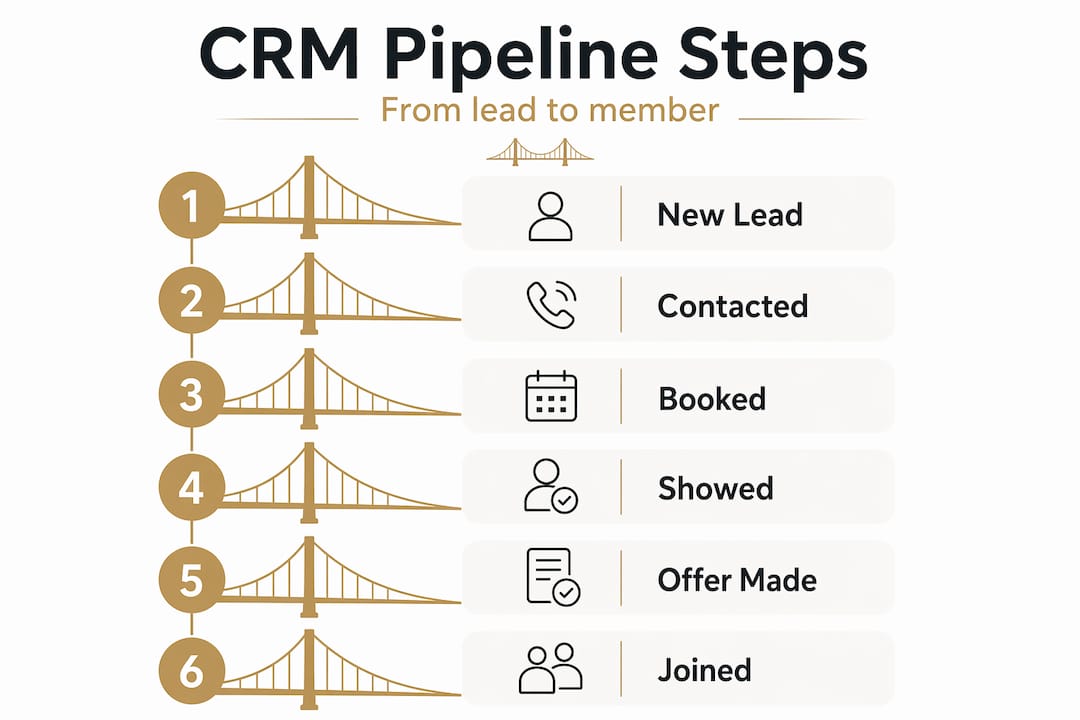
| Pipeline stage | Responsible party | Target timeframe |
|---|---|---|
| New Lead | Automation | Immediate (under 5 min) |
| Contacted | Sales/Front desk | Within 5 minutes |
| Booked | Sales/Front desk | Same call or same day |
| Showed | Coach or manager | Scheduled trial time |
| Offer Made | Sales/Front desk | End of trial visit |
| Joined | Admin | Same day as offer |
UTM tagging (Urchin Tracking Module, the parameters you add to URLs) is equally critical. Without uniform UTM naming across every ad, email, and social post, your CRM will show leads as "Direct" or "Other," making it impossible to know what is actually working. Set naming conventions before launch, and never deviate from them.
Pro Tip: Create a shared UTM naming doc (Google Sheets works fine) and require every team member to use it before any link goes live. One rogue naming convention poisons months of attribution data.
Strong lead generation strategies only pay off when the back end is ready to handle what comes in. Build the system first.
Executing rapid lead capture and nurturing to maximize conversions
Speed is not a nice-to-have. It is the single biggest lever you have after a lead arrives. The first hour after a lead arrives is the highest-leverage window, and automation is the only way to guarantee a response in that window every single time, regardless of whether your front desk is busy.
Here is how a well-designed nurturing sequence looks in practice:
- Day 0, within 5 minutes: Automated reply via email and SMS. Confirm receipt, introduce the gym, and include a direct booking link.
- Day 1: Personalized follow-up call or voice note from a real staff member.
- Day 3: Value-driven message (a short video, a member success story, or a class highlight).
- Day before the trial: Reminder with logistics, parking info, what to wear, and what to expect.
- Day of the trial: Brief motivational message to reduce no-shows.
- Day after the trial: Check-in message with a specific membership offer.
- Day 7: Final follow-up if no decision has been made, with a time-limited offer if appropriate.
A multi-touch nurturing sequence during trials boosts conversion rates significantly because it keeps your gym top-of-mind without requiring manual effort from your team at every step.
Channel matching matters more than most gym owners realize. If a lead comes through Instagram, their first follow-up should come via Instagram DM or WhatsApp, not just email. People respond where they are already active. This is a basic brand promotion technique that most gyms skip.

Here is a quick reference for matching follow-up channel to lead source:
| Lead source | Primary follow-up channel | Secondary channel |
|---|---|---|
| Meta (Facebook/Instagram) | SMS or WhatsApp | |
| Google Ads | Phone call | |
| Referral form | Phone call | |
| Website organic | SMS |
The human element cannot be fully automated. Automation handles speed and consistency. Humans handle persuasion and closing. Your staff needs a script for the first live conversation, one that focuses on the prospect's goals, not on your gym's features. That shift alone, from features to transformation, changes conversion rates noticeably.
Pro Tip: For gym lead nurturing, stop the automated sequence the moment a lead books or joins. Nothing kills trust faster than getting a "have you considered trying us?" email the day after signing up.
Strong email marketing for gyms also means segmenting by stage. A lead who visited but did not join needs different messaging than a brand-new inquiry. Your automation tool should support this without much complexity. Review your lead follow-up best practices quarterly to make sure your sequences stay relevant and do not go stale.
Tracking and attributing marketing sources to optimize ROI
You cannot fix what you cannot measure. This sounds obvious until you realize most gym owners are making budget decisions based on gut feel because their tracking is broken.
Consistent UTM tagging and conversion tracking across platforms is essential to calculate customer acquisition cost (CAC) accurately. CAC tells you exactly how much you spent to acquire one member from each channel. Without it, you might be spending $200 per member on Google and $800 per member on Meta and have no idea.
Here is the minimum you need to track at each funnel stage:
- Lead to booked visit rate: Of everyone who fills out a form, how many book a trial?
- Booked to showed rate: Of those who book, how many actually show up?
- Showed to joined rate: Of those who visit, how many become members?
- CAC by source: What did you spend to produce one paying member from each channel?
Set up a simple reporting dashboard in Google Sheets or a tool like Google Looker Studio. Pull weekly numbers. Look for which stage has the worst drop-off. That is where you work first.
| Funnel metric | Healthy benchmark | Warning sign |
|---|---|---|
| Lead to booked | 40% or higher | Below 25% |
| Booked to showed | 70% or higher | Below 50% |
| Showed to joined | 60% or higher | Below 40% |
| CAC (average) | Under $150 per member | Over $300 per member |
These benchmarks are starting points, not universal rules. Your local market, price point, and trial offer all affect them. The value is in tracking your numbers consistently over time, not in hitting someone else's ideal.
A solid paid ads strategy without proper attribution is just spending money and hoping for the best. Pair your ad spend with disciplined tracking and you gain real control over your growth rate. This is also where your wellness brand outreach, whether through local partnerships or community events, needs tracking too. Every lead source deserves a UTM tag. No exceptions.
For a broader look at how this feeds into your overall membership marketing strategies, attribution data is what tells you whether a gym marketing campaign paid off or just generated noise.
Reviewing metrics and iterating your fitness marketing workflow for continuous growth
Building the workflow is the first half. Maintaining and improving it is the part that actually produces compounding results over time.
The structure we recommend is straightforward:
- Review: Pull your funnel KPIs for the past quarter. Speed-to-lead, show rate, close rate, and CAC by source.
- Decide: Identify the single weakest metric. Not the top three. One.
- Test: Make one targeted change designed to improve that metric specifically.
- Repeat: Measure the impact after 30 to 60 days before making the next change.
This is how a Review, Decide, Test, Repeat cycle improves funnel performance without creating chaos. Gym owners who try to fix everything at once end up not knowing what actually moved the needle.
Weekly KPI dashboards give your team operational visibility. Monthly reviews catch emerging problems before they compound. Quarterly reviews are for strategic decisions, like pausing a channel, changing your offer, or investing in new fitness brand engagement tactics.
"The goal is not a perfect workflow. The goal is a workflow that gets measurably better every quarter."
Document every change you make and the result it produced. This creates a record your team can learn from, and it makes onboarding new staff dramatically easier. When someone new joins your front desk, they should be able to open a folder and see exactly what the follow-up process is, why it was designed that way, and what changed most recently.
Pro Tip: Bring your front desk team into the quarterly review. They hear objections directly from prospects and often know exactly why leads are not converting. Their input is more valuable than any dashboard metric alone.
Strong marketing funnel optimization is a habit, not a one-time project. And fitness marketing personalization becomes much easier once you have real data on what each segment of your audience responds to.
Why speeding up your workflow handoffs beats throwing more budget at ads
Here is something most gym marketing conversations get wrong: they treat slow membership growth as an advertising problem. More spend, better creative, tighter targeting. But in most cases, the ad is not broken. The handoff is.
When a lead fills out a form and hears nothing for three hours, their intent evaporates. They have already moved on to their next task, and your gym has become an afterthought. No amount of retargeting fixes that. Marketing rarely fails at top-of-funnel ads but breaks structurally at handoffs between funnel stages, and this is a reality most gym owners genuinely do not recognize until they see it in their own data.
We have seen gyms cut their ad spend by 30% and increase memberships by improving speed-to-contact from two hours to under five minutes. The leads were always there. The system was just too slow to catch them.
Rigorous CRM logging also creates accountability in a way that gut-feel management never can. When every lead is tracked by name, source, and stage, it is immediately visible when follow-ups are not happening. That visibility changes team behavior without requiring confrontational conversations.
The honest truth about how to market a fitness brand is this: execution quality beats budget size, almost every time. The gym that calls within five minutes, sends a thoughtful follow-up, and closes with a personalized conversation will beat the gym with a bigger ad budget and a broken back end. Improving your fitness marketing workflow strategies is where the real return on investment lives.
Get expert help building your fitness brand marketing workflow
Building a high-performance marketing workflow is not complicated, but it requires real expertise to implement correctly the first time. Most gym owners do not have the bandwidth to manage CRM setup, ad attribution, automation sequences, and KPI reporting simultaneously while also running their gym.
At Enoch Marketing, we specialize exclusively in fitness brands, which means our CrossFit gym marketing services are designed around the exact workflow problems you are reading about here. We handle paid media on Meta and Google, CRM integration, automation builds, and performance dashboards, all tailored to your local market and your membership goals. You get a connected system, not a collection of disconnected tactics. Learn more about our agency and how we work, or contact us for marketing help to schedule a free strategy session and find out exactly where your current workflow is losing members.
Frequently asked questions
What is a fitness brand marketing workflow?
It is a connected system combining paid and organic marketing, lead capture, CRM follow-up, and in-club sales designed to convert prospects into members efficiently. Fitness marketing workflows run as connected funnel systems from paid media all the way through in-club execution.
How quickly should I respond to new gym leads?
Within five minutes if possible, with automation handling the initial reply to preserve lead intent and maximize your conversion chances. Responding within 5 minutes using instant automation is the operational standard for capturing lead intent before it fades.
Why is UTM tagging important for gym marketing?
UTM tagging tracks which campaigns bring in leads, enabling accurate calculation of acquisition costs and ROI so you can cut what is not working and scale what is. Consistent UTM tagging is essential for correct marketing attribution and CAC accuracy.
What follow-up sequence works best for fitness trials?
A multi-touch sequence spanning 7 to 10 days with value-driven check-ins and a clear offer at the right moment works best, and it should stop the moment the prospect joins. Trial follow-up sequences with multiple touchpoints double conversion rates by nurturing prospects effectively through the decision stage.
How often should I review my fitness marketing KPIs?
A quarterly review cadence using a structured process allows focused, measurable improvements without overwhelming your team with constant changes. Quarterly KPI reviews with a Review, Decide, Test, Repeat process drive sustained and compounding growth over time.