Running paid ads and watching your budget disappear with nothing to show for it is one of the most demoralizing experiences a gym owner can face. You know your facility is great, your coaches are skilled, and your community is tight-knit, but the sign-ups just aren't coming in. The good news is that paid advertising for local gyms isn't a guessing game when you follow a structured system. This tutorial walks you through every stage, from setting up your first campaign to scaling it into a reliable membership machine, using real data from gyms that have already cracked the code.
Table of Contents
- Laying the groundwork: What you need for paid ads success
- Step-by-step setup: Crafting your winning gym ads
- Budgeting and optimization: Get more members, spend less
- Measuring results: Tracking, troubleshooting, and scaling up
- Why most gym ad strategies fall short—and what actually works
- Ready to turn paid ads into predictable gym growth?
- Frequently asked questions
Key Takeaways
| Point | Details |
|---|---|
| Track CPL and ROAS | Always measure cost per lead and return on ad spend to maximize growth from every dollar invested. |
| Optimize campaigns weekly | Continuous improvement with testing and adjustments significantly boosts sign-ups and ROI. |
| Local targeting matters | Tailoring ads to your immediate area brings higher qualified leads and better conversion rates. |
| Scale successful ads gradually | Only increase your budget for campaigns with strong, proven performance data. |
Laying the groundwork: What you need for paid ads success
With the motivation to get real ad results, you'll first need to prepare your digital toolkit and baseline metrics. Before you spend a single dollar, you need to understand two numbers that will govern every decision you make.
Cost per lead (CPL) is what you pay each time someone submits their contact information through your ad. Return on ad spend (ROAS) tells you how much revenue you earn for every dollar you put into advertising. If you spend $100 and bring in $530 in new membership revenue, your ROAS is 5.3x. Understanding and tracking CPL and ROAS made it possible for gyms to achieve up to 5.3x returns on their ad investment.
Here's a quick benchmark table to orient yourself:
| Metric | Beginner benchmark | Strong performer |
|---|---|---|
| Cost per lead (CPL) | $4.00 to $6.00 | $0.83 to $2.00 |
| ROAS | 1.5x to 2x | 4x to 5.3x |
| Weekly budget | $25 to $50 | $100 to $300 |
| Targeting radius | 10 to 15 miles | 3 to 7 miles (urban) |
Before launching, make sure you have these essentials in place:
- Facebook Ads Manager account connected to your gym's Facebook Business Page
- Meta Pixel installed on your website to track visitor behavior and conversions
- A minimum starting budget of $25 per week (you can scale from there)
- A defined targeting radius based on how far your typical member drives to your gym
- Conversion events configured so the platform knows what a "lead" looks like
The explaining ROAS concept matters here because many gym owners optimize for clicks instead of actual sign-ups. Clicks are vanity. Sign-ups are revenue.
Pro Tip: Set up your conversion tracking events inside Meta Events Manager before you run a single ad. If you skip this step, you'll have no reliable data to optimize from, and your campaign will essentially be flying blind.
Step-by-step setup: Crafting your winning gym ads
Now, with your key metrics and tools in place, you're ready to build and launch your local campaign. Here's how to do it from scratch.
-
Choose your campaign objective. For most gyms, "Lead Generation" is the right choice because it keeps prospects inside Facebook's native form, which reduces friction. If you have a high-converting landing page, "Traffic" or "Conversions" can also work well.
-
Define your audience. Target by zip codes or a specific radius around your gym address. Layer in interest targeting such as CrossFit, group fitness, weightlifting, and even followers of local competitor gyms. Narrow by age (typically 22 to 45) and gender based on your current member demographics.
-
Build your ad creative. Short video clips (15 to 30 seconds) showing actual workouts perform exceptionally well. Before-and-after member transformation images grab attention in the feed. Member testimonials, especially short talking-head videos, build immediate trust.
-
Write a compelling offer. Vague ads get ignored. Specific offers convert. Think "First month for $49," "Free intro class this week only," or "Join today and skip the enrollment fee." Pair every offer with a clear call to action like "Claim your spot" or "Get started today."
-
Set your ad schedule. Run ads Tuesday through Saturday when fitness motivation tends to peak. Pause on Sundays and Mondays to conserve budget during lower-engagement windows.
-
Launch and monitor. Give your ads at least three to five days before drawing conclusions. The algorithm needs time to learn.
Gyms using targeted, compelling offers saw 60 to 80 sign-ups per week from campaigns starting at just $25.
"One Crunch Gym location ran a targeted Facebook campaign with a free trial offer and generated 210 leads at a $4.33 CPL, converting the majority into paying members within 60 days."
Pro Tip: Use Facebook's Lookalike Audience feature by uploading your current member email list. The platform will find local people who share behavioral and demographic traits with your best clients, dramatically improving your targeting accuracy from day one.
Budgeting and optimization: Get more members, spend less
Launching your campaign is just the start; the true results come from ongoing tuning. Most gym owners set a budget, launch, and forget. That approach burns money. The gyms winning with paid ads treat their campaigns like a living system that needs daily attention.
Here's a comparison of what happens with and without active optimization:
| Scenario | Month 1 result | Month 2 result |
|---|---|---|
| No optimization | 20 leads at $8.50 CPL | 18 leads at $9.20 CPL |
| Active A/B testing | 40 leads at $4.33 CPL | 85 leads at $2.90 CPL |
| Budget reallocation | Flat performance | 5.3x ROAS achieved |
A Bay Area gym achieved 5.3x ROAS specifically because the team monitored spend daily and shifted budget away from underperforming ads within 48 hours of spotting a problem.
Here's how to stay on top of your campaign budget and performance:
- Check your CPL every morning. If it spikes above your target, pause the weakest ad immediately.
- Rotate your creatives every 10 to 14 days. Ad fatigue is real. Fresh visuals reset audience engagement.
- Test one variable at a time. Change either the headline, image, or offer, never all three at once, so you know what actually moved the needle.
- Respond to new leads within five minutes. Speed-to-contact is one of the biggest conversion factors in fitness sales. A lead that waits 24 hours is usually a lost lead.
- Reallocate budget weekly. Move dollars from ads with a high CPL to ads with a low CPL. This single habit can improve ROAS for gyms by 30 to 50 percent over a 30-day period.
Start with a $25 to $50 weekly budget to gather data. Once you identify a winning ad combination, scale to $100 to $200 per week with confidence.
Measuring results: Tracking, troubleshooting, and scaling up
After you adjust your campaigns, it's crucial to clearly track outcomes and decide when and how much to invest further. Here's a numbered process to keep your analysis clean.
-
Open your Ads Manager dashboard daily. Review CPL, cost per acquisition (CPA), click-through rate (CTR), and ROAS side by side.
-
Check your lead form completion rate. If people click but don't submit, your form is too long or your offer isn't compelling enough.
-
Audit your landing page or lead form weekly. Broken forms, slow load times, and confusing copy all kill conversions silently.
-
Flag ad fatigue early. A rising CPL combined with a falling CTR almost always means your audience has seen your creative too many times.
-
Decide on scaling thresholds. A campaign earning a CPL under $4 and a ROAS above 3x is ready to scale. Increase budget by 20 percent per week, not all at once.
Case studies show gyms scaling campaigns from 26 to 210 leads in one to two months, converting at high rates and adding over 200 new paying members in 60 days. One campaign attributed 80 percent of new sign-ups directly to optimized paid ads during that window.
Your campaign is ready to scale when you see these signs:
- CPL has been stable or declining for at least two consecutive weeks
- Your lead-to-member conversion rate sits above 30 percent
- You're getting consistent five-minute response times on new leads
- Your offer has been validated by at least 50 conversions
- Your improving ad strategy process is documented and repeatable
Scaling without these signals in place is how gyms waste money. Scaling with them is how gyms grow fast.
Why most gym ad strategies fall short—and what actually works
Here's the uncomfortable truth most paid ads guides won't tell you: the strategy isn't the hard part. The follow-through is. Most generic advice treats paid ads like a one-time setup, but the gyms achieving improved ROAS for fitness businesses are the ones reviewing data every single week and adjusting their messaging based on what their local community actually responds to.
National fitness brands have massive budgets and brand recognition. You can't out-spend them. But you can out-target them. A local gym in a specific neighborhood can speak directly to the frustrations, goals, and lifestyle of people within five miles in a way no national chain ever could. That specificity is your competitive edge.
The other piece most gym owners miss is the follow-up. An ad that generates a lead is only the beginning. The gym owners who win are the ones calling new leads within minutes, nurturing them through text and email, and showing up consistently in their feed with relevant content. Paid ads without a follow-up system is like filling a bucket with a hole in it. Plug the hole first, then pour in the water.
Ready to turn paid ads into predictable gym growth?
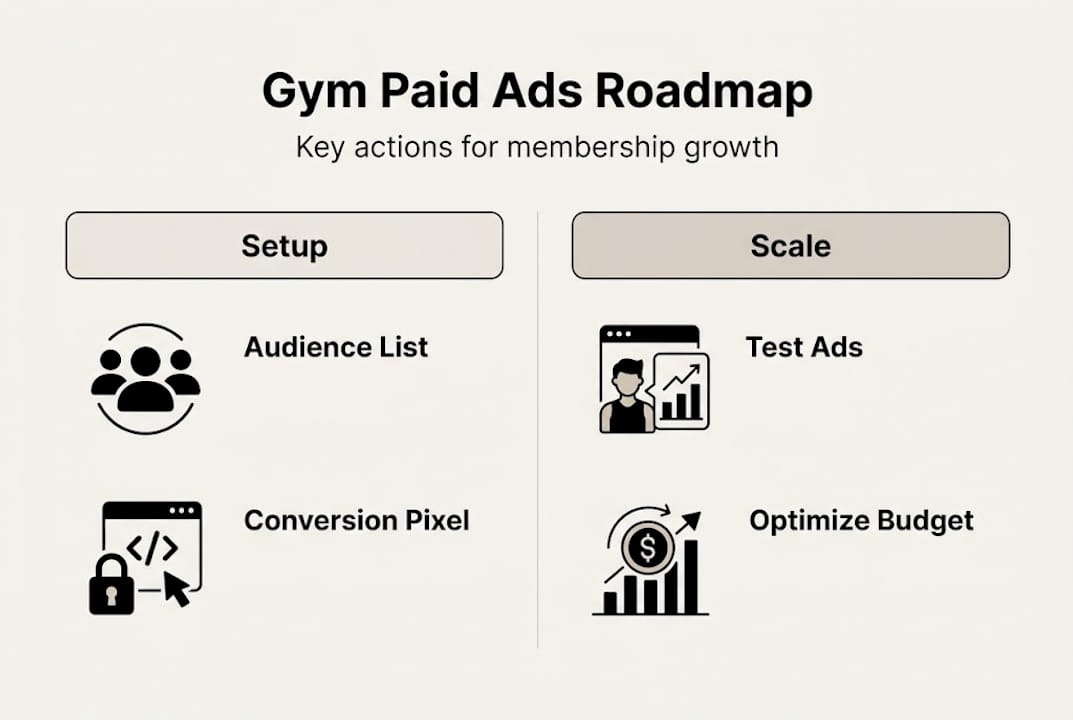
You now have a clear roadmap, from setting up tracking and targeting to optimizing budgets and scaling winning campaigns. But knowing the strategy and executing it flawlessly are two very different things.
At Enoch Marketing solutions, we work exclusively with CrossFit gyms and fitness studios across the U.S. to build and manage paid ad campaigns that generate real, measurable membership growth. We handle the setup, the creative, the optimization, and the reporting so you can focus on coaching. If you're ready to move from inconsistent DIY ads to a system that fills your gym with qualified local members, book your free strategy session today.
Frequently asked questions
What is a good cost per lead for local gym ads?
Effective campaigns often see a CPL as low as $0.83 for Facebook gym ads, with a strong benchmark range of $0.83 to $6 depending on your market and offer.
How much should I budget for my first paid ad campaign?
Starting with at least $25 per week is recommended. Gyms have used that budget to generate 60 to 80 sign-ups weekly when the targeting and offer are dialed in.
Which ad platform works best for CrossFit gyms?
Facebook and Instagram consistently deliver the strongest results. Facebook's performance for low CPL and high local sign-up volume makes it the top choice for most gym campaigns.
How quickly can paid ads generate new members?
Results can come fast when the campaign is optimized. Crunch Gym converted 210 leads into 200 new members in under 60 days using a structured Facebook ad strategy.