
Most new gym memberships don't come from national ad campaigns or flashy billboards. They come from neighbors, local searches, and community word-of-mouth. Fitness marketing that focuses on your immediate neighborhood will almost always outperform broad brand awareness spending for CrossFit boxes and boutique studios. If you've been pouring money into general advertising and wondering why the results feel flat, this guide will show you exactly where to redirect that energy and how to measure what's actually working.
Table of Contents
- Defining local gym marketing: Core concepts and community focus
- Core strategies for local gym success
- Real-world impact: Data-driven results of local strategies
- Adapting your approach: Budget, location, and competition
- The overlooked truths about local gym marketing
- Get expert help growing your gym locally
- Frequently asked questions
Key Takeaways
| Point | Details |
|---|---|
| Focus on your area | Local gym marketing delivers more members by targeting those within 5-10 miles of your gym. |
| Use core strategies | Local SEO, referrals, partnerships, and geo-ads are the tested drivers of growth. |
| Data proves impact | Gyms using these strategies report up to double revenue and a steady lead flow. |
| Adapt to your market | Customize your approach based on budget, location count, and competition for best results. |
| Consistency is vital | Ongoing local engagement and fresh updates keep your gym top of mind and trusted. |
Defining local gym marketing: Core concepts and community focus
Local gym marketing is the practice of targeting people who live, work, or train within a close radius of your facility, typically five to ten miles. It's not about competing with a national fitness chain's media budget. It's about becoming the obvious choice for everyone in your neighborhood who wants what you offer.
This is fundamentally different from generic fitness marketing, which casts a wide net hoping to catch anyone interested in exercise. Generic campaigns built around vague messaging like "get fit this year" don't land the same way a Facebook ad targeting your zip code at 6 a.m. does. The closer you get to your actual community, the more relevant every dollar you spend becomes.
"Local gym marketing emphasizes community integration, local visibility, and hyper-local digital optimization over broad national campaigns." — Shopify Fitness Marketing Guide
Community integration is the real differentiator. A CrossFit box that sponsors a neighborhood 5K, partners with a local physical therapist, or runs a free Saturday workout in the park earns trust that no paid ad can manufacture. People sign up for gyms they feel connected to. That connection starts locally.
The core components of a strong local gym marketing approach include:
- Local SEO (search engine optimization): Getting your gym to appear when someone Googles "CrossFit near me" or "boutique gym in [your city]"
- Local business partnerships: Teaming up with complementary businesses like chiropractors, nutrition shops, or athletic wear retailers
- Community activities: Events, charity workouts, open houses, and neighborhood sponsorships
- Referral programs: Structured incentives that turn your current members into recruiters
- Geo-targeted ads: Paid campaigns on Meta or Google that only reach people within a defined radius of your gym
Each of these tactics works best when they reinforce each other. A strong referral program feeds your local SEO through reviews. Community events generate social content. That social content supports your fitness advertising strategies and keeps your brand visible without requiring a massive ad budget. When it comes to building a recognizable identity in your market, gym branding for local impact ties all these pieces together.
Core strategies for local gym success
Knowing the categories is a start. Knowing how they actually perform and how to implement them without wasting time is where most gyms fall short. Here's a breakdown of the five strategies every local gym should have active, along with what the numbers say about each one.
| Strategy | Description | Typical result |
|---|---|---|
| Local SEO | Google Business Profile, local citations, reviews | 25-35% of new leads, low ongoing cost |
| Referral programs | Member incentives to recruit friends | $87-180 cost per acquisition, 30-50% conversion |
| Business partnerships | Cross-promos with local health/wellness businesses | High-quality leads, low ad spend |
| Community events | Free classes, charity events, local sponsorships | Brand awareness, social proof, loyalty |
| Geo-targeted ads | Meta and Google ads with radius targeting | Fast lead volume, scalable with clear ROI |
The data behind these strategies is compelling. Referral programs are highly efficient with a cost per acquisition between $87 and $180, conversion rates of 30 to 50 percent, and members recruited through referrals staying 25 to 30 percent longer than those acquired through paid ads. That retention advantage alone justifies building a formal referral program even before you touch paid advertising.
Here's how to activate the five strategies in a practical way:
- Optimize your Google Business Profile. Fill out every field, add weekly photos, post updates, and respond to every review within 24 hours. This single action drives more local search visibility than almost any other tactic.
- Launch a simple referral program. Give current members a tangible reward like a free month or branded gear for each person they bring in who signs up. Keep the process frictionless. The harder it is to redeem, the less it gets used.
- Build two or three local business partnerships. Approach a sports chiropractor, a smoothie bar, or a running shoe store. Offer to display their materials in your lobby in exchange for them doing the same for you. Add a cross-promotion discount and both businesses win.
- Run a monthly community event. A free workout, a local charity fundraiser, or a nutrition talk costs you one hour of planning and generates photos, reviews, and new leads. Core local marketing tactics like these build compounding visibility over time.
- Test geo-targeted ads with a clear offer. Run a Meta ad targeting people within five miles with a specific offer like a two-week free trial or a discounted first month. Track cost per lead and sign-up rate. This data tells you everything about what your local market responds to.
Pro Tip: Don't try to run all five at full capacity simultaneously. Pick your Google Business Profile and referral program as a foundation, get those humming, then layer in the other tactics. Trying to do everything at once leads to inconsistent execution across all channels, which is worse than doing two things really well.
Paid ads for local gyms work best when paired with strong organic presence. And if you want members to actually stay after you acquire them, personalized marketing for retention is the next layer to build. How you structure gym offers also plays a massive role in conversion rates once leads are in the funnel.

Real-world impact: Data-driven results of local strategies
It's easy to talk about strategies in theory. What gym owners actually need is evidence that these tactics produce real numbers. The good news is the data is strong.
| Tactic | Measurable result |
|---|---|
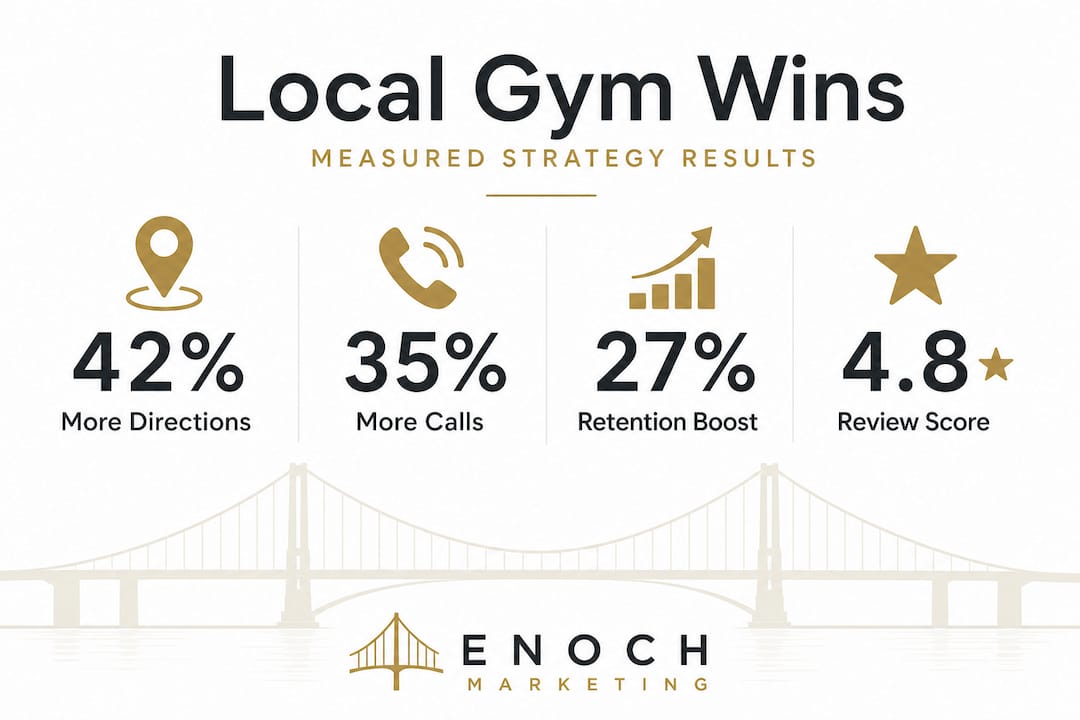
| Google Business Profile optimization | 42% more directions requested, 35% more website clicks |
| Local SEO overall | 25-35% of new leads at a compounding low cost ($127 average CAC) |
| Local SEO combined with social media | 220% organic traffic increase, 45% new sign-up growth |
| PPC combined with SEO | 2,700 leads generated at $17 cost per lead |
| Local SEO, reviews, and partnerships | Revenue doubled within 12 months |
These are not outliers. Case studies from local fitness studios consistently show that gyms combining local SEO with active review management and community partnerships achieve dramatic growth without massive ad budgets. A $17 cost per lead via targeted PPC and SEO is a number most paid-only campaigns can't touch.
The recency factor matters more than most gym owners realize. A gym with 200 reviews but the most recent one from 14 months ago will consistently lose search visibility and trust to a gym with 40 reviews and five from last week. Google's algorithm favors active, recently reviewed businesses. So does your prospective member who's scanning your profile on a Tuesday morning deciding whether to book a tour.
Local SEO drives 25 to 35 percent of new leads at a compounding low cost, and Google Business Profile optimization alone generates 42 percent more directions requests. That's not a small number when you consider that every directions request represents someone actively looking for your gym.
Here are quick lessons every gym can act on immediately:
- Ask for reviews after every milestone. First week completed, first PR hit, one month in. Automate the ask through your gym management software.
- Post photos weekly to your Google Business Profile. Interior shots, class photos, coach spotlights. Fresh images signal an active business.
- Monitor your local search rankings monthly. If you're not showing up in the top three for "CrossFit [your city]," that's a fixable problem with a clear solution.
- Track where new members found you. Ask on intake forms. This data tells you exactly which channels are producing and which ones need work.
If you want a broader framework for membership marketing strategies, tying these data points into a structured plan makes the difference between scattered tactics and a real growth system.
Adapting your approach: Budget, location, and competition
Not every gym is starting from the same position. A CrossFit box opening in a mid-sized market with no direct competitors nearby has a very different situation than a boutique studio entering a city with four other similar gyms within a mile. Your local marketing strategy needs to reflect your reality.
Multi-location gyms, low-budget studios, and gyms in saturated markets all need distinct approaches. Here's how to think about each scenario:
- Multi-location gyms: Build separate local pages on your website for each location with unique content, locally relevant keywords, and distinct Google Business Profiles. Run location-specific ad campaigns so you're not cannibalizing your own audiences.
- Low-budget studios: Prioritize partnerships and referral programs. These two tactics have the lowest cost and the most reliable ROI. Avoid running paid ads until you have enough data and budget to track return properly.
- Competitive markets: Go hyper-local with your keyword targeting. Instead of "CrossFit gym in Chicago," target "CrossFit gym in Lincoln Park" or "boutique fitness studio near Wicker Park." The more specific the keyword, the less competition and the more qualified the searcher.
- New gyms: Start with your Google Business Profile and five solid local partnerships before you spend a dollar on ads. Build credibility before building ad volume.
Pro Tip: The easiest tactics to launch, like posting on social media and running ads, often require the most ongoing management to produce results. The harder tactics to set up, like local SEO and referral programs, tend to pay dividends for months after the initial setup. Balance your attention accordingly.
Strong lead generation strategies tie these adaptations together into a consistent flow. And if you want your gym to stand out as a thought leader in your community, investing in content marketing for CrossFit gives you an organic edge that compounds over time regardless of your ad budget.
The overlooked truths about local gym marketing
Here's a take you won't often hear: most local gym marketing problems aren't strategy problems. They're consistency problems. Gym owners read about referral programs, set one up, promote it once, and then move on. They optimize their Google Business Profile in January and don't touch it again until December. They run a great community event and never do another one.
The gyms that win locally are not doing anything dramatically different. They are doing the basics relentlessly. Fresh reviews every month. Updated photos every week. New offers every quarter. Active social presence every day. The compounding effect of consistent, small actions is what builds the kind of community trust that no single campaign can manufacture.
The recency principle is undervalued across the board. Most gym owners focus on building volume. More reviews, more followers, more posts. Recency beats volume almost every time. A prospect Googling your gym at 7 a.m. before work doesn't care that you have 300 reviews from three years ago. They care that someone left a five-star review last Thursday.
The myth of "set it and forget it" kills more local marketing programs than poor strategy ever will. Your Google Business Profile is not a one-time project. Your referral program needs to be mentioned at every onboarding call. Your local partnerships need to be re-energized every few months or they go cold. Personalized marketing for trust is what keeps existing members engaged enough to become your best recruiters.
Where should you double down for sustainable advantage? Community events and referral programs. These are the two tactics most gyms underinvest in because they require real human effort, not just ad spend. That's exactly why they work. They build relationships that no algorithm can replicate.
Get expert help growing your gym locally
Understanding these strategies is one thing. Building and managing them consistently while running a gym, coaching classes, and managing staff is a completely different challenge. Most gym owners know what they should be doing. They simply don't have the bandwidth to execute it at the level that produces real growth.
At Enoch Marketing, we work exclusively with CrossFit gyms and boutique fitness studios across the United States. That focus means we already understand your market, your member psychology, and the competitive dynamics you're navigating. From local SEO and paid media to lead funnels and brand strategy, our gym marketing services are built specifically for the fitness industry. If you're ready to stop guessing and start growing, speak with a marketing expert on our team and get a free strategy session tailored to your gym.
Frequently asked questions
What are the most effective local gym marketing strategies for small budgets?
Low-budget studios should prioritize partnerships with local businesses and structured referral programs, since these deliver the best return without requiring significant ad spend.
How does local SEO help gyms attract more members?
Local SEO drives 25 to 35 percent of new leads at a lower compounding cost than paid ads, while improving visibility in map results and increasing website clicks and directions requests.
Are referral programs really more effective than paid ads for gyms?
Yes. Members acquired through referrals stay 25 to 30 percent longer than those acquired through paid ads, making referral programs more cost-effective over the full membership lifetime.
What should multi-location gyms do differently for local marketing?
Multi-location gyms need a separate local page, unique Google Business Profile, and location-specific ad campaigns for each facility to avoid audience overlap and maximize local relevance.
How often should gyms update their local marketing tactics?
Monthly reviews of your Google Business Profile, review pipeline, and active offers keep your local presence fresh and competitive, since recency strongly influences both search rankings and prospect trust.