
Most gym owners assume that showing up on every platform — Instagram, TikTok, Google, email, SMS, print — is what multi-channel marketing means. That assumption is expensive. Understanding what is multi-channel marketing for gyms actually means recognizing that presence without strategy is just noise. The truth is that a focused approach using three to four well-chosen channels outperforms scattered activity on ten platforms every time. This article breaks down how multi-channel marketing works in the fitness industry, what it costs you to get it wrong, and exactly how to build a system that brings in members and keeps them.
Table of Contents
- Key Takeaways
- What multi-channel marketing for gyms actually means
- The real benefits of multi-channel marketing for gyms
- Common mistakes gym owners make with multi-channel marketing
- How to build a gym multi-channel marketing strategy that works
- Choosing the right tools for multi-channel gym marketing
- My honest take on what most gyms get wrong
- Ready to put this into practice?
- FAQ
Key Takeaways
| Point | Details |
|---|---|
| Multi-channel means selected, not all | Focus on 3-4 platforms where your audience is active instead of spreading thin across every channel. |
| Fragmented channels hurt conversions | Uncoordinated messaging across platforms creates confusion and loses leads that were already interested. |
| Retention depends on engagement | 89% customer retention is achievable with strong multi-channel engagement versus 33% with weak engagement. |
| Tracking is non-negotiable | Unique links and voucher codes per channel let you measure what actually drives sign-ups and where to scale. |
| Centralized communication wins | Pulling all conversations into one place reduces dropped leads and creates a consistent member experience. |
What multi-channel marketing for gyms actually means
Multi-channel marketing for gyms is the practice of reaching potential and current members across multiple platforms — each one working independently but contributing to a single growth goal. Think of it as showing up where your people already spend time, with messages tailored to each context.
Here are the marketing channels for gyms that matter most in a practical channel mix:
- Social media (Instagram, Facebook): Visual content, community building, paid ads targeting local zip codes
- Email: Nurturing leads, membership promotions, retention campaigns for existing members
- SMS: High-open-rate reminders, class updates, win-back campaigns for churned members
- Your website and local SEO: The home base where traffic converts and Google Maps drives walk-ins
- Physical and print: Flyers, community boards, local event sponsorships that anchor your brand locally
It's worth drawing the line between multi-channel and omnichannel marketing. Multi-channel means being present on several platforms, each with its own strategy. Omnichannel means all those platforms share data and deliver a single unified experience. Most gyms should aim for multi-channel first and work toward omnichannel as they scale.
The comparison below shows how the two approaches differ in practice:
| Feature | Multi-channel | Omnichannel |
|---|---|---|
| Channel coordination | Independent per channel | Fully integrated and synchronized |
| Data sharing | Partial or manual | Real-time across all touchpoints |
| Complexity | Moderate | High |
| Best for | Growing gyms | Established gym chains |
| Member experience | Consistent tone | Personalized and contextual |
Effective multi-channel marketing means choosing three relevant platforms rather than trying to be everywhere. Your job is to deliver real value at every touchpoint, not just fill every channel with content for the sake of it.

The real benefits of multi-channel marketing for gyms
Numbers tell this story better than theory. Multi-channel customers have 30% higher lifetime value and companies with strong multi-channel engagement retain 89% of customers compared to just 33% for those with weak engagement. For a gym where every lost member is recurring revenue walking out the door, that gap is significant.
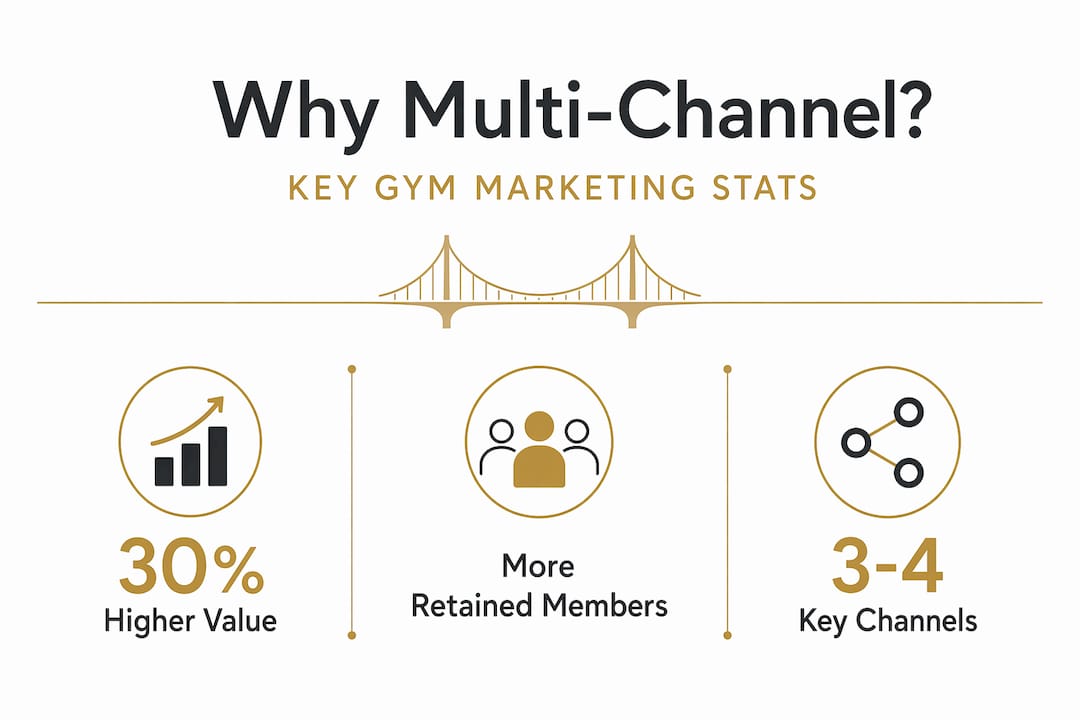
Consider what this means at scale. If your gym has 200 members paying $150 per month, the difference between 89% and 66% annual retention is roughly $414,000 in lost annual revenue. That math alone makes the investment in a proper multi-channel marketing strategy obvious.
The benefits extend beyond retention:
- Revenue growth: Multi-channel campaigns can lead to 9.5% yearly revenue growth alongside 7.5% operational cost reductions.
- Engagement during disruptions: The same campaigns achieve 246% higher engagement during consumer behavior shifts, which matters when seasons change or a competitor opens nearby.
- AI-driven efficiency: AI-driven tools can improve ROI by up to 50% while reducing operational costs, making campaigns smarter without adding headcount.
- Better booking rates: AI-powered sales agents in multi-channel systems increase gym bookings by 32%.
The average fitness facility retains only 66% of members annually. Multi-platform marketing for fitness is not a luxury. It is the difference between sustainable growth and a gym that relies entirely on referrals to survive.
Common mistakes gym owners make with multi-channel marketing
The biggest pitfall is not a bad ad. It is a bad system. Gyms that invest in multiple channels but fail to coordinate them end up with what looks like marketing but functions like chaos.
Here is what fragmented multi-channel marketing actually looks like in practice. A prospect sees your Instagram ad, sends a DM, and gets a reply two days later. They also receive a generic email that has no idea they already expressed interest. Then an SMS arrives offering a discount on the membership they already asked about. That is not marketing. That is fragmented communication that loses leads who were already warm.
Three specific misconceptions keep gyms stuck:
- More channels equals more results: Volume without coordination creates confusion, not conversions. The fastest responder often wins in fragmented systems, creating inconsistent and unprofessional experiences.
- Gym management software handles marketing: Walled garden platforms like certain popular gym management tools limit your ability to run true multi-channel campaigns because they lock member data inside proprietary systems.
- Set it and forget it: Automated sequences still need human review, suppression rules, and regular refreshes to stay relevant.
Pro Tip: Before adding a new channel to your marketing mix, audit your current channels first. Ask whether your team can see the full conversation history for every lead in one place. If the answer is no, adding another channel will compound the problem, not solve it.
The fix is centralization. Pulling all conversations — DMs, SMS, calls, emails — into a single operating system dramatically improves lead conversion and the overall member experience. You stop losing leads to the gap between channels.
How to build a gym multi-channel marketing strategy that works
Building an effective system is less about tools and more about decisions made before you launch anything. Here is how to approach it:
-
Identify your three to four channels. Look at where your current members actually came from. Survey them. Check your analytics. If Facebook ads and word of mouth plus email are driving most sign-ups, those are your priority channels. Chasing TikTok because a competitor is there is a distraction if your audience is not active there.
-
Coordinate your messaging across platforms. Every channel should support the same campaign idea but speak in its own voice. A promotion for a free week trial should feel at home in an Instagram Reel, a text message, and a Google search ad without being word-for-word identical.
-
Use unique tracking per channel. Unique voucher codes and tracking links per channel let gyms pinpoint exactly what is driving sign-ups and optimize spend accordingly. Without this, you are guessing which $500 you wasted.
-
Apply cross-channel suppression rules. A cross-channel suppression strategy coordinates send limits across email, SMS, and push notifications to prevent message fatigue. Effective suppression increases deliverability by five to twelve points within sixty days and keeps your audience from tuning out.
-
Centralize your pipeline. Choose a CRM or marketing platform that shows every touchpoint a lead has had across all channels in one timeline. When your team follows up, they know exactly what the prospect saw, clicked, and responded to.
Pro Tip: Assign content types to specific channels rather than posting the same thing everywhere. Use email for detailed promotions and class schedules, SMS for time-sensitive alerts, and social media for community storytelling and social proof. Each channel has a job. Let it do that job.
For real-world examples of campaigns that use this kind of structured thinking, the gym promotion strategies in paid media demonstrate how channel-specific messaging drives measurable sign-ups. Additionally, personalizing fitness marketing within your channel mix is one of the fastest ways to improve retention without increasing your ad budget.
Choosing the right tools for multi-channel gym marketing
The technology you use shapes what is possible in your campaigns. Many gyms start with their gym management software and assume that handles marketing. It does not. Most of those platforms are built for scheduling, billing, and attendance. Their marketing features are secondary.
Relying solely on walled garden platforms limits your ability to run true multi-channel campaigns because member data stays locked inside those systems. You cannot easily connect it to external ad platforms, email tools, or SMS providers without workarounds that break regularly.
The table below shows how integrated gym management software compares to broader multi-channel marketing platforms:
| Feature | Gym management software | Multi-channel marketing platform |
|---|---|---|
| Member scheduling and billing | Excellent | Minimal or none |
| Email and SMS marketing | Basic | Advanced with automation |
| Ad platform integrations | Limited | Native or via API |
| AI personalization | Rare | Increasingly standard |
| Data portability | Low | High |
| Cross-channel tracking | Not supported | Built-in |
| Scalability for growth | Moderate | High |
AI-powered marketing tools are now essential for unifying messages and automating repetitive tasks, freeing your team to focus on high-impact engagement. The best setup for most growing gyms is to use gym management software for operations and a dedicated marketing platform for campaigns, with the two systems connected through integrations.
Understanding how data drives decisions in your marketing stack is what separates gyms that scale from those that plateau.
My honest take on what most gyms get wrong
I've worked with enough gym owners to see a pattern. The ones who struggle with multi-channel marketing are almost never struggling because they picked the wrong platform. They struggle because they treat each channel as a separate operation run by different people with no shared view of the member.
In my experience, the single most valuable thing a gym can do is build one unified conversation history. When your front desk knows someone clicked a Facebook ad about a six-week challenge before they walked in for a tour, that context changes everything. The conversation becomes warmer, more specific, and far more likely to convert.
What I've learned is that the "right channel" debate is mostly a distraction. The gyms I've seen grow consistently are not the ones chasing every new platform. They are the ones who got really good at two or three channels, tracked everything obsessively, and kept their messaging tight and coordinated.
There is also a subtle trap with automation. Automation done right saves hours and scales your outreach. Automation done wrong makes your gym feel like a robot sent an email. The balance is this: automate the follow-up sequence, but write the messages like a real person. Use suppression rules so you are not hammering someone with three texts and two emails in a single day. The goal is to feel present, not intrusive.
My take is that most gyms are underinvesting in the connective tissue of their marketing. Not the ads. The system that holds it all together.
— Collin
Ready to put this into practice?
If you have read this far, you understand the gap between running channels and running a real multi-channel marketing strategy. Enochmarketing specializes exclusively in CrossFit gyms and local fitness brands across the United States, and this is the exact work the agency does every day.
From paid media on Meta and Google to local SEO, lead funnels, and social content built around your gym's identity, Enochmarketing builds the full system. Not just the ads. See what a strategy built specifically for gym growth looks like on the gym marketing services page. If you want to know what it costs before you commit, transparent pricing options are available for gyms of different sizes. Or skip straight to booking a session through the contact page.
FAQ
What is multi-channel marketing for gyms?
Multi-channel marketing for gyms means promoting your facility across several platforms — social media, email, SMS, paid ads, and local SEO — with each channel working toward the same membership growth goals. The key is selecting the right channels for your audience rather than being active on all of them.
How many channels should a gym use in its marketing strategy?
Most gyms perform best with three to four focused channels rather than spreading effort thin across many. Choosing three relevant platforms and doing them well outperforms being present on ten platforms with inconsistent execution.
What is the biggest risk of multi-channel marketing for gyms?
The biggest risk is fragmentation. When channels are not coordinated, leads receive inconsistent messages and fall through the gaps between platforms. Centralized conversation tracking is the most effective fix.
How does multi-channel marketing improve gym member retention?
Consistent engagement across multiple channels keeps members connected to your gym community beyond their workouts. Businesses with strong multi-channel engagement retain 89% of customers compared to 33% for those with weak cross-channel presence.
Can a small gym afford a multi-channel marketing strategy?
Yes. Starting with two or three channels — typically social media, email, and local SEO — is affordable and scalable. The cost of a fragmented or absent strategy, measured in lost memberships and missed leads, almost always exceeds the cost of getting it right.