
If you're a gym owner spending money on marketing without seeing a steady stream of new members, you're not alone. Knowing how to market your gym effectively in 2026 means going beyond posting a few Instagram photos and hoping for referrals. It means building a real system: one that positions your gym, attracts leads online, nurtures them through email, converts them with the right offer, and keeps them coming back. This article breaks down exactly how to do that, step by step, with no filler.
Table of Contents
- Key takeaways
- How to market your gym with strong positioning
- Your website and local SEO
- Social media and short-form video
- Email automation and membership retention
- Reputation, referrals, and community growth
- My honest take on gym marketing in 2026
- Ready to grow your gym faster?
- FAQ
Key takeaways
| Point | Details |
|---|---|
| Positioning drives everything | Define your ideal member first, then build your offer, content, and messaging around that person. |
| Local SEO gets you found | An optimized Google Business Profile is often the fastest path to more "gym near me" clicks and calls. |
| Email delivers the highest ROI | Automated email sequences consistently outperform most other channels for gym lead nurture and retention. |
| Video content fuels discovery | Short-form video is the top format for reaching new audiences on Instagram, TikTok, and YouTube Shorts. |
| Reputation compounds growth | Systematic review requests and referral asks after milestone moments lower your acquisition cost over time. |
How to market your gym with strong positioning
Before you spend a dollar on ads or content, you need to know exactly who you're marketing to. Most gyms lose money on marketing because their message is too broad. "Get fit. Join us." attracts no one in particular and converts even fewer.
Start by building a profile of your ideal member. Are they a working parent who wants 45-minute workouts before the kids wake up? A competitive athlete chasing performance? Someone who's tried big-box gyms three times and quit each time? The clearer your picture, the sharper your marketing becomes. Once you know who you're speaking to, you can build an offer they actually want.
Strong offers for gyms in 2026 typically look like one of these:
- Free "No Sweat Intro" or goal session where a coach meets with the prospect one-on-one before they ever set foot on the floor
- Two-week trial at a low barrier price ($1 to $49) that lets people experience the community with minimal risk
- Results-based challenge with a specific outcome promise, like losing 8 pounds in 30 days or completing a beginner program
Pro Tip: Price your entry offer to cover your cost per lead, not to be your cheapest possible price. If it costs you $40 to acquire a lead through ads, a free trial burns cash. A $49 jump-start program is sustainable.
Learning how gym offers drive leads is one of the highest-leverage investments of your time as an owner. The right front-end offer turns a curious browser into a paying member faster than any amount of brand awareness.
Your website and local SEO
Your website is the hub of everything. Social posts, ads, referrals, and Google searches all point back to it. If your site is slow, confusing, or missing a clear next step, you're paying for traffic that never converts.

Here is what a gym website built for conversions needs:
| Element | Why it matters |
|---|---|
| Above-the-fold headline | Tells the visitor exactly who you help and what result they get |
| Single primary CTA button | Reduces decision fatigue. One action: book a free intro or claim a trial |
| Mobile speed under 3 seconds | Most gym searches happen on phones. Slow pages kill conversions |
| Dedicated landing pages | Separate pages for each offer perform better than generic homepages |
| Embedded Google reviews | Social proof visible without leaving the page removes hesitation |
Local SEO is where the real volume lives for most gyms. When someone types "CrossFit gym near me" or "personal training [city]," you want to appear in the top three map results. That starts with your Google Business Profile. Fill out every field: categories, services, hours, photos, and weekly posts. The gyms that dominate local search are the ones treating their Google Business Profile like a second website.
Beyond that, sprinkle your city name and neighborhood naturally into your website copy, page titles, and image alt tags. Add an FAQ section to your site that answers real questions people type into Google, like "How much does CrossFit cost in [city]?" or "Is CrossFit good for beginners?" These small moves stack up into significant organic visibility over months.
Social media and short-form video
Here is the shift that most gym owners are still missing. Gen Z uses social platforms for discovery the way older generations used Google. Instagram Reels and TikTok videos now surface in response to typed searches, not just algorithmic feeds. That changes how you should think about every piece of content you create.
The role of video content in gym marketing has never been more direct. Short-form video is the most engaging format for 66% of consumers, and for gyms specifically, it's the fastest way to show what your community actually feels like. No amount of text or static images replicates a 30-second clip of your coaches cheering a member through a personal record.
What to create each week:
- Member wins and transformations filmed with their permission, showing real people with real results
- Coach tips and movement breakdowns that demonstrate your expertise without being salesy
- Behind-the-scenes moments: whiteboard workouts, class energy, post-WOD conversations
- Social-search-optimized captions that use phrases your ideal member would type, like "beginner CrossFit workout" or "how to start going to the gym"
Pro Tip: Put your keywords on screen, not just in captions. When a viewer watches without sound, on-screen text tells the algorithm and the viewer exactly what your content is about. This directly improves social search rankings.
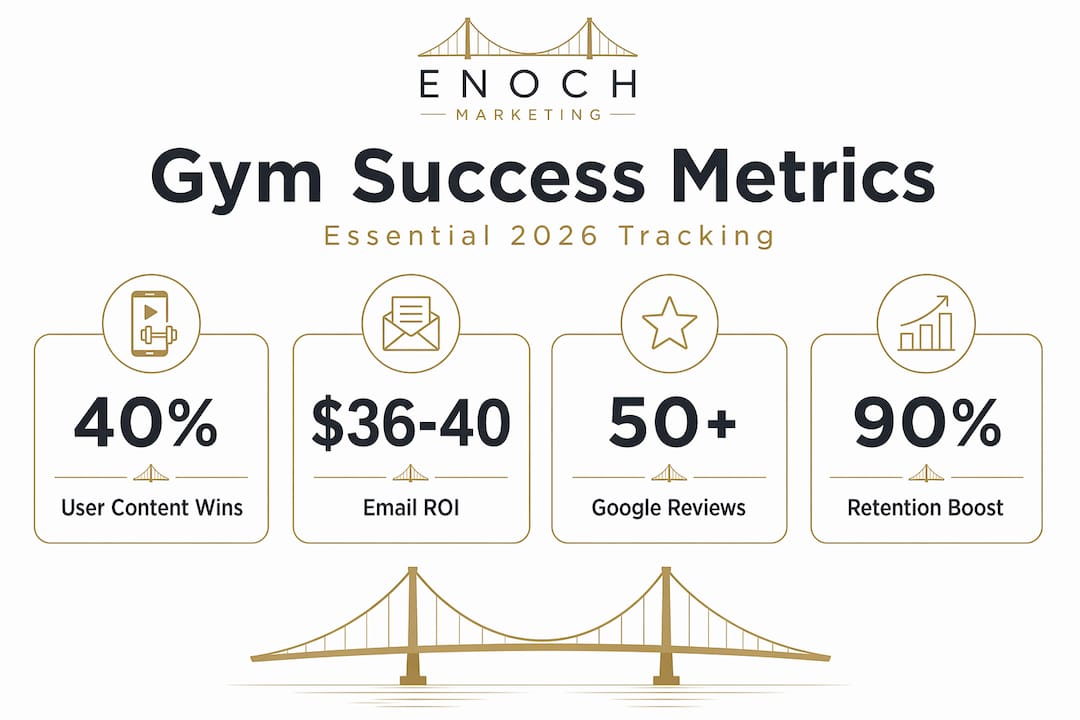
Research confirms that user-generated content outperforms polished ads in trust and conversion, with 40% of adults citing UGC as a major factor in purchase decisions. Stop waiting for your content to look perfect. Start capturing real moments from real members.
Email automation and membership retention
Email is the channel most gym owners underuse and underestimate. Done right, email marketing for fitness businesses returns an average of $36 to $40 for every $1 spent, with top performers exceeding $70. No social platform comes close to those numbers.
The key is automation. You do not have time to personally follow up with every lead, every trial member, and every lapsed member. But a well-built email system does it for you, 24 hours a day. Here is the sequence structure that works for gyms:
- Lead nurture sequence (days 1 to 7): Three to five emails sent after someone opts in, sharing your story, member results, and a strong CTA to book their intro
- Trial-to-member conversion (days 1 to 14 of trial): Emails timed to their trial experience, answering objections and reinforcing the value of membership
- Onboarding sequence (first 30 days as a member): Weekly touchpoints covering what to expect, how to get the most from your coaching, and community resources
- Win-back sequence (60 to 90 days after lapse): A short series that acknowledges the gap and offers a low-barrier reason to return
Automated email workflows like these directly improve both conversion and retention by keeping your gym top of mind without requiring your manual attention every day.
Pro Tip: Celebrate member milestones in your emails. When someone hits 30 days or a personal record, send a personalized congratulations email with a gentle ask for a Google review. The timing makes members far more likely to respond positively.
Tracking your numbers matters here too. Know your cost per lead, cost per acquisition, and member lifetime value. These three numbers tell you whether your marketing system is profitable and where to fix it first.
Reputation, referrals, and community growth
Your best marketing asset is not your Instagram account. It is what your members say about you when you're not in the room.
Review requests triggered at milestone moments like a member's 30-day anniversary or their first personal record produce significantly better results than asking at random. Build these asks into your email automations and front-desk scripts. When a member is on a high, they want to share it.
A star-filter review system is worth implementing immediately. When a member clicks a review link and selects three stars or below, they get routed to a private feedback form instead of your public Google page. Members who select four or five stars get sent directly to Google. This protects your public rating while still giving you genuine feedback to improve.
Referrals follow a similar logic. Referral systems need automation and formal asks early in the member journey, not just when you remember to mention it at the desk. A simple automated email at day 14 that says "Know someone who would love this?" with a referral link generates predictable word-of-mouth without requiring constant effort from you.
Here is a quick comparison of reactive versus proactive reputation management:
| Approach | Reactive | Proactive |
|---|---|---|
| Review requests | Ask when you remember | Automated at milestones |
| Negative feedback | Visible on Google | Routed to private form |
| Referral asks | Word of mouth only | Automated email at day 14 |
| Review volume | Inconsistent | Steady and compounding |
The compound effect of steady reviews and systematic referrals is significant. Gyms with 50-plus Google reviews and a 4.7 average rating convert far more "gym near me" searches than gyms with 12 reviews and silence.
My honest take on gym marketing in 2026
I've seen gym owners pour money into Facebook ads, hire influencers, and redesign their websites three times in two years. And I've seen others grow from 80 members to 200 in 18 months by doing fewer things with more discipline.
The gyms that win are not the ones with the flashiest content. They are the ones with connected systems. Their Google profile feeds their website. Their website feeds their email list. Their email list nurtures leads and retains members. Their member milestones trigger review requests and referral asks. Every piece reinforces the others.
What I've learned working specifically with CrossFit and functional fitness gyms is that sponsored content and influencer deals are losing ground fast. The gym owners building real revenue are leaning into their own communities, their own email lists, and their own member stories. That is direct revenue you control.
The biggest mistake I see? Treating each marketing tactic as a standalone experiment instead of part of a system. One great Reel does not build a gym. One email does not retain a member. But an integrated sequence of touchpoints, consistently executed, does both. Start by auditing what you have, fix the biggest leak first, and build from there.
— Collin
Ready to grow your gym faster?
If you've read this far, you already know more about gym marketing than most owners in your area. The question is whether you have the time, team, and tools to execute all of it consistently.
At Enochmarketing, we work exclusively with CrossFit gyms and fitness studios across the United States. We handle paid media, local SEO, email automation, social content, and lead generation for fitness studios so you can focus on coaching. If your website is leaking members before they ever contact you, our website conversion audit shows you exactly where and how to fix it. Book a free strategy session and see what a purpose-built marketing system looks like for a gym at your stage of growth.
FAQ
What is the most cost-effective way to market a gym?
Email marketing delivers the highest return for gyms, averaging $36 to $40 per dollar spent. Combined with a strong Google Business Profile and consistent short-form video, these three channels provide the best ROI without requiring a large ad budget.
How does social media help gyms attract new members?
Platforms like Instagram and TikTok now function as search engines for fitness content. Gyms that post short-form video with searchable captions and on-screen keywords get discovered by people actively looking for workouts and gym options in their area.
How often should a gym ask for Google reviews?
The most effective approach is to automate review requests after milestone moments like a member's first 30 days or a personal record. Asking at those high-emotion moments yields significantly higher response rates than random or infrequent requests.
What email sequences do gyms need?
At minimum, gyms need four automated sequences: a lead nurture series, a trial-to-member conversion series, a new member onboarding series, and a win-back series for lapsed members. These cover every stage of the member lifecycle.
How do I lower my gym's cost per acquisition?
Systematic referral programs and consistent Google review generation lower your cost per acquisition over time by increasing organic and word-of-mouth leads. Pairing these with a well-converting website and targeted paid ads creates the most efficient member acquisition system.