
Paid ads are non-negotiable for fitness studios that want predictable, scalable member acquisition — but only when three things are already in place: a compelling offer, local targeting, and a fast follow-up system. Without all three, you're not running ads; you're running an expensive experiment with no feedback loop.
Here's the short version of when to act:
- Run ads when you have a clear low-commitment offer (free trial week, intro class), a defined local radius, and a CRM that triggers a response within minutes of a lead coming in.
- Pause ads when retention is poor, your offer is vague, or no one is following up on leads consistently. Ads amplify what's already working — they don't fix a broken system.
- The single success criterion: your cost per new member must stay below your allowable acquisition cost, which is determined by member lifetime value (LTV), not by how cheap your leads are.
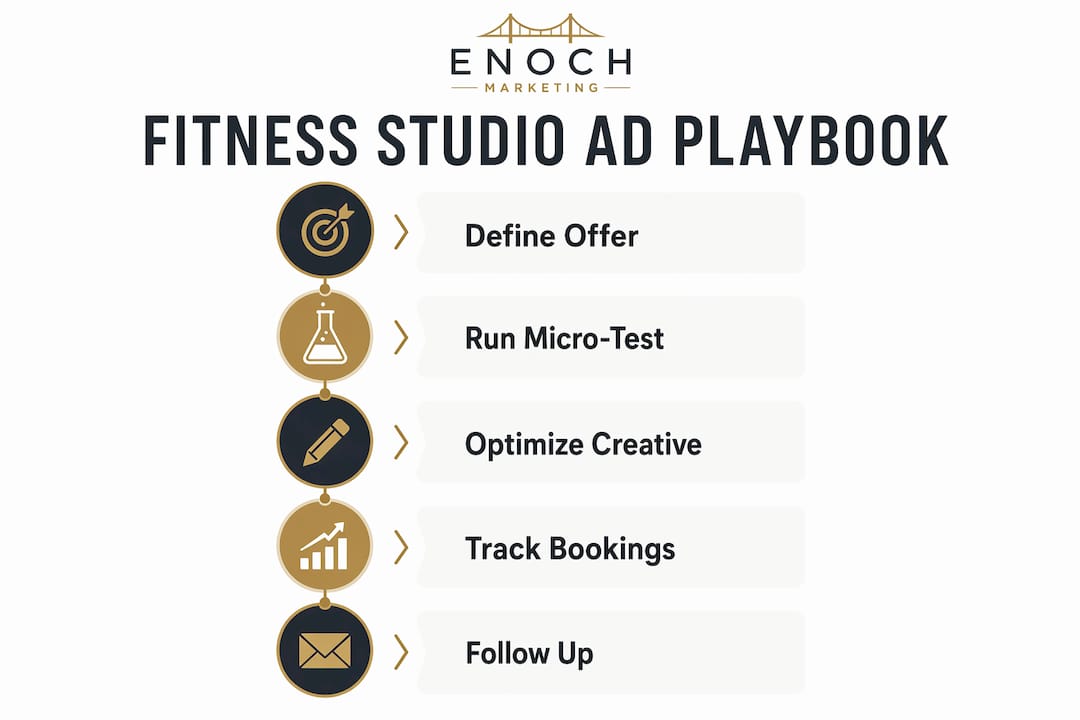
Health clubs experience an annual member attrition rate of 37–40%. This means you must replace approximately 37–40% of your membership each year just to stay flat. And leads contacted within 5 minutes are dramatically more likely to convert than those who wait hours for a callback. Enochmarketing's audit→strategy→launch→scale process is built around both realities: fix the funnel before spending, then scale what converts.
Table of Contents
- Why paid ads are essential for fitness studio growth
- Why gym ads fail — and the five fixes that actually work
- Which platforms should you use, and how do you match offers to channels?
- What should you measure, and is $20/day enough to start?
- How does a simple paid-ad funnel work for a fitness studio?
- Why follow-up wins: the operational playbook
- What do you need before running your first studio ad?
- What are the legal and ethical rules for fitness studio ads?
- What do successful fitness studio paid ad campaigns actually look like?
- How do you create fitness studio ads that actually get clicked?
- Key Takeaways
- The part most studio owners get wrong
- What Enochmarketing does for fitness studios that are ready to grow
- Sources and further reading
Why paid ads are essential for fitness studio growth
Organic marketing is real, but it's slow. SEO compounds over 6–18 months. Referrals depend on having members first. Community presence builds trust but doesn't fill a class schedule next Tuesday. Paid advertising is the only channel that lets you turn a dial and control lead volume on demand.
The attrition math is brutal. With high annual attrition, a studio with 150 members loses dozens of members per year through natural churn alone. That's more than one member per week, every week, just to stay even. Paid ads are how you keep the pipeline moving faster than the leak.
About half of fitness and wellness businesses don't run paid advertising at all. Of those that do, most spend without a system and see inconsistent results. The gap between operators who have a disciplined paid media process and those who don't is enormous, and it shows up directly in membership numbers.
Paid and organic channels aren't competitors. Google Search captures people already searching "CrossFit gym near me" — high intent, ready to book. Meta and Instagram interrupt the right people before they're searching, planting the idea and building desire. CTV (connected TV) layers trust and recall on top of both. A fitness studio CTV test at modest budgets produced a +128% jump in trial volume and a 9-point lift in trial-to-member conversion over 67 days. Paid ads, used correctly, are amplification fuel for a studio that already has something worth amplifying.
Why gym ads fail — and the five fixes that actually work
Most ad failures aren't platform problems. They're operational problems that show up in the ad account.
- Weak or missing offer. "Join our gym" is not an offer. A free 7-day trial, a $49 intro month, or a no-commitment first class is. The fix: lead with a low-commitment entry point that removes the risk of saying yes.
- Creative or message mismatch. If your ad shows a high-intensity athlete and your landing page talks about "a welcoming community for all fitness levels," you've broken trust before the lead fills out a form. Mirror the ad's tone, visuals, and language on the landing page.
- Overly broad targeting. A 25-mile radius in a dense metro means you're paying for people who will never drive to your location. Target a 3–5 km radius around your studio, or map commute corridors. Local landmarks in ad copy ("two blocks from Riverside Park") outperform generic fitness messaging.
- Tracking blind spots. If you're only measuring clicks and leads, you're flying blind. Track to booked trial, not just form fill. Connect your booking system to your ad platform so you know which campaigns actually produce members, not just names in a spreadsheet.
- Slow or inconsistent follow-up. This is the biggest one. The ad failure most gym owners experience is actually a follow-up failure. A lead that waits two hours for a response is already cold. Commit to a 5-minute response SLA — automated SMS first, then a human call or text.
Pro Tip: Run a one-week micro-test with $5–$10/day, one offer, and one creative. The metric that tells you if it's working isn't clicks or even leads — it's booked trials per 100 clicks. If that number is near zero, the problem is the offer or the landing page, not the ad platform.
If you're seeing cheap leads but low conversion to booked trials, reallocate budget to the creative or targeting variant that produces the most bookings, not the most form fills. Common gym marketing mistakes almost always trace back to optimizing for the wrong metric.

Which platforms should you use, and how do you match offers to channels?
Platform choice isn't about preference. It's about matching intent to offer.
| Platform | Primary use case | Creative format | Best offer type | Local targeting tip |
|---|---|---|---|---|
| Paid social (Meta/Instagram) | Demand creation, cold audiences | Short video, carousel, static image | Free trial week, 7-day intro, $1 first month | 3–5 km radius, interest + life-event targeting |
| Search (Google) | Demand capture, high intent | Text ad, responsive search | "Book a free intro session," "Claim your free class" | Zip code or radius around studio, location extensions |
| Video streaming (YouTube) | Brand building, social proof | 15–30 second pre-roll, coach-led content | Story-driven intro, transformation hook | Geo-targeted by metro or zip |
| Connected TV (CTV) | Trust and recall, priming | 30-second spot, polished brand creative | Awareness-first, no hard CTA needed | DMA or zip-level targeting |
Google Search delivers the highest-intent traffic of any channel — someone searching "CrossFit gym near me" is shopping this week. Meta and Instagram interrupt the right person before they're searching, which means the offer has to do more work. A free trial or low-barrier intro removes the friction of a cold decision.
For creative volume, platforms reward a range of creative variants — run 3–5 hooks and formats and let the algorithm find the winner. Coach-led short videos (30–60 seconds, filmed at the studio) consistently outperform stock imagery for boutique fitness brands. Local specificity in copy ("serving the Wicker Park neighborhood") lifts click-through rates over generic fitness messaging.
For a deeper look at winning paid media campaign examples across channels, Enochmarketing's resource library covers CrossFit-specific creative structures that translate directly to other fitness formats.
What should you measure, and is $20/day enough to start?
Track these six metrics, in this order of importance:
- Cost per booked trial (primary KPI) — the only number that connects ad spend to real pipeline
- Trial-to-member conversion rate — tells you whether your on-ramp experience converts
- Cost per new member (CPA) — your true acquisition cost
- Cost per lead (CPL) — useful for creative testing, but a vanity metric without booked-trial data
- Return on ad spend (ROAS) — relevant for front-end packages and intro offers
- Member lifetime value (LTV) — sets your allowable CPA ceiling
Optimizing for cost per booked trial rather than raw lead cost is the single most important shift most studio owners need to make.
| Metric | Benchmark range | Notes |
|---|---|---|
| Cost per lead (CPL) | $5–$25 | Varies widely by offer and creative quality |
| Trial-to-member conversion | 30–60% | For well-run studios with strong on-ramp |
| Cost per new member (Meta) | $20–$80 | Boutique studios with strong creative often beat this |
| Cost per new member (Google) | $50–$150 | Higher intent, higher CPC, higher conversion |
| Monthly budget (small studio) | $1,500–$2,900 | Across channels including content production |
| Monthly budget (mid-size gym) | $4,100–$7,500 | Digital and OOH combined |
Is $20/day enough? Yes, for learning. At $20/day ($600/month), you can run a disciplined micro-test: one offer, one creative, a tight local radius, and a clear tracking setup. The goal at this stage isn't scale — it's learning which offer and creative combination produces booked trials. Once you have that data, scaling is straightforward.
The Two-Brain Business guidance on this is direct: many gyms should start at $5–$20/day and avoid agency fees that exceed their actual media spend. Scale when front-end revenue from new members exceeds ad spend. Most successful gym operations spend 5–10% of monthly revenue on advertising, with pre-launch studios pushing toward 12–18% of projected revenue to accelerate acquisition.
Allow 30–90 days to judge a channel fairly. Thirty days gives you enough data to optimize creative and targeting. Ninety days tells you whether the channel is structurally profitable for your studio.
How does a simple paid-ad funnel work for a fitness studio?
A paid-ad funnel for a fitness studio has five stages. Each one has a job, and a failure at any stage kills the whole sequence.
- Low-friction local offer. The ad leads with a specific, time-limited offer: "Free 7-day trial for [City] residents" or "Claim your first class free." Vague offers ("Join us today!") produce vague results.
- Landing page that mirrors the ad. Same headline, same visual tone, same offer. One clear call to action: book a trial. No navigation menu, no distractions. A structured free consultation or assessment offer on the landing page increases booking rates by reducing the perceived commitment.
- Immediate automated response. The moment a lead submits, they get an SMS confirmation and a calendar link. This is not optional. Leads that don't hear back within minutes start shopping elsewhere.
- Human follow-up within 5 minutes. A text or call from a real person at the studio. Not a chatbot. Not a 24-hour email. A person. This is where most studios lose members they already paid to acquire.
- Booking confirmation, reminder sequence, and welcome experience. Automated reminders 24 hours and 2 hours before the trial. A personal welcome when they walk in. A structured on-ramp that connects them to the community within the first 30 days.
For tracking, connect your booking system to your ad platform. When a trial is booked, that event should fire back to Meta or Google as a conversion. This closes the loop and lets the algorithm optimize for actual bookings, not just form fills. For a detailed paid ads funnel walkthrough built specifically for local gym growth, Enochmarketing's tutorial covers the technical setup step by step.
Why follow-up wins: the operational playbook
The ad is only as good as the system that receives the lead. This is the part most studio owners underinvest in, and it's where the real conversion happens.

Enochmarketing's process runs in four stages: audit → strategy → launch → scale. The audit stage isn't about the ad account — it's about the offer, the landing page, the follow-up sequence, and the booking system. If those aren't working, launching ads accelerates failure, not growth.
Here's what a working follow-up cadence looks like in practice. The moment a lead submits a form, an automated SMS goes out: "Hey [Name], thanks for your interest in [Studio]! Your free trial is ready — here's your booking link: [link]." Within 5 minutes, a staff member sends a personal text or makes a call. Not a template. A real message that references the offer they clicked on. Twenty-four hours later, if they haven't booked, a second personal follow-up goes out. Then a 7-day nurture sequence via email or SMS that shares a coach introduction, a member story, and a class schedule.
The 5-minute window is not a guideline — it's the threshold. Leads contacted within 5 minutes are up to 9x more likely to convert than those contacted after an hour. Most studios respond in hours, not minutes. That gap is where memberships are lost.
Pro Tip: Set "booked trial" as your primary conversion event in both Meta and Google Ads, not "lead form submitted." When the algorithm optimizes for bookings rather than form fills, lead quality improves and cost per member drops.
Paid ads work best as amplification for a pre-existing funnel. If your referral and organic social systems are already producing some members, paid ads multiply that momentum. If they're not, fix retention and social proof first — then add paid spend. The audit→strategy→launch→scale approach forces this sequencing and prevents studios from scaling a broken system.
What do you need before running your first studio ad?
Don't spend a dollar on ads until these are in place:
- A clear, low-commitment offer (free trial, intro week, first class free) with a defined expiration or scarcity element
- Local targeting radius defined (3–5 km from studio, or commute corridors mapped)
- A landing page that mirrors the ad, has one CTA, and loads fast on mobile
- A booking system or calendar integrated directly into the landing page (no email-to-schedule friction)
- A CRM or lead capture tool with an immediate SMS/email autoresponder triggered on form submit
- Tracking pixels installed on the landing page and booking confirmation page (Meta Pixel, Google Tag)
- At least one month of retention data to estimate average member tenure and calculate LTV and allowable CPA
Minimum tech stack: a booking/calendar tool (Mindbody, Pike13, or equivalent), a basic CRM with SMS capability (many booking tools include this), Google Analytics 4, Meta and Google Ads accounts, and payment or on-ramp processing.
For a small independent studio, expect to spend $1,500–$2,900/month across channels in the early testing phase. A mid-size gym typically runs $4,100–$7,500/month. In the first 30 days, the goal is learning, not scale. By day 90, you should have enough data to identify your best-performing offer and channel and start increasing spend with confidence.
What are the legal and ethical rules for fitness studio ads?
Fitness advertising in the United States is governed by Federal Trade Commission (FTC) guidelines, platform-specific policies, and state-level consumer protection laws. Getting this wrong can mean ad account suspension or, in serious cases, regulatory action.
FTC requirements for fitness ads: Any claim about results ("Lose 20 pounds in 30 days") must be substantiated and represent typical results, not outlier outcomes. If you feature a transformation or testimonial, you must disclose whether results are typical. The FTC's endorsement guidelines require clear disclosure when a testimonial comes from a compensated person, including trainers or influencers you pay or trade services with.
Platform policies: Meta and Google both prohibit ads that imply a person's body is inadequate or use before/after imagery in ways that could be considered body-shaming. Meta specifically restricts "before and after" weight loss imagery in some placements. Review each platform's advertising policies before running health and fitness creative — violations result in ad disapproval or account flags.
Membership contract disclosures: Several states, including California and New York, have specific laws governing gym membership contracts, cancellation rights, and automatic renewal disclosures. If your ad promotes a membership offer, the terms must be clearly stated and comply with state-level consumer protection statutes.
Ethical considerations: Avoid targeting ads at people based on health conditions or body image insecurities in ways that could be considered exploitative. Fitness advertising that leads with community, performance, and lifestyle outcomes tends to outperform fear-based or shame-based messaging anyway — and it keeps you on the right side of platform policies.
What do successful fitness studio paid ad campaigns actually look like?
Real results come from studios that combine a strong offer, tight targeting, and a fast follow-up system. Here are three patterns that consistently produce results.
The boutique studio trial funnel. A CrossFit gym running Meta ads with a "Free 7-day trial for [City] residents" offer, targeting a 5 km radius around the studio, with coach-led video creative. The landing page mirrors the ad headline, has a single booking CTA, and triggers an SMS within 60 seconds of form submission. A staff member follows up by phone within 5 minutes. This structure, when executed cleanly, produces cost-per-new-member figures in the $20–$80 range on Meta — consistent with industry benchmarks for well-run boutique studios.
The CTV trust-building test. A mid-sized fitness studio added a small CTV campaign alongside existing Meta and Google spend. The 30-second spot featured real members and coaches, ran on streaming platforms within a defined local DMA, and drove no direct conversions on its own. What it did was lift performance across every other channel. The Adwave case study documenting a similar approach showed a +128% jump in trial volume and a 9-point lift in trial-to-member conversion over 67 days. CTV works as a trust layer, not a direct-response channel
The Google Search capture play. A yoga studio running Google Search ads on "yoga studio [neighborhood]" and "yoga classes near me" terms, with a "Book your first class free" offer and a landing page that loads in under 2 seconds on mobile. Google Search converts at 5–15% trial-to-member rates because the searcher is already actively shopping. The cost per new member runs higher than Meta ($50–$150), but the lead quality is stronger and the sales cycle is shorter.
How do you create fitness studio ads that actually get clicked?
Creative is where most studio owners either win or waste their budget. A few principles separate the ads that produce booked trials from the ones that get scrolled past.
Lead with a person, not a logo. Coach-led videos filmed at the studio outperform polished stock imagery every time for boutique fitness brands. Thirty seconds of a real coach explaining what makes your studio different, filmed on a phone with decent lighting, will beat a $2,000 production shoot that looks like every other gym ad.
Match the message to the audience's moment. Someone scrolling Instagram at 7 PM on a Tuesday is not in the same mindset as someone searching "CrossFit gym near me" at noon on a Saturday. Meta creative should interrupt and inspire — short, visual, emotionally resonant. Google ad copy should be direct and intent-matched: "Book a free intro class at [Studio Name] in [Neighborhood]."
Use specificity as a hook. "Join our gym" competes with every other gym in the city. "Free 7-day trial for [City] residents — no contract, no commitment" is a specific offer with a specific audience. Local references ("two blocks from [Landmark]," "serving [Neighborhood] since 2019") build immediate relevance and trust.
Test multiple hooks, not multiple audiences. Most studios make the mistake of testing different audiences with the same creative. The bigger variable is the hook — the first 3 seconds of a video or the first line of a static ad. Run 3–5 hook variations to the same audience and let the platform find the winner. Creative volume matters in modern ad delivery; platforms reward variety.
Calls to action should match the offer's commitment level. "Sign up now" is high friction for a cold audience. "Claim your free trial" or "Book your first class" is low friction and specific. For Google Search, "Book a free intro session" outperforms "Learn more" because it matches the searcher's intent to act.
For performance-focused studios, understanding sports performance training and how to describe it in ad copy can sharpen messaging for audiences who respond to outcome-driven language rather than community-first framing.
Key Takeaways
Paid ads produce predictable member growth for fitness studios only when the offer, follow-up system, and tracking are in place before the first dollar is spent.
| Point | Details |
|---|---|
| Attrition demands a pipeline | With an annual attrition rate of 37–40%, studios must replace nearly two-fifths of their members each year — paid ads keep acquisition ahead of churn. |
| Follow-up speed determines conversion | Leads contacted within 5 minutes are up to 9x more likely to convert; automate the first response, then follow with a human within minutes. |
| Optimize for booked trials, not leads | Cost per booked trial is the primary KPI; raw CPL is a vanity metric unless connected to actual bookings and member acquisition. |
| Match platform to offer and intent | Meta/Instagram for demand creation with trial offers; Google Search for high-intent capture; CTV for trust and recall at modest budgets. |
| Enochmarketing's approach | Enochmarketing runs an audit→strategy→launch→scale process for CrossFit gyms and fitness studios, fixing the funnel before scaling spend. |
The part most studio owners get wrong
There's a version of this conversation that goes: "We tried ads, they didn't work." And when you dig into what actually happened, the ads worked fine. The leads came in. Nobody called them back for two days. The landing page had a phone number but no booking link. The offer was "contact us for more information."
The ad wasn't the problem.
What I see consistently is studio owners treating paid advertising as a shortcut around the harder operational work — building a real offer, training staff to follow up, setting up a booking system that doesn't require three steps and a prayer. Ads don't fix those gaps. They expose them faster and at greater cost.
The studios that get real results from paid media are the ones that treat the ad as the last piece, not the first. They know their allowable CPA because they've calculated LTV. They have a booking system that works on mobile. They have someone whose job it is to respond to leads within minutes. When those things are in place, paid ads become genuinely powerful — a dial you can turn up when you need more members and down when you're at capacity.
That's the playbook. Not complicated. Just operational.
What Enochmarketing does for fitness studios that are ready to grow
If the operational pieces are in place and you're ready to add paid media, Enochmarketing runs a focused strategy session that covers exactly what you need before spending a dollar. The session includes a funnel audit (offer, landing page, follow-up sequence), an allowable CPA estimate based on your on-ramp price and estimated LTV, quick-win recommendations you can act on immediately, and a suggested 30–90 day test plan with channel and budget guidance.
Enochmarketing works exclusively with CrossFit gyms and fitness studios across the United States, which means the benchmarks, creative approaches, and funnel structures are built for your business model — not adapted from a generic agency playbook. Most studios see initial trial bookings within the first two to three weeks of launch when the funnel is set up correctly. From there, the process moves to optimization and scale based on real conversion data.
If you're ready to build a paid media system that produces consistent member growth, explore Enochmarketing's services or review the pricing and package options to find the right fit for your studio's stage and budget.
Sources and further reading
- Paid Advertising for Gyms, Studios and Wellness Businesses: What the Numbers Say — BrightCore
- The Gym Owner's Guide to Paid Ads — Two-Brain Business
- How to Run Gym Ads That Actually Work — Two-Brain Business
- Best Advertising for Gyms and Fitness Centers — Adwave
- Fitness Studio CTV Case Study: 14x ROAS in 67 Days — Adwave
- Gym and Fitness Studio Marketing Guide — Vertical Impression
- Grow Your Studio: Facebook, Instagram and Google Ads Guide — Vagaro
- Enochmarketing Blog — CrossFit Gym Marketing Resources