
Yes, competitor conquesting can work for most local gyms, but only if your offer, landing page, and follow-up speed can back up the click. If your Google Business Profile is weak or your front desk takes hours to call back leads, fix that first. If your fundamentals are solid, run a small, tracked 30-day test with a dedicated landing page before committing real budget.
TL;DR:
- Conquesting is most effective when your gym has a compelling value proposition, fast response times, and a well-optimized Google Business Profile; otherwise, initial fixes should take priority.
- Separate conquesting campaigns for each competitor or offer, with dedicated landing pages and quick follow-up, are essential to accurately measure and improve performance.
- The average starting budget ranges from $15 to $30 per day on Google Ads, with a 30 to 90 day testing period to assess if the campaign meets cost-per-acquisition goals.
- Campaigns should avoid sending traffic to the homepage, focus on clear, low-friction offers, and use authentic creative such as real class clips or member transformations to increase conversions.
- Conquesting works best when layered with referral and loyalty programs, with initial efforts focusing on fixing local fundamentals before scaling aggressively.
Table of Contents
- What Is Competitor Conquesting for Gyms, and Why It Matters
- When Conquesting Works for a Gym (and When Not to Bother)
- Channels and Tactics for Conquesting Campaigns
- Step-by-Step Campaign Setup Checklist
- Ad Copy and Offers That Convert Comparison Shoppers
- Landing Pages and Follow-Up: Turning Clicks Into Booked Visits
- Measurement, Benchmarks, and When to Scale
- Risks, Ad Policy, and Ethical Considerations
- A Real Conquest Campaign: Spend, Members, and ROI
- How to Analyze Competitor Weaknesses and Value Propositions
- Budget Allocation for Conquesting Within Your Overall Marketing Spend
- Timeline and Phases for Running a Conquesting Campaign
- Combining Conquesting Ads With Referral and Loyalty Programs
- Handling Competitor Pushback and Ad Sabotage Risks
- How Conquesting Fits Into Long-Term Gym Growth
- How Enoch Marketing Runs Conquesting Campaigns for Gyms
- Sources
- FAQ
What Is Competitor Conquesting for Gyms, and Why It Matters
Competitor conquesting means targeting people who are actively engaging with a rival gym, through their branded search terms, their physical location, or their social following, and showing them your ad instead. It's a direct interception play, aimed at high-intent shoppers already comparing options rather than people who haven't decided to join a gym at all.
That distinction matters. Local SEO and referral marketing build a pipeline of members who find you organically over months. Conquesting skips that runway and puts your offer in front of someone mid-decision, often while they're standing in a competitor's parking lot or searching their name on Google.
The primary channels for this tactic include:
- Paid search campaigns bidding on competitor brand terms
- Geo-fencing and device ID targeting around rival gym locations
- Social and YouTube retargeting layered with geographic filters
- Display network placements that reinforce search visibility
When Conquesting Works for a Gym (and When Not to Bother)
Conquesting performs best when three things line up: your gym sits within a few miles of the competitor, you have a genuine differentiator (better hours, a specialty program, a cleaner facility), and someone actually answers the phone fast when a lead comes in.
Skip it, or at least pause it, if any of these apply:
- Your Google Business Profile has outdated hours, few reviews, or no recent photos
- Your team takes longer than an hour to respond to a web lead
- Your churn rate is high enough that you're refilling a leaky bucket
- You haven't nailed down a clear intro offer yet
If your fundamentals are shaky, that budget is better spent on local marketing strategies and Google Business Profile optimization, since most new members still come from proximity and word of mouth before they come from an ad.
Pro Tip: Run a "readiness audit" before you spend a dollar on conquesting. Call your own front desk from a burner number, pretend to be a shopper, and time how long it takes someone to call you back. If it's over 30 minutes, that's your first fix.
Channels and Tactics for Conquesting Campaigns
Each channel plays a different role, and testing them in isolation tells you which one actually moves members through your door.
- Paid search. Build keyword lists around exact competitor names and common misspellings, in a campaign separate from your branded terms. Expect competitor-term CPCs to run higher than generic fitness keywords, since Quality Scores tend to be lower on trademark terms unless your landing page is tightly relevant.
- Geo-fencing and device ID targeting. Draw a fence around a rival's parking lot or entrance, capture device IDs of visitors, and serve ads to those same devices for a set window afterward, typically a few hours to a few days.
- Social and YouTube. Layer geo-targeted radius audiences with interest signals (fitness apps, competitor pages) and retarget anyone who has engaged with your content.
- Display and retargeting. Use these placements to reinforce your message to people who clicked but didn't convert on search, rather than as a standalone acquisition channel.
Step-by-Step Campaign Setup Checklist
Structure matters more than most gym owners expect. Mixing competitor keywords into your existing campaigns muddies your data and makes it impossible to know what's working.
- Build a separate campaign dedicated to conquesting, with one ad group per competitor or per offer.
- Set a starting budget in the $15 to $30 per day range for Google and $10 to $20 per day for Meta, based on common starter benchmarks for gym ads, and adjust after two weeks of data.
- Set conversion tracking for form fills, phone calls, and booked trial visits, and connect it to your CRM so no lead falls through a gap.
- Build a dedicated landing page for each competitor or offer variant. Do not send this traffic to your homepage.
Pro Tip: Add call extensions and location extensions to every conquesting ad. They raise your ad's relevance signals and give impatient shoppers a way to skip the form entirely.
Ad Copy and Offers That Convert Comparison Shoppers
Comparison shoppers respond to concrete, low-friction offers, not vague brand messaging. A free trial week, a 14-day challenge, or a discounted first month all work because they lower the risk of switching gyms.
Keep your copy legally clean. Google's trademark policy generally allows bidding on a competitor's brand name but restricts using that trademark inside your ad text in many cases. Lead with your own name, your hours, your specialty classes, or your price, and let the targeting do the interception work.
For creative, short class clips shot on a phone often outperform polished promotional videos, because they read as authentic rather than salesy. A few formats worth testing:
- 15 second clips of a live class in progress
- Before-and-after member transformation photos (with permission)
- A single clear call-to-action: "Claim your free week" beats "Learn more" every time
Landing Pages and Follow-Up: Turning Clicks Into Booked Visits
A conquesting ad that lands on your homepage is money wasted. Comparison shoppers need a page built specifically to answer the question they're already asking: why you instead of them?
Your landing page should include:
- Transparent pricing or a clear starting offer
- A handful of specific member testimonials, not generic praise
- Your class schedule and gym hours, visible without scrolling
- One booking call-to-action, repeated at the top and bottom of the page
Speed on the back end matters just as much as the page itself. Leads contacted within five minutes convert at a noticeably higher rate than leads who wait hours, and slow or manual follow-up is one of the most common reasons conquesting campaigns underperform. Automated booking confirmations and text reminders close the gap between a click and a visit. Track your funnel from lead to visit to join, and you'll usually find the leak sitting in that first five minutes, not in your ad spend. For more on structuring this flow, see this breakdown of landing pages in gym marketing.
Measurement, Benchmarks, and When to Scale
Four numbers tell you whether a conquesting campaign deserves more budget: cost per click, cost per lead, lead-to-visit rate, and visit-to-join rate. Multiply your average membership value by expected retention months to get lifetime value, then compare that against your fully loaded cost per acquisition.
- CPC: competitor terms typically run higher than generic fitness keywords
- CPL: track this weekly, not monthly, so you catch problems early
- Lead to visit: aim to improve this number before you touch your ad budget
- Visit to join: this is where your sales process, not your ads, does the work
A 7x return is achievable under the right conditions, but treat any single case as a ceiling, not a guarantee. A 30 to 90 day test window with a predefined CPA target and a hard cost cap is the most reliable way to find out if the channel will scale for your gym specifically. If you hit your CPA target consistently for three or four weeks, scale spend in 20% increments rather than doubling overnight.
Risks, Ad Policy, and Ethical Considerations
Bidding on a competitor's name is legal under most ad platform rules, but the details matter. Google's trademark policy permits keyword bidding while restricting trademark use inside your actual ad copy in many circumstances, so keep competitor names out of your headlines and descriptions.
Beyond policy, there's a reputational line worth respecting:
- Don't advertise an offer you can't actually honor once someone walks in
- Avoid negative comparisons or disparaging creative aimed at a named competitor
- Keep geo-fence radii reasonable and dwell windows short. Aggressive, invasive targeting can backfire publicly if a competitor or their members notice
- Be transparent about pricing in your ads and on your landing page to avoid bait-and-switch complaints
A conquesting campaign that wins members without burning trust in your local market is worth far more than one that wins members and a bad reputation in the same month.
A Real Conquest Campaign: Spend, Members, and ROI
One documented example shows what disciplined geo-fencing can do. A gym used device ID targeting around competitor locations and generated 73 new memberships from $5,400 in ad spend, producing roughly $38,500 in contracted revenue, about a 7x return.
What made that number possible wasn't just the targeting. It was the operational pieces around it:
- A tight geo-fence around known competitor addresses rather than a broad city-wide net
- A dedicated landing page matched to the ad's offer
- Fast lead handoff so interested shoppers didn't cool off waiting for a callback
If you're considering something similar, start smaller than that case study. Test one competitor location, one offer, and a $500 to $1,000 monthly budget before expanding to multiple locations. If you want a structured framework for the Google Ads side specifically, this Google Ads guide for gym owners walks through campaign setup in more detail.
How to Analyze Competitor Weaknesses and Value Propositions
Before you write a single ad, spend an hour actually studying the gym you're targeting. Read their last 20 Google reviews and note the recurring complaints: crowded equipment during peak hours, unresponsive staff, outdated locker rooms, confusing membership terms. Those complaints are your ad copy.
Visit their website and their Google Business Profile as a prospective member would. Is their pricing hidden behind a "contact us" form? Lead with transparent pricing. Do they lack a free trial? Offer one. Is their class schedule outdated or hard to find? Make yours the first thing a visitor sees on your landing page.
Pay attention to what they're not saying, too. If a competitor markets heavily on price but never mentions coaching quality, and you have strong coaches, that's your wedge. If they emphasize luxury amenities but their reviews mention long wait times for equipment, lead with convenience and open floor space.
Map this out by strength, not just by complaint. A rival might have great equipment but weak community, or great pricing but inconsistent class schedules. Build a short list, three or four points, and let those anchor your ad copy, your landing page headline, and your offer. Trying to counter every possible weakness in one ad dilutes the message. Pick the gap that matters most to the shopper you're targeting, and make your ad answer it directly. This is also where a quick, honest self-audit helps, since your differentiator only works if it's actually true.
Budget Allocation for Conquesting Within Your Overall Marketing Spend
Conquesting should be a slice of your marketing budget, not the whole thing.
Within that paid slice, conquesting itself shouldn't dominate. Since referred members convert about 30% better and retain about 37% better than paid leads in industry-cited figures, a referral program often deserves first claim on your budget even though it costs less to run. Conquesting fills a different gap: it captures shoppers who were never going to hear about you through word of mouth because they're loyal, for now, to someone else.
A workable approach for a gym spending $2,000 to $3,000 monthly on marketing is to dedicate $500 to $800 of that to a conquesting test, keep it isolated from your branded search and retention spend, and review results every two weeks. Don't pull budget from your Google Business Profile management or your email and text follow-up systems to fund a conquesting test. Those channels are cheaper per lead and tend to compound over time, while conquesting delivers a more immediate but more expensive result.
If the test performs, scale it gradually by adding a second competitor location or increasing daily budget by small increments, rather than doubling spend the moment you see a promising week.
Timeline and Phases for Running a Conquesting Campaign
Treat a conquesting campaign as a phased experiment, not a permanent line item, at least until it proves itself.
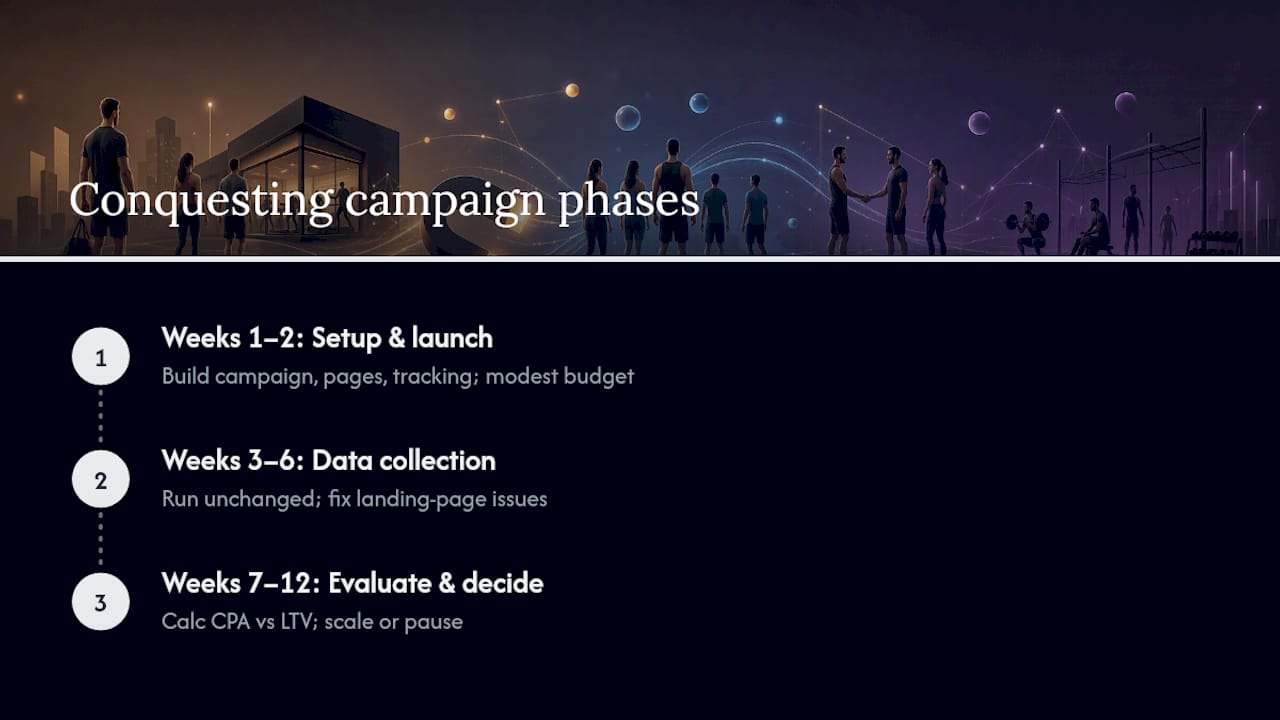
Weeks 1 to 2: setup and launch. Build your separate campaign structure, dedicated landing pages, and tracking. Launch with a modest budget and resist the urge to judge results in the first few days, since early data is noisy.
Weeks 3 to 6: data collection. Let the campaign run without major changes so you get a clean read on cost per lead and lead-to-visit rate. This is the window to fix obvious problems, like a landing page with a high bounce rate, but avoid changing your targeting or budget dramatically.
Weeks 7 to 12: evaluate and decide. By the end of this stretch you should have enough leads to calculate a real cost per acquisition and compare it against your membership lifetime value. A 30 to 90 day test with predefined scale rules gives you a clean decision point rather than an open-ended guess.
If your CPA target is hit consistently, scale spend in controlled steps, watching for CPC creep as you expand your geo-fence or add competitor locations. If CPA runs well above target with no improvement after adjusting landing pages and offers, pause the campaign and redirect that budget to referral and retention work instead. Revisit conquesting in a quarter once your fundamentals have improved, rather than abandoning the tactic permanently.
Combining Conquesting Ads With Referral and Loyalty Programs
Conquesting and referral marketing solve different problems, and running them together often outperforms either one alone. Conquesting brings in members who didn't know you existed. Referral and loyalty programs keep those same members long enough to become your next referral source.
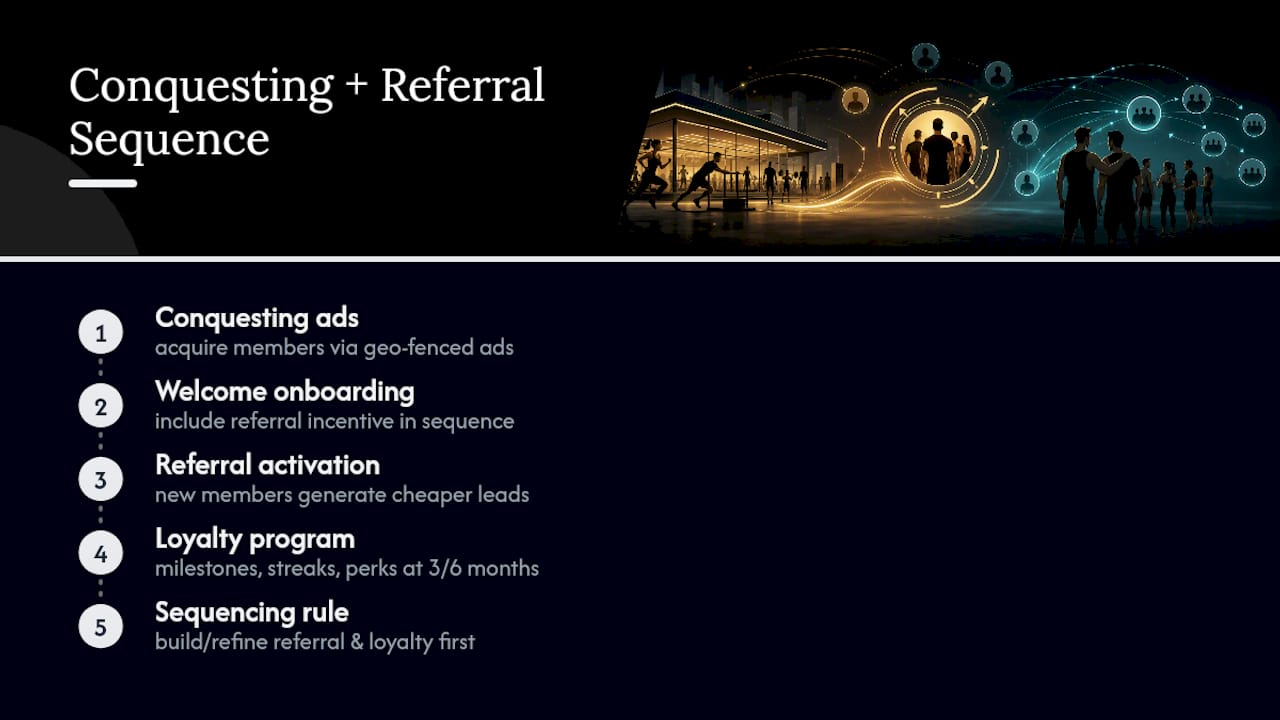
A practical way to connect the two: build your conquesting landing page with a referral incentive baked into the new member's welcome sequence. Someone who joins because of a geo-fenced ad still becomes a full member with friends, coworkers, and gym habits of their own. If your onboarding immediately introduces a referral bonus, a new member acquired through conquesting can start generating cheaper, higher-converting leads within their first few months.
Loyalty programs work similarly on the retention side. A member who switched from a competitor because of your ad is statistically more likely to churn early, since they've already proven they'll switch gyms once. A structured loyalty program, milestone rewards, streak tracking, small perks at 3 and 6 month marks, gives that member a reason to stay past the initial honeymoon period.
The sequencing matters: don't launch a conquesting campaign in isolation from these systems. Build or refresh your referral and loyalty mechanics first, or at least simultaneously, so every new member acquired through paid conquesting gets folded into a system designed to keep them and multiply them, rather than landing in a generic onboarding flow with no retention hooks attached.
Handling Competitor Pushback and Ad Sabotage Risks
Running conquesting ads occasionally draws a reaction from the gym you're targeting. Most of the time, this stays limited to a competitor noticing your ads and adjusting their own marketing in response, which is a normal competitive dynamic, not a problem to solve.
Less common but worth preparing for: a competitor may click your ads repeatedly to drain your budget, a tactic known as click fraud. Google Ads has automated systems that filter a large share of invalid clicks, but if you notice unusual click spikes with no corresponding leads, you can report the activity and request a review through your Google Ads account.
Another risk is a competitor filing a trademark complaint if your ad copy strays into using their brand name directly in headlines or descriptions. This is why staying inside Google's trademark policy from the start matters. Keep a screenshot record of your live ads so you have documentation if a dispute arises.
Occasionally a competitor responds with their own conquesting campaign targeting your location. The right response isn't panic or a bidding war. Reinforce your actual differentiators, keep your offer honest, and let your follow-up speed and member experience do the real competing. A price war fought purely through ad spend rarely ends well for either gym, while a gym that wins on service and follow-up tends to keep the members it acquires regardless of what a competitor's ads say.
How Conquesting Fits Into Long-Term Gym Growth
I'd rather see a gym owner spend the first ninety days on local fundamentals than jump straight to conquesting. Ads targeting a rival's parking lot only pay off once your booking flow, your follow-up speed, and your offer are already solid. A full-stack plan treats conquesting as one lever among several, layered on top of local SEO and referral systems, not a replacement for them. The gyms that win long term use conquesting to accelerate growth they've already built the infrastructure to support.
— Collin
How Enoch Marketing Runs Conquesting Campaigns for Gyms
Enoch Marketing is the alternative to piecing together a conquesting campaign yourself or hiring a generalist agency that treats your gym like any other local business. Because Enoch focuses on gyms and fitness studios, campaign structure, competitor keyword lists, and comparison landing pages are tailored specifically for gym economics from day one, not adapted from a template made for other industries.
A typical engagement starts with an audit of your current local presence and lead handling, since a conquesting campaign built on top of a broken follow-up process wastes money regardless of how good the ads are. From there, the Paid Advertising service covers campaign setup on Google and Meta, dedicated landing pages, and CRM-connected tracking so every lead gets logged and followed up automatically. Packages start with the Get Found plan at $1,500 per month for gyms building visibility, scaling up to the Growth Engine package for gyms ready to run paid acquisition alongside local SEO and content. Book a strategy session to see what a test campaign would look like for your specific market.
Sources
- Gym gains 73 new memberships by Geo Fencing competitive locations
- Google Ads trademark policy
- Local marketing for gyms (Rework resources)
FAQ
What Is Competitor Conquesting?
Competitor conquesting is an advertising tactic that targets people actively engaging with a rival business, through branded search terms, physical location data, or social activity, and shows them your ad instead. For gyms, it typically intercepts shoppers searching a competitor's name or visiting their location.
What Are the Most Effective Marketing Campaigns for Gyms?
Local Google Business Profile optimization and referral programs tend to deliver the most reliable member growth, since referred members convert and retain noticeably better than paid leads. Paid conquesting works best as an added layer once those fundamentals are solid, not as a replacement for them.
How Do Gyms Attract Customers?
Most gyms attract members through proximity, word of mouth, and a strong local search presence, supplemented by paid ads for faster, more measurable growth. A clear offer and a fast follow-up process matter as much as the marketing channel itself.
What Are Some Effective Ways to Advertise a Gym?
Geo-fencing around competitor locations, paid search on competitor and generic keywords, and geo-targeted social ads all work when paired with a dedicated landing page and fast lead response. Enoch Marketing builds these campaigns specifically for CrossFit gyms and fitness studios through its paid advertising services.
How Much Does Conquesting Advertising Cost for a Gym?
Starting budgets typically run $15 to $30 per day for Google Ads and $10 to $20 per day for Meta, though competitor brand terms often carry higher costs per click than generic keywords. Current package pricing for full-service management is listed on Enoch Marketing's pricing page.