Use native lead form ads to get volume, but only if you pair every submission with a specific offer, a short qualifying form, and a text within five minutes of submission. Skip any one of those three and you'll pay for leads that never show up. The formula that actually produces paying members is: a commitment-based offer, a form under six fields, immediate SMS follow-up, and a booking link that puts a real trial slot on the calendar before the prospect closes the app.
TL;DR:
- Native lead forms increase submissions due to auto-fill, but they generate lower intent leads, resulting in about 30-50% show rates for trial bookings.
- Using commitment-based offers like paid challenges filters out tire kickers, with paid trials converting at two to three times the rate of free ones.
- Keep form fields to four or fewer, include a booking or qualification question, and integrate calendar pickers to improve lead quality and scheduling efficiency.
- Video content showing real gym energy and trainer intro videos outperform static images, especially when tested organically before ad spend.
- Fast follow-up, within five minutes via SMS and phone call, significantly boosts trial attendance, making automation and calendar integration crucial for high show rates.
Table of Contents
- What Are Lead Form Ads for Gyms, and When Should You Use Them?
- What Offer Gets a Form Fill to Show Up for a Trial?
- How Should You Design a Gym Lead Form for Fitness Ads?
- What Creative and Targeting Work Best for Gym Ads?
- How Much Should You Budget for Gym Lead Form Campaigns?
- How Fast Should You Follow Up With Gym Leads?
- Which Metrics Actually Prove Your Gym Ads Are Working?
- What Do Real Gym Lead Form Campaigns Actually Show?
- What I See Working for CrossFit Gyms Right Now
- How Enoch Marketing Can Help Your Gym Grow
- Sources
- FAQ
What Are Lead Form Ads for Gyms, and When Should You Use Them?
Lead form ads, often called instant forms or native lead ads on Meta, let someone submit their contact information without leaving Facebook or Instagram. The platform auto-fills name, email, and phone from the person's profile, which strips out the friction of typing on a phone screen. That's the entire mechanical advantage, and it's a real one: fewer taps between "interested" and "submitted" means more submissions for the same ad spend.
Auto-fill is why instant forms tend to generate noticeably more completions than sending the same audience to an external landing page, and often at a lower cost per lead. GymNation saw leads jump 64% after shifting its Facebook and Instagram campaigns to Instant Forms, a result that tracks with what most fitness marketers see when they cut the extra click.
The trade-off is intent. A landing page with a booking calendar forces a small amount of friction, and friction filters. People who click through three screens to pick a trial time are more committed than someone who taps "submit" on autopilot while scrolling. That gap shows up downstream: booking funnels with real calendar selection often produce show rates of 70 to 85%, versus 30 to 50% for a basic lead form.
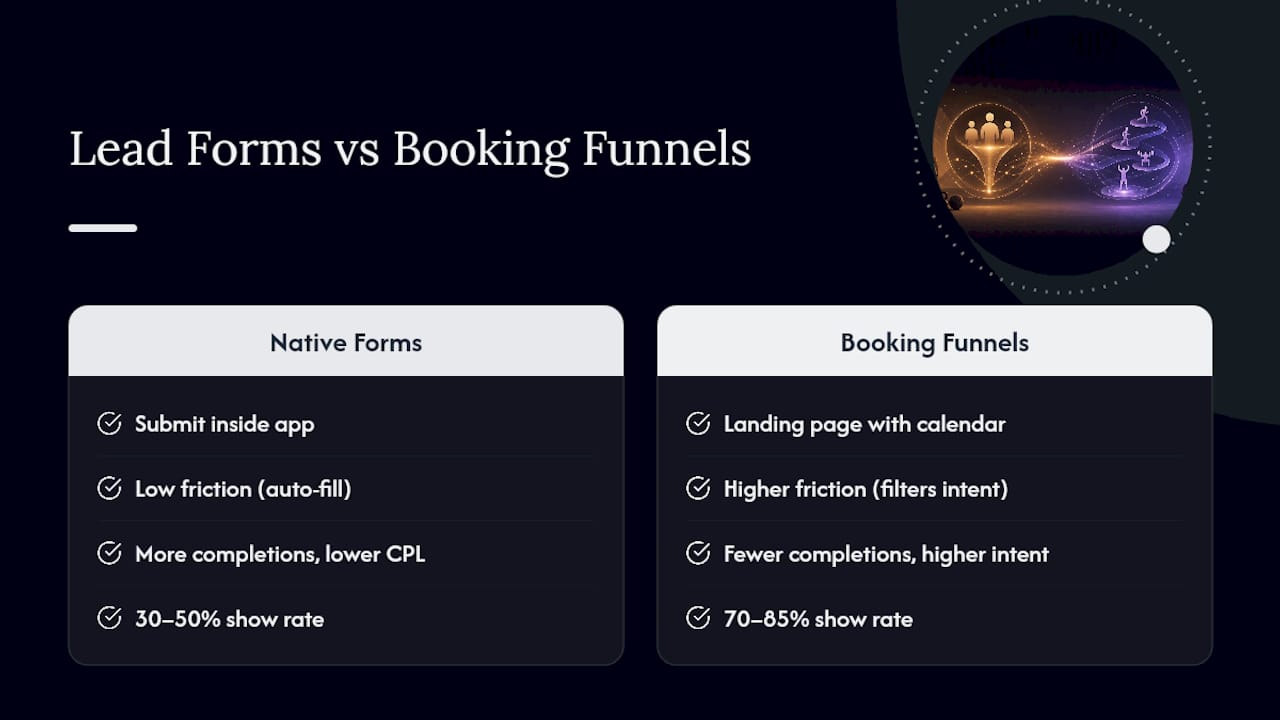
The practical rule: start with native forms when you need volume, especially in a new market or with a fresh audience. Once you understand your offer and your follow-up system works, layer in a landing page with calendar booking for your best-performing audiences. Don't choose one over the other permanently. Use forms to fill the funnel, and use booking pages to raise the floor on show rate once your process can handle it.
What Offer Gets a Form Fill to Show Up for a Trial?
The offer decides more of your outcome than the ad creative does. A free trial pulls in the most leads and the lowest show rate, because zero dollars means zero commitment. A paid low-ticket offer, like a 28-day challenge for $29 or $49, screens for intent before the prospect ever talks to staff. Practitioner data across small-gym campaigns shows paid trials converting at 2 to 3 times the show and conversion rate of free ones, because paying, even a small amount, filters out tire kickers.
Build your offer in this order:
- Pick the commitment level: free trial for volume, $29 to $49 challenge for quality, or a paid intro month for gyms with strong onboarding.
- Stack tangible deliverables on top: a trainer intro session, a starter meal guide, and a printed class schedule.
- Set a deadline. "This week only" or a capped number of spots outperforms an evergreen offer in every fitness campaign we've reviewed.
- Write the hook around outcome, not features: "28 days. One coach. No more guessing what to do at the gym."
Testimonials and before/after photos work, but only with documented consent from the actual member, and results language should avoid guaranteeing outcomes for a new prospect. Keep transformation claims tied to that specific person's story, not a promise of what any new member will experience.
Pro Tip: Price the challenge low enough that it feels like a no-brainer, but never free. $1 removes almost all the screening value of a paid offer.
How Should You Design a Gym Lead Form for Fitness Ads?
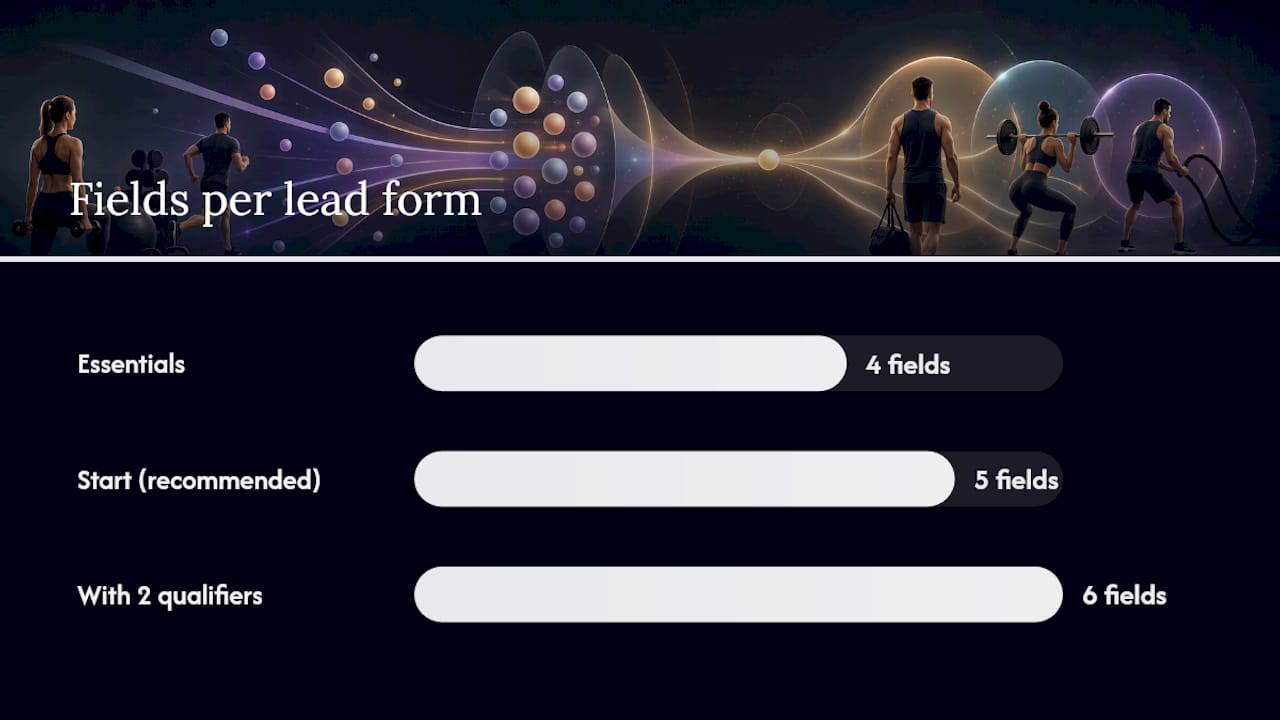
Every field you add past the essentials costs you completions. The math is simple: more fields, fewer submissions, but each additional field can raise the quality of who's left. Your job is finding where that trade stops paying off.
Start with the non-negotiables:
- Name — obvious, but confirms the auto-fill worked correctly.
- Phone number — this is the field your entire follow-up sequence depends on.
- Email — backup contact channel and useful for retargeting lists later.
- Preferred time to visit — even a simple dropdown (morning, afternoon, evening) helps your front desk plan the follow-up call.
Beyond those four, one or two qualifying questions add real signal without tanking completion. "What's your main goal?" with options like weight loss, strength, or general fitness lets you route the lead to the right trainer and personalize your first text. "Have you done CrossFit or group fitness before?" flags whether someone needs an extra reassurance message about intimidation or difficulty.
Multi-step forms, where you ask contact info first and qualifiers second, tend to hold completion rates better than cramming everything onto one screen. If you have booking software connected, consider a calendar picker as the final step instead of a generic time-of-day dropdown. It costs you a small percentage of completions but produces a scheduled trial instead of a lead who still needs to be called and talked into a time. For most gyms running instant forms for the first time, four fields and one qualifier is the right starting point. Add complexity only after you've measured the baseline.
What Creative and Targeting Work Best for Gym Ads?
Video tends to outperform static images for gyms, because the product you're selling is an experience, and experience is hard to convey in a photo. A 15 to 30 second clip of your actual gym floor during a class, with real members and real energy, consistently outperforms polished stock-style content. Trainer intro videos, where a coach speaks directly to camera about who the gym is for, build trust fast because prospects want to know who they'll be working with before they show up.
A carousel of real member transformations, framed as their story rather than a generic promise, also performs well when paired with a challenge offer. Test creative organically on your business page before spending a dollar on ads. Post the video, see how it performs with your existing audience, then put a small amount behind whatever gets genuine engagement. That organic-to-paid validation step, boosting a winner with as little as $5, tells you what actually stops the scroll in your specific market before you commit real budget to it.
On audience strategy, run a cold local radius campaign appropriate to your market density, alongside a lookalike audience built from your current member list. Layer in warm retargeting for anyone who engaged with a post or watched most of a video but didn't submit a form. Always exclude recent trialists and current members from prospecting campaigns. Nothing wastes budget faster than showing a "join now" ad to someone already inside your four-minute-AMRAP suffering.
- Test three to five creative variations per campaign, not one.
- Rotate creative every two to three weeks before performance decays.
- Split budget roughly evenly across variations until you see a clear winner, then shift weight.
Pro Tip: If a video gets strong organic engagement but weak paid results, the problem is usually the offer or the form, not the creative. Isolate variables one at a time.
How Much Should You Budget for Gym Lead Form Campaigns?
Fitness sits among the more expensive verticals on Meta and Google, with published benchmarks putting cost per lead well above many other industries depending on your market. That's not a reason to avoid paid ads. It's a reason to build your budget around learning fast rather than spreading thin.
- Choose the lead generation objective for instant forms, and the traffic or conversions objective if you're sending people to a booking landing page.
- Start each ad set at a low to moderate daily budget. Anything lower rarely clears the platform's learning phase before you run out of patience.
- Run at least two to three ad sets in parallel (different audiences or offers) for two weeks before judging results.
- Budget for a realistic testing window over several weeks or a month to gather sufficient data, to gather enough data to make real decisions.
- Watch for early narrowing signals, like cost per lead climbing while frequency also climbs, and widen the audience or refresh creative before cutting spend.
Run Search alongside Meta rather than instead of it. Search catches people already typing "gym near me" or "CrossFit trial," which is high-intent demand that pure prospecting on Meta won't reach. A combined approach across both channels, plus retargeting and SMS follow-up, consistently beats any single-channel strategy for gyms.
Scaling too fast is the most common way gyms tank their own lead quality. Adding qualifiers or tightening your audience radius as you scale protects the funnel better than just raising the daily budget.
How Fast Should You Follow Up With Gym Leads?
Speed is the single highest-leverage variable in this entire funnel, and most gyms treat it like an afterthought. If your system doesn't text a new lead within five minutes, that lead is worth roughly half of what it would have been with an immediate response. People submit a form while doing five other things. The window where they still remember doing it, and still care, is short.
Build a three-step immediate sequence:
- Minute one: automated SMS confirming the submission and asking them to pick a trial time from a booking link.
- Minute five to ten: a personal text from a real staff member or coach, referencing their stated goal from the form.
- Within the hour: a phone call if they haven't booked yet, especially for higher-value offers like paid challenges.
Calendar integration matters here more than most gyms realize. A prospect who picks their own slot from a live calendar is choosing a real commitment, not just expressing interest, and that's part of why booking-funnel show rates run so far ahead of raw form completions. If your CRM or booking software can push that calendar link straight into the first automated text, you'll cut your admin workload and lift your show rate at the same time.
No-shows still happen. Build a recovery flow: an SMS reminder the morning of the trial, a short "excited to see you today" message from the assigned coach an hour before, and an automatic reschedule offer if someone doesn't check in within 15 minutes of their slot. Treat a missed trial as a delayed lead, not a dead one. A well-timed reschedule message often recovers a meaningful share of no-shows without any additional ad spend. Tools that automate this sequence, similar to what's outlined in lead funnel optimization guides built specifically for gyms, remove the dependency on a staff member remembering to send a text at the right moment.
Which Metrics Actually Prove Your Gym Ads Are Working?
Cost per lead tells you almost nothing on its own. A $15 lead that never shows up is more expensive than a $40 lead who joins, and plenty of gyms keep chasing the cheaper number while their member count stays flat.
Track the full funnel instead:
- Leads generated → raw form completions, the top of funnel and the least useful number by itself.
- Booked trials → leads who actually scheduled a visit, your first real qualification checkpoint.
- Attended trials → the core conversion event that tells you whether your follow-up system works, not just your ad targeting.
- Paid members → the number that pays your bills.
From those four numbers, calculate cost per lead, cost per booked trial, and cost per member. Watch how each ratio shifts week to week, because a change in one stage usually points to exactly where the funnel is breaking.
On the tracking side, make sure your Meta Pixel fires correctly, your conversion events map to actual booked and attended trials (not just page views), and your CRM tags each lead with the campaign and ad set that produced it. UTM parameters on any landing page links let you confirm attribution even when someone bounces between platforms before converting.
Use benchmarks as a diagnostic tool, not a scoreboard. If cost per lead looks fine but cost per booked trial is climbing, the problem sits in your form or offer, not your targeting. If booked trials look strong but attendance is weak, the fix belongs in your follow-up sequence and reminder flow, not your ad account.
What Do Real Gym Lead Form Campaigns Actually Show?
GymNation's shift to Instant Forms produced a 64% increase in leads, a scale of lift that's realistic when a gym removes the extra click of an external landing page for a cold, high-volume audience. The lesson isn't "instant forms are magic." It's that reducing friction at the top of the funnel works best when the gym already has a follow-up system strong enough to handle the extra volume.
A smaller pattern shows up consistently in practitioner case studies of local gyms running paid 28-day challenges instead of free trials: fewer total leads, but meaningfully higher show rates and challenge-to-membership conversion, because the $29 to $49 price point pre-qualifies for commitment before the first phone call.
Three lessons run through both examples:
- Offer design determines who shows up, not just how many people click.
- Follow-up speed determines whether a booked trial becomes an attended one.
- A booking flow that puts a real time slot on the calendar consistently outperforms a generic "we'll call you" form, especially once volume climbs.
What I See Working for CrossFit Gyms Right Now
Most gyms treat lead form ads as the whole strategy instead of step one. That's the core mistake. A 30 day plan that actually moves the needle looks like this: audit your current funnel in week one, lock in one commitment-based offer in week two, run creative tests and launch instant forms in week three, and fully automate the five-minute text and booking confirmation by week four.
The pitfalls I see most often: obsessing over cost per lead while ignoring attendance rate, treating a slow manual follow-up process as good enough because "someone eventually calls them back," and running the same three ad creatives for two months past their expiration date.
If you're evaluating a specialist agency instead of building this in-house, ask for a specific 30 to 90 day deliverable timeline, weekly reporting on booked and attended trials rather than just leads, and a follow-up automation system, not just ad management.
— Collin
How Enoch Marketing Can Help Your Gym Grow
We are an alternative to a general marketing agency for gyms that need the full funnel built once and running correctly, not just ads turned on and left alone. We build the offer, the form, the follow-up automation, and the booking integration as one connected system, because a lead form without a five-minute response and a real trial slot is just an expensive way to collect phone numbers.
Our services cover paid media on major platforms, custom lead funnel builds, booking automation, and reporting that tracks booked and attended trials, not just cost per lead. When you evaluate any agency, ask what deliverables show up in the first 30 days and what a realistic 90 day milestone looks like. We also build paid advertising campaigns around whichever platform fits your market, whether that's Meta prospecting or Search demand capture.
If you want a specialist to build this instead of piecing it together yourself, book a free strategy session and we'll walk through what your current funnel is actually producing.
Sources
- Facebook Ads for Gyms: Targeting, Creative & Budget (2026)
- Facebook Ads for Fitness: Gym Advertising Guide - Scale Growth Digital
- GymNation: Facebook ads case study | Meta for Business
FAQ
How Do You Generate Leads for a Gym?
Combine a commitment-based offer, like a paid trial or short challenge, with a short native lead form and immediate SMS follow-up within five minutes of submission. Pair Meta prospecting with Search ads to catch both cold audiences and people already searching for a gym near them.
Is $10 a Day Enough for Facebook Ads?
Ten dollars a day rarely clears Meta's learning phase for fitness campaigns, given that fitness cost per lead runs higher than many other verticals. Most gyms need a moderate daily budget per ad set to gather enough data to optimize properly.
Is $40 a Month a Lot for a Gym?
Forty dollars a month for a gym membership is on the lower end for most US markets. Whether it's competitive depends entirely on local pricing and what's included, like coaching versus open gym access.
What Are Effective Ways to Advertise a Gym?
Instant lead form ads on Meta paired with fast SMS follow-up, Search ads for people already looking for a gym, retargeting for warm site visitors, and a referral or challenge offer that gives current members a reason to bring a friend all perform consistently for gyms.
Should a Gym Use a Lead Form or a Landing Page?
Use a native lead form when you need volume and are testing a new audience or offer, since forms tend to produce more completions at a lower cost. Switch to a landing page with calendar booking once you know your offer works and want higher-intent leads with better show rates.