
A gym sales funnel is the structured path that turns a stranger into a paying, committed member. Most gym owners lose 70% of their leads before a single conversation happens. Knowing how to optimize gym sales funnel stages, from first inquiry through 90-day retention, is the difference between a gym that grows predictably and one that survives on referrals. The right combination of CRM tools, automated follow-up, and consultative sales conversations can push your trial-to-member conversion rate from the industry average of 20–30% up to 50–65%.
How to map and benchmark your gym sales funnel
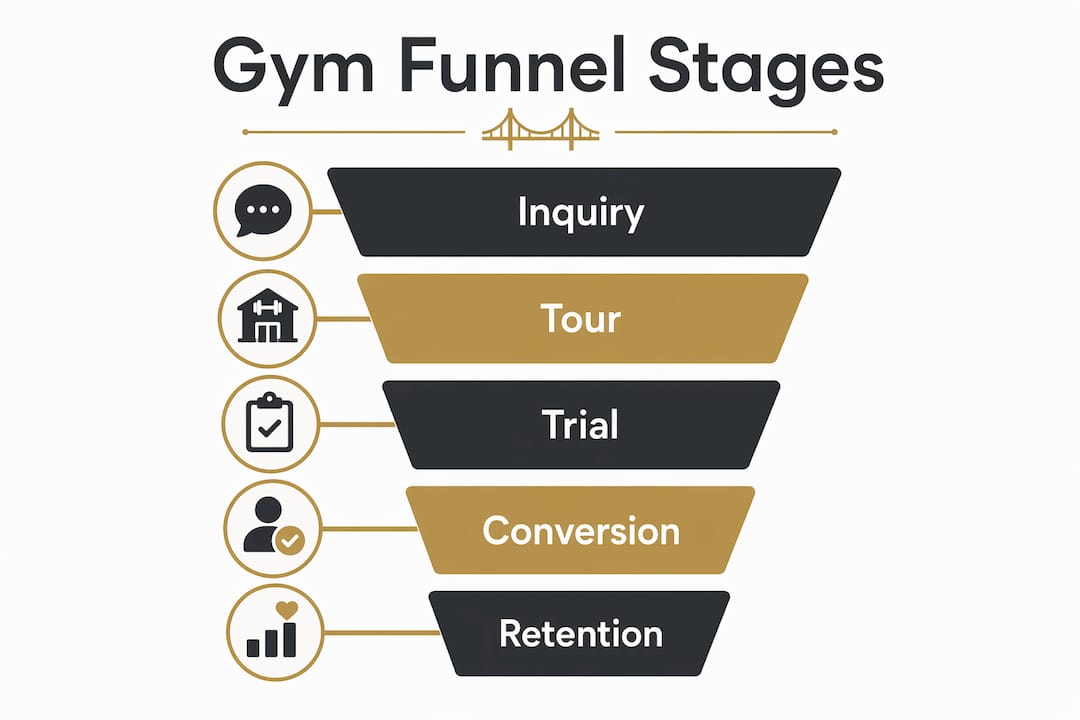
The gym sales funnel follows five stages: inquiry, tour, trial, conversion, and retention. Most owners skip the mapping step entirely and wonder why their ads stop working. Analyzing 4 weeks of data enables targeted funnel optimization rather than broad guesswork. That means you need numbers at every stage before you touch a single setting.
Start by pulling your CRM data for the past month. Count how many leads came in, how many booked a tour, how many started a trial, and how many became paying members. The gap between each number is your bottleneck. Most gyms find the biggest drop-off happens at two points: the lead-to-tour stage and the trial-to-member stage.

| Funnel Stage | Average Gym Rate | Top Performer Rate |
|---|---|---|
| Lead to Tour | 20–35% | 50–60% |
| Tour to Trial | 60–70% | 80–90% |
| Trial to Member | 20–30% | 50–65% |
| Member at 90 Days | 55–65% | 80–90% |
Once you see where prospects drop off, you can fix that one stage before moving to the next. Tools like PushPress, Mindbody, and HubSpot all offer pipeline views that make this mapping straightforward. The goal is to treat your funnel like a financial statement. Every percentage point of improvement at the trial-to-member stage is direct revenue.
Pro Tip: Set a weekly 15-minute calendar block to review your funnel metrics. Consistency beats intensity when it comes to spotting conversion trends early.
Why lead response speed is your biggest conversion lever
Speed-to-lead is the single most underrated factor in gym marketing funnel performance. Leads contacted within 5 minutes are 21 times more likely to visit than those contacted after 30 minutes. That statistic should change how you think about your entire follow-up process.
The fix is automation at the first touchpoint, not the last. Here is a proven rapid-response sequence you can set up in any CRM:
- Immediate SMS (0–2 minutes): Send an automated text the moment a lead submits a form. Keep it personal in tone: "Hey [Name], this is [Staff Name] from [Gym]. We got your info and would love to set up a quick tour. When works for you?"
- Automated email (5 minutes): Follow the SMS with a short email that includes a direct booking link, a photo of your facility, and one client success story.
- Human call (within 30 minutes): A real staff member calls during business hours. This is where automation hands off to a person. The call is short, warm, and focused on booking the tour, not selling the membership.
- No-show nudge (24 hours): If the lead booked a tour but did not show, send an automated SMS and email within 24 hours offering to reschedule.
- 5-day nurture sequence: For leads who do not book, run a 5-email sequence over the following week that shares member stories, class highlights, and a limited-time offer.
Tools like GoHighLevel, Keap, and ActiveCampaign handle this entire sequence without manual effort. The key is that automation handles logistics like speed and reminders, while your staff handles the emotional, relationship-building moments.
Pro Tip: Never automate the sales conversation itself. Use automation to get the prospect on the phone or in the gym, then let your team take over. Full automation of sales conversations reduces conversion because it removes emotional connection.
How to build a trial nurture sequence that converts
Getting a prospect through the door for a trial is a win. Keeping them engaged long enough to sign up is the real work. Trial visitors who attend at least 3 classes during their trial period double their probability of converting to a paying member. Your nurture sequence needs to drive that attendance.
Here is a step-by-step trial nurture flow that works for both free and paid intro periods:
- Day 1 (Welcome): Send a personal SMS from a staff member welcoming them by name. Include the class schedule and one specific class recommendation based on their stated goal.
- Day 2 (Check-in): A brief text asking how their first session went. This is not automated. A real person sends this.
- Day 4 (Social proof): Email a short video or written testimonial from a member with a similar goal. Pair it with a class invite for the upcoming weekend.
- Day 6 (Community invite): Invite them to a community event, open gym, or challenge. Belonging drives retention more than any discount.
- Day 8 (Goal check-in): A staff member calls or texts to ask about their progress and schedule a brief goal-setting conversation before the trial ends.
- Day 10 (Offer): Present the membership offer in the context of their goals, not the price sheet.
The difference between free and paid trials matters here. Paid intro packs priced at $10–$30 for a few sessions act as intent filters. They reduce your follow-up workload because the prospects who pay even a small amount are far more serious. Free trials widen the top of your funnel but require more disciplined follow-up to compensate for lower intent.
Key elements that make trial nurture sequences work:
- Personalization by name and stated goal in every touchpoint
- A mix of automated messages and real human contact
- Community-focused invites, not just class reminders
- Timing that respects the prospect's pace without going silent
What makes a sales conversation actually convert?
The most effective gym sales technique is not a script. It is a conversation structure built around the prospect's goals. Transformational sales conversations that focus on prospect goals and struggles consistently outperform pitches centered on equipment or pricing. The reason is simple: people do not buy memberships. They buy the version of themselves they want to become.
Train your staff to open every sales conversation with questions, not features. Ask the prospect what brought them in, what they have tried before, and what success looks like for them in three to six months. Let them talk. The more they describe their goal, the more invested they become in achieving it.
Build the member vision before you ever mention price. Walk them through what their first 90 days could look like. Describe the community, the progress milestones, and the specific classes that match their goals. By the time you present the membership options, the conversation is about which plan fits their life, not whether to join at all.
Key principles for consultative gym sales:
- Lead with questions. Ask about goals, past experience, and what has held them back.
- Reflect their language. Use the words they used to describe their goals when you present the membership.
- Avoid feature dumps. Never list equipment, class types, or amenities before you understand what the prospect actually wants.
- Address hesitation directly. If they say they need to think about it, ask what specific concern is holding them back and address it in the moment.
Pro Tip: Role-play sales conversations with your staff weekly. Record the sessions and review them together. The fastest way to improve conversion is to hear where conversations stall.
For more on converting gym leads into paying members, the approach above applies across gym types, from CrossFit boxes to boutique studios.
Common mistakes that create funnel leaks
Most gym sales funnel problems are not marketing problems. They are process problems that show up as marketing problems. Here are the most common mistakes and how to fix them:
- Treating the funnel as ending at signup. Retention starts in the first 90 days. A member who cancels at week six was lost somewhere in your onboarding, not your ads. Extend your funnel definition to include the 90-day commitment milestone.
- Over-automating emotional steps. Automation is right for reminders, scheduling, and no-show nudges. It is wrong for the sales conversation and the post-signup check-in. Full automation of sales conversations reduces conversion because it strips out the human connection that closes deals.
- Measuring cost-per-lead instead of CAC to LTV. A $5 lead that never converts costs more than a $30 lead that stays for two years. Measuring Customer Acquisition Cost relative to Lifetime Value with a target ratio of 5:1 gives you a real picture of funnel health.
- Fixing everything at once. Optimize one funnel stage at a time. Start with the stage that shows the biggest drop-off. Changing too many variables simultaneously makes it impossible to know what worked.
- Ignoring follow-up automation for no-shows. A prospect who booked a tour and did not show is still a warm lead. Most gyms never follow up a second time.
"The gyms that grow fastest are not the ones with the biggest ad budgets. They are the ones that lose the fewest leads between stages." — A consistent pattern across high-performing fitness businesses.
Track your key marketing metrics weekly. When a stage drops below benchmark, investigate the process before blaming the traffic source.
Key takeaways
A gym sales funnel converts more members when rapid response, structured nurture, and consultative sales work together at every stage.
| Point | Details |
|---|---|
| Map before you fix | Pull 4 weeks of CRM data to find your biggest drop-off stage before changing anything. |
| Speed-to-lead wins | Contact new leads within 5 minutes using automated SMS to multiply tour bookings. |
| Trial engagement drives conversion | Getting trial members to 3+ classes doubles their likelihood of signing up. |
| Sell the transformation | Lead sales conversations with goal-focused questions, not pricing or equipment lists. |
| Measure CAC to LTV | Target a 5:1 LTV-to-CAC ratio to confirm your funnel is profitable, not just active. |
The part most gym owners get backwards
I have worked with enough gym owners to spot the pattern immediately. They pour money into Meta Ads, get leads flowing in, and then wonder why their membership count barely moves. The funnel is not broken at the top. It is broken in the middle, and nobody is looking there.
The biggest myth I see is that more leads solve the problem. They do not. If your lead-to-tour rate is 20% and your trial-to-member rate is 25%, doubling your ad spend doubles your waste. The math only works when the middle of the funnel is solid.
What actually moves the needle is the combination of fast automated response and a genuinely skilled sales conversation at the end. Neither one works without the other. I have seen gyms with great automation and terrible close rates, and gyms with great salespeople who lose leads before the first call because nobody followed up for three days.
The other thing worth saying plainly: retention is part of the funnel. A member who leaves at week eight was not retained. That is a funnel failure, not a product failure. The gyms I see growing consistently treat the 90-day mark as the real conversion goal. Everything before that is just the beginning. If you want to attract quality members who actually stay, you need the whole system working together.
— Collin
Ready to stop losing leads between funnel stages?
Enochmarketing works exclusively with CrossFit gyms and fitness brands across the United States to build the exact systems described in this article. That includes paid media on Meta and Google, automated lead nurture sequences, CRM setup, and sales training frameworks that turn more trials into long-term members.
If your gym is generating leads but not converting them, the problem is almost always fixable with the right process in place. Enochmarketing's team audits your current funnel, identifies the leak, and builds a custom strategy to close it. Book a free strategy session through the gym growth services page and find out exactly where your funnel is losing revenue.
FAQ
What is a gym sales funnel?
A gym sales funnel is the structured sequence of stages, from first inquiry through paid membership, that a prospect moves through before committing. Optimizing each stage increases the total number of leads that become paying members.
How fast should i respond to new gym leads?
Contact new leads within 5 minutes. Leads reached in that window are 21 times more likely to visit than those contacted after 30 minutes, making speed the single most impactful conversion factor.
What conversion rate should my gym trial achieve?
Average gyms convert 20–30% of trial visitors to members. Top-performing gyms using structured nurture sequences reach 50–65%, according to data from Intellivizz.ai.
Should i offer free trials or paid intro packs?
Paid intro packs priced at $10–$30 filter for higher-intent prospects and reduce follow-up workload. Free trials increase lead volume but require more disciplined nurture sequences to compensate for lower prospect commitment.
What metrics should i track to measure funnel health?
Track conversion rates at each funnel stage and measure Customer Acquisition Cost relative to Lifetime Value. A 5:1 LTV-to-CAC ratio indicates a profitable, sustainable funnel rather than just a busy one.