
Attracting gym members is defined as converting local leads into paying, retained members through a repeatable system of referrals, rapid follow-up, and targeted marketing. The gym industry is more competitive than ever, and relying on word-of-mouth alone leaves serious revenue on the table. Tools like Fitagentic.ai for AI-driven SMS follow-up, structured referral programs, and Google Business Profile optimization are now the baseline for gyms that want to grow. This guide breaks down exactly how to get more gym members in 2026 using performance-driven tactics that work at the local level.
How to attract gym members with a high-converting referral program
Referral programs are the single highest-ROI member acquisition channel available to gym owners. Referred prospects convert at 55 to 70%, compared to roughly 10 to 20% for cold paid-ad leads. That gap is enormous. It means every referred prospect is worth three to five cold leads in terms of conversion probability.
The most effective referral model for gyms is the "give a month, get a month" structure. The referring member receives one free month of membership, and the new member receives their first month free or discounted. This model works because both parties win immediately, and the cost to the gym is typically between $0 and $50 per referral. Compare that to paid social ad costs of $80 to $200 per lead, and the math is obvious.
Here is what a scalable referral program looks like in practice:
- Offer a clear, motivating reward. Free membership months outperform cash discounts because they increase perceived value without cutting into cash flow.
- Automate the ask. Use your gym management software (Mindbody, Zen Planner, or PushPress) to trigger a referral request email or SMS after a member hits a milestone like their 30th class or a personal record.
- Track referral cohorts. Know which members refer the most and how those referrals retain over time. This data tells you where to invest your reward budget.
- Recognize top referrers publicly. A leaderboard on your gym's app or a shoutout during class costs nothing and drives competitive members to refer more.
- Promote the program consistently. Referral programs fail when they are under-promoted. Post about it monthly on social media, mention it during onboarding, and include it in your email newsletter.
Referral asks land best when timed around peak emotional moments: right after a member sets a personal record, completes a challenge, or hits a 90-day milestone. Members who refer five or more people over 12 months should receive significant rewards such as a free annual membership or branded gear. That tier structure turns your best advocates into a genuine growth engine.
Pro Tip: Set up a simple two-step automation: trigger a referral SMS 24 hours after any member logs a personal record in your tracking app. The emotional high from that moment makes them far more likely to share.
| Referral metric | Benchmark |
|---|---|
| Conversion rate for referred leads | 55 to 70% |
| Referral reward cost per acquisition | $0 to $50 |
| Share of new members from referrals (healthy gym) | 20 to 35% |
How can rapid lead follow-up automation increase gym member conversion rates?
Speed is the most underrated variable in gym member acquisition. Responding to new leads within one hour makes a business 7x more likely to qualify that lead compared to slower responses. The ideal target is five minutes or less. Most gyms respond in hours or days, which is why most gyms lose leads they already paid to generate.

AI-driven SMS follow-up responding in under 60 seconds is the highest-ROI method to convert paid-ad leads into gym tours. Fitagentic.ai is one platform built specifically for this. It sends a conversational SMS the moment a lead submits a form, books a tour, or clicks a Facebook ad. The lead feels attended to immediately, which dramatically increases show rates for free trials.
A practical lead nurture sequence looks like this:
- Day 0, within 5 minutes: Automated SMS confirms their inquiry and asks one qualifying question ("What's your main fitness goal?").
- Day 0, within 1 hour: Automated email delivers your offer details and a direct booking link for a free trial or intro class.
- Day 1: A human staff member calls or texts personally to answer questions and confirm the booking.
- Day 3: Automated reminder SMS goes out if the trial has not been booked yet.
- Day 5: Email with a social proof element, such as a member success story or a short video tour of the facility.
- Day 7: Final follow-up from a human with a time-sensitive offer ("Our next intro class has two spots left this week").
Most gyms lose conversions at the speed-to-lead stage. Automation handles the immediate response and reminders. Humans handle the emotional complexity of closing. That division of labor is what separates gyms with 30% trial-to-member conversion from those stuck at 10%.
Pro Tip: Never let automation handle objections or pricing conversations. The moment a lead asks "How much does it cost?" or "I'm not sure if I'm ready," a real person needs to take over. Automation that tries to close complex objections kills trust fast.
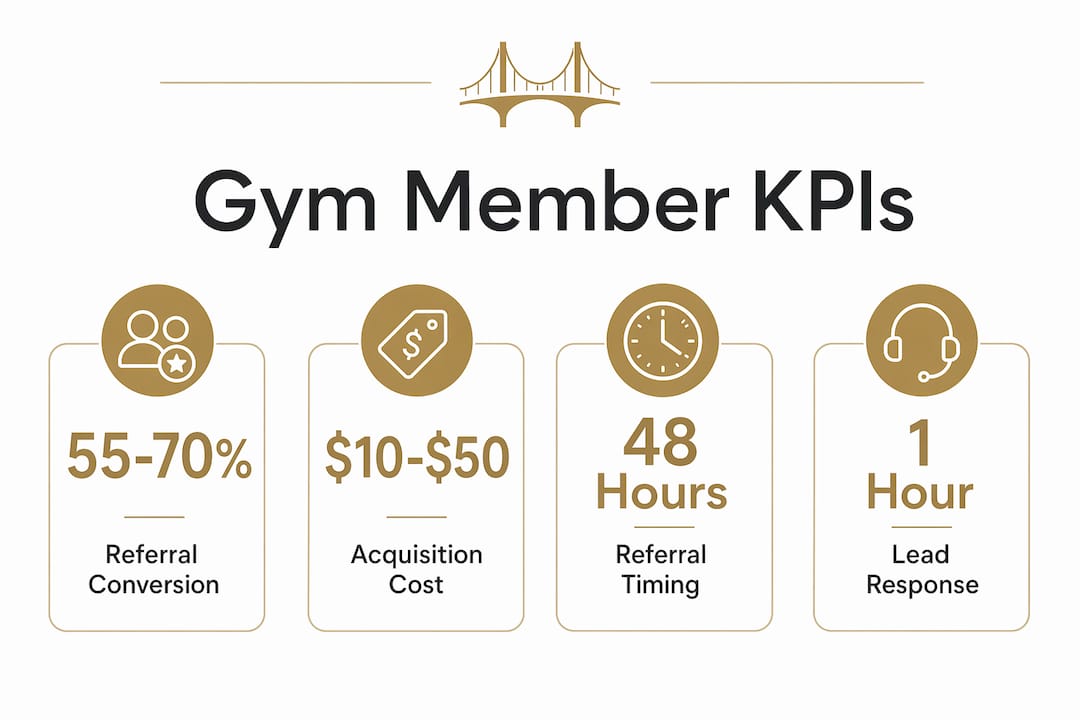
Key performance indicators to track in your lead funnel include: lead-to-trial booking rate, trial show rate, trial-to-member conversion rate, and average days from first contact to membership sign. If your trial show rate drops below 50%, your follow-up sequence needs more touchpoints. If your trial-to-member rate drops below 40%, your sales conversation needs work.
What marketing channels effectively attract local gym members in 2026?
The most effective marketing mix for gym membership growth in 2026 combines paid social advertising, local SEO, organic content, and community partnerships. No single channel wins alone. The question is how to allocate budget and effort across all four.
Paid social advertising on Meta (Facebook and Instagram) remains the dominant paid channel for local gyms. Paid social performs best with tight geo-targeting (one to five miles from your location), member-facing creative, and constant creative iteration of 8 to 12 new ad variants per month. Generic stock-photo ads and broad targeting are the two fastest ways to burn your budget. Member testimonial videos and before-and-after transformation content consistently outperform studio-produced brand content in click-through rates.
Local SEO is the most underused low-cost channel in the gym industry. A complete Google Business Profile with weekly updates, prompt review responses, and consistent local citations captures high-intent searchers at near-zero cost. Someone searching "CrossFit gym near me" or "best gym in [city]" is already sold on the category. You just need to show up first. Claim your profile, add photos weekly, respond to every review within 24 hours, and build citations on Yelp, Apple Maps, and local directories.
| Channel | Cost level | Lead quality | Best for |
|---|---|---|---|
| Meta paid ads | Medium to high | Medium | Volume and awareness |
| Google Business Profile | Low | Very high | High-intent local search |
| Referral program | Very low | Highest | Conversion and retention |
| Community partnerships | Low | High | Trust and local authority |
Community partnerships with complementary local businesses are one of the most overlooked gym membership growth tips available. Partner with physical therapists, chiropractors, nutritionists, and sports apparel retailers. Cross-promote through each other's email lists, offer joint intro packages, and co-host local events. These partnerships cost almost nothing and generate warm leads who already trust health and fitness.
Organic social content should prioritize member-generated content over polished brand posts. Repost member workout videos, milestone celebrations, and transformation stories with permission. This content builds social proof and costs nothing to produce. A step-by-step marketing plan for 2026 should allocate roughly 40% of marketing budget to paid ads, 30% to local SEO and content, and 30% to referral program incentives and community events.
How to optimize member experience to boost retention and attract referrals
Retention is the foundation of sustainable gym revenue growth. Bundled services and outcome-based offerings increase member lifetime value and reduce the pressure to constantly acquire new members. A gym that retains 80% of its members annually needs far fewer new sign-ups to grow than one retaining 60%.
The member experience starts at onboarding. A structured onboarding program that includes a goal-setting session, a facility walkthrough, and a 30-day check-in call dramatically improves 90-day retention. Members who feel seen and supported in their first month are significantly more likely to stay past the six-month mark, which is where most churn happens.
Here are the highest-impact retention tactics for gym owners:
- Track member progress formally. Use apps like SugarWOD, Wodify, or TrainHeroic to log workouts and milestones. Members who see their progress visualized stay longer and refer more.
- Create milestone moments. Celebrate 100th class, six-month anniversaries, and personal records publicly. These moments generate organic social content and trigger referral behavior.
- Bundle coaching and nutrition. Offering a membership plus nutrition coaching as a package increases average revenue per member and improves results, which drives retention.
- Upsell specialty classes. Olympic lifting, mobility, or endurance programs give members a reason to deepen their commitment beyond the standard membership.
- Survey members at 60 days. A short three-question survey at the 60-day mark identifies at-risk members before they cancel. Early intervention saves memberships.
Pro Tip: The best time to ask a member to refer a friend is within 48 hours of a milestone. Set an automated trigger in your CRM so that when a member logs their 50th class, they receive a personal-feeling text that says "You just hit 50 classes. Know anyone who should be here with you?"
Sustainable gym growth depends on balancing acquisition, retention, and diversification. Chasing new sign-ups while ignoring retention is the most common and most expensive mistake gym owners make. Increasing member lifetime value by even $30 per month per member compounds dramatically over a 12-month period.
Key takeaways
Attracting and retaining gym members requires a system built on referral programs, fast lead follow-up, multi-channel marketing, and a member experience that generates organic growth.
| Point | Details |
|---|---|
| Referral programs convert best | Referred leads convert at 55 to 70%, far above cold paid-ad leads. |
| Speed-to-lead is critical | Responding within five minutes makes you 7x more likely to qualify a lead. |
| Local SEO is underused | A complete Google Business Profile captures high-intent local searchers at near-zero cost. |
| Retention drives revenue | Bundled services and milestone tracking increase member lifetime value and reduce churn. |
| Automation plus humans wins | Automation handles speed; humans handle emotional complexity and closing. |
Why most gym owners are solving the wrong problem
Here is what I have seen working with fitness brands across the country: most gym owners treat member acquisition as a marketing problem when it is actually a systems problem. They spend money on ads, get leads, and then lose those leads to slow follow-up, weak onboarding, and no referral structure. The marketing worked. The system failed.
The operators who scale fastest are not necessarily running the best ads. They are the ones who respond to every lead within five minutes, ask for referrals at the right moment, and treat their Google Business Profile like a living asset rather than a one-time setup. These are not glamorous tactics. They are disciplined, repeatable processes.
I also see too many gym owners overspending on brand awareness and underspending on performance marketing tied directly to leads and conversions. A beautiful Instagram feed does not pay rent. A referral program that generates 25% of your new members every month does.
The uncomfortable truth about how to scale gym revenue in 2026 is that technology alone does not fix a broken follow-up process. Fitagentic.ai and similar tools are powerful, but they amplify what is already there. If your offer is weak or your trial experience is mediocre, automation just delivers that mediocrity faster. Fix the fundamentals first, then layer in the technology.
— Collin
How Enochmarketing helps gyms grow their membership
If you have read this far and recognize gaps in your referral program, lead follow-up, or paid media strategy, Enochmarketing was built specifically to close those gaps for CrossFit gyms and fitness brands.
Enochmarketing offers performance-driven gym marketing including Meta and Google Ads management, lead funnel creation, local SEO, referral program design, and full brand strategy. Every service is built around one outcome: more paying members, not just more impressions. The agency works exclusively with fitness brands, which means no learning curve and no generic playbooks. If you want a proven lead generation system built for your gym's specific market, book a free strategy session with the Enochmarketing team today.
FAQ
What is the fastest way to get more gym members?
The fastest way to increase gym memberships is to launch a structured referral program and tighten your lead follow-up to under five minutes. Referred leads convert at 55 to 70%, and fast response times make businesses 7x more likely to qualify a lead.
How much should a gym spend on marketing to grow memberships?
A practical starting allocation is 40% of your marketing budget on paid social ads, 30% on local SEO and content, and 30% on referral incentives and community partnerships. The exact split depends on your current member base and local competition.
How do referral programs work for gyms?
A gym referral program rewards existing members for bringing in new sign-ups, typically with a free membership month or store credit. The most effective models time the referral ask around positive member moments like personal records or milestone classes.
What is the best social media strategy for gym membership growth?
Member-generated content consistently outperforms studio-produced brand posts for driving local trust and inquiries. Repost member milestones and transformation stories, run geo-targeted Meta ads with 8 to 12 creative variants per month, and respond to every comment and message within 24 hours.
How does local SEO help attract gym members?
A complete and actively maintained Google Business Profile captures high-intent local searchers who are already looking for a gym in your area. Weekly photo updates, consistent review responses, and accurate local citations are the three highest-impact actions you can take.