
Gym marketing ROI is defined as the net revenue gained from marketing activities relative to what you spent to generate it. Knowing why measure gym marketing ROI matters is the difference between growing a gym on purpose and hoping referrals hold the floor. 83% of marketing leaders now prioritize proving ROI, up from 68% five years ago. That shift reflects a hard truth: spending on ads, social content, and promotions without tracking results is not marketing. It is guessing with a budget.
Why measure gym marketing ROI and what it actually tells you
Measuring marketing ROI converts your ad spend from a line item into a decision-making tool. Without it, you cannot tell whether your Meta campaign brought in 12 paying members or 12 free trial signups who never came back. Those two outcomes look identical in a basic dashboard but represent completely different financial realities.
The industry standard framework uses three core metrics: Customer Acquisition Cost (CAC), Lifetime Value (LTV), and the LTV to CAC ratio. CAC is the total marketing spend divided by the number of paying members acquired in a given period. LTV is the average monthly membership fee multiplied by the average number of months a member stays. The LTV to CAC ratio tells you whether your marketing is profitable at all.

Successful gym owners target a 3:1 LTV to CAC ratio, meaning every dollar spent on acquisition should return three dollars in member revenue. A ratio below 3:1 signals either overspending on ads or poor retention pulling down lifetime value. A ratio above 5:1 often means you are underinvesting and leaving growth on the table.
Supporting KPIs round out the picture. Track these alongside your core metrics:
- Conversion rate: percentage of leads who become paying members
- Churn rate: percentage of members who cancel each month
- Lead response time: how fast your team contacts a new inquiry
- Cost per lead (CPL): total ad spend divided by total leads generated
Pro Tip: Never use trial participants or free class attendees as the denominator in your CAC calculation. Using leads instead of paying members inflates your apparent efficiency and masks real funnel weaknesses.
Which marketing channels deliver the best ROI for gyms?
Not all channels perform equally, and the gap between the best and worst is significant. Fitness brands see an average 2.1x ROI on digital ads overall, but social media ads on platforms like Instagram and TikTok reach 2.8x ROI. TV advertising, by contrast, shows a negative 5% ROI for fitness brands. That is not a small gap. It is the difference between growth and loss.
The data points to a clear direction: shift budget toward measurable digital channels and away from broad, untargeted media. That does not mean digital is automatically efficient. Agency commissions, poor creative, and weak landing pages all erode net ROI even on high-performing platforms.
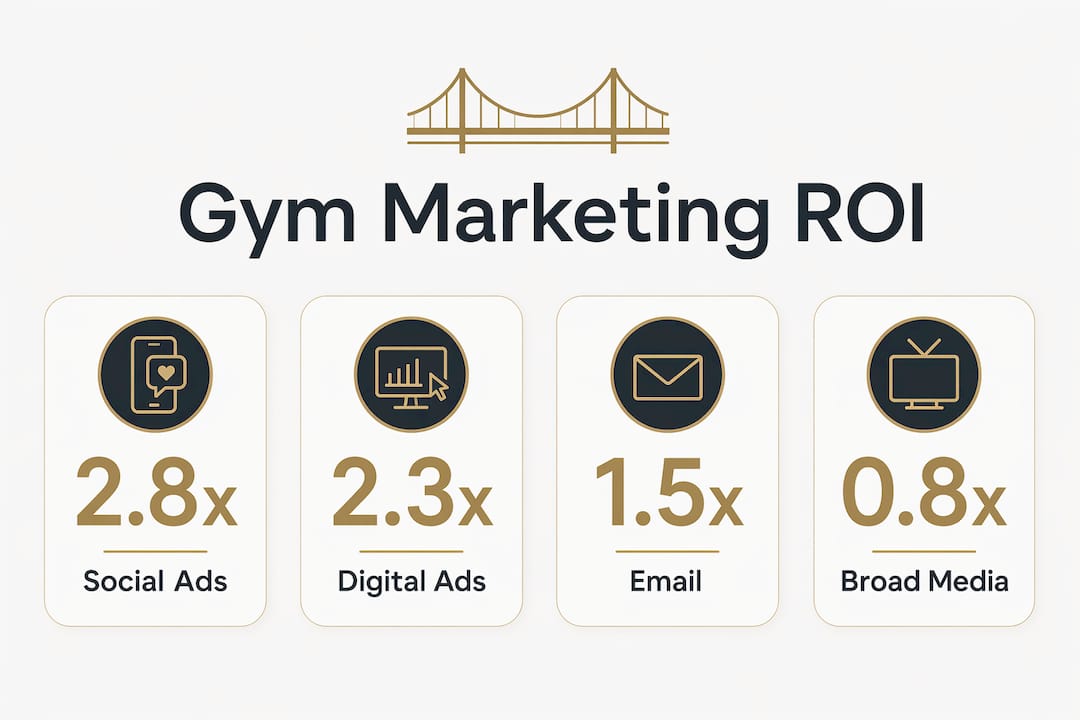
Here is how common gym marketing channels compare:
| Channel | Average ROI | Notes |
|---|---|---|
| Social media ads (Instagram, TikTok) | 2.8x | Highest ROI; requires strong creative |
| Digital ads (Google, Meta overall) | 2.1x | Reliable; depends on targeting quality |
| Email marketing | High (retention focus) | Best for upsell and member retention |
| Offline events and partnerships | ~1.9x | Moderate; hard to track attribution |
| TV advertising | Negative 5% | Declining returns for fitness brands |
Gyms using multi-channel marketing testing are 2.5x more likely to hit revenue goals. Testing across channels is not optional for serious growth. It is the mechanism that tells you where to concentrate your budget next quarter.
A few principles guide smart channel allocation:
- Run each channel for at least 60 days before judging performance
- Track CAC separately per channel, not as a blended average
- Reallocate budget from channels above your CAC target to those below it
- Factor in agency fees and creative costs when calculating net ROI
What mistakes undermine accurate ROI measurement in gyms?
The most common measurement error is using the wrong denominator. Calculating CAC with trial signups or leads instead of paying members produces a number that looks good but means nothing. A gym that spent $2,000 and generated 40 leads has a $50 CPL. If only 8 of those leads converted to paying members, the real CAC is $250. Those are very different business decisions.
Blended metrics are the second major trap. Averaging CAC across all channels hides which ones are profitable. A Facebook campaign at $80 CAC and a Google campaign at $320 CAC average to $200 CAC. That average looks acceptable. But the Google campaign is likely destroying margin while the Facebook campaign funds growth.
Speed of response is a metric most gym owners ignore entirely. Responding to a new lead within 5 minutes makes qualification 21 times more likely than waiting even 30 minutes. Slow follow-up does not just lose leads. It inflates your CAC because you are spending money to generate interest you then fail to capture.
Pro Tip: Platform-reported metrics often over-attribute conversions. Meta and Google both count conversions that would have happened anyway. Geo-lift testing and incrementality testing separate genuine demand creation from baseline conversions, giving you a truer picture of what your ads actually caused.
Two more pitfalls worth naming:
- Focusing entirely on acquisition while ignoring retention metrics in your ROI model
- Treating vanity metrics like follower counts or impressions as proxies for revenue impact
How can gym owners practically track and improve marketing ROI?
Practical ROI tracking starts with a monthly rhythm, not an annual review. By the time you review a full year of blended data, you have already wasted months of budget on underperforming channels. Monthly channel-specific CAC tracking reveals profitable and wasteful marketing far more clearly than quarterly averages.
A workable monthly tracking process looks like this:
- Pull channel-specific spend for the month from each platform (Meta Ads Manager, Google Ads, email platform).
- Count paying members acquired from each channel using your CRM or intake form data.
- Calculate CAC per channel by dividing spend by paying members.
- Compare each channel's CAC against your LTV to determine if the ratio is above or below 3:1.
- Shift budget from channels above your CAC target toward those performing below it.
- Review churn rate monthly and flag any member who has missed two consecutive weeks.
CRM tools that integrate with your ad platforms automate much of this attribution work. Without that integration, you are manually matching lead sources to payment records, which introduces errors and delays. The step-by-step gym marketing plan framework from Enochmarketing walks through how to set performance goals and build tracking into your campaigns from day one.
Pro Tip: Email marketing delivers $36 in revenue per $1 spent, but almost entirely through retention and upsell, not acquisition. Build a separate email sequence for at-risk members and track its impact on churn rate monthly.
For gyms ready to move beyond basic tracking, incrementality testing is the next level. Geo-lift tests run your campaign in one market and withhold it from a comparable market, then measure the difference in new member signups. The result is the true lift your marketing created, stripped of organic baseline growth.
Why balancing acquisition and retention is vital for gym marketing ROI
Acquisition gets the attention, but retention drives the math. A 5% improvement in retention outperforms adding 20 new members in revenue impact for most gyms. That is because retained members cost almost nothing to keep compared to the CAC of replacing them.
Average annual gym retention sits around 74%, with monthly churn rates often reaching 6.5%. At that churn rate, a gym with 200 members loses 13 members per month. To grow by even 10 members net, you need to acquire 23 new members every month just to stay ahead. That is an expensive treadmill.
Retention-focused tactics that directly improve ROI include:
- Visit frequency tracking: members who visit fewer than twice per week are at high churn risk
- Personalized check-ins: automated messages triggered by missed visits reduce early cancellations
- Referral programs: referred members typically have lower CAC and higher LTV than ad-acquired members
- Upsell sequences: personal training add-ons and nutrition coaching raise LTV without additional acquisition spend
Personalized retention campaigns raise member lifetime value by addressing individual engagement patterns rather than broadcasting the same message to everyone. A member who attends group classes responds to different messaging than one who trains solo at off-peak hours.
The practical implication is that your marketing ROI model must include retention spend, not just acquisition spend. A gym spending $3,000 per month on ads and $0 on retention is measuring only half the equation.
Key takeaways
Gym marketing ROI requires tracking CAC, LTV, and churn rate by channel every month. Blended averages and vanity metrics hide the truth about where your budget is actually working.
| Point | Details |
|---|---|
| Use paying members for CAC | Dividing spend by leads or trials inflates efficiency and hides funnel problems. |
| Target a 3:1 LTV to CAC ratio | Ratios below 3:1 signal overspending or poor retention dragging down lifetime value. |
| Track ROI by channel monthly | Blended averages mask which campaigns are profitable and which are burning budget. |
| Retention amplifies acquisition ROI | A 5% retention gain outperforms adding 20 new members in net revenue impact. |
| Speed of lead response matters | Responding within 5 minutes makes a lead 21 times more likely to qualify and convert. |
What I have learned from watching gyms measure ROI the wrong way
Busy marketing does not equal profitable marketing. I have seen gym owners running Meta ads, posting daily on Instagram, sending weekly emails, and sponsoring local events simultaneously, all while their CAC was climbing and their LTV was shrinking. The activity looked impressive. The numbers told a different story.
The gyms that grow consistently share one habit: they review their numbers on a fixed monthly schedule and act on what they find within the same week. Not next quarter. Not after the next campaign ends. That week. Marketing signals decay fast, and a channel that was profitable in january can turn negative by march if creative fatigue or audience saturation sets in.
The other pattern I keep seeing is gym owners trusting platform dashboards too much. Meta will tell you that your campaign drove 40 conversions. Your CRM might show 18 new paying members that month from all sources combined. Those two numbers cannot both be right. Measurement problems often come from design flaws, not marketer incompetence. Build your tracking system before you launch campaigns, not after.
The common gym marketing mistakes that cost owners the most are almost always measurement failures in disguise. Fix the measurement first. The marketing decisions become obvious after that.
— Collin
How Enochmarketing helps gyms build measurable marketing systems
Gym owners who want real ROI from their marketing need more than ad spend. They need a system that connects every campaign to paying member data.

Enochmarketing works exclusively with CrossFit gyms and fitness brands across the United States, building paid media campaigns, lead funnels, and local SEO strategies designed around measurable outcomes. Every engagement starts with an audit of your current CAC, LTV, and channel performance so you know exactly where you stand before a dollar of new budget moves. Gym owners ready to replace guesswork with data can review growth and lead generation services or check transparent pricing options to find the right fit for their gym's size and goals.
FAQ
What is gym marketing ROI?
Gym marketing ROI is the net revenue generated from marketing activities divided by the total cost of those activities. A 3:1 ratio, meaning $3 in member revenue for every $1 spent, is the standard benchmark for healthy gym marketing performance.
How do I calculate CAC for my gym?
Divide your total marketing spend for a given period by the number of paying members acquired during that same period. Never use leads, trials, or free class attendees as the denominator, since that calculation overstates efficiency and hides conversion problems.
Which marketing channel has the best ROI for gyms?
Social media ads on Instagram and TikTok currently deliver the highest average ROI at 2.8x for fitness brands. Digital ads overall average 2.1x ROI, while TV advertising shows negative returns for most gyms.
Why does retention affect marketing ROI?
Retention directly raises LTV, which is the top half of the LTV to CAC ratio. A 5% improvement in retention outperforms adding 20 new members in revenue impact, making retention spend one of the highest-ROI investments a gym can make.
How often should gym owners review their marketing ROI?
Monthly reviews are the minimum standard for effective ROI tracking. Reviewing by channel rather than as a blended average reveals which campaigns are profitable and allows budget reallocation before underperforming channels drain significant spend.