
Gym marketing calendar creation is the process of structuring your annual fitness marketing activities around quarterly goals, consistent campaign cycles, and channel-focused budget planning to maximize lead generation and member retention. Without a planned promotional calendar, most gym owners default to reactive, last-minute campaigns that waste budget and miss peak enrollment windows. A well-built calendar gives you predictable growth, better budget control, and a clear rhythm your entire team can follow. The difference between gyms that grow steadily and those that plateau often comes down to one thing: planning in advance rather than scrambling each month.
What are the essential components of a gym marketing calendar?
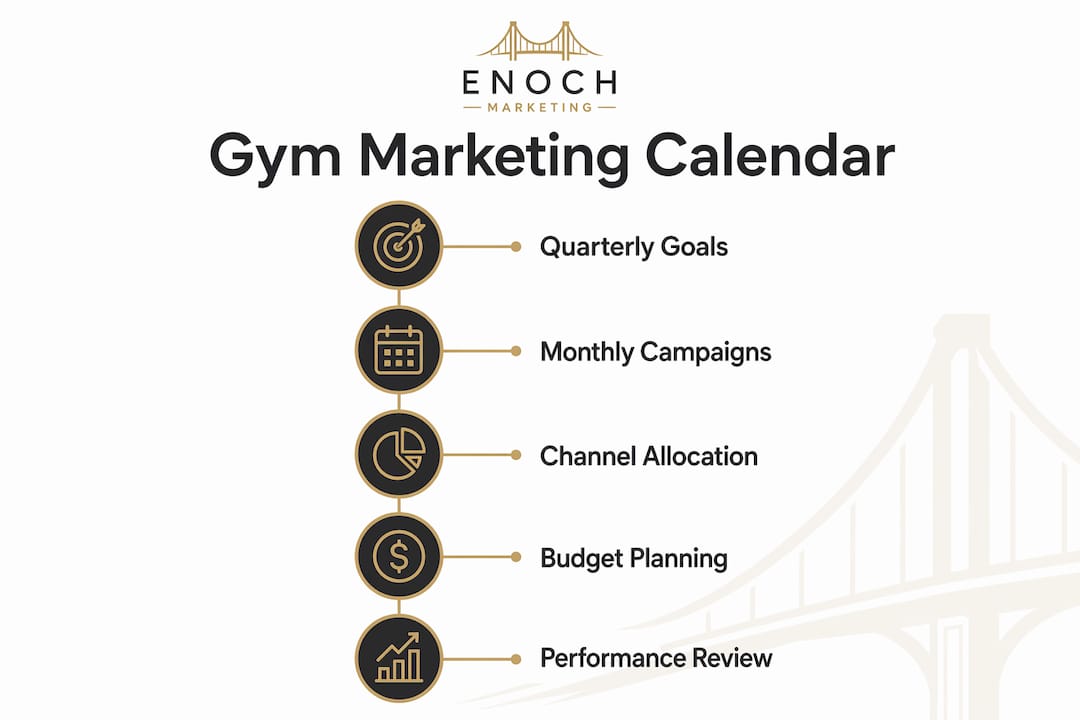
A gym marketing calendar is built on four core layers: quarterly goals, monthly campaign rhythms, channel allocation, and retention marketing. Each layer depends on the others. Remove one and the whole system loses coherence.
Quarterly goal-setting with SMART criteria
Quarterly planning structures the year into four focused sprints, each with one SMART goal. A SMART goal is Specific, Measurable, Achievable, Relevant, and Time-bound. For example: "Generate 40 new trial memberships in Q1 through Meta Ads and a referral program." One goal per quarter keeps your team focused and makes performance reviews straightforward.
Monthly and weekly campaign rhythms
Each month follows a repeatable pattern. Week 1 publishes anchor content, the main post or campaign that sets the month's theme. Weeks 2 and 3 run supporting offers, such as a limited-time trial, a community challenge, or a referral incentive. Week 4 is reserved for performance review and prep for the next campaign. This rhythm prevents the last-minute scramble that kills execution quality.

Channel and budget allocation
Effective budget distribution separates gyms that grow from those that spin their wheels. The table below shows a practical starting point for a monthly gym marketing plan:
| Channel | Budget Share | Primary Purpose |
|---|---|---|
| Paid social (Meta, TikTok) | 35–45% | Lead generation and retargeting |
| Local SEO and Google Ads | 5–10% | High-intent local search traffic |
| Referral and community programs | 5–10% | Word-of-mouth acquisition |
| Email and SMS retention | 10–15% | Member retention and upsells |
| Content and creative production | 15–20% | Brand presence and organic reach |
Pro Tip: Set your campaign production window 6–8 weeks before launch. That gives you time to write copy, create visuals, build landing pages, and test ads before the campaign goes live.
Retention marketing via email and SMS is the most underused channel in fitness. Retaining existing members costs 5–10 times less per dollar than acquiring new ones. That gap is too large to ignore.
How to build your gym promotional calendar step by step
Building a gym promotional calendar from scratch takes one focused planning session and a simple tool. Google Sheets, Notion, or a dedicated gym management platform all work. The goal is a single document your whole team can access and update.
-
Map your annual themes. Start with the four quarters. Assign each quarter a growth theme: Q1 for New Year acquisition, Q2 for spring retention and community events, Q3 for summer challenges and referrals, Q4 for holiday promotions and year-end renewals.
-
Set one SMART goal per quarter. Write the goal at the top of each quarter's section. Every campaign that quarter should connect directly to that goal. If a campaign idea does not support the goal, cut it or move it.
-
Build your month-by-month campaign list. For each month, identify the anchor campaign, the supporting offer, and the retention touchpoint. January gets a New Year trial offer. February gets a Valentine's Day partner promotion. March gets a spring challenge. This level of detail makes execution mechanical, not creative.
-
Assign production timelines. Work backward from each launch date. A Meta Ads campaign launching on the first of the month needs creative approved by week two of the prior month. Planning 6–8 weeks ahead removes the stress of last-minute production and gives you time to test before spending real budget.
-
Coordinate channels for each campaign. Every campaign should touch at least three channels: paid social, email, and organic content. A referral promotion, for example, runs as a Meta Ad, an email to current members, and a series of Instagram posts. Cross-channel coordination multiplies reach without multiplying budget.
-
Schedule weekly performance reviews. Block 30 minutes every Friday to check campaign metrics. Look at cost per lead, lead-to-tour conversion rate, and new member sign-ups. Adjust the next week's spend based on what the data shows.
-
Build a minimum viable weekly routine. Daily short-form posts, one longer weekly content piece, and a monthly email newsletter form the backbone of consistent presence. This routine keeps your gym visible between major campaigns.
Pro Tip: Color-code your calendar by channel. Blue for paid social, green for email, orange for events. A quick visual scan tells you whether any week is missing a channel or overloaded on one.
Which marketing channels yield the best ROI for gyms?
Channel selection is where most gym owners make their biggest budgeting mistakes. Broad brand awareness campaigns on social media feel productive but rarely generate leads at a cost that makes sense. 70–80% of new gym members come from hyper-local, high-intent channels like Google Search and referrals, not broad social campaigns. That single fact should reshape how you build your effective gym advertising schedule.
Paid social: Meta and TikTok
Meta Ads remain the highest-volume lead generation channel for most gyms. TikTok is growing fast, particularly for gyms targeting members under 35. Allocating 35–45% of your budget to paid social gives you enough volume to test audiences, run retargeting campaigns, and generate consistent leads. Retargeting website visitors and video viewers with a direct offer converts at a far lower cost than cold audience campaigns.
Local SEO and Google Local Service Ads
Google Search captures people actively looking for a gym near them. These leads convert faster and at lower cost than social leads because the intent is already there. Local SEO investment, including Google Business Profile optimization and local citation building, compounds over time. Pair it with Google Local Service Ads for immediate visibility in your zip code.
Retention marketing via email and SMS
Most gyms spend 90% of their marketing budget on acquisition and almost nothing on retention. That is a costly imbalance. Email and SMS campaigns targeting existing members drive renewals, upsells, and referrals at a fraction of the cost of new member acquisition. A monthly check-in email, a birthday offer, and a milestone celebration SMS cost almost nothing to send and keep members engaged between visits.
AI-driven lead response
Speed matters more than most gym owners realize. Gyms using AI to respond to leads within 60 seconds push lead-to-tour conversion rates from 15–25% up to 30–45%, cutting cost per acquisition by over 50%. An AI-powered SMS agent that responds instantly, qualifies the lead, and books a tour removes the single biggest drop-off point in most gym sales funnels.
How to maintain consistent campaign cadence and avoid common pitfalls
Consistency beats creativity every time in gym marketing. Studios with planned promotional calendars run six times more campaigns annually than those planning month-to-month. More campaigns mean more data, more touchpoints, and more opportunities to convert leads into members.
The most common pitfalls gym owners face when executing a marketing calendar:
- Last-minute planning. Campaigns built in a rush use weak creative, skip testing, and often launch late. The 6–8 week production window exists to prevent this.
- Neglecting retention. Acquisition campaigns get all the attention while existing members receive nothing. A member who feels ignored cancels. A member who receives regular value stays and refers friends.
- Inconsistent posting. Gaps in content signal to your audience and to social algorithms that your gym is inactive. A minimum viable routine prevents this without requiring daily creative effort.
- Ignoring performance data. Running the same campaign month after month without reviewing results wastes budget. Weekly reviews catch underperforming campaigns before they drain your budget.
- Spreading budget too thin. Trying to run on every channel simultaneously with a small budget produces weak results everywhere. Pick two or three channels and own them before expanding.
"Consistency is more vital than creative brilliance to overall campaign performance in gyms and studios." — Zatrovo Blog
Align your promotional offers with seasonal trends and member lifecycle stages. january and september are peak acquisition months. Summer is ideal for community challenges and referral programs. December is the right time for renewal offers and year-end appreciation campaigns. Your calendar should reflect these natural rhythms, not fight them.
Pro Tip: Use automation tools to schedule email and SMS campaigns at least two weeks in advance. Scheduled campaigns go out on time even when your week gets busy.
Key takeaways
A gym marketing calendar built on quarterly goals, consistent 3–4 week campaign cycles, and channel-focused budget allocation is the most reliable path to sustained membership growth.
| Point | Details |
|---|---|
| Plan campaigns quarterly | Set one SMART goal per quarter and build every campaign around it. |
| Run campaigns every 3–4 weeks | Consistent cadence outperforms sporadic large promotions by a wide margin. |
| Prioritize high-intent channels | Allocate 35–45% to paid social and 5–10% to local SEO for the best lead quality. |
| Invest in retention marketing | Email and SMS for existing members cost far less than acquiring new ones. |
| Use AI for lead response | Responding within 60 seconds can more than double your lead-to-tour conversion rate. |
What I've learned from watching gyms plan (and not plan) their marketing
The gyms that grow the fastest are rarely the ones with the biggest budgets or the most creative campaigns. They are the ones that show up consistently, every week, with a clear offer and a clear audience. I have watched gym owners spend thousands on a single flashy campaign in january, get a burst of leads, and then go quiet for two months. The leads they did not follow up on went cold. The members they did not nurture canceled. By march, they were back to square one.
The shift that changes everything is treating your marketing calendar like a business operating system, not a creative project. When you plan the full year in advance, you stop making decisions under pressure. You stop running the same tired New Year promotion because it is the only idea you had time to execute. You start building campaigns that connect to each other, that warm up cold audiences before asking for the sale, and that keep your current members feeling valued.
The AI lead response piece is the one most gym owners are still sleeping on. Responding to a lead within 60 seconds versus responding the next morning is not a small difference. It is the difference between a booked tour and a lost prospect. Automating that first response costs almost nothing and pays back immediately.
My honest advice: block one full day in december to build your next year's calendar. Assign quarterly goals, map your monthly campaigns, set your production timelines, and schedule your retention touchpoints. That one day of planning will save you dozens of hours of reactive scrambling and produce measurably better results. If you want help with lead generation strategies that fit inside a structured calendar, the frameworks already exist. You just have to use them.
— Collin
How Enochmarketing builds and executes your gym marketing calendar
Enochmarketing specializes exclusively in CrossFit gyms and fitness brands across the United States. The agency builds custom marketing calendars grounded in quarterly goals, paid media execution on Meta and Google, local SEO, and AI-powered lead follow-up. Every campaign is planned weeks in advance, tracked against real performance data, and adjusted based on results.
If your gym is running without a clear promotional calendar or relying on referrals to fill your classes, Enochmarketing's gym marketing services give you a full-year plan, consistent campaign execution, and a team that knows the fitness industry from the inside. Book a free strategy session and get a calendar built around your gym's specific goals and market.
FAQ
What is a gym marketing calendar?
A gym marketing calendar is a structured annual plan that maps out all promotional campaigns, channel activities, and budget allocation across the year. It organizes campaigns around quarterly goals and a consistent 3–4 week cadence.
How often should a gym run marketing campaigns?
Gyms should run a new campaign every 3–4 weeks. Studios that plan annually run six times more campaigns than those planning month-to-month, which produces significantly better results.
What percentage of budget should go to paid social?
Allocate 35–45% of your total marketing budget to paid social platforms like Meta and TikTok. This share covers both lead generation campaigns and retargeting to warm audiences.
Why does lead response time matter for gym marketing?
Gyms that respond to leads within 60 seconds see conversion rates jump from 15–25% up to 30–45%. Slow follow-up is the single biggest reason paid ad spend fails to produce members.
How do I avoid common gym marketing calendar mistakes?
Start planning 6–8 weeks before each campaign launch, include retention touchpoints for existing members every month, and review performance data weekly. Avoiding last-minute planning and neglecting current members are the two fixes that produce the fastest results.