
A fitness business annual marketing plan is a structured, 12-month roadmap that aligns every marketing dollar and campaign with your gym's membership and revenue goals. Without one, most gym owners default to reactive spending: a Facebook ad here, a promotion there, and no clear thread connecting any of it. The result is inconsistent lead flow and high customer acquisition costs. This guide covers goal setting, budget allocation, channel selection, campaign calendars, and performance tracking using 2026 best practices, including AI-driven lead nurturing and proven quarterly campaign cycles.
What should a fitness business annual marketing plan include?
A complete annual marketing plan covers six core elements: measurable goals, a defined budget, chosen marketing channels, a campaign calendar, a weekly activity routine, and a quarterly review process. Miss any one of these and the plan becomes a wish list rather than a working system.
Setting SMART goals
Every goal in your yearly fitness business roadmap must be specific, measurable, achievable, relevant, and time-bound. "Get more members" is not a goal. "Add 20 new members by the end of Q1 through paid Meta ads and referrals" is. Tie each goal to a metric you can track weekly, such as leads generated, tours booked, or trial conversions.

Allocating your marketing budget
Budget is where most gym owners either underinvest or guess. The SBA recommends that established fitness businesses allocate 7–8% of gross revenue to marketing, while studios launching new programs or in growth mode should budget 10–15%. That gap matters. A gym generating $300,000 annually should spend between $21,000 and $24,000 on marketing if it is stable, or up to $45,000 if it is actively trying to grow.
- Established gyms: 7–8% of gross revenue
- Growth-stage or new program launches: 10–15% of gross revenue
- Quarterly reviews: Reallocate budget based on what channels are converting, not what feels comfortable
- Referral tracking: Count referrals per active member per quarter as a budget efficiency signal
Pro Tip: Block 90 minutes at the end of every quarter to review your budget against actual results. Gyms that skip this step tend to keep funding underperforming channels out of habit.
Measuring success requires benchmarks. Lead-to-tour conversion rates typically range from 15–25%, with 30% or above considered strong. Member referral rates usually fall between 0.1 and 0.3 per active member per quarter, and anything above 0.5 is exceptional. These numbers give you a baseline before you spend a dollar.
Which marketing channels work best for gyms in 2026?
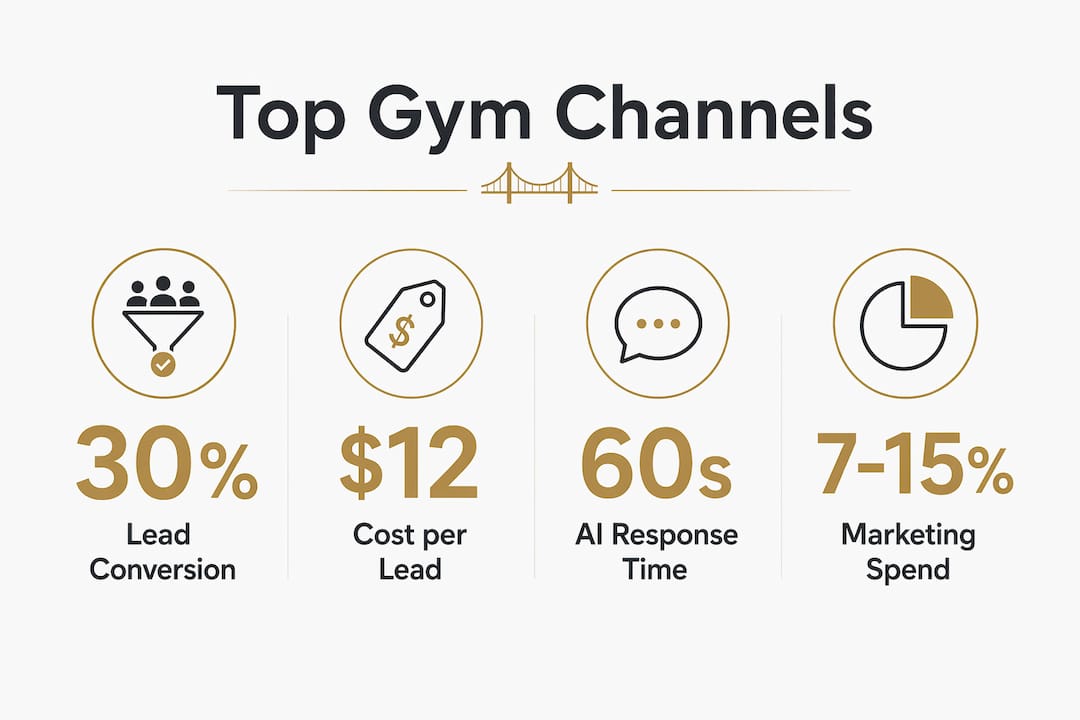
The most effective fitness marketing strategy concentrates spending on channels that produce measurable leads, not just brand visibility. Performance-based channels like drive-time-targeted paid ads, referrals, and organic local search account for 70–80% of new members at most gyms. That figure alone should reshape how you think about channel mix.
Channel budget breakdown
Industry data shows a clear picture of where fitness marketing budgets go and where they should go:
- Paid social ads (Meta, TikTok): 35–45% of budget, the single largest investment for most gyms
- Community partnerships: 5–15%, often underused despite strong local ROI
- Local SEO: 5–10%, a long-term asset that compounds over time
- Referral programs: 5–10%, the lowest cost-per-acquisition channel available
- SMS nurture: 5–10%, critical for speed-to-lead follow-up
- Email marketing: 3–5%, best for retention and reactivation campaigns
- Organic social: 5–10%, builds trust but rarely drives direct conversions alone
The AI lead nurturing advantage
Speed of response is the single biggest variable in lead conversion. AI-driven lead response in under 60 seconds can push lead-to-tour conversions from the typical 15–25% range up to 30–45%. That improvement directly lowers your customer acquisition cost. Operators using AI-based automated responses convert leads to tours at nearly double the rate of manual follow-up. Tools like SMS automation connected to your lead forms make this possible without adding staff hours. For a practical look at how automation works in this context, this breakdown of SMS lead automation is worth reading.
The most common mistake gym owners make is over-investing in awareness channels, such as broad Instagram reach campaigns, while underfunding the performance channels that actually close members. Awareness has a role, but it should not consume budget that belongs in paid search, retargeting, or referral incentives.
How to build a 12-month campaign calendar for your gym
A campaign calendar turns your annual fitness promotion plan from a document into a daily operating tool. The goal is to give every month a clear theme and every week a defined set of tasks.
Building the 12-month structure
- January: New Year membership push. Run paid Meta ads targeting local adults who searched fitness-related terms in December. Offer a free first week or waived enrollment fee.
- February: Retention focus. Run a member appreciation campaign. Recognize top referrers publicly.
- March: Spring transformation challenge. Six-week program with before-and-after tracking. Capture testimonials for use in Q2 ads.
- April: Community partnership activation. Partner with a local nutrition shop or physical therapy clinic for a co-promotion.
- May: Referral program push. Offer existing members a reward for every new member they bring in. Track referral rates against your 0.1–0.3 benchmark.
- June: Summer body campaign. Paid social with video content showing real member results.
- July: Reactivation campaign. Email and SMS outreach to lapsed members with a return offer.
- August: Back-to-routine push targeting parents and professionals after summer.
- September: Fall challenge launch. Similar structure to the spring challenge with updated creative.
- October: Local SEO push. Update Google Business Profile, collect new reviews, and publish local content.
- November: Holiday survival campaign. Position your gym as the antidote to holiday weight gain.
- December: Early New Year offer. Lock in January members before the rush with a pre-enrollment discount.
The 3-month incentive rotation
Running the same incentive all year kills engagement. A repeating 3-month cycle of micro-rewards, raffles, and recognition prevents campaign fatigue and keeps member participation high. Rotate the format every quarter so members always have a fresh reason to engage.
| Month cycle | Incentive type | Example |
|---|---|---|
| Month 1 | Micro-rewards | Free branded gear for hitting attendance goals |
| Month 2 | Raffle | Monthly prize draw for consistent members |
| Month 3 | Recognition | Member spotlight on social media and in-gym signage |
Pro Tip: Map your campaign calendar in a shared Google Sheet with columns for theme, channel, budget, owner, and KPI. Review it in your quarterly planning session and update it before the next quarter starts.
Weekly minimum viable marketing routine
A weekly marketing routine prevents the daily scramble of panicked, inconsistent spending and keeps lead flow steady. Your non-negotiable weekly tasks should include: posting two to three organic social pieces, checking ad performance and adjusting bids, following up with all open leads, and sending one email or SMS to your nurture list. These tasks take less than three hours per week and produce compounding results over a full year.
How do you track and improve your fitness marketing results?
Tracking is where most gym owners fall short. They run campaigns but never close the loop on what worked. A proper review process fixes that.
Quarterly marketing reviews should last 60–90 minutes and focus on three questions: What is working? What should change? What are the next steps? Block this time in your calendar before the quarter ends, not after.
Key metrics to track every quarter
- Lead-to-tour conversion rate: Target 15–25%, aim for 30% or above
- Member referral rate: Track per active member per quarter; above 0.5 is exceptional
- Customer acquisition cost (CAC): Total marketing spend divided by new members acquired
- Net Promoter Score (NPS): Measures member satisfaction and predicts referral likelihood
- Cost per lead by channel: Identifies which channels deliver the most efficient leads
Pro Tip: Use a simple spreadsheet to log weekly lead counts, tours booked, and new members signed. After 90 days, you will have enough data to make confident budget decisions instead of guesses.
Responsive budget adjustment is the practical output of every review. If paid Meta ads are producing leads at $12 each and local SEO is producing leads at $40 each, shift budget toward Meta. Do not wait until the end of the year to make that call. For a deeper look at gym lead generation benchmarks and tactics, Enochmarketing has published a detailed breakdown worth bookmarking.
What mistakes undermine a fitness marketing plan?
The most damaging mistake is treating marketing as a series of one-off campaigns rather than a continuous system. A gym that runs a big January push and then goes quiet until summer will see lead flow collapse in the gap. Marketing success depends on treating promotion as an ongoing operating system with daily and weekly routines, not a project with a start and end date.
Common pitfalls and how to fix them
- Skipping the weekly routine: Sporadic posting and irregular ad management produce irregular results. Commit to the minimum viable routine every week without exception.
- Over-investing in awareness: Broad reach campaigns build familiarity but rarely convert. Shift budget toward performance-based channels that produce trackable leads.
- Slow lead follow-up: Every hour of delay after a lead submits a form reduces conversion probability. Automate your first response with SMS or email to hit that sub-60-second window.
- Ignoring referrals: A structured referral program is the lowest-cost acquisition channel most gyms have. If you are not actively incentivizing referrals, you are leaving members on the table.
- No creative refresh: Running the same ad creative for more than six weeks causes audience fatigue. Rotate visuals and copy monthly.
"The gym owners who grow consistently are not the ones with the biggest budgets. They are the ones who show up in their marketing every single week, review what works, and adjust without drama."
Key takeaways
A fitness business annual marketing plan works when it combines a realistic budget, the right channel mix, a structured campaign calendar, and a disciplined weekly routine reviewed every quarter.
| Point | Details |
|---|---|
| Budget by business stage | Spend 7–8% of gross revenue if established, 10–15% if in growth mode. |
| Prioritize performance channels | 70–80% of new members come from paid ads, referrals, and local search. |
| Automate lead follow-up | AI response under 60 seconds can push conversion rates to 30–45%. |
| Use a 3-month incentive rotation | Rotate micro-rewards, raffles, and recognition to prevent member fatigue. |
| Review quarterly, not annually | Block 60–90 minutes each quarter to assess what is working and reallocate budget. |
What I have learned building fitness marketing plans that actually work
The biggest shift I have seen in fitness marketing over the past few years is not the rise of TikTok ads or AI tools. It is the realization that most gym owners do not have a marketing problem. They have a consistency problem. They run a great campaign in January, burn out by march, and wonder why leads dry up in april.
The gyms that grow year over year treat marketing like a utility. It runs every week whether the owner feels inspired or not. The weekly routine is non-negotiable, the quarterly review is calendared in advance, and the annual plan is a living document that gets updated, not archived.
AI-driven lead nurturing has genuinely changed the math on customer acquisition. When I see a gym respond to a lead in under a minute automatically, and then watch their tour rate climb toward 40%, it is hard to argue against building that into every plan from day one. The technology is not complicated. The commitment to setting it up is the actual barrier.
My honest advice: build the simplest plan you will actually execute, not the most impressive one you will abandon. A 12-month calendar with clear monthly themes, a weekly task list, and a quarterly review beats a 40-page strategy document that sits in a Google Drive folder untouched.
— Collin
Ready to build your gym's marketing plan with expert support?
Building a full annual marketing plan takes time, and executing it consistently takes systems most gym owners do not have in place yet. Enochmarketing works exclusively with CrossFit gyms and fitness brands across the United States, building paid media campaigns on Meta and Google, setting up AI-driven lead funnels, and managing local SEO so your gym dominates its local market.
If you want a plan built specifically for your gym's stage, market, and goals, the team at Enochmarketing offers a free strategy session to audit your current marketing and map out a path forward. Check out the full range of gym marketing services and see what a performance-focused approach looks like in practice.
FAQ
What is a fitness business annual marketing plan?
A fitness business annual marketing plan is a 12-month roadmap that defines your marketing goals, budget, channels, campaign schedule, and review process. It replaces reactive, ad-hoc spending with a structured system for consistent client acquisition and retention.
How much should a gym spend on marketing?
Established gyms should spend 7–8% of gross revenue on marketing, while gyms in growth mode or launching new programs should budget 10–15%, according to SBA guidelines.
What is a good lead-to-tour conversion rate for a gym?
A lead-to-tour conversion rate of 15–25% is typical, and 30% or above is considered strong. AI-driven follow-up under 60 seconds can push rates into the 30–45% range.
How often should I review my gym's marketing plan?
Review your marketing plan every quarter in a focused 60–90 minute session. Ask what is working, what should change, and what the next steps are, then adjust your budget and campaigns accordingly.
What is the most cost-effective marketing channel for gyms?
Referral programs consistently deliver the lowest customer acquisition cost of any channel. Pairing a structured referral incentive with automated SMS follow-up produces strong results at minimal spend.