
Almost half of U.S. adults do not meet recommended physical activity guidelines, which means your potential member base is enormous. The problem is that those people will not find your CrossFit gym by accident. Understanding why fitness marketing matters is the difference between a box that grows month over month and one that survives on referrals alone. This article breaks down the economics, the tactics, and the mindset shifts that turn a marketing budget into a predictable membership growth engine.
Table of Contents
- Why fitness marketing matters for CrossFit gym growth
- Retention vs. acquisition: The economics that make marketing critical
- Targeting intent: Local search and digital marketing strategies that convert
- Building community partnerships to amplify fitness adoption
- Why consistent, educational marketing builds trust and boosts results
- Rethinking fitness marketing: Shifting from lead gen to member activation
- Grow your CrossFit gym with expert marketing support
- Frequently asked questions
Key Takeaways
| Point | Details |
|---|---|
| Large untapped market | Nearly half of U.S. adults do not meet physical activity guidelines, offering growth opportunities for CrossFit gyms. |
| Retention is profitable | Retaining members costs significantly less than acquiring new ones and increases lifetime value. |
| Local intent wins | Targeted local search marketing captures high-intent prospects ready to join. |
| Community boosts growth | Partnerships with local organizations expand reach and support sustained member engagement. |
| Educate to build trust | Consistent, educational marketing helps build member loyalty more effectively than one-off promotions. |
Why fitness marketing matters for CrossFit gym growth
The opportunity sitting outside your gym doors is bigger than most owners realize. Nearly half of U.S. adults met federal aerobic physical activity guidelines in 2024, with significant variation across gender, education level, and health status. That variation is important. It tells you that the inactive population is not one monolithic group. It is a collection of distinct segments, each with different motivations, barriers, and communication preferences.

For CrossFit gyms specifically, this creates a layered opportunity. Adults who are inactive but health-conscious respond differently to marketing than former athletes who have drifted from structured training. Parents seeking functional fitness respond differently than young professionals chasing body composition goals. Effective fitness marketing starts by recognizing these distinctions and speaking to each segment directly.
Here is a snapshot of the addressable market based on current physical activity data:
| Segment | Activity status | Primary opportunity |
|---|---|---|
| Sedentary adults (18 to 44) | Not meeting aerobic guidelines | Community and beginner-friendly messaging |
| Strength seekers | Meeting aerobic but not muscle guidelines | CrossFit's strength and conditioning angle |
| Lapsed athletes | Previously active, now irregular | Re-engagement and accountability campaigns |
| Active explorers | Meeting guidelines but seeking variety | Performance and community culture content |
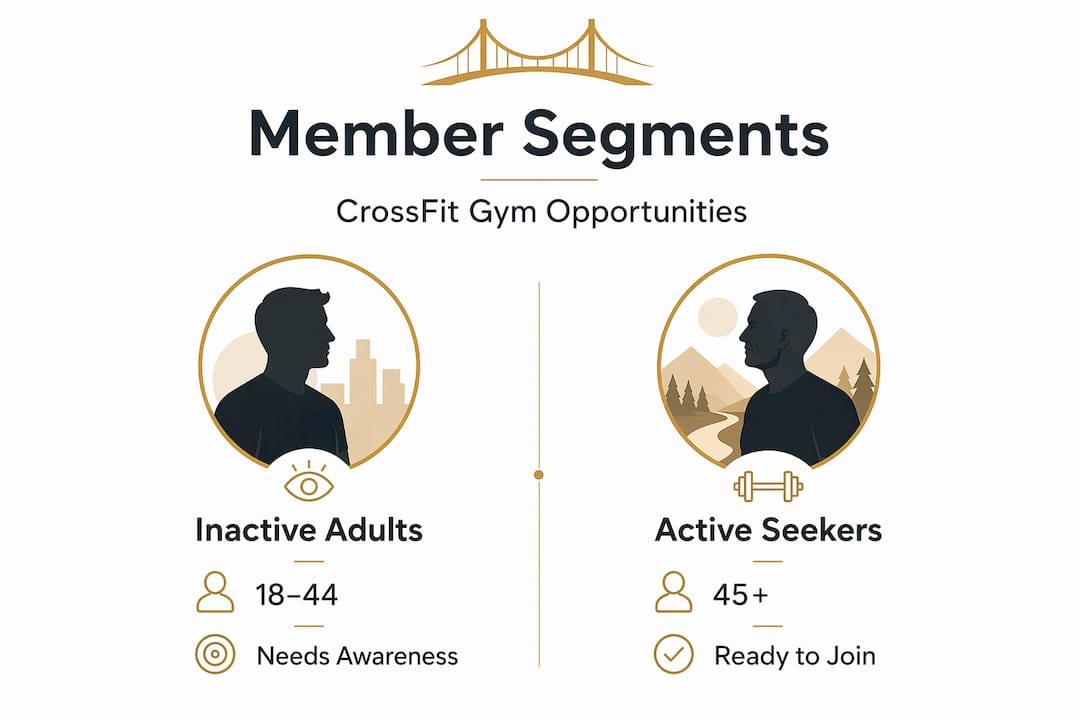
The local gym marketing strategies you deploy need to map to these segments, not just broadcast a generic "join our gym" message to everyone within a 10-mile radius.
Key targeting priorities include:
- Age and gender breakdowns that reveal which demographics are underserved in your zip code
- Household income data for setting realistic membership price points in paid campaigns
- Search behavior that reveals whether your audience is researching CrossFit specifically or just "gyms near me"
- Device usage patterns because mobile search dominates local fitness decisions
Retention vs. acquisition: The economics that make marketing critical
Once you understand the size of your potential market, the next question is where to focus your marketing dollars. Most gym owners default to pure acquisition. That is understandable but expensive. Acquiring a new gym member costs approximately five times more than retaining an existing one, which means every member who walks out the door is not just lost revenue, it is a multiplied cost to replace them.
This is why the importance of fitness marketing extends well beyond generating leads. Marketing is the mechanism that keeps current members engaged, informed, and emotionally connected to your gym's community. When done well, it reduces churn. When ignored after sign-up, it accelerates it.
Here is the retention-focused marketing sequence that produces the best results in the first 90 days:
- Day 1 to 7: Send a welcome series that reinforces the decision to join. Include a short video from your head coach, a class schedule guide, and what to expect in the first foundations class.
- Day 8 to 30: Use social media retargeting to show new members content that reflects their experience, success stories from athletes at their level, and community highlights.
- Day 31 to 60: Deploy email or SMS check-ins tied to their progress milestones. Acknowledge streaks, PRs, or simply three consecutive weeks of attendance.
- Day 61 to 90: Begin referral activation. Members who survive the first 90 days are your most motivated advocates. Give them a reason and a simple mechanism to bring a friend.
"The gym members most likely to churn are those who never fully integrated into the community. Marketing that creates connection before they feel isolated is cheaper than the ads you will buy to replace them."
Personalizing fitness marketing for retention means using what you know about a member's goals and class history to send communications that feel relevant, not generic.
Pro Tip: Set up a simple automation that flags any member who has not attended in 10 days. Trigger a personal-sounding text or email from the head coach. One touchpoint at the right moment recovers members who are quietly drifting out the door.
Targeting intent: Local search and digital marketing strategies that convert
Understanding the economics of retention leads directly to a smarter approach to acquisition. Not all leads are equal. Someone searching "CrossFit gym open enrollment near Denver" is fundamentally different from someone scrolling Instagram who happens to see your ad. Intent-based marketing captures the first group at the exact moment they are ready to make a decision.
A Denver CrossFit gym increased call and form inquiries by 35% after launching local intent keyword campaigns on Google Ads. The mechanism is not complicated. It is targeting people who are already searching for what you offer, then making sure your gym is the answer they find.
Key digital tactics that convert local prospects:
- City-specific keyword targeting: Phrases like "CrossFit gym [your city]" or "best CrossFit near [neighborhood]" capture high-intent searchers who are comparison-shopping and ready to visit
- Separate map-pack and search campaigns: Your Google Business Profile (map-pack) and your paid search ads serve different intent levels. Track them separately so you know which drives actual visits
- Device-specific bid adjustments: Mobile searchers looking for a gym near them are closer to a decision than desktop researchers. Bid higher on mobile during peak hours (early morning, lunch, evening)
- Dedicated landing pages: Never send ad traffic to your homepage. A landing page that mirrors the ad's language and offers a single clear action (book a free class) converts far better
| Tactic | Primary benefit | Best use case |
|---|---|---|
| Local intent keywords | High conversion rate | Google Search campaigns |
| Geographic radius targeting | Budget efficiency | New gym launches |
| Mobile bid adjustments | Foot traffic | Evening and weekend campaigns |
| Tailored landing pages | Reduced friction | Any paid campaign |
Understanding scaling gym advertising means knowing when to increase spend and on which channels. Build marketing funnels for CrossFit gyms that guide cold prospects through awareness, consideration, and conversion rather than asking strangers to sign a membership agreement on the first click.
Pro Tip: Create a "free intro class" landing page with a live calendar embed. Removing the friction of back-and-forth scheduling increases bookings dramatically. People commit when they can pick a slot in 30 seconds.
Building community partnerships to amplify fitness adoption
Paid digital campaigns are powerful, but they are not the only channel that drives growth. The role of marketing in gyms increasingly includes community-level partnerships that build trust and visibility in ways that ads cannot replicate.
Community collaborations among organizations, governments, and businesses can overcome barriers to physical activity and support healthier, more active populations. For a CrossFit gym owner, this is not abstract research. It is a practical playbook.
Effective partnership types for local gyms:
- Corporate wellness programs: Partner with local employers to offer discounted memberships or on-site workshops. You get access to a captive audience of health-motivated employees
- Local nonprofit collaborations: Sponsor a charity 5K or host a fundraiser WOD. The visibility within a cause-aligned community builds goodwill that referrals can not
- School and youth athletics programs: Offer strength and conditioning sessions for high school sports teams. Parents notice. Coaches talk
- Healthcare provider referrals: Connect with physical therapists and primary care doctors who recommend structured fitness for patients recovering from inactivity-related conditions
"The gym that becomes a community institution, not just a facility, earns members who stay for years, not months."
These partnerships support your strategic community partnerships approach by creating multiple points of visibility in the same local market. One ad campaign reaches a prospect once. A community partnership can keep your gym's name in front of the same prospect at six different touchpoints over three months.
Why consistent, educational marketing builds trust and boosts results
There is a reason why fitness promotion is crucial beyond just generating awareness. Fitness consumers are skeptical. They have been burned by programs that did not deliver, coaches who were not qualified, and gyms that felt intimidating the moment they walked in. Before someone pays for a CrossFit membership, they research. They watch your Instagram. They read your Google reviews. They look at who your coaches are.
Educational marketing that covers performance, recovery, and coaching builds trust and repeat engagement far better than hype-based promotion. The impact of marketing in fitness is most durable when it teaches rather than sells.
Here is how to build a trust-based marketing content calendar:
- Coach spotlights: Short videos where your coaches explain their certifications, their coaching philosophy, and what they love about working with beginners
- Movement education posts: A 60-second breakdown of a kipping pull-up or a squat clean scaling option shows prospects that your gym is approachable and technically credible
- Member journey content: Real member stories with real timelines. Not before-and-after transformation photos, but narratives about what changed beyond their body
- Recovery and nutrition education: Content that addresses what happens outside the gym positions your box as a complete resource, not just a place to work out
- FAQ content targeting common objections: "Is CrossFit safe for beginners?" and "How quickly will I see results?" are searches your prospects are already making. Answer them in your content
Pro Tip: Post consistently more than posting perfectly. A gym that publishes authentic, useful content three times a week outperforms one that posts a polished production once a month. Frequency builds familiarity, and familiarity builds trust.
Effective CrossFit marketing is not about shouting louder than the competition. It is about being the gym that prospects feel they already know before they ever book an intro class.
Rethinking fitness marketing: Shifting from lead gen to member activation
Here is the perspective that most marketing conversations around gyms skip entirely: generating a lead is the cheapest part of the equation. Activating that lead, turning a new sign-up into a genuinely engaged member who shows up four times a week and tells their friends, is where real growth happens.
Most gym owners focus marketing only on lead generation, while the biggest returns come from reducing early churn by activating leads in the first 90 days. We see this pattern constantly. A gym runs a strong January campaign, signs up 40 new members, and by March has retained 14. The marketing worked. The activation did not.
The shift we advocate is treating the post-sign-up experience as a marketing function, not an operations function. Your onboarding email sequence is marketing. Your coach's first-week check-in call is marketing. The Spotify playlist in the 6 a.m. class is marketing. Every touchpoint that shapes how a new member feels about your gym is part of the campaign.
Marketing funnels insights consistently show that gyms who extend their funnel past the sign-up point see lower cost per retained member and higher lifetime value per member. The math is simple. If you spend $150 to acquire a member who leaves in 60 days, your effective cost is enormous. If you spend an additional $20 on an activation sequence that keeps them for 18 months, your acquisition cost per year of membership drops dramatically.
Stop thinking about marketing as the thing you do to get people in the door. Start thinking about it as the ongoing conversation that keeps them there.
Grow your CrossFit gym with expert marketing support
Knowing why fitness marketing matters is one thing. Building and running campaigns that generate consistent leads, convert them into paying members, and keep those members engaged long enough to refer their friends is another. That is a full-time job on top of the full-time job of running a gym.
Enoch Marketing works exclusively with CrossFit gyms and fitness brands across the United States. We build the full system: local search campaigns that capture high-intent prospects, retention-focused email and SMS sequences, community content that builds trust before someone ever books an intro, and the reporting that tells you what is actually working. Explore our CrossFit gym marketing services or review marketing pricing options that fit your gym's stage and budget. Ready to see what a custom strategy looks like for your market? Contact Enoch Marketing and book a free strategy session today.
Frequently asked questions
Why is fitness marketing especially important for CrossFit gyms?
CrossFit gyms serve a community-oriented, coached fitness experience that most inactive adults are not yet aware they need. Fitness marketing bridges that gap by reaching local prospects at the moment they are searching for structured guidance, and a Denver CrossFit gym's 35% increase in inquiries after local intent campaigns shows exactly how well that works when done right.
How does member retention impact my gym's marketing budget?
Every member you keep is one you do not have to replace. Because acquiring a new member costs roughly five times more than retaining an existing one, even modest retention improvements free up significant budget that can fuel smarter acquisition campaigns.
What marketing tactics work best for gyms targeting local customers?
Targeting city-specific search terms and pairing them with dedicated landing pages that offer a single clear action (book a free intro class) captures high-intent prospects most likely to convert. Local intent campaigns consistently outperform broad awareness advertising for local gyms with limited budgets.
Can partnerships with community organizations help my gym's marketing?
Absolutely. Community partnerships reduce barriers to physical activity and put your gym's name in front of audiences that paid ads rarely reach, including corporate employees, youth athletes, and healthcare patients who need structured fitness guidance.
Why isn't regular promotional marketing enough for fitness consumers?
Fitness consumers research before they buy. Educational marketing builds trust by addressing real concerns like coach qualifications, class difficulty, and realistic results. Hype-based promotions attract attention but rarely convert the skeptical adults who make up the majority of your untapped market.