
Gym marketing budget allocation is the process of distributing your marketing funds across paid, organic, and retention channels to maximize membership growth and local market reach. Most gyms invest 5–12% of revenue on marketing, with new gyms pushing 12–18% to accelerate early acquisition. The industry term for this practice is channel budget allocation, and getting it right separates gyms that grow predictably from those that burn cash on tactics that never convert. This guide gives you the exact percentages, seasonal shifts, and execution steps to make every dollar count.
What is gym marketing budget allocation and how should you split it?
A well-structured gym marketing budget allocation splits spend across five core channels. Each channel serves a different role in your membership funnel, and the percentages below reflect what high-performing gyms use in 2026.
| Channel | Recommended allocation | Primary purpose |
|---|---|---|
| Paid social (Meta, TikTok) | 35–45% | Awareness and lead generation |
| Google search and local service ads | 15–25% | High-intent prospect capture |
| Referral incentives | 5–10% | Low-cost member acquisition |
| Creative production (photo, video) | 10–15% | Ad creative and brand content |
| Retention platforms (email, SMS) | 10–15% | Member nurture and churn reduction |

Paid social takes the largest share because Meta and TikTok ads let you target by zip code, age, and fitness interest with precision. Meta ads monthly budgets typically run $800–$3,500, while Google Ads run $600–$3,000 per month. Google costs more per click but converts better because searchers already want a gym. For a concrete example, a $24,000 annual budget would put roughly $8,400–$10,800 into Meta, $3,600–$6,000 into Google, and the remainder into referrals, creative, and retention.
Referral incentive budgets typically represent 5–10% of total marketing spend. One month of free membership or a cash reward works well as an incentive. Referrals are the lowest cost acquisition channel when the program is structured correctly, so even a modest allocation here pays back quickly.
Pro Tip: Review channel performance every 30 days. If your paid social retargeting is generating leads at under $30 per lead, shift 5% from Google into that channel until cost per lead rises.
How to adjust your budget for seasonal gym marketing demands
Marketing budgets should not stay flat year-round. Seasonal marketing budgets vary significantly, with the highest acquisition spend concentrated in january and february, and retention focus dominating the summer months.
Here is how to shift your spend across the year:
- January and february (25–30% of annual budget): This is peak acquisition season. New Year's resolution demand is at its highest. Pour the majority of your paid social and Google budget here. Run lead magnet campaigns, free trial offers, and transformation challenges.
- March through may (15–20% of annual budget): Demand stays moderate. Shift some budget from awareness ads toward email nurture sequences for leads who did not convert in january. Spring body-goal messaging works well for paid social.
- June through august (15–20% of annual budget): Acquisition slows. Redirect funds toward retention campaigns, community events, and member referral programs. SMS check-ins and loyalty rewards keep members engaged through the summer drop-off period.
- September through november (15–20% of annual budget): A secondary acquisition window opens as routines reset after summer. Reactivate lapsed members with email win-back campaigns and run back-to-routine paid social ads.
- December (10–15% of annual budget): Spend lightly on acquisition. Focus on gift card promotions and early sign-up deals for january to build your pipeline before the new year rush.
Shifting budget this way means you are not paying peak CPMs in july when nobody is signing up. You protect margin in slow months and attack hard when demand is highest. A gym marketing calendar built around these windows makes execution far easier.
How to build and implement your gym promotional budget plan
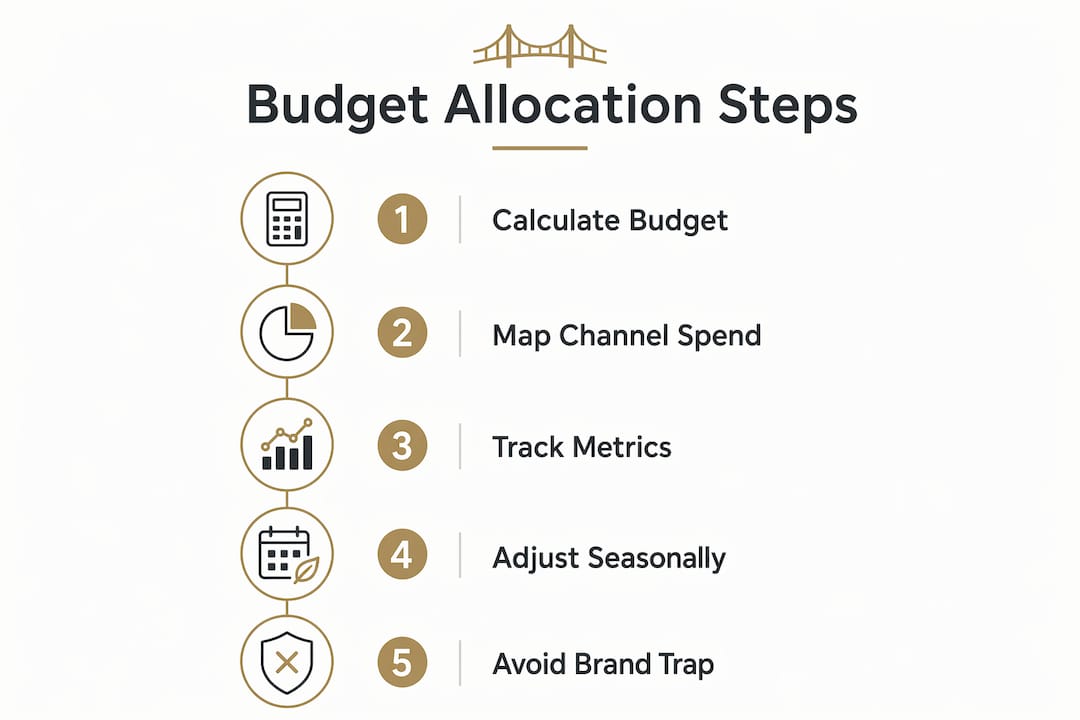
A practical fitness marketing strategy starts with one number: your total monthly marketing budget. Set it at 5–12% of monthly revenue. A gym generating $50,000 per month should spend $2,500–$6,000 on marketing. New gyms should push toward the higher end of that range or beyond to build their member base faster.
Step 1: Calculate your total budget
Take your average monthly revenue and multiply by your target percentage. If you are pre-launch or under 100 members, treat your budget as an investment rather than a percentage of current revenue. Set a fixed monthly spend based on your acquisition goal and work backward from cost per lead.
Step 2: Map channel spend to your gym's stage
Early-stage gyms should weight heavily toward paid social and Google, since referrals require an existing member base to work. Mature gyms with 300-plus members can reduce paid acquisition spend and increase referral and retention budgets. The table below shows a sample split by gym maturity.
| Gym stage | Paid social | Google ads | Referrals | Creative | Retention |
|---|---|---|---|---|---|
| Pre-launch (0–50 members) | 45% | 25% | 5% | 20% | 5% |
| Growth (50–200 members) | 40% | 20% | 8% | 15% | 12% |
| Mature (200+ members) | 30% | 15% | 12% | 10% | 15% |
Step 3: Track the metrics that matter
Gyms should track cost per lead by channel, conversion rates from lead to member, and monthly churn. These three numbers tell you exactly where your budget is working and where it is wasting. Review them monthly and reallocate accordingly.
Step 4: Avoid the brand awareness trap
Over-investing in brand awareness before building a performance-based lead generation engine is a leading cause of wasted spend. Brand content and logo ads do not fill your CRM. Direct response ads with a clear offer and a landing page do. Build your lead gen foundation first, then layer in brand content once you have consistent monthly leads coming in.
Pro Tip: Run your Google Ads for gyms with exact-match and phrase-match keywords only in the first 60 days. Broad match burns budget on irrelevant searches before you have enough conversion data to filter efficiently.
How does retention marketing fit into your gym advertising budget?
Retention marketing is 5–10 times more cost-efficient than acquisition per dollar of revenue retained. That figure means keeping one member costs a fraction of what it takes to replace them. Yet most gym owners treat retention as an afterthought and allocate almost nothing to it.
The recommended allocation for retention platforms sits at 10–15% of your total marketing budget. For a gym spending $4,000 per month on marketing, that is $400–$600 going toward email platforms, SMS tools, and CRM automation. That spend directly reduces churn, which compounds into significant revenue over 12 months.
Effective retention campaigns include:
- Monthly check-in emails that celebrate member milestones and share class updates
- SMS win-back sequences triggered when a member misses two or more weeks
- Referral nudges sent to your most engaged members, offering a reward for bringing in a friend
- Personalized fitness content delivered by email based on the classes a member attends most
Gyms that personalize fitness marketing through segmented email and SMS campaigns see measurably lower churn than those sending generic newsletters. Segmentation does not require expensive software. Most mid-tier CRM platforms let you tag members by class type, attendance frequency, and join date.
Pro Tip: Set up an automated SMS message that fires when a member has not checked in for 10 days. A simple "We miss you" message with a link to book a class recovers a meaningful percentage of at-risk members before they cancel.
Retention is also your cheapest referral engine. A member who feels connected to your gym community will bring in friends without being asked. Allocating budget to nurture that connection pays off in acquisition savings you never have to measure directly. Maintaining gym equipment safety also contributes to member confidence and retention, since members who trust your facility stay longer.
Key Takeaways
Effective gym marketing budget allocation requires splitting spend across five channels, adjusting for seasonal demand, and protecting retention spend as a non-negotiable line item.
| Point | Details |
|---|---|
| Set budget as a revenue percentage | Allocate 5–12% of monthly revenue, with new gyms pushing 12–18% to build membership faster. |
| Weight paid social and Google first | Paid social takes 35–45% and Google 15–25%, forming the core of your lead generation spend. |
| Shift budget with the seasons | Put 25–30% of annual spend into january and february when acquisition demand peaks. |
| Protect retention budget | Allocate 10–15% to email and SMS platforms; retention costs 5–10x less than new acquisition. |
| Track cost per lead monthly | Measure cost per lead by channel and reallocate budget toward what converts, not what looks good. |
What I have learned about gym marketing budget allocation after working with dozens of gyms
Gym owners consistently make the same mistake: they spend on what feels productive rather than what converts. A polished brand video gets likes. A direct response Meta ad with a free trial offer gets phone numbers. Those are not the same thing, and confusing them is expensive.
The gyms I have seen grow fastest treat their marketing budget like a portfolio. They diversify across channels, but they weight toward what is working right now. They do not stay loyal to a channel out of habit. If Google Ads are delivering leads at $25 each and Meta has crept to $70, they shift dollars to Google that week. That kind of flexibility requires tracking, and most gym owners are not tracking closely enough.
Seasonal flexibility is not optional. A flat monthly budget ignores the reality that january is worth three times what july is for acquisition. Gyms that front-load their annual spend into the first quarter and then shift to retention in summer consistently outperform those that spend the same amount every month.
The other thing I push hard on is retention as a marketing function. Most gym owners see retention as an operations issue. It is not. It is your highest-ROI marketing channel. Every dollar you spend keeping a member is a dollar you do not have to spend replacing them. Build that into your budget from day one, not as an afterthought when churn gets bad.
— Collin
How Enochmarketing can sharpen your gym's marketing spend
Knowing the right percentages is one thing. Executing them across Meta, Google, email, and referral programs while running a gym is another challenge entirely.
Enochmarketing works exclusively with CrossFit gyms and fitness brands across the United States, building and managing the exact channel mix described in this guide. From paid media campaigns on Meta and Google to lead funnel creation and local SEO, every service is built around one goal: filling your gym with paying members. Gym owners who want a clear picture of where their current budget is going and what it should be doing can book a free strategy session with the Enochmarketing team. The audit alone typically surfaces significant budget waste that can be redirected toward channels that actually convert.
FAQ
What percentage of revenue should a gym spend on marketing?
Most gyms allocate 5–12% of revenue to marketing. New gyms in their first year should push toward 12–18% to build their member base faster.
What is the best channel for gym lead generation?
Paid social ads on Meta consistently deliver the highest lead volume for gyms, with cost per new member ranging $20–$80. Google Ads cost more per click but convert better for high-intent searchers.
How much should a gym spend on referral programs?
Referral incentive budgets typically represent 5–10% of total marketing spend. One month of free membership is a proven and cost-effective incentive structure.
When should gyms increase their marketing spend?
Gyms should concentrate 25–30% of their annual budget in january and february, when new member demand peaks. A secondary push in september captures back-to-routine sign-ups after summer.
Why is retention part of the marketing budget?
Retention marketing via email and SMS is 5–10 times more cost-efficient than acquiring new members. Allocating 10–15% of your budget to retention platforms directly reduces churn and lowers your total acquisition cost over time.