
Gym digital presence is defined as the full collection of online assets, platforms, and marketing activities that represent your gym to prospective and current members. This includes your Google Business Profile, social media channels, booking storefront, website, and paid ad campaigns working together as one system. A gym with a strong online presence gets found first in local searches, builds trust before a prospect ever walks through the door, and converts interest into memberships faster than gyms relying on word of mouth alone. The industry term for this integrated approach is digital marketing for gyms, and understanding its components is the first step toward building a system that actually grows your member base.
What are the key components of a gym's digital presence?
A gym's digital presence is an integrated ecosystem built from several distinct but connected assets. Each one plays a specific role. Together, they determine whether a prospect finds you, trusts you, and joins.
Google Business Profile (GBP)

GBP is your gym's most important local search asset. It controls how your gym appears on Google Maps and in the local pack at the top of search results. Accurate hours, photos, amenities, and member reviews all live here. Gyms that update their GBP weekly with fresh photos and current offers consistently rank higher in local searches.
Conversion-optimized booking storefront
A booking storefront is not a traditional website. It is a page built specifically to get a prospect to sign up or book a class in under 90 seconds. 37% of gyms have no digital path to purchase, meaning a prospect who wants to join has no way to do so online. That is a direct revenue loss.
Active social media profiles
Instagram and TikTok are the primary platforms for fitness content. Your profiles serve as a living portfolio of your gym's culture, coaches, and community. Consistent posting builds familiarity and trust before a prospect ever contacts you.
Supporting digital assets
These include your main website as an informational hub, email and SMS lead nurture sequences, and paid ad campaigns on Meta and Google. Each asset feeds the others. A paid ad drives traffic to your storefront. Your GBP builds trust. Your social media reinforces the decision to join.
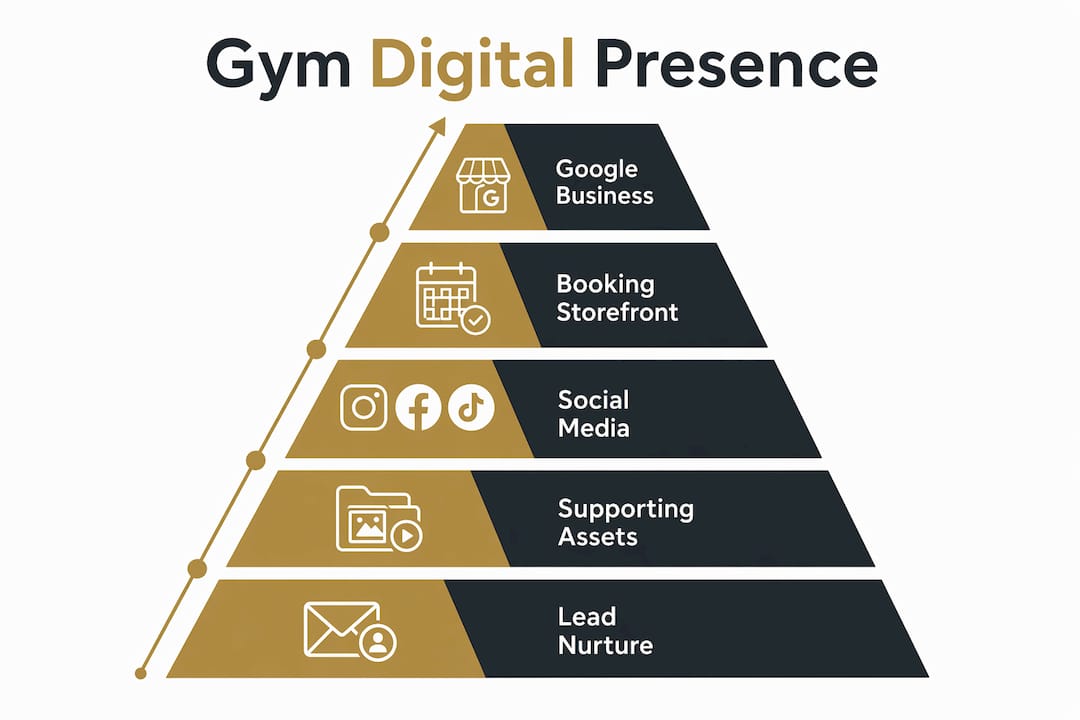
Pro Tip: Treat your GBP, storefront, and social profiles as three legs of one stool. If one is weak, the whole system wobbles.
How does Google Business Profile impact gym visibility?
GBP is often the first interaction a local prospect has with your gym. When someone searches "CrossFit gym near me" or "gym in [your city]," your GBP listing appears before your website. The information there, including your rating, photos, hours, and reviews, forms their first impression.
Optimizing your GBP is not a one-time task. The gyms that dominate local search treat it as an ongoing content channel. Here is what consistent GBP management looks like in practice:
- Post weekly updates. Add new photos of classes, equipment, and members (with permission). Share current promotions or events. Google rewards active profiles with higher placement.
- Keep your information accurate. Hours, address, phone number, and service categories must be current. A prospect who shows up when you are closed does not come back.
- List your amenities in detail. Parking, showers, childcare, and specialty equipment all appear in GBP. Prospects filter by these features.
- Respond to every review. Responding to positive and negative reviews signals to Google that you are an active, trustworthy business. It also signals the same to every prospect reading those reviews.
- Link directly to your booking storefront. Your GBP should send traffic straight to a page where a prospect can sign up, not to a generic homepage.
The local SEO playbook for gyms starts and ends with GBP management. No other single tactic delivers the same return per hour invested for a local fitness business.
Pro Tip: Use the GBP "Products" section to list your membership tiers with prices. Prospects who see pricing upfront convert at a higher rate because you have already answered their biggest question.
Why does social media matter for gym growth?
Fitness content is inherently visual, and Instagram and TikTok are the dominant platforms for reaching fitness audiences. A gym's social media presence extends its community beyond the four walls of the facility. It lets prospects see your culture, your coaches, and your members before they ever visit.
The content that performs best is not promotional. Community-focused content and member success stories consistently outperform discount posts and limited-time offers. A member transformation story or a coach spotlight builds emotional connection. A "20% off this weekend" post attracts deal seekers who churn within 90 days.
Authentic storytelling retains longer-term clients. Marketing strategies that focus on community and member success build loyalty that discount-driven tactics simply cannot match. Gyms that lead with their people, not their prices, attract members who stay.
Organic reach on both platforms has declined significantly. Posting great content is necessary but no longer sufficient on its own. AI tools for content production now allow gym owners to maintain consistent posting volume without spending hours each week creating from scratch. AI can generate caption variations, suggest content formats, and repurpose existing video clips into multiple posts.
A practical social media approach for gyms includes:
- Member spotlights and success stories posted at least twice per week
- Behind-the-scenes content showing coaches, programming decisions, and gym culture
- Interactive features like polls, Q&As, and challenge posts in Stories to drive engagement
- Reels and short-form video on TikTok and Instagram for maximum organic reach
- Paid social ads on Meta targeting local zip codes to amplify top-performing organic posts
For a deeper look at building this content system, the social media strategy guide from Enochmarketing walks through the full framework.
What technologies convert online interest into memberships?
The biggest shift in gym digital marketing over the past three years is the move from informational websites to conversion-focused digital storefronts. A traditional gym website tells prospects about your gym. A digital storefront gets them to buy.
The storefront approach enables prospects to purchase a membership or class package in under 90 seconds from their phone. No callback required. No email inquiry waiting 48 hours for a response. The prospect decides, clicks, and joins.
Class scheduling integrations like Mindbody and Glofox plug directly into booking storefronts, letting prospects see real-time class availability and reserve a spot before they have even paid for a membership. That first booking creates commitment.
The highest-ROI technology post-click is AI-driven SMS lead response. When a prospect fills out a lead form from a paid ad, an AI agent sends a personalized text within 60 seconds. That speed matters enormously. A lead who gets a response within one minute is far more likely to book a tour than one who waits for a manual callback hours later.
| Feature | Traditional website | Digital storefront |
|---|---|---|
| Primary goal | Inform | Convert |
| Membership signup | Contact form or phone | Online purchase in under 90 seconds |
| Lead response | Manual callback | AI SMS within 60 seconds |
| Class booking | External link or phone | Integrated scheduling in-page |
| Mobile experience | Informational scrolling | Single-action conversion page |
Pro Tip: Add a sticky CTA button to every page of your digital storefront. "Book a Free Class" or "Join Now" should always be visible, regardless of how far down the page a prospect scrolls.
The gym online presence guide for 2026 covers the full technical setup for building a storefront that converts. Coordinating your paid and organic search presence across the entire SERP, including ads, maps, reviews, and organic results, is what separates gyms that dominate their local market from those that compete on price alone.
Key Takeaways
A gym's digital presence is only as strong as the weakest link in its ecosystem: GBP, storefront, social media, and lead nurture must all work together to convert local interest into paying members.
| Point | Details |
|---|---|
| GBP is your first impression | Update it weekly with photos, offers, and review responses to rank higher locally. |
| Storefronts beat websites for conversion | A booking page that converts in under 90 seconds removes the biggest barrier to joining. |
| Social media builds trust before contact | Member stories and community content outperform discount posts for long-term retention. |
| AI SMS response wins leads | Responding to a lead within 60 seconds dramatically increases tour bookings and memberships. |
| Coordinate all digital assets | Paid ads, organic search, reviews, and social must work as one system, not separate efforts. |
What I have learned building gym digital presence from the ground up
The most common mistake I see gym owners make is investing in a beautiful website before they have fixed their Google Business Profile. A $10,000 website redesign will not move the needle if your GBP shows the wrong hours, has no photos, and has not been updated in eight months. Local search is where the decision happens. Fix that first.
The second mistake is chasing follower counts on social media instead of building genuine community content. I have watched gyms with 500 engaged followers outgrow gyms with 10,000 passive ones. The role of storytelling in fitness marketing is not a soft concept. It is the difference between a member who stays for three years and one who cancels after 60 days.
AI tools have genuinely changed what is possible for small gym operators. A solo gym owner can now maintain a consistent content calendar, respond to leads instantly, and run paid campaigns without a full marketing team. The technology is accessible. The gap between gyms using it and those ignoring it is widening fast.
The gym owners who win long-term are the ones who treat their digital strategy as an ongoing operation, not a one-time project. Consistency beats perfection every time.
— Collin
How Enochmarketing helps gyms build a presence that converts
Enochmarketing works exclusively with CrossFit gyms and fitness brands across the United States. Every service the agency offers, from GBP optimization and local SEO to Meta and Google Ads, is built around one goal: turning your online presence into a predictable source of new members.
The agency's process starts with a full audit of your current digital assets, identifies the gaps costing you leads, and builds a custom plan to close them. Whether you need a conversion-focused storefront, a social media content system, or AI-powered lead nurture, Enochmarketing delivers it as a complete growth system. Gym owners who want a clearer picture of what is possible can explore the full service offering or book a free strategy session directly through the site.
FAQ
What is gym digital presence?
Gym digital presence is the complete set of online assets and marketing activities that represent your gym, including your Google Business Profile, social media profiles, booking storefront, website, and paid ad campaigns.
Why does a gym need a digital storefront instead of a website?
A digital storefront is built to convert prospects into members in under 90 seconds. A traditional website informs but rarely converts, and 63% of gyms have no digital path to purchase at all.
How does Google Business Profile help a gym get more members?
GBP controls how your gym appears in local search results and Google Maps. Weekly updates with photos and review responses improve your ranking and build trust with prospects before they contact you.
What social media platforms work best for gyms?
Instagram and TikTok are the most effective platforms for gym marketing because fitness content is visual and both platforms prioritize short-form video. Member success stories and community content consistently outperform promotional posts on both channels.
How fast should a gym respond to online leads?
AI-driven SMS response within 60 seconds of a lead form submission produces the highest conversion rates. Manual callbacks that arrive hours later lose the majority of paid ad leads to faster-responding competitors.