
A gym's online presence is the combined effect of its local SEO, Google Business Profile, website performance, and social media activity on how many local members find and choose it over competitors. Gym owners who treat digital marketing as optional are losing members to competitors who rank first on Google Maps, collect five-star reviews weekly, and post consistent content on Instagram. Improving your gym's online presence means building a system where every digital touchpoint, from your website to your Google listing, works together to attract, convince, and convert local prospects. This guide breaks down exactly how to do that in 2026.
How to improve your gym's online presence: start with Google Business Profile
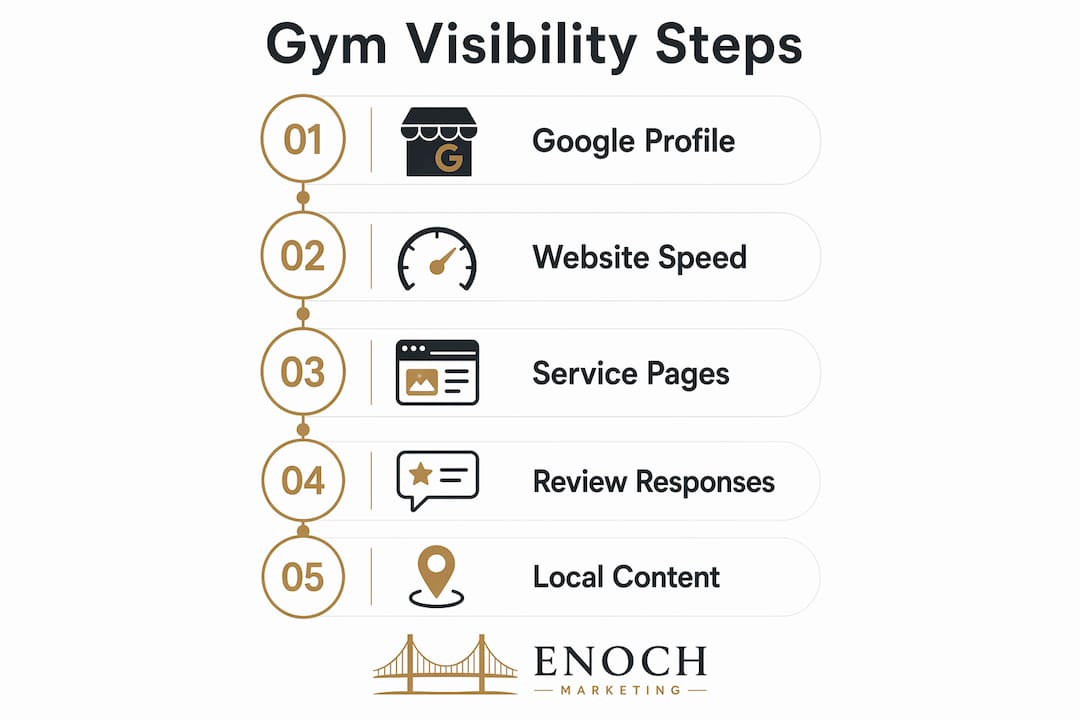
Google Business Profile (GBP) is the single highest-leverage tool for local gym discovery. When someone searches "CrossFit gym near me" or "best gym in [city]," Google ranks results based on three factors: proximity, relevance, and prominence. A fully completed GBP consistently outranks half-finished listings for local searches. That means a competitor with fewer members but a better-optimized profile will appear above you.
Here is how to complete your GBP the right way:
- Nail your NAP consistency. Your name, address, and phone number must match exactly across your website, GBP, and every directory listing. Even minor differences, like "St." versus "Street," confuse Google's ranking algorithm.
- Choose specific categories. Select a precise primary category such as "CrossFit gym" or "Fitness center," then add secondary categories like "Personal trainer" or "Yoga studio" to capture related searches.
- Upload 20 or more quality photos. Show your equipment, classes in action, trainer headshots, and the exterior of your facility. Listings with strong photo libraries generate significantly more direction requests and website clicks.
- Fill out every service and attribute. List your class types, membership options, and amenities. Attributes like "wheelchair accessible" and "women-led" filter into specific searches you would otherwise miss.
- Use the Q&A feature proactively. Post and answer your own questions before prospects ask them. Cover topics like trial class availability, parking, and membership pricing.
- Publish weekly GBP posts. Treat them like short social media updates: a new class announcement, a member spotlight, or a limited-time offer. Posts keep your listing active and signal relevance to Google.
- Build a review acquisition system. Post-workout SMS review requests generate a 15 to 25% tap-through rate, compared to just 1 to 2% for email. That gap is enormous. Send a direct Google review link via text immediately after a class or personal training session.
Pro Tip: Respond to every Google review, positive or negative, within 48 hours. Google treats owner responses as a signal of active management, which supports your prominence score in local rankings.
What makes a high-converting gym website?
Your website is not a brochure. It is a conversion tool, and it should be built to make one thing easy: getting a prospect to book a trial class or contact you. A gym website that prioritizes aesthetics over function loses leads every day. The elements of high-converting gym websites share a common focus: clarity, speed, and a clear path to action.
The core features your site needs:
- Keyword-optimized title tags and H1s. Your homepage title tag should include your primary keyword and city. "CrossFit Gym in Austin, TX | Gym Name]" tells Google exactly what you are and where you operate. [Title tags with location are the most important on-page SEO element for click-through rates.
- Class schedules and membership pricing on the homepage or one click away. Prospects who cannot find pricing or schedules within seconds leave. Put both in your main navigation.
- An embedded Google Map. This reinforces your location to both users and Google's crawlers, supporting your local SEO signals.
- Real photos and trainer bios. Stock photography kills trust. Authentic images of your actual coaches and members build the social proof that converts a skeptical visitor into a trial booking.
- A call-to-action on every page. "Book a Free Trial," "View Membership Options," or "Get Started Today" should appear above the fold and at the bottom of every page.
- Schema markup. Implement LocalBusiness, FAQ, and Offer schema to give Google structured data about your gym. FAQ schema generates richer SERP placements and increases your chances of appearing in AI Overview answers.
Page speed is non-negotiable. Core Web Vitals are a confirmed Google ranking signal. Compress images, defer non-critical scripts, and use a content delivery network to keep load times under three seconds on mobile.
| Website element | Why it matters |
|---|---|
| Location in title tag | Signals local relevance to Google for city-specific searches |
| Mobile-first design | Majority of local searches happen on smartphones |
| Schema markup | Unlocks rich results and AI Overview placements |
| Fast load speed | Directly impacts Core Web Vitals and local ranking position |
| Real trainer photos | Builds trust and reduces bounce rate from skeptical visitors |

Pro Tip: Create individual service pages for each class type you offer, like "Olympic Weightlifting Classes in [City]" or "HIIT Training [City]." Specialized service pages distribute topical relevance across your site and rank for long-tail searches your homepage never will.
How to use social media to build local trust and drive memberships
Social media for gyms is not about follower counts. It is about building enough trust with local prospects that they walk through your door. Social media marketing in fitness converts at a 4 to 10% rate when the content focuses on trust-building rather than promotional posts. That conversion range is achievable for any gym that commits to a consistent, audience-focused strategy.
The platform selection matters. Instagram works best for visual transformation content and community culture. TikTok reaches younger demographics with short coaching tips and behind-the-scenes clips. Facebook Groups build hyper-local community and are particularly effective for gyms running challenges or events. Pick two of these three and execute them well before adding more channels.
What to post and how often:
- Post 3 to 5 times per week. Consistent posting frequency correlates directly with higher engagement and lead generation. Sporadic posting signals an inactive gym to both the algorithm and your audience.
- Rotate content formats. Mix Reels, Stories, carousels, and static posts. Each format reaches a different segment of your audience and gets different algorithmic treatment.
- Feature member success stories. A 60-second video of a member describing how your gym changed their life outperforms any promotional graphic. Real results from real people are your most persuasive content.
- Share educational content. Short coaching tips, nutrition advice from your trainers, and workout breakdowns position your gym as the expert authority in your area.
- Respond to every comment and DM within 24 hours. Response speed signals to both the platform algorithm and your audience that your gym is active and approachable.
For a deeper breakdown of platform-specific tactics, the social media growth guide for CrossFit gyms from Enochmarketing covers exactly how to structure your content calendar by platform.
Pro Tip: Pin your best-performing member testimonial video to the top of your Instagram profile. First-time visitors to your page see it immediately, and it does more conversion work than any pinned promotional post.
How to build long-term visibility with content, reviews, and citations
Sustained local visibility requires three systems running in parallel: content marketing, review acquisition, and citation management. Each one reinforces the others, and neglecting any one of them creates a ceiling on how high you can rank.
Content marketing means publishing blog posts and guides written by your coaches that answer the questions your prospects are already searching. Topics like "How to start CrossFit as a beginner in City]" or "What to expect from your first gym trial class" attract organic traffic and build topical authority. [Local SEO in 2026 increasingly rewards AI-optimized content that answers specific user questions, since Google's AI Overviews pull directly from well-structured, expert-authored pages. For concrete examples of what this looks like in practice, the content marketing examples for gyms resource from Enochmarketing is worth reviewing.
Review acquisition needs a cadence, not a one-time push. Target five or more new Google reviews per week. The most effective method is a post-workout SMS with a direct review link. Respond to every review publicly. This activity directly feeds the "prominence" factor that Google uses to rank gyms locally.
Citation management means listing your gym accurately on directories like Yelp, Mindbody, ClassPass, and local chamber of commerce sites. Each listing is a citation that reinforces your NAP data and provides a backlink. The rules here are simple:
- Use identical business name, address, and phone number on every platform.
- List on niche fitness directories first, then broader local directories.
- Audit existing citations quarterly using a tool like BrightLocal or Moz Local to catch inconsistencies before they damage your rankings.
- Never create duplicate location pages for the same address. Google penalizes this.
Customer lifetime value in the fitness industry ranges from $600 to $3,000 per member. That number reframes what it means to invest in content or citation management. Acquiring one member through a well-ranked blog post pays for months of content work.
Key takeaways
A gym's local search ranking and member acquisition rate are directly determined by the quality of its Google Business Profile, website SEO, social media consistency, and review velocity working together.
| Point | Details |
|---|---|
| GBP is your top priority | A fully completed Google Business Profile with 20+ photos and weekly posts outranks incomplete listings. |
| Website converts, not just ranks | Include class schedules, pricing, schema markup, and real photos to turn visitors into trial bookings. |
| Social media builds trust first | Post 3 to 5 times weekly with member stories and educational content to hit 4 to 10% conversion rates. |
| Reviews drive local prominence | Send post-workout SMS review requests to generate 15 to 25% tap-through rates and build ranking signals. |
| Citations must be consistent | Identical NAP data across Yelp, Mindbody, and local directories protects and strengthens local rankings. |
Why most gym owners are doing this in the wrong order
After working with CrossFit gyms and fitness brands across the country, the pattern I see most often is gym owners who invest in social media before fixing their Google Business Profile or website. They spend hours creating Reels while their GBP sits half-finished and their website loads in six seconds on mobile. The result is traffic that never converts.
My honest recommendation: fix your GBP and website first. These are the two assets that capture demand that already exists. Someone searching "CrossFit gym near me" is ready to join. If your listing is incomplete or your website is slow, you lose that person to a competitor who did the basics right. Social media, by contrast, creates demand. It is a longer game.
I also see gym owners spread across five platforms and doing none of them well. Focusing on two or three channels and executing them consistently beats a scattered presence every time. Pick Instagram and Google, dominate both, and add TikTok or Facebook only when you have the systems to support it.
The other mistake I see constantly is ignoring NAP consistency. One location listed as "123 Main St" on the website and "123 Main Street" on Yelp is enough to suppress your local rankings. It sounds minor. It is not.
— Collin
Ready to grow your gym's membership with expert digital marketing?
If you have read this far, you already know that improving your gym's digital presence requires more than posting on Instagram occasionally. It takes a coordinated system across GBP, SEO, content, and social media, all built around your specific market and audience.
Enochmarketing specializes exclusively in CrossFit gyms and fitness brands across the United States. The agency builds and manages the full digital presence stack: GBP optimization, local SEO, social media content, website design, and paid media on Meta and Google. If you want a team that already understands your industry and your members, explore the gym marketing services Enochmarketing offers or review the pricing options to find the right fit for your gym's growth stage.
FAQ
What is the fastest way to improve local gym rankings?
Completing your Google Business Profile fully, including 20 or more photos, accurate categories, and weekly posts, produces the fastest improvement in local search rankings. Pairing this with a post-workout SMS review request system accelerates results significantly.
How many social media platforms should a gym focus on?
Gym owners should focus on two to three platforms at most. Experts recommend dominating Instagram and Google before expanding to TikTok or Facebook, since spreading effort across too many channels reduces quality and consistency on all of them.
What are the most important elements of a high-converting gym website?
The most important elements are a location-specific title tag, mobile-first design, fast load speed, class schedules and pricing within one click, real photos of coaches and members, and a clear call-to-action on every page.
How do gym reviews affect local SEO?
Google uses review volume, recency, and owner response rate as part of its "prominence" ranking factor for local results. Gyms that collect five or more new reviews per week and respond to all of them consistently outrank competitors with stale or unanswered reviews.
What is local SEO for gyms?
Local SEO for gyms is the practice of optimizing your Google Business Profile, website, citations, and content so your gym appears at the top of location-based searches like "gym near me" or "CrossFit in [city]." It targets prospects who are actively searching for a gym in your area.