
A gym website is the single most important digital asset you own. It determines whether a prospect finds you, trusts you, and walks through your door. Right now, 10 million people intend to join a gym but have not yet committed. That gap represents real revenue sitting unclaimed. Why gym websites matter comes down to one fact: your website is the first place those prospects go to decide if your gym is worth their time. The gyms capturing that traffic are the ones with clear messaging, fast mobile pages, and visible calls to action. The ones losing it are not.
Why gym websites matter for local growth
A gym website functions as your 24/7 sales rep, local SEO signal, and trust-builder all at once. Without one that works, you are invisible to the people searching for a gym near them right now. Google's local algorithm rewards businesses that have a complete, well-structured web presence. That means your site directly influences whether you appear in the Google Map Pack, which is the top three local results that capture the majority of clicks for "gym near me" searches.
The benefits of a strong gym website go beyond just showing up in search results:
- Local discovery: A properly built site with location-specific pages helps Google understand exactly where you operate and who you serve.
- Credibility and trust: Transparent pricing, real trainer bios, and member testimonials tell prospects you have nothing to hide.
- Online booking: Integrated trial sign-up forms let motivated prospects commit before they talk themselves out of it.
- Mobile performance: Most local searches happen on phones. A fast, clean mobile experience keeps prospects on your page.
- Conversion efficiency: A healthy gym website converts 3–5% of visitors into bookings. Below 2% means your site is actively losing you members.
That 3–5% benchmark is more meaningful than it sounds. If your site gets 500 visitors a month and converts at 2%, you get 10 leads. Fix the site to hit 4%, and you get 20. That doubles your pipeline without spending a dollar more on ads.
Pro Tip: Add a trial sign-up button above the fold on your homepage. Prospects who see a clear offer immediately are far more likely to act. A well-structured trial offer flow can convert up to 50% of trial visitors into full members.

Why do gym websites fail to convert visitors?
Most gym websites fail for the same handful of reasons. The problems are predictable, fixable, and expensive to ignore. Understanding them is the first step toward turning your site into a membership machine.
The most common conversion killers are:
- Hidden pricing: "DM for pricing" is a conversion killer. Transparent pricing increased inquiries by 20% in one documented case study. Hiding your rates signals insecurity and wastes everyone's time.
- Feature-focused messaging: Listing your squat racks and class schedule tells prospects nothing about how their life will change. Gyms that lead with outcomes convert better than those that list equipment.
- No visible calls to action: If a prospect has to hunt for a way to sign up, they will leave. Every page needs a clear next step.
- Slow mobile load times: Bounce rates rise 32% when a page takes 3 seconds to load instead of 1. That is a third of your traffic walking away before they see anything.
- Complicated booking flows: Multi-step forms with too many fields create friction. The simpler the sign-up process, the higher your completion rate.
Pro Tip: Run your gym website through Google PageSpeed Insights. If your mobile score is below 70, fixing it is the fastest way to stop losing leads you already paid to attract.
How local SEO drives consistent gym membership leads
Local SEO is the process of making your gym the most visible option when someone nearby searches for fitness. It is not a one-time task. It is a compounding asset that builds over months and years, generating free, high-quality leads long after the work is done. That is the core difference between SEO and paid ads. Ads stop the moment you stop paying. SEO keeps working.
Here is how to build a local SEO foundation that actually moves the needle:
- Optimize your Google Business Profile. Fill out every field, add photos weekly, and respond to every review. Consistent effort here can earn you a top 3 Map Pack ranking within 6–12 months.
- Build local citations. Get your gym listed accurately on Yelp, Apple Maps, and fitness directories. Consistent name, address, and phone number data across platforms strengthens your local authority.
- Target hyper-local keywords. Phrases like "CrossFit gym in [your neighborhood]" or "strength training near [local landmark]" carry up to 40% lower competition than broad terms and attract higher-intent searchers.
- Add schema markup. Implementing LocalBusiness schema with GeoCoordinates and aggregateRating unlocks rich snippets and improves your Map Pack visibility. Most gym websites skip this entirely.
- Generate reviews systematically. Ask every new member to leave a Google review after their first week. Review velocity is a direct ranking signal.
| SEO Tactic | Timeline to Results | Difficulty |
|---|---|---|
| Google Business Profile optimization | 1–3 months | Low |
| Hyper-local keyword pages | 3–6 months | Medium |
| Local citation building | 2–4 months | Low |
| Schema markup implementation | 1–2 months | Medium |
| Review velocity program | Ongoing | Low |
The highest ROI in gym SEO comes from ranking for neighborhood-specific terms. A prospect searching "CrossFit gym in Wicker Park" is far closer to signing up than someone searching "CrossFit gym." Target the people who are already nearby and already decided they want to join. For a deeper look at building this system, the local SEO playbook from Enochmarketing covers the full strategy.
What makes a gym website actually convert prospects?
Design and content work together. A beautiful site with weak messaging fails. A clear site with poor design fails. The gyms that convert well get both right. Here is what separates the sites that fill classes from the ones that just look nice.
Lead with outcomes, not features
Your homepage headline should answer one question: "What will my life look like after joining?" Prospects are not buying a gym membership. They are buying a stronger body, more confidence, or a community. Messaging that leads with member experience consistently outperforms feature lists. Replace "We have 5,000 square feet of equipment" with "Get stronger in 60 days or your money back."
Make pricing impossible to miss
Pricing pages should be one click from your homepage, clearly labeled, and easy to read. Hiding pricing forces prospects to contact you before they are ready, which most will not do. Effective gym websites never hide pricing and keep trial signup forms accessible on every device. Transparency filters out unqualified leads and builds immediate trust with serious prospects.
Use real photos and social proof
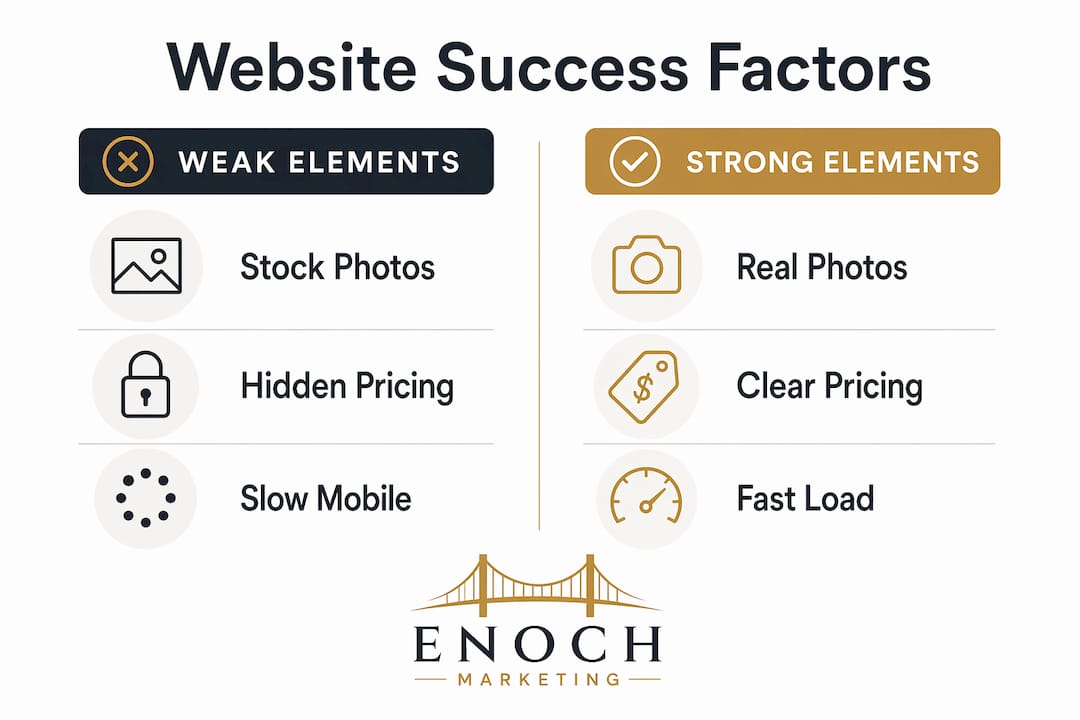
Stock photos of generic gym equipment tell prospects nothing about your culture. Real photos of your coaches, your members, and your actual space build the emotional connection that converts hesitant visitors. Pair those photos with specific testimonials that name results. "I lost 18 pounds in my first 3 months" is more persuasive than "Great gym, highly recommend."
| Weak Website Element | Strong Website Element |
|---|---|
| Stock fitness photos | Real member and coach photos |
| "DM for pricing" | Clear pricing table on dedicated page |
| Generic "Join Now" button | "Start Your Free Week" trial CTA |
| Equipment and class list | Outcome-focused headline and story |
| Desktop-only layout | Mobile-first, fast-loading design |
Pro Tip: Place a short video testimonial from a real member on your homepage. Video builds trust faster than text and keeps visitors on your page longer, which signals quality to Google.
For gym owners who want to go deeper on turning site visitors into paying members, converting CrossFit leads is a topic Enochmarketing covers with specific tactics for fitness businesses.
Key takeaways
A gym website that converts requires clear pricing, outcome-focused messaging, fast mobile performance, and a consistent local SEO strategy working together.
| Point | Details |
|---|---|
| Conversion benchmark | A healthy gym website converts 3–5% of visitors into bookings; below 2% signals lost revenue. |
| Transparent pricing wins | Hiding pricing kills inquiries; clear pricing pages increase leads and filter unqualified prospects. |
| Local SEO compounds | Google Business Profile optimization and hyper-local keywords build free, consistent lead flow over time. |
| Mobile speed is non-negotiable | A 3-second load time raises bounce rates by 32%, costing you leads you already earned. |
| Outcomes beat features | Prospects respond to messaging about results and community, not equipment lists or class schedules. |
The part most gym owners get wrong
I have reviewed hundreds of gym websites over the years, and the pattern is almost always the same. The owner spent real money on a design they love, then filled it with content that talks about the gym instead of the member. The homepage says "State-of-the-art facility" and "Certified coaches." The prospect reads it and thinks, "So what? Will this work for me?"
The emotional connection is the missing piece. A prospect who is nervous about starting a fitness journey does not need a list of your certifications. They need to see someone who looks like them, with a story that sounds like theirs, who got a result they want. That is what closes the gap between "thinking about joining" and "signing up today."
The other thing I see constantly is gym owners treating their website like a finished product. They build it once, then ignore it for three years. SEO does not work that way. Google rewards sites that are actively maintained, updated with fresh content, and accumulating new reviews. The gyms I have seen dominate their local markets treat their website like a living part of their business, not a digital brochure.
Mobile-first design is also no longer a preference. It is the baseline. If your site is hard to use on a phone, you are losing the majority of your potential members before they ever read a word of your copy. Fix the speed. Simplify the navigation. Put the trial sign-up button where a thumb can reach it.
The gyms that win in 2026 are the ones that treat their website as their best salesperson. It works every hour of every day, never calls in sick, and scales without a salary.
— Collin
How Enochmarketing helps gyms build websites that grow memberships
Enochmarketing works exclusively with CrossFit gyms and fitness businesses across the United States. The agency builds websites designed to rank locally, convert visitors, and support the full membership sales process from first click to signed contract.
Services include web design built for conversion, local SEO, Google and Meta ad campaigns, and lead funnel creation tailored to the fitness industry. Every engagement starts with a full audit of your current site and marketing. From there, Enochmarketing builds a custom strategy and executes it. If you are ready to stop relying on referrals and start generating consistent leads online, review the marketing service options or check the agency pricing to find the right fit for your gym.
FAQ
Why does a gym website matter more than social media?
A gym website is the only digital asset you fully own and control. Social media platforms can change their algorithms or restrict your reach at any time, while your website consistently builds SEO authority and captures leads on your terms.
What is a good conversion rate for a gym website?
A conversion rate of 3–5% from visitor to booking is the healthy benchmark for gym websites. Rates below 2% indicate friction in your messaging, design, or booking flow that is actively costing you members.
How long does local SEO take to work for a gym?
Consistent local SEO efforts, including Google Business Profile optimization and review building, can earn a gym a top 3 Map Pack ranking within 6–12 months. Results compound over time, making early investment worthwhile.
Should gyms show pricing on their website?
Yes. Transparent pricing builds trust, increases qualified inquiries, and saves time for both the gym and the prospect. One case study showed a 20% increase in inquiries after a gym added clear pricing to its site.
What is the most important page on a gym website?
The homepage is the highest-traffic page and the first impression for most prospects. It should lead with an outcome-focused headline, display a visible trial sign-up offer, and load in under 2 seconds on mobile devices.