
Conversion rate optimization for gyms is the systematic process of turning more website visitors and trial users into paying members by fixing the specific points in your funnel where prospects drop off. Known in digital marketing as CRO, this practice applies data, automation, and structured follow-up to every stage of the membership journey. The fitness industry average for landing page conversions sits at 6.8%, while top campaigns reach 8–12%. Average gyms convert 20–30% of trial visitors into members. Top gyms hit 50–65% by using automated nurture sequences and airtight follow-up systems.
What is conversion rate optimization for gyms and why does it matter?
CRO for fitness is the discipline of measuring where prospects leave your funnel and then testing changes to keep more of them moving forward. Most gyms focus almost entirely on generating more leads. The real problem is that most gyms lack an integrated conversion system combining CRM, scheduling, and automated follow-up. Spending more on ads without fixing the funnel is like filling a bucket with a hole in it.
The gap between average and top-performing gyms is not about traffic volume. It is about what happens after a prospect raises their hand. A gym generating 100 leads per month at a 20% trial-to-member rate signs 20 new members. The same 100 leads at 55% signs 55. That difference compounds every single month without spending an extra dollar on advertising.

CRO applies to every touchpoint: your landing page, your response time, your trial experience, your follow-up sequence, and your onboarding process. Each stage either moves a prospect closer to signing or loses them permanently.
What are the critical funnel stages for gyms and where do leads leak?
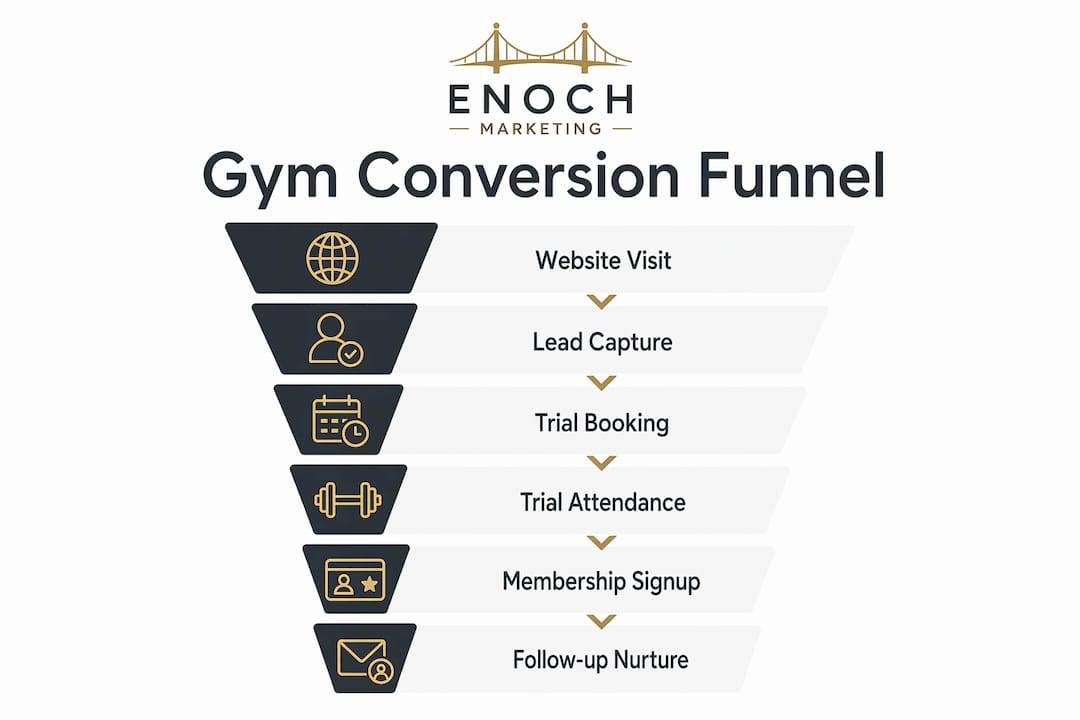
The gym membership funnel has six distinct stages. Each one has a measurable conversion rate, and each one can leak prospects if left unmanaged.
| Funnel Stage | Typical Conversion Rate | Common Leak Cause |
|---|---|---|
| Website visitor → Lead | 4–8% | Weak offer, slow page, poor targeting |
| Lead → Trial booked | 40–60% | Slow follow-up, no clear call to action |
| Trial booked → Trial attended | 50–70% | No reminder sequence, same-day booking |
| Trial attended → Membership signed | 30–50% | No structured close, weak offer at the end |
| Member signed → 90-day retention | 60–80% | Poor onboarding, no community integration |
The biggest single leak point for most gyms is trial no-shows. Reminder cadences and same-day or next-day booking dramatically improve attendance rates. A prospect who books a trial three weeks out is far less likely to show up than one who books for tomorrow morning.
The second major leak is slow lead response. A prospect who fills out a form and hears nothing for 24 hours has already moved on mentally. Speed-to-lead is the highest-leverage fix in the entire funnel.
The third leak is weak trial-to-membership conversion. Most gyms deliver a great workout but have no structured conversation at the end. The trial experience sells the product. The close sells the membership.
Pro Tip: Map your own funnel numbers before benchmarking against industry averages. Your specific bottleneck may be at a completely different stage than the typical gym, and identifying that broken stage first saves you from fixing the wrong problem.
How does automation improve gym conversion rates?
Speed-to-lead is the single highest-impact change a gym can make. Leads contacted within 5 minutes have a 100 times higher chance of converting than leads contacted later. No gym owner can manually respond to every inquiry within 5 minutes while coaching classes. Automation solves this completely.
The most effective first-hour sequence uses three automated touchpoints: an SMS, an email, and a second SMS. Automating these three touches within the first hour after an inquiry dramatically improves lead engagement and trial show rates. The SMS gets opened. The email provides detail. The second SMS creates urgency and a direct booking link.
Top gyms extend this into a 7-touchpoint nurture sequence across the trial period. Touchpoints include a pre-trial reminder, a post-trial check-in, a membership offer, a follow-up on that offer, a social proof message, a final-chance message, and a long-term re-engagement for non-converters. Manual follow-up leaks prospects at every stage because it depends on a staff member remembering to act. Automation removes that dependency entirely.
Best practices for gym follow-up automation include:
- Trigger the first SMS within 5 minutes of form submission
- Send a booking confirmation with a calendar link immediately
- Schedule a pre-trial reminder 24 hours before and again 2 hours before
- Send a post-trial message within 1 hour of the session ending
- Follow up on any membership offer within 48 hours if unsigned
- Re-engage non-converters at 14 days and 30 days with a new angle
Pro Tip: Automation handles speed and consistency. A real staff member should still make a personal call before the trial and after it. The conversion rates in fitness marketing that top gyms achieve come from combining automated speed with genuine human connection at the key decision moments.
Paid trials vs. free trials: which one converts better?
The trial offer structure affects lead quality more than most gym owners realize. Small paid intro packs act as an intent filter that keeps out deal-seekers and yields higher conversion per visitor than free trials, especially when follow-up bandwidth is limited.
A paid intro pack of 3–5 sessions for a nominal fee signals commitment from the prospect. Someone who pays $27 to try your gym is far more likely to show up and engage seriously than someone who clicked a "free week" ad while scrolling. The payment itself creates psychological investment.
Free trials widen the top of the funnel and work well when your follow-up system is airtight. They generate more leads but require more nurturing to convert. The right choice depends on your current follow-up capacity and your marketing goals.
| Trial Type | Lead Volume | Lead Quality | Follow-up Required | Best For |
|---|---|---|---|---|
| Free trial | High | Lower intent | High | Gyms with strong automation |
| Paid intro pack | Lower | Higher intent | Moderate | Gyms with limited follow-up capacity |
The evidence is clear: pricing matters less than follow-up quality. A free trial with a 7-touchpoint nurture sequence will outperform a paid intro pack with no follow-up system. The offer gets people in the door. The system converts them into members.
How do landing pages and paid ads drive more gym memberships?
The industry average for fitness landing pages is 6.8% conversion. Falling below 4% signals a targeting or messaging problem. Reaching 8–12% requires specific structural choices on both the ad and the page.
Well-structured fitness ad campaigns segmented by location and service type, with negative keywords and conversion tracking, consistently drive 8–12% landing page conversion rates. Generic campaigns targeting broad fitness keywords waste budget on people who will never join your gym.
The practical steps to reach top-tier conversion rates are:
- Match the ad headline exactly to the landing page headline. Message match is the single biggest driver of landing page conversion.
- Place your offer above the fold. A visitor should see your trial offer without scrolling.
- Add social proof near the form. A photo and one-sentence testimonial from a real member outperforms any stock image.
- Keep the form to three fields maximum: name, phone number, and email.
- Use location-specific ad groups. A prospect in your zip code converts at a higher rate than someone 15 miles away.
- Add negative keywords to block irrelevant searches like "gym equipment for sale" or "free gym near me."
- Import offline conversions. Connect your CRM to your ad platform so you can see which campaigns produce paying members, not just leads.
The role of landing pages in gym marketing goes beyond aesthetics. Every element on the page either builds trust and reduces friction or creates doubt and increases it. A cluttered page with five different offers converts at a fraction of a focused page with one clear next step.
Key Takeaways
Gym CRO is a data-driven system that fixes specific funnel leaks, automates follow-up, and converts more trials into paying members without increasing ad spend.
| Point | Details |
|---|---|
| Fix the funnel before scaling ads | Identify your weakest funnel stage and repair it before spending more on traffic. |
| Speed-to-lead is non-negotiable | Contacting leads within 5 minutes produces dramatically higher conversion rates than delayed outreach. |
| Automate the first hour | Trigger SMS, email, and SMS within 60 minutes of every inquiry to maximize show rates. |
| Match trial type to your capacity | Use paid intro packs when follow-up bandwidth is limited; free trials when automation is airtight. |
| Track CAC to LTV, not just CPL | A 5:1 LTV-to-CAC ratio signals readiness to scale ad spend with confidence. |
What I've learned working with gyms on conversion
The most common mistake I see gym owners make is scaling ad spend before diagnosing their funnel. They assume the problem is not enough leads. Almost every time, the real problem is that existing leads are not being followed up with fast enough or consistently enough.
The second mistake is treating all metrics as equal. Tracking only cost per lead is misleading. The metric that actually matters is the ratio of customer acquisition cost to lifetime value. A 5:1 LTV-to-CAC ratio tells you the business is healthy and ready to scale. A 2:1 ratio tells you the funnel is broken regardless of how cheap your leads are.
The highest-return changes I consistently recommend are: automate the first contact, build a no-show reminder sequence, and create a structured membership conversation at the end of every trial. None of these require a big budget. They require a system. The gym sales funnel optimization work that moves the needle most is almost always operational, not advertising-related.
One more thing: do not undervalue onboarding. A member who feels connected to your community at 30 days will still be there at 90 days. Retention is the final stage of CRO, and most gyms ignore it completely after the membership is signed.
— Collin
How Enochmarketing helps gyms grow memberships with CRO
Enochmarketing works exclusively with CrossFit gyms and fitness brands across the United States, building the exact systems described in this article. That means structured lead funnels, automated follow-up sequences, targeted Meta and Google Ads campaigns, and landing pages built to convert at the top of the industry range.
If your gym is generating leads but not converting them into members at the rate you need, the issue is almost always a fixable system problem. Enochmarketing's gym growth and lead generation services are built specifically to find and fix those problems for fitness businesses. Book a free strategy session to get a clear picture of where your funnel is leaking and what it will take to fix it.
FAQ
What is a good conversion rate for a gym landing page?
The fitness industry average is 6.8%. Top campaigns with strong targeting and message match reach 8–12%. Falling below 4% signals a targeting or landing page problem that needs immediate attention.
How do I increase gym memberships without more ad spend?
Fix your follow-up speed and trial-to-membership conversion process first. Automating your first-hour contact sequence and building a structured close at the end of every trial can double your membership sign rate from the same lead volume.
What is the average trial-to-member conversion rate for gyms?
Average gyms convert 20–30% of trial visitors into paying members. Top-performing gyms using automated nurture sequences consistently achieve 50–65%, according to fitness industry benchmarks.
Should I offer a free trial or a paid intro pack?
Paid intro packs filter for higher-intent prospects and yield better conversion per visitor when your follow-up capacity is limited. Free trials generate more leads but require a strong automated nurture system to convert them effectively.
What metrics should gym owners track for CRO?
Track conversion rates at every funnel stage, trial show rate, trial-to-member rate, and the ratio of customer acquisition cost to member lifetime value. A 5:1 LTV-to-CAC ratio is the benchmark that indicates your funnel is ready to scale.