
Remarketing for gyms is the practice of targeting paid ads specifically at people who have already visited your gym's website, engaged with your content, or interacted with your brand online without signing up. The industry term for this is retargeting, and it works by placing a tracking pixel on your website that records visitor behavior, then feeds that data to platforms like Google Ads and Meta so you can follow up with personalized ads. Unlike cold prospecting, which casts a wide net at strangers, remarketing focuses on warm leads who already know you exist. That distinction is what makes it one of the highest-ROI advertising strategies available to gym owners today.
What is remarketing for gyms and how does it actually work?
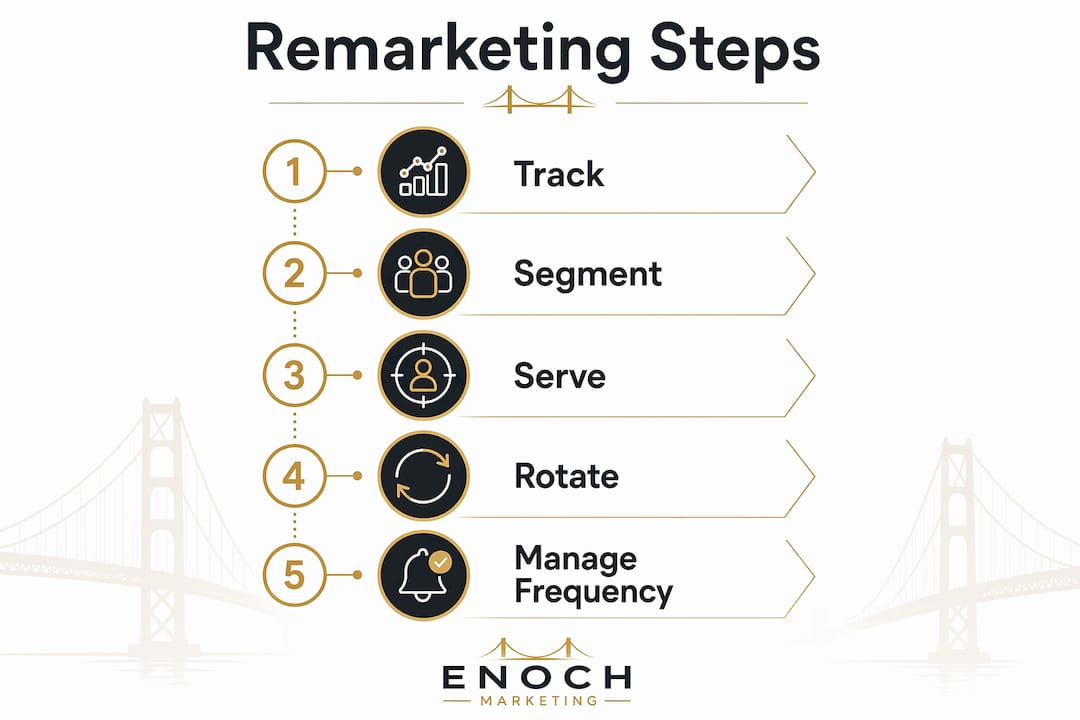
Remarketing operates through a three-step cycle: track, segment, and serve. When someone visits your gym's website, a snippet of code called a pixel fires and drops a cookie in their browser. Google Ads remarketing uses this cookie to identify that visitor later and show your ads across the Google Display Network, YouTube, and Search. Meta Pixel does the same across Facebook and Instagram, tracking specific events like page views, pricing page visits, and form starts.

The data collected builds what ad platforms call custom audiences. These are lists of real people grouped by what they did on your site. A visitor who spent three minutes on your membership pricing page belongs in a different audience than someone who bounced after five seconds on your homepage. That distinction matters enormously for what ad you show them next.
Here is how the workflow runs in practice:
- Install your pixel. Place the Google Ads tag and Meta Pixel on every page of your gym's website. Both platforms offer step-by-step setup guides, and most website builders like Squarespace and WordPress support direct integrations.
- Define your events. Tell the pixel what actions to track: page views, pricing page visits, class schedule views, form submissions, and thank-you page loads (which signal a completed sign-up).
- Build audience segments. Inside Google Ads or Meta Ads Manager, create custom audiences based on those events. Separate pricing page viewers from general visitors and from sign-up abandoners.
- Create tailored ads for each segment. Write copy and design visuals that speak directly to where each group dropped off in the funnel.
- Launch and monitor. Set budgets, frequency caps, and conversion tracking before going live.
Pro Tip: Meta Pixel alone is not enough in 2026. Browser privacy restrictions and iOS updates limit cookie tracking. Add Meta's Conversion API alongside the pixel so your server sends event data directly to Meta, bypassing browser-level blocks. This combination significantly improves measurement accuracy and keeps your retargeting audiences populated.
Why gym remarketing outperforms cold audience campaigns
Remarketing focuses on warm audiences to close sales rather than fill the top of the funnel. That shift in focus changes the economics of your ad spend entirely. Cold prospecting requires you to educate, build trust, and create desire all in one ad. Remarketing skips the first two steps because the visitor already took the time to explore your site.
The core benefits of remarketing campaigns for fitness centers include:
- Higher intent signals. Someone who visited your pricing page is far closer to buying than someone who saw a generic fitness ad on social media.
- Lower cost per conversion. Because you are targeting a smaller, more qualified audience, your budget goes further. You spend less to reach people who are more likely to act.
- Multiple touchpoints without wasted reach. Research shows that remarketing targets visitors who did not convert with personalized messaging, keeping your gym visible across the platforms they use daily.
- Funnel-stage alignment. You can serve trust-building content to early-stage visitors and urgency-driven offers to people who abandoned your sign-up form.
"The gym owner who treats every website visitor the same is leaving money on the table. The visitor who read your class schedule three times is not the same as the one who glanced at your homepage. Serve them differently."
Remarketing also supports gym membership growth by keeping your brand visible during the consideration window. Most people do not sign up for a gym membership on their first visit. They compare options, think it over, and come back when they are ready. Remarketing makes sure your gym is the one they come back to.
Effective gym remarketing strategies and segmentation best practices
Segmentation is where most gym owners either win or waste their budget. Treating all remarketing users identically is one of the most common and costly mistakes in fitness advertising. The fix is building distinct audience segments based on specific behaviors, then writing ads that speak to each group's exact situation.
| Audience segment | Visitor behavior | Ad message focus |
|---|---|---|
| Homepage bouncers | Viewed homepage, left quickly | Brand awareness, social proof, member testimonials |
| Pricing page viewers | Spent time on pricing, did not submit | Address cost objections, highlight value, offer a free trial |
| Class schedule browsers | Viewed class times, did not sign up | Highlight specific classes, show community, create urgency |
| Sign-up abandoners | Started form, did not complete | Remove friction, offer a limited-time incentive, simplify next step |
| Recent converters | Completed sign-up in last 30 days | Exclude from campaigns to avoid wasted spend |
Segmenting by high-intent behaviors improves both conversion rates and budget efficiency because you stop spending on people who have already converted or who showed no real interest. Excluding recent converters alone can meaningfully reduce wasted impressions.
Ad creative strategy matters just as much as segmentation. Rotating creatives every two to four weeks prevents the drop in performance that comes when the same audience sees the same ad too many times. Use testimonials from real members for trust-building segments. Use time-sensitive offers like "Join this week and get your first month free" for sign-up abandoners. Use motivational video content for class schedule browsers who need an emotional nudge.
Frequency management is the other critical lever. Frequency caps around two to four ads per week for broad retargeting audiences prevent overexposure and the annoyance that comes with it. High-intent segments like pricing page viewers can tolerate slightly higher frequency because their interest level is already elevated.
Pro Tip: Build a "VIP" audience of visitors who viewed your pricing page AND your class schedule in the same session. These people are doing serious research. Give them a direct offer with a phone number or a calendar link to book a free tour. This segment converts at a much higher rate than general site visitors.
Common pitfalls and how to optimize gym remarketing campaigns in 2026
Even well-built remarketing campaigns degrade over time without active management. The most damaging mistake is the "set it and forget it" approach, where gym owners launch campaigns and check back weeks later to find burned-out audiences and rising costs per lead.
The most common pitfalls to avoid include:
- Ignoring ad frequency. When the same person sees your ad 20 times in a week, they stop clicking and start hiding your ads. Monitor frequency reports weekly inside Google Ads and Meta Ads Manager.
- Skipping A/B tests. Run at least two creative variations per audience segment at all times. Test the headline, the offer, and the visual separately so you know what is actually driving performance.
- Neglecting conversion tracking. If you cannot measure which ads produce sign-ups, you cannot optimize. Verify that your pixel tracks events correctly before spending a dollar on remarketing.
- Forgetting exclusions. Always exclude people who signed up in the last 30 days. Showing membership ads to existing members wastes budget and creates a poor experience.
- Relying only on browser-side pixels. iOS privacy changes and browser restrictions reduce pixel accuracy. Supplement with server-side tracking through Meta's Conversion API or Google's enhanced conversions to maintain data quality.
Aligning remarketing messages to visitor drop-off points is the single most effective optimization you can make. Homepage visitors need trust signals like member counts, certifications, and before-and-after stories. Sign-up abandoners need friction removed, whether that means a simpler form, a chat option, or a direct call to action that bypasses the form entirely. Matching the message to the moment is what separates a profitable campaign from a money pit.
For paid ads strategy that compounds over time, build a monthly review cadence: check frequency, refresh creatives, update exclusion lists, and review conversion data. Campaigns that get this treatment consistently outperform those that do not.
Key takeaways
Gym remarketing works because it targets people who already showed interest, letting you spend less to convert more by matching the right message to the right visitor at the right moment.
| Point | Details |
|---|---|
| Remarketing targets warm leads | Focus ad spend on visitors who already explored your site rather than cold audiences. |
| Pixel plus Conversion API | Use both browser-side and server-side tracking to maintain audience accuracy in 2026. |
| Segment by behavior | Build separate audiences for pricing viewers, class browsers, and sign-up abandoners. |
| Rotate creatives regularly | Refresh ad visuals and offers every two to four weeks to prevent performance decay. |
| Exclude recent converters | Remove new members from active campaigns to protect budget and member experience. |
Why most gyms are leaving remarketing money on the table
I have reviewed dozens of gym ad accounts over the years, and the pattern is almost always the same. The gym owner ran a Facebook campaign, got some clicks, and called it a day. No pixel. No segmentation. No follow-up. They spent money to get people to their website and then let those visitors walk away forever.
Here is what I have found to be true after working specifically in the fitness space: the sale almost never happens on the first visit. People are comparing your gym to two or three others. They are thinking about price, schedule, and whether they will actually use the membership. Remarketing is how you stay in that conversation while they decide.
The gyms that win are the ones that treat high-intent visitors differently. Someone who visited your pricing page three times in a week deserves a direct offer, not a generic brand awareness ad. That level of specificity requires proper segmentation and a willingness to build multiple ad sets, but the payoff in conversion rate is significant.
The other thing most gym owners underestimate is tracking quality. If your pixel is misfiring or your conversion events are not set up correctly, your ad platform is optimizing toward the wrong signals. I have seen campaigns improve dramatically just by fixing broken event tracking, before changing a single ad. Get the measurement right first. Everything else depends on it.
— Collin
How Enochmarketing helps gyms build remarketing campaigns that convert
Enochmarketing builds and manages remarketing campaigns exclusively for CrossFit gyms and fitness brands across the United States. Every campaign starts with a full audit of your current tracking setup, audience structure, and ad creative, so nothing gets built on a broken foundation. From there, the team builds custom audience segments, writes ad copy tailored to each visitor type, and manages creative rotation to keep performance strong month over month.
If you are ready to stop letting warm leads walk away, Enochmarketing's gym marketing services include full remarketing campaign management alongside Meta and Google Ads, local SEO, and lead funnel creation. You can also review service pricing to find the right fit for your gym's growth stage. Book a free strategy session and find out exactly what your current ad setup is leaving behind.
FAQ
What is the difference between remarketing and retargeting?
Remarketing and retargeting describe the same core practice: showing ads to people who previously visited your website. Google popularized the term "remarketing" while the broader ad industry often uses "retargeting," but both refer to pixel-based audience re-engagement.
How long does it take to build a remarketing audience for a gym?
Audience size depends on your website traffic volume. Most gym websites need at least two to four weeks of pixel data to build segments large enough for Meta or Google to serve ads effectively. Higher-traffic sites build usable audiences faster.
What platforms work best for gym remarketing campaigns?
Meta (Facebook and Instagram) and Google Ads are the two primary platforms for gym remarketing. Meta excels at visual storytelling and community-driven content, while Google reaches people actively searching for fitness options through Display and Search remarketing.
How much should a gym spend on remarketing ads?
Budget depends on audience size and campaign goals, but remarketing typically requires less spend than cold prospecting because the audience is smaller and more qualified. Many gyms start with $300 to $600 per month on remarketing and scale based on conversion results.
How do I know if my gym's remarketing campaign is working?
Track cost per lead, cost per membership sign-up, and return on ad spend inside your ad platform. Verify that your pixel is recording conversion events correctly, and compare your remarketing campaign's conversion rate against your cold prospecting campaigns to measure the difference.