
A conversion rate in fitness marketing is the percentage of prospects who complete a specific desired action, such as signing up for a free trial, booking a gym tour, or purchasing a membership. Explaining conversion rates in fitness marketing matters because this single metric connects your ad spend directly to real member growth. Google Ads fitness campaigns convert at 6.8%–7.2%, while the average gym sits at 3.2%. That gap represents real revenue left on the table. Gym owners who understand where their funnel leaks, and fix those leaks, grow memberships without spending more on ads.
What are the essential fitness marketing conversion metrics?
Conversion rate is calculated with one formula: conversions divided by total visitors, multiplied by 100. Simple in theory, but fitness marketing uses several distinct versions of this calculation, and confusing them leads to bad decisions.
The three metrics every gym owner needs to track are the overall conversion rate, the landing page conversion rate, and the trial-to-member conversion rate. Your overall conversion rate measures how many people who see your ad eventually become leads. Your landing page conversion rate measures how many visitors fill out your form. Your trial-to-member rate measures how many people who try your gym actually join.

Two cost metrics sit alongside these rates: cost per lead (CPL) and cost to acquire a customer (CAC). CPL tells you what you paid to get a name and phone number. CAC tells you what you paid to get a paying member. The difference matters enormously.
| Metric | Formula | What it measures |
|---|---|---|
| Overall conversion rate | Conversions ÷ total visitors × 100 | Ad to lead efficiency |
| Landing page CVR | Form fills ÷ page visitors × 100 | Page copy and offer strength |
| Trial-to-member rate | Members ÷ trial attendees × 100 | Sales and experience quality |
| Cost per lead (CPL) | Ad spend ÷ leads generated | Lead acquisition cost |
| Cost to acquire member (CAC) | Ad spend ÷ new members | True marketing efficiency |
Pro Tip: CPL is misleading on its own. A $10 lead that never shows up costs more than a $50 lead that joins and stays for two years. Always pair CPL with your trial-to-member rate and CAC before drawing conclusions about a campaign.
What are typical conversion benchmarks for gym marketing funnels?
A fitness marketing funnel has five stages, and each one loses people. Understanding where your numbers fall at each stage tells you exactly where to focus your effort.
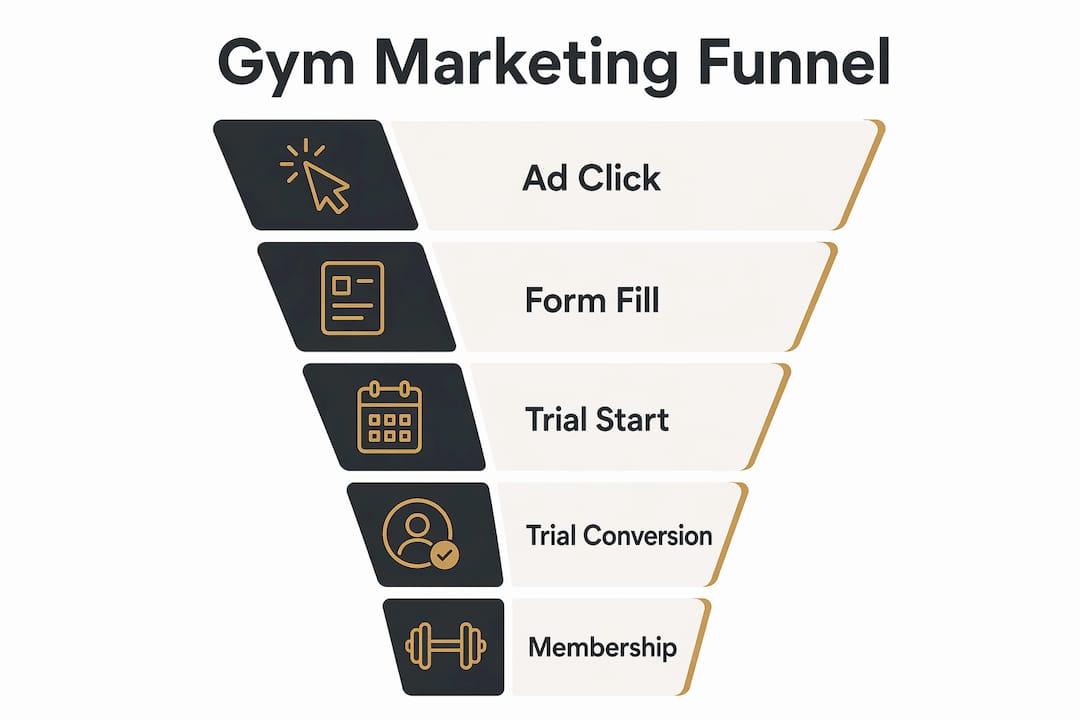
The average overall fitness conversion rate in 2026 is 3.2%, with top-performing gyms reaching 5.8%. That difference is not random. Top gyms have tighter funnels, faster follow-up, and stronger offers. Google Ads campaigns in the fitness space convert at 6.8%–7.2%, which is why paid search remains the highest-ROI channel for gyms running local campaigns.
Here is how a typical funnel breaks down from ad click to signed member:
| Funnel stage | Typical range | Top gym range |
|---|---|---|
| Ad click → form fill | 25%–35% | 35%–45% |
| Form fill → contacted lead | 60%–80% | 85%–95% |
| Contacted → booked call or tour | 50%–70% | 65%–80% |
| Booked → showed up | 60%–75% | 75%–90% |
| Showed → signed member | 60%–70% | 70%–85% |
These funnel stage drop-offs show that most gyms lose the majority of their potential members in the middle of the funnel, not at the top. That is a critical insight. Spending more on ads to fix a contact-speed problem is like pouring water into a bucket with a hole in the bottom.
Trial-to-member conversion rates typically range from 30% to 60%, with boutique gyms on the higher end when their sales process is tight. The cost per booked trial runs $20–$50 on Google search and $35–$80 on paid social, depending on your market and offer.
Pro Tip: Improving any single middle-funnel stage by 10–20 percentage points can double or triple your total memberships without raising your ad budget. Fix the leak before you turn up the tap.
How do gym owners improve conversion rates in their fitness campaigns?
The most effective conversion optimization in fitness starts before you run a single ad. Groundwork determines whether your campaigns produce members or just clicks.
Define your offer and audience first
A tested offer directed at a specific audience outperforms a generic ad every time. Free first class, two-week trial, or a discounted first month with a clear expiration date all create urgency. Vague offers like "join today" produce weak results because they give the prospect no reason to act now. Pair your offer with a single, focused landing page that has one call to action and no navigation menu to distract visitors.
Speed up your lead follow-up
Contacting leads within 5 minutes increases conversion odds by 9 times compared to waiting an hour or more. Most gym owners respond to leads hours later, or not at all. That delay kills conversions that the ad already paid for. AI-driven SMS agents that respond within 60 seconds push lead-to-tour rates from the 15%–25% range that manual follow-up achieves up to 30%–45%.
Build a multi-channel follow-up system
No single channel closes every lead. A strong lead nurture system combines SMS, email, and phone calls in a timed sequence over the first 72 hours. SMS gets opened. Email provides detail. A phone call closes the fence-sitters. Relying on email alone leaves a large portion of leads uncontacted in any meaningful way.
Here are the core tactics that move the needle on conversion optimization in fitness:
- Speed: Respond to every new lead within 5 minutes using an automated SMS system.
- Offer clarity: Use a specific, time-limited offer on every ad and landing page.
- Landing page focus: One offer, one form, one call to action per page.
- Video and social proof: Landing pages with video testimonials and countdown timers convert measurably better than static pages.
- Local SEO: Google Business Profile and local search optimization capture high-intent prospects who are already searching for a gym near them.
- Track CAC vs. LTV: A 5:1 LTV-to-CAC ratio is the benchmark for scalable growth. Scale spend when you hit it. Pause when you fall below it.
- Referral programs: Existing members who refer friends convert at dramatically higher rates than cold ad traffic.
Pro Tip: Run your paid ads on Google and Meta simultaneously but track them separately. Google captures demand. Meta creates it. Each channel has a different conversion profile, and blending them into one report hides which one is actually working.
What common mistakes reduce conversion rates in fitness marketing?
Most gyms that struggle with conversions are not running bad ads. They are making predictable, fixable mistakes in how they handle leads after the click.
The most expensive mistake is treating CPL as the primary success metric. A low CPL feels like a win, but if those leads never book a tour or show up, the campaign is failing. CPL without close rate data is a vanity metric that leads gym owners to cut campaigns that are actually working and keep ones that are not.
The second most costly mistake is slow lead follow-up. Only 49% of gym owners invested in digital ads in 2023, and many of those who did failed to build a follow-up system to handle the leads those ads generated. A lead that waits more than an hour for a response has already moved on to the next gym in their search results.
Other common conversion killers include:
- Generic ad creative: Ads that speak to everyone convert for no one. Targeting a specific person with a specific problem produces far better results.
- No full-funnel tracking: If you only track clicks and leads, you cannot see where members are dropping out. You need data from click through to signed contract.
- Weak landing pages: Sending ad traffic to your homepage instead of a dedicated landing page is one of the most common gym marketing mistakes that kills conversion before it starts.
- Email-only nurture: SMS and AI-driven agents convert leads at significantly higher rates than email sequences alone. Email open rates in fitness marketing are low enough that relying on them exclusively means most leads never hear from you again.
- Ignoring show-up rates: A booked trial that does not show up is a lost member. Confirmation texts, reminder calls, and clear directions all improve show rates and are rarely used consistently.
Key Takeaways
Conversion rate optimization in fitness marketing requires tracking the full funnel from ad click to signed member, not just the cost of a lead.
| Point | Details |
|---|---|
| Know your benchmarks | The average gym converts at 3.2%; top gyms reach 5.8% by fixing middle-funnel leaks. |
| Speed closes members | Contacting leads within 5 minutes increases conversion odds by 9 times over delayed follow-up. |
| CPL is not the goal | Track CAC against member lifetime value at a 5:1 ratio to measure true campaign health. |
| Fix the funnel before scaling spend | Improving one middle-funnel stage by 10–20 points can double memberships without more ad budget. |
| Multi-channel nurture wins | Combining SMS, email, and phone follow-up outperforms any single-channel approach. |
What I have learned from watching gyms win and lose on conversion
Gym owners who focus on CPL are almost always disappointed. The ones who focus on CAC relative to member lifetime value are the ones who scale. That shift in mindset is the single biggest change I have seen produce consistent results.
The speed-to-lead data is not theoretical. I have watched gyms with identical ad budgets produce wildly different membership numbers based purely on how fast they responded to new leads. The gym that called within three minutes closed at twice the rate of the gym that called the next morning. The ad was the same. The offer was the same. The only variable was response time.
The other pattern I keep seeing is gym owners who increase ad spend when their conversion rate drops, instead of auditing the funnel first. More traffic into a broken funnel produces more wasted spend, not more members. The leaky funnel problem is almost always a middle-funnel issue: slow contact, weak follow-up, or a sales conversation that never happens.
AI-driven SMS agents have changed the game for gyms that adopt them. A system that texts a new lead within 60 seconds, qualifies them with two or three questions, and books a tour automatically removes the biggest conversion bottleneck most gyms have. The technology exists and it is not expensive. The gyms using it are pulling ahead of those that are not.
The mindset shift that matters most: stop thinking about lead generation and start thinking about conversion-driven marketing. Leads are not the product. Members are.
— Collin
How Enochmarketing helps gyms turn leads into members
Enochmarketing works exclusively with CrossFit gyms and fitness brands across the United States, which means every strategy is built for your specific market and member acquisition goals.
The agency runs paid media campaigns on Meta and Google Ads, builds dedicated lead funnels with high-converting landing pages, and sets up automated follow-up systems that contact new leads within minutes. If your gym is generating leads but not converting them into members, the gym growth services at Enochmarketing are built to fix exactly that. Gym owners can also check whether their current website is the source of the problem with Enochmarketing's website conversion audit. Book a free strategy session to see where your funnel is leaking and what it would take to fix it.
FAQ
What is a good conversion rate for a gym?
The average fitness conversion rate in 2026 is 3.2%, while top-performing gyms reach 5.8%. Google Ads fitness campaigns convert at 6.8%–7.2% for high-intent search traffic.
How do I calculate my gym's conversion rate?
Divide the number of conversions (leads, trials, or memberships) by the total number of visitors or prospects, then multiply by 100. Track this separately for each funnel stage to find where drop-off occurs.
Why is my cost per lead low but memberships are flat?
A low CPL only measures the cost of getting a name and number. If your follow-up is slow, your offer is weak, or your sales process is inconsistent, those leads will not convert into members regardless of how cheap they were to acquire.
How fast should I contact a new gym lead?
Contact every new lead within 5 minutes. Research shows that responding within 5 minutes increases conversion odds by 9 times compared to waiting longer. AI-driven SMS systems make this achievable without manual effort.
What is a healthy trial-to-member conversion rate for a gym?
Trial-to-member rates typically range from 30% to 60%. Boutique gyms with a strong sales process and clear follow-up system land at the higher end of that range.