
Successful gym brands are defined by a combination of strategic market positioning, diversified revenue, and community-driven identity that separates thriving fitness businesses from those that plateau. The characteristics of successful gym brands go beyond equipment and square footage. Industry benchmarks show that top-performing boutique studios earn $110 per member per month compared to $49 at budget gyms. That $61 gap reflects a deliberate brand strategy, not just a price difference. Gym owners who understand these traits can build businesses that retain members, command premium pricing, and grow without relying solely on referrals.
1. What are the characteristics of successful gym brands?
The defining traits of top gym brands fall into three categories: financial discipline, member experience, and brand identity. Financially, the strongest operators keep membership fees below 75% of total revenue. They build identity around a lifestyle, not just a workout. They also treat member retention as a revenue strategy, not an afterthought.
The industry average monthly churn rate is 4.2% across fitness studios. That means a 500-member gym loses roughly 21 members every month. Top-quartile operators hold churn at 2.5% or below, which translates to $50,000–$120,000 in additional annual revenue for a midsize gym. The math makes retention one of the highest-return activities a gym owner can prioritize.

Successful brands also invest in marketing systems, not just word of mouth. Enochmarketing works specifically with CrossFit gyms and fitness brands to build the paid media, local SEO, and brand strategy infrastructure that supports this kind of growth.
2. Strategic customer targeting and market positioning
The most profitable gym brands know exactly who they serve. Successful boutique brands target women aged 25–45 with household incomes above $100,000. That demographic supports premium pricing, responds to community-driven marketing, and has the schedule flexibility to attend regularly.
Positioning your gym for this segment requires more than a good location. It means aligning your facility design, class schedule, pricing, and social media content with the lifestyle your ideal member already lives. A gym in a suburban neighborhood near high-income households should look, feel, and communicate differently than a downtown budget gym.
- Define your primary member profile before setting pricing or designing your space
- Choose your location based on where your target demographic lives, works, and shops
- Price for perceived value, not for the lowest barrier to entry
- Build your social content around the lifestyle your members aspire to, not just workout clips
Pro Tip: Map your current member base by zip code and income bracket. If your best members cluster in one area, that is your expansion target, not the neighborhood with the cheapest rent.
3. How successful gym brands diversify revenue beyond memberships
Membership fees alone create a fragile business. Top-performing fitness studios generate 30–40% of revenue from personal training, retail, and digital offerings, keeping membership fees below 75% of total income. That revenue mix creates stability when membership numbers fluctuate.
The revenue gap between boutique and budget gyms is significant. On an 800-member base, boutique studios generate $220,800 more annually than budget gyms at the same membership count. That gap comes almost entirely from ancillary revenue.
| Revenue Stream | Boutique Studio Benchmark | Budget Gym Benchmark |
|---|---|---|
| Membership fees | Under 75% of total revenue | 85–95% of total revenue |
| Personal training | 15–25% of total revenue | Under 5% of total revenue |
| Retail and apparel | 5–10% of total revenue | Minimal |
| Digital and on-demand | Growing segment | Rare |
Pro Tip: Start with personal training packages before adding retail. Training revenue scales with your existing staff and requires no inventory investment.
Building a fitness brand marketing workflow that promotes these revenue streams consistently is what separates gyms that grow from those that stagnate.
4. What role does community and brand identity play in gym success?
Community is the single most defensible competitive advantage a gym can build. Members who feel they belong to something do not cancel when a cheaper option opens nearby. Gymshark's community-centric strategy helped it reach a $1.4 billion valuation by building a loyal tribe through influencer partnerships and genuine engagement rather than traditional advertising. Gymshark achieved 40% of its early sales through Instagram by prioritizing authentic connection over promotional content.
Identity-anchored brands create inelastic demand. Lululemon sustained a 56.6% gross margin while spending less on marketing than most competitors. The reason is that members link the brand to their personal identity, not just their fitness routine. That emotional connection makes price comparison irrelevant.
"Authenticity is not a marketing tactic. It is the foundation of every fitness brand that has built a real community rather than just a customer base."
Practical community-building tactics that work for gym brands include:
- Hosting member milestone events (first pull-up, first competition, one-year anniversary)
- Creating private social groups where members connect outside of class
- Featuring member stories in email and social content, not just trainer highlights
- Running community events that bring members together around shared goals
The shift from attribute-anchored branding ("we have great equipment") to identity-anchored branding ("this is who you become here") is what turns a gym into a lifestyle brand.
5. Why facility experience and quality instruction drive loyalty
A clean, well-designed facility signals professionalism before a member takes a single class. Member loyalty depends more on charismatic instructors delivering quality experiences than on physical space alone. Retention improves significantly when instructors build genuine relationships with members, remember their names, and track their progress.
The facility still matters. Cluttered spaces, broken equipment, and poor lighting communicate low standards. Members who pay premium prices expect a premium environment. The investment in aesthetics pays back through retention, referrals, and the ability to charge more.
Here is what the best gym operators prioritize in facility and instruction:
- Hire instructors for personality first, certifications second. Skills can be trained. Charisma and genuine care for members cannot.
- Maintain equipment on a fixed schedule, not just when something breaks. Members notice.
- Design your space for social interaction, not just movement. Waiting areas, open floor plans, and visible community boards all encourage connection.
- Invest in lighting and sound. These two elements shape the emotional experience of every class more than most operators realize.
- Track instructor-specific retention rates. If members follow one trainer and leave when that trainer leaves, you have a dependency problem, not a community.
Operator focus on charismatic instructors who build relationship-driven loyalty consistently yields higher retention than facility upgrades alone. Hire well, train consistently, and measure the results by member retention per class, not just attendance numbers.
6. Operational systems and churn management
Operational excellence separates gyms that grow from those that grind. Reducing churn from 4.2% to 2.5% adds $50,000–$120,000 annually to a midsize gym's revenue. That improvement does not require new equipment or a bigger space. It requires timing-based retention tactics and consistent follow-up systems.
Waitlists are one of the most underused retention tools in fitness. A class that fills up signals demand and creates urgency. Members on a waitlist are more committed than members who walk in with no friction. Standardizing community experience across locations, as McKinsey research on franchise fitness systems confirms, is what makes growth repeatable rather than dependent on one charismatic owner.
The months with the worst retention are predictable. January signups who never build a habit cancel by march. Summer schedules disrupt routines. Operators who build incentive programs around these windows, rather than reacting after cancellations spike, protect revenue before it walks out the door.
7. Fitness influencer and social media marketing
Community-driven social media marketing yields 6.6x ROI and drives 40% of early sales through organic word of mouth for boutique fitness brands. That return is not accidental. It comes from a deliberate strategy of featuring real members, partnering with credible voices, and building content that reflects the community rather than selling to it.
Fitness influencer marketing works best when the influencer is already a genuine member or believer in the brand. Paid partnerships with people who have never trained at your gym produce content that members immediately recognize as inauthentic. Micro-influencers with 5,000–50,000 followers who train at your gym consistently outperform celebrity endorsements for local gym brands.
A proven social media strategy for gyms prioritizes member transformation stories, behind-the-scenes content, and class highlights over promotional posts. The ratio that works is roughly four value-driven posts for every one promotional message.
8. Local SEO and digital presence
A gym's digital presence is its first impression for most potential members. Local SEO determines whether your gym appears when someone searches "CrossFit gym near me" or "personal training in [city]." Gyms that rank in the top three local search results capture the majority of organic clicks in their market.
The key elements of local SEO for gyms include a fully optimized Google Business Profile with current hours, photos, and regular posts. Review volume and recency matter significantly. A gym with 200 reviews averaging 4.8 stars outranks a competitor with 30 reviews at 5.0 stars in most local markets. Enochmarketing builds local SEO systems specifically for fitness brands, including review generation workflows and location-specific content strategies.
Performance marketing strategies that combine paid search with local SEO create a compounding effect. Paid ads capture immediate demand while organic rankings build long-term visibility without ongoing ad spend.
9. Scalable brand systems for multi-location growth
Gyms that scale successfully treat their brand as a system, not a personality. The owner's charisma cannot be the primary reason members stay. Franchise and multi-location gym systems that codify their community experience and operational standards grow faster and retain members more consistently than those that rely on informal culture.
A scalable brand system includes documented onboarding for new members, standardized class formats, consistent visual identity across all locations, and a content calendar that any staff member can execute. Building a CrossFit brand online with these systems in place means growth does not dilute the member experience that made the first location successful.
The brands that reach 10 or more locations all share one trait: they built systems before they needed them, not after the second location exposed every gap in their operations.
Key Takeaways
Successful gym brands win on retention, identity, and revenue diversification, not just membership volume.
| Point | Details |
|---|---|
| Retention drives revenue | Cutting churn from 4.2% to 2.5% adds up to $120,000 annually for a midsize gym. |
| Diversify beyond memberships | Top studios keep membership fees below 75% of revenue by adding training and retail income. |
| Identity beats attributes | Brands linked to member lifestyle, like Lululemon, sustain higher margins with lower marketing spend. |
| Instructors outperform equipment | Charismatic, relationship-driven trainers improve retention more than facility upgrades alone. |
| Systems enable scale | Codified community and operational standards are what make multi-location growth repeatable. |
What I have learned from watching gym brands succeed and fail
The gyms I have seen fail almost always made the same mistake: they invested in equipment before they invested in community. A $50,000 rig does not keep members coming back. A coach who knows your name and remembers your PR does.
The operators who build lasting brands obsess over the first 90 days of a member's experience. That window is where habits form or do not. A member who attends 12 times in their first month is almost certain to stay for a year. A member who attends twice in their first month is almost certain to cancel. The gyms that track this and act on it, with personal check-ins, milestone celebrations, and targeted outreach, dramatically outperform those that just hope members figure it out.
The other thing most gym owners underestimate is the compounding value of churn reduction versus acquisition. Adding 20 new members feels exciting. Keeping 20 members who were about to cancel is worth more and costs far less. The best operators I have seen treat retention as a marketing channel, not an operational afterthought. They run campaigns to re-engage at-risk members the same way they run campaigns to attract new ones.
My honest recommendation: before you spend another dollar on ads, map your churn by month and by coach. The data will tell you exactly where your brand is leaking, and fixing those leaks will fund your growth better than any campaign.
— Collin
How Enochmarketing helps fitness brands grow with purpose
Gym owners who understand these traits still need the marketing infrastructure to act on them. Enochmarketing specializes exclusively in CrossFit gyms and fitness brands across the United States, building the paid media, local SEO, and brand strategy systems that turn these characteristics into measurable growth.
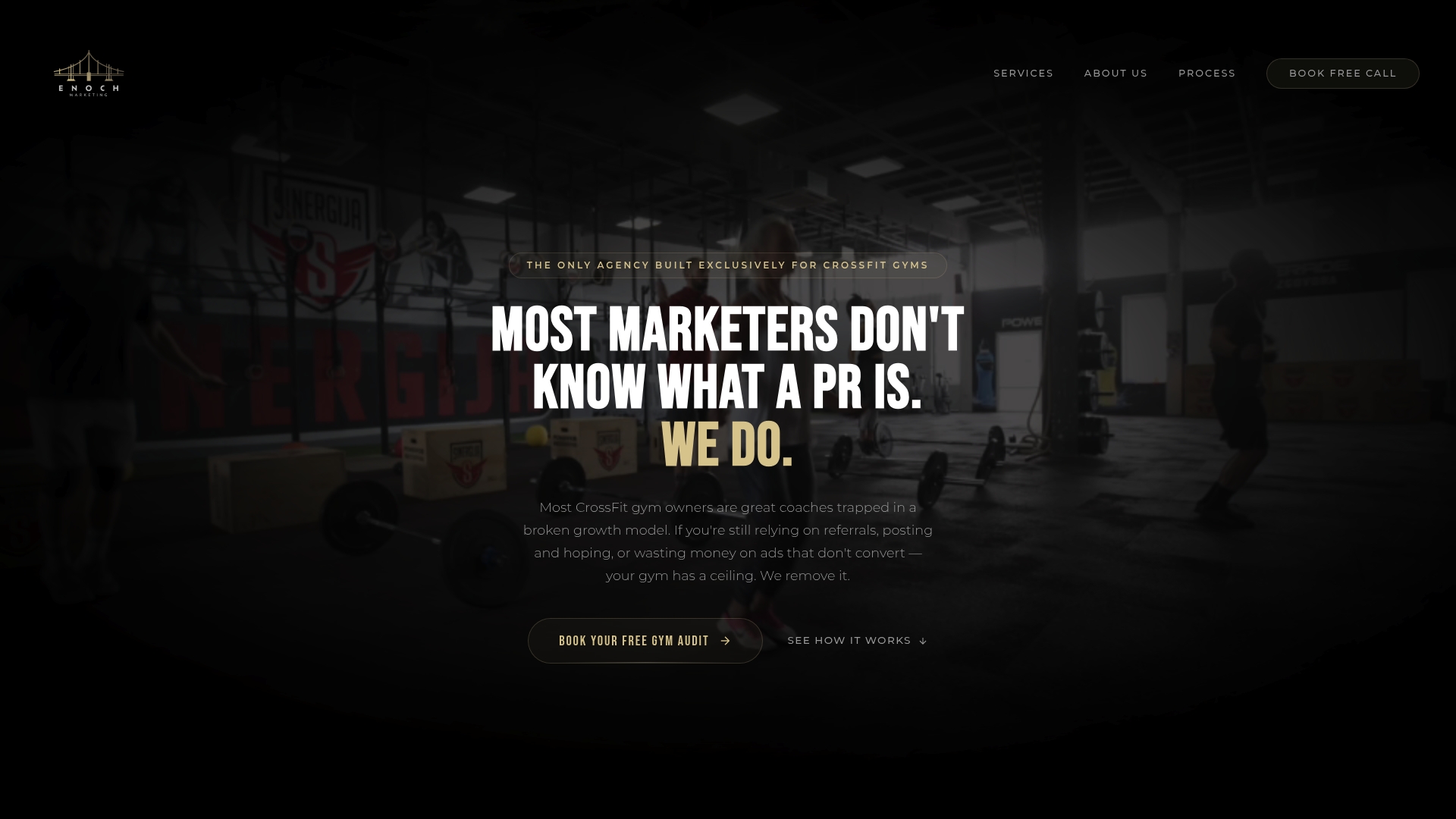
From Meta and Google Ads to lead funnel creation and social media content, Enochmarketing's gym growth services are built around the specific challenges fitness brands face. The agency audits your current marketing, builds a custom strategy, and scales what works. If you are ready to stop relying on referrals and start building a brand that attracts members consistently, see the pricing options and book a free strategy session to get started.
FAQ
What makes a gym brand successful long-term?
Successful gym brands combine low member churn, diversified revenue, and a strong community identity. Top operators keep monthly churn at 2.5% or below and generate 30–40% of revenue from sources beyond membership fees.
How important is community to gym brand success?
Community is the most defensible competitive advantage a gym can build. Gymshark reached a $1.4 billion valuation by prioritizing genuine community over traditional advertising, achieving 40% of early sales through organic Instagram engagement.
What revenue mix should a successful gym target?
Top-performing studios keep membership fees below 75% of total revenue. The remaining 25–40% comes from personal training, retail, and digital offerings, which creates financial stability when membership numbers fluctuate.
How does instructor quality affect gym retention?
Charismatic instructors who build relationship-driven loyalty improve retention more than facility upgrades alone. Members stay for coaches who know their names and track their progress, not for equipment.
What is the first step to building a stronger gym brand?
Start by mapping your current member churn by month and by coach. That data reveals where your brand is losing members and which retention tactics will have the highest financial impact before you invest in new marketing.