
Zen Planner Engage and its Campaign Marketplace give gym owners a practical way to automate lead nurture, onboarding, and member reactivation without hiring a developer or writing code. The fastest path to results is clean CRM data followed by one prebuilt template rather than a sprawling overhaul. Clean your data, activate a starter campaign, and turn on the automation. From there, the platform handles the follow-up that used to eat your front desk's afternoon.
TL;DR:
- Properly cleaning and segmenting your CRM data before launching automation significantly improves campaign accuracy and reduces the risk of messages going to the wrong individuals.
- Starting with one well-designed campaign in the first month yields better results than attempting multiple complex sequences simultaneously.
- Using Engage’s AI tools for social media content creation outperforms manual posting, but automation still requires ongoing testing and personalization.
- Tracking five key metrics—lead volume, lead-to-trial rate, trial-to-member conversion, cost per lead, and churn rate—helps evaluate campaign effectiveness and guides necessary adjustments.
- Outsourcing paid ad management can accelerate results for busy owners, but successful automation relies on disciplined data hygiene and incremental implementation.
Table of Contents
- What Does Zen Planner Marketing Actually Include?
- Will Marketing Automation Actually Save You Time?
- How Do You Run Zen Planner Marketing Campaigns Step by Step?
- How Do You Customize a Campaign Marketplace Template?
- What Metrics Should You Track in Zen Planner?
- What's Your 30 to 60 Day Zen Planner Launch Plan?
- Should You Run This Yourself or Bring in Help?
- What Actually Moves the Needle Here
- When It Makes Sense to Bring in a Gym Marketing Partner
- Where to Read More on Zen Planner Marketing
- Sources
- FAQ
What Does Zen Planner Marketing Actually Include?
Zen Planner marketing isn't one feature. It's a layered system built around three pieces: Engage, the Campaign Marketplace, and an optional managed digital marketing service for owners who want ads handled for them.
Zen Planner Engage is the automation engine. It bundles AI-assisted content creation, email and SMS automation, webchat, lead capture forms, and two-way texting into a single dashboard tied directly to your gym's CRM. Instead of juggling a separate email tool and a separate texting app, everything lives where your member data already sits.
The Campaign Marketplace is where templates live. Zen Planner Engage ships with over 100 prebuilt campaigns covering onboarding, lead nurture, reactivation, event promotion, and ad-funnel follow-up, refined using feedback from partner gyms to cut the time it takes to launch something usable.
For owners who'd rather not touch ad platforms directly, Zen Planner's digital marketing service handles the technical setup, creative, copywriting, and performance reporting on Google and Meta campaigns. You approve the strategy; someone else builds and monitors the machine.
What ties it together is integration. Zen Planner's CRM acts as a single source of truth linking scheduling, billing, attendance, and marketing activity, so a missed class or an expiring membership can trigger a message automatically instead of waiting for a staff member to notice.
That means:
- Engage handles content, texting, email, and webchat from one dashboard.
- The Campaign Marketplace supplies ready-made sequences instead of blank-page campaign building.
- Managed digital marketing covers ad setup and reporting for owners who want it fully handled.
- CRM integration connects attendance and billing data directly to marketing triggers.
Will Marketing Automation Actually Save You Time?
Automation's real value shows up in the hours it takes off your staff's plate and the leads it stops losing. One gym operator using Zen Planner Engage reported a 25% increase in operational efficiency after shifting routine follow-up onto automated sequences. That's not a hypothetical. It's what happens when a front desk stops manually texting every trial member and lets a triggered sequence do it instead.
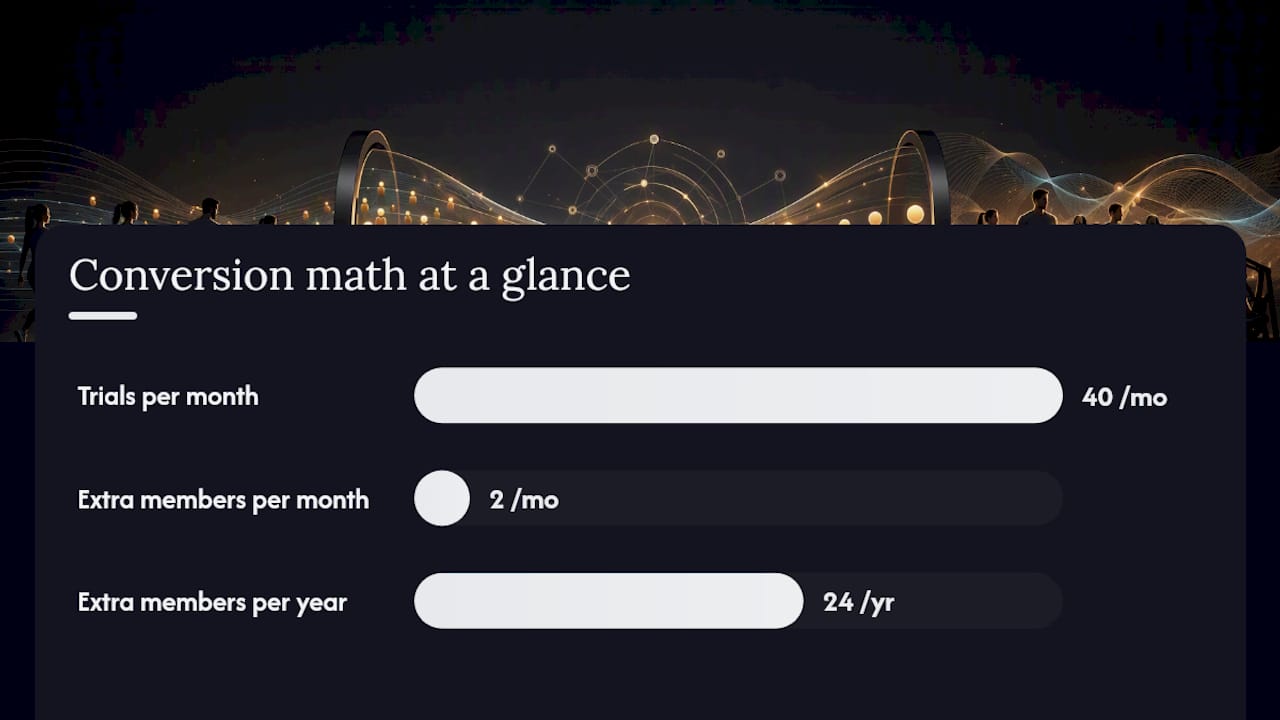
The math on small conversion gains is easy to underestimate. A gym running 40 trials a month that converts 5% more of them, thanks to a consistent nurture sequence instead of sporadic follow-up, picks up roughly two extra members monthly. Over a year, that's two dozen members who would have slipped through a busy front desk's cracks.
Retention runs the same way. Attendance-based triggers can flag a member who hasn't checked in for 10 days and fire off a "we miss you" message before that member quietly cancels. Milestone messaging (100th class, one-year anniversary) does the opposite job: it reinforces the relationship at the moment members are most likely to feel good about staying.
Where automation pulls its weight:
- Onboarding sequences that greet new members without staff having to remember to do it.
- Trial nurture that follows up consistently instead of only when someone has time.
- Reactivation flows triggered by attendance gaps, not guesswork.
- Milestone messages that reinforce loyalty at the right moment.
None of this replaces a coach's judgment. It replaces the manual grunt work that kept coaches from having that judgment applied where it matters.
How Do You Run Zen Planner Marketing Campaigns Step by Step?
Most gyms that struggle with Zen Planner marketing didn't fail because the tools were weak. They skipped the groundwork. Here's the order that actually works.
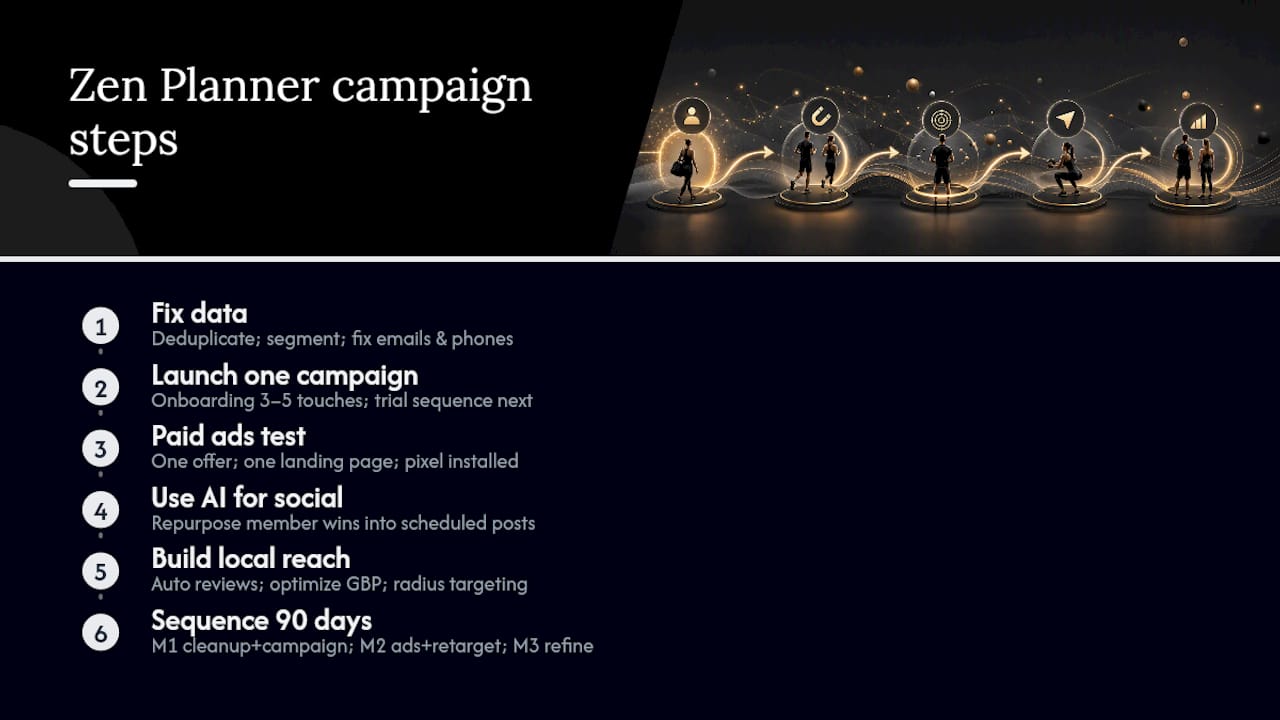
1. Fix your data before you automate anything. Deduplicate member records, segment contacts by attendance and lifecycle stage (lead, trial, active member, at-risk, canceled), and correct malformed emails and phone numbers. Automation built on messy data sends the wrong message to the wrong person, and that's the single most common cause of campaigns that quietly fail.
2. Launch one starter campaign, not five. A basic onboarding sequence with three to five touch points over the first two weeks is the easiest win. A trial nurture sequence comes next, typically five to seven messages spread across a two-week trial window. Reactivation sequences ("We miss you") work best triggered off a 10 to 14 day attendance gap rather than a fixed calendar date.
3. Set up paid ads with a narrow first test. For Google and Meta, keep the initial checklist simple: one offer, one landing page, one retargeting pixel installed before the campaign goes live. Retargeting catches the people who clicked but didn't convert, which is usually a bigger opportunity than the first-click traffic itself.
4. Use Engage's AI content tools for social, not just email. Repurpose a member's personal best or a class highlight into a scheduled social post instead of writing from scratch every week. Consistency matters more than volume here.
5. Build local reach into the routine. Automatically solicited reviews, an optimized Google Business Profile, and location-targeted ad radius settings compound over months in ways a single boosted post never will.
6. Sequence your first 90 days deliberately. Month one: data cleanup and one live campaign. Month two: paid ads and retargeting layered on top. Month three: refine creative based on real numbers and turn on the retention automations you didn't have bandwidth for earlier.
Pro Tip: Don't turn on every automation at once. Launch one sequence, watch it for two weeks, and fix what's broken before adding the next one. A gym running five half-tuned campaigns performs worse than one running a single sharp one.
How Do You Customize a Campaign Marketplace Template?
A template pulled straight from the marketplace and sent unchanged will underperform. Members can tell when a message wasn't written for them, and generic campaigns tend to feel impersonal to people who already know their coach by name.
Start by matching the template type to a specific goal: trial conversion, onboarding, retention, or a one-time event. Then customize it before it goes live.
- Swap generic placeholder copy for your gym's actual offer language and timing.
- Insert real coach names into messages instead of a generic "our team."
- Use attendance tags to trigger the right message at the right moment, not on a fixed schedule.
- Adjust calls-to-action to match how your members actually book (app, front desk, text reply).
The biggest pitfalls are predictable: launching on dirty data, over-automating so every touchpoint feels robotic, and never testing a second version of the creative once the first one is live. Personalizing a template with local details and coach voice consistently outperforms unchanged templates.
Pro Tip: If a template mentions "our facility" more than twice, rewrite it. Members respond to a name and a place, not a category description.
What Metrics Should You Track in Zen Planner?
Five numbers tell you almost everything: lead volume, lead-to-trial rate, trial-to-member conversion, cost per lead, and churn rate. Watching all five together, rather than any one in isolation, is what separates a campaign that's actually working from one that just looks busy.
Engage's dashboards connect campaign activity to member outcomes automatically, so a spike in signups can be traced back to the sequence or ad that drove it rather than guessed at after the fact.
For attribution without overcomplicating things:
- Tag every campaign link with a basic UTM so you know its source.
- Give conversions a realistic window, most gym sales cycles run 7 to 14 days from first contact to signup.
- Watch out for double-counting when a lead touches both an email sequence and a retargeting ad before converting.
Review ad tests weekly. Review overall strategy and retention numbers monthly. Faster cycles waste time chasing noise; slower ones let a broken campaign run too long before anyone notices.
What's Your 30 to 60 Day Zen Planner Launch Plan?
1. Audit before you build. Pull your CRM data, define two or three target segments (new leads, active trials, lapsed members), and choose exactly one starter template plus one paid channel.
2. Configure and stress-test. Set up the automation, then run it against an internal email address and phone number first to confirm the sequence fires correctly before a real member sees it.
3. Launch a small ad test. A split budget of $500 or more across two ad variations gives you enough signal to tell what's working without overcommitting before you have data.
4. Watch closely for the first two weeks. Track lead volume and conversion daily for the first 7 to 14 days, adjust creative that's underperforming, and get retention sequences live for anyone who joins during this window.
5. Assign ownership. One person should own campaign review, even if that's the owner. Put a recurring 30-minute review on the calendar and write down what worked so it doesn't get rebuilt from memory next quarter.
Should You Run This Yourself or Bring in Help?
A typical agency growth process runs audit, strategy, launch, then scale. That maps almost exactly onto the Zen Planner rollout above; the difference is who's doing the work and how fast it moves.
Specialist help tends to earn its cost in three places: ad creative that actually stops the scroll, ongoing bid and audience optimization that a busy owner won't check weekly, and analytics wiring that connects ad spend to actual membership revenue instead of vanity metrics.
- DIY makes sense when you have the hours, some marketing instinct, and want to keep costs down while you learn the platform.
- Outside help makes sense when time or technical bandwidth is the real constraint, not budget, and every week of delay costs you leads.
- A hybrid approach, running Engage automations in house while outsourcing paid ad management, is common and reasonable.
- Either path benefits from the same foundation: clean data and one working template before scaling anything.
What Actually Moves the Needle Here
Most advice about gym marketing automation treats the software as the hard part. It isn't. Zen Planner's interface is straightforward enough that any front desk staffer can learn it in an afternoon. The hard part is discipline: cleaning data before automating, launching one sequence instead of five, and resisting the urge to "set and forget" a campaign that needs a second look after two weeks.
The conventional advice to "automate everything immediately" is backwards. Owners who succeed with Engage treat the first 30 days as a controlled test, not a full rollout. They fix data, run one campaign, watch it closely, then expand. Owners who skip that step end up blaming the software for problems that started with a messy contact list.
If you take one thing from this: prioritize the boring work first. Data hygiene and a single well-customized template will outperform five generic campaigns launched on autopilot every time. Everything else, ads, social, retargeting, layers on top of that foundation, not instead of it.
— Collin
When It Makes Sense to Bring in a Gym Marketing Partner
You can absolutely run everything above yourself. But if you're a CrossFit gym or fitness studio owner without a spare 10 hours a week for ad testing and creative tweaks, that's exactly where a specialist speeds things up and lowers the risk of a botched launch.
Our agency works with gyms and fitness studios, delivering paid media campaigns, lead funnels, and social content designed to support fitness membership sales. We handle the parts owners tend to under-invest in: Meta and Google ad management, funnel design that feeds straight into your CRM, and local SEO that keeps your gym visible to people searching nearby. If you'd prefer assistance auditing your marketing setup and building a campaign calendar, you can book a free strategy session for support in identifying where your funnel may be losing members.
Where to Read More on Zen Planner Marketing
For official product details, see Zen Planner Engage, Zen Planner's digital marketing services, and the CRM and marketing automation overview. For hands-on funnel work, see gym lead generation and gym sales funnel optimization.
FAQ
How Much Does Zen Planner Cost Per Month?
Zen Planner does not publish flat monthly pricing publicly; costs depend on gym size, feature tier, and whether Engage and managed digital marketing are added, so a direct quote from Zen Planner is the reliable way to get an exact figure.
Is Zen Planner Secure?
Zen Planner is built as a dedicated fitness business management platform handling billing, attendance, and member data, and it follows standard industry practices for data protection expected of a CRM handling payment and personal information.
What Is the Zen Planner App?
The Zen Planner app is the member-facing and staff-facing mobile tool tied to the same CRM as Engage, used for class check-ins, scheduling, billing visibility, and receiving the automated messages your campaigns send.
How Can I Cancel My Zen Planner Membership?
Canceling a Zen Planner software subscription (not a gym membership) requires contacting Zen Planner directly or your account representative, since cancellation terms depend on your specific contract and billing cycle.
Do I Need an Agency to Use Zen Planner Marketing Effectively?
No, Zen Planner's Engage and Campaign Marketplace are built for owners to run directly, though a fitness-focused marketing agency can speed up ad optimization and creative work for owners without the time to manage it themselves.