
Conversion tracking in gym ads is the process of measuring which marketing efforts produce actual membership sign-ups, not just clicks or form submissions. Without it, you have no reliable way to calculate your Cost Per Acquired Member, the metric that determines whether your ad spend is profitable or wasteful. Gym ad campaigns without conversion tracking lose money at an alarming rate because they cannot connect ad spend to paying members. This guide covers the metrics that matter, how to import offline data, the mistakes that distort your results, and how to apply tracking data to grow your gym's membership.
Why track conversions in gym ads at all?
Conversion tracking is the foundation of every profitable gym marketing decision. When you run Meta or Google Ads without it, you are paying for activity, not results. A campaign can generate hundreds of clicks and dozens of form fills while producing zero paying members. That gap between lead volume and actual revenue is where most gym marketing budgets disappear.
The industry standard for measuring true ad performance is Cost Per Acquired Member (CPA). Benchmarks place a healthy CPA between $50 and $150, depending on your market and offer. Knowing your CPA tells you exactly how much each new member costs you and whether your current budget allocation makes sense. Without that number, every budget decision is a guess.

Conversion tracking also feeds the ad platform's algorithm. Google Ads and Meta Ads use your conversion data to find more people who behave like your best members. When you only track clicks, the algorithm chases clickers. When you track sign-ups, it chases buyers. That distinction alone justifies the setup time.
What metrics should you track in gym ad campaigns?
Surface-level data like impressions and click-through rates tell you almost nothing about membership growth. The metrics that actually matter connect your ad spend to revenue.
The most important gym marketing metrics are:
- Cost Per Lead (CPL): Industry benchmarks put a healthy CPL at $8–$15 for fitness ads. Anything above that signals a targeting or creative problem.
- Cost Per Booked Trial: The ideal range is $40–$80. This metric tells you how efficiently your ads fill your intro sessions or free trial offers.
- Trial-to-Member Conversion Rate: A healthy conversion rate sits at 30–50%. If yours is lower, the problem is usually in your sales process, not your ads.
- Phone Calls and Direction Requests: These are high-intent actions. A prospect who calls or asks for directions is far closer to joining than one who clicks a link.
- Attribution Window: Gym membership decisions rarely happen in a single session. Most prospects take 2–14 days to decide. Set your attribution window to at least 14 days, or you will undercount conversions and misread campaign performance.
| Metric | Healthy Benchmark |
|---|---|
| Cost Per Lead (CPL) | $8–$15 |
| Cost Per Booked Trial | $40–$80 |
| Trial-to-Member Rate | 30–50% |
| Cost Per Acquired Member | $50–$150 |
Tracking all four layers gives you a complete picture. Most gym owners only track the top of the funnel and wonder why their "successful" campaigns don't grow membership.
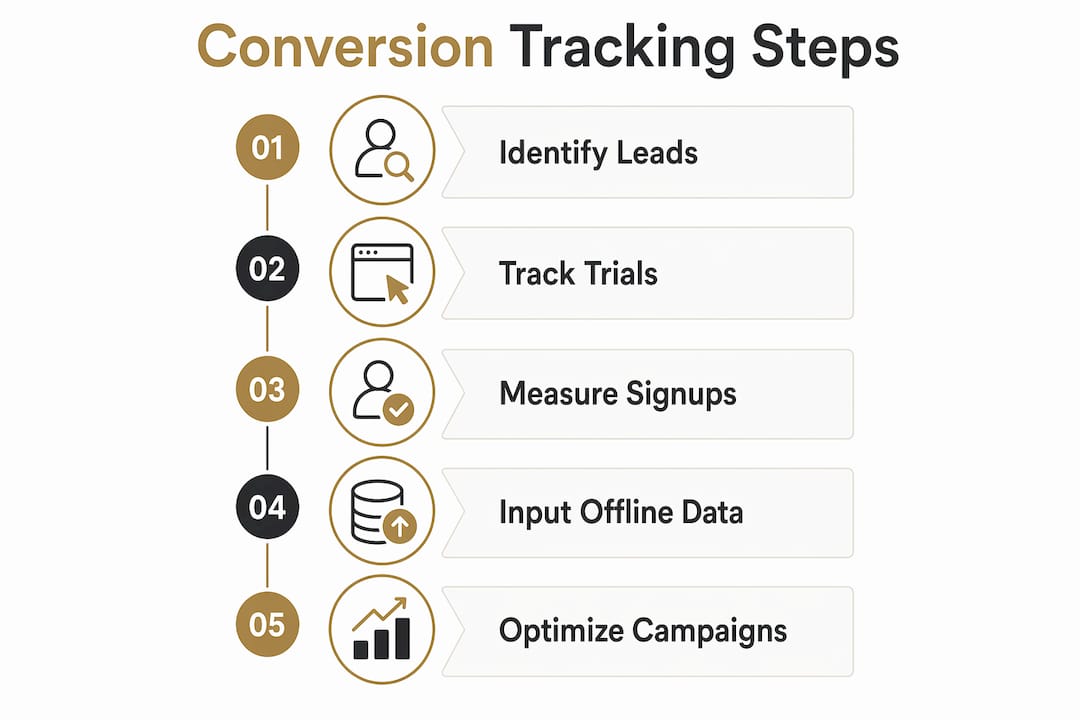
Why does offline conversion data matter for gym ads?
Online tracking captures form fills and website events. It does not capture the moment someone walks in, completes a trial, and signs a membership agreement. That gap is where most gym ad optimization breaks down.
Offline conversion import solves this. You take membership sign-up data from your CRM or gym management software and upload it directly into Google Ads or Meta Ads. The platform then matches those sign-ups back to the original ad clicks that drove them. Importing offline conversions into ad platforms improves lead quality by 25–40% over 90 days. That improvement comes from the algorithm learning which ad interactions actually produce paying members, not just leads.
The process works in stages:
- Capture the lead online. A form fill, call, or chat triggers a lead record in your CRM with a Google Click ID (GCLID) or Meta Lead ID attached.
- Track the offline outcome. When the lead books a trial, attends, or signs up, log that event and the date in your CRM.
- Upload the data weekly. Export a CSV with the lead IDs and conversion events, then import it into your ad platform. Google Ads and Meta Ads both support this natively.
- Weight conversions by value. Uploading member lifetime values and weighting premium memberships higher tells the algorithm to prioritize prospects who buy your best offers.
Pro Tip: Set up your CRM to auto-tag every inbound lead with the ad source and click ID at the moment of capture. Doing this manually after the fact is error-prone and often incomplete.
AI bidding algorithms optimize most efficiently when fed accurate offline conversion data. Without it, they optimize for leads, and many of those leads never become members.
What are the most common gym ad tracking mistakes?
Most gym owners make the same tracking errors. Recognizing them early saves thousands in wasted spend.
- Tracking vanity metrics instead of true conversions. Clicks and lead form fills without membership confirmation mislead every downstream decision. A campaign with a 5% click-through rate and zero new members is a failing campaign, full stop.
- Missing conversion events. Phone calls, direction requests, and chat initiations are high-intent signals. If you have not set up call tracking through Google Ads call extensions or a dedicated tracking number, you are blind to a major conversion source.
- Judging campaigns too early. Gym ad algorithms need 30–60 days and roughly 30 conversions to stabilize. Pausing or restructuring campaigns before that point resets the learning phase and wastes the initial spend. Expect a learning spend of $1,200–$2,400 before your campaign performs at full capacity.
- Ignoring speed-to-lead. Leads contacted within 5 minutes of form submission convert at 9 times the rate of leads contacted after an hour. If your follow-up process relies on manual outreach, you are losing members to delay.
- No funnel follow-up system. A lead who does not book a trial within 24 hours needs a multi-step automated sequence. Without one, your funnel leaks at the most critical point.
Pro Tip: Audit your conversion events in Google Tag Manager or Meta Events Manager before launching any campaign. A misconfigured event that fires on page load instead of form submission will inflate your conversion numbers and destroy your optimization data.
These mistakes share a common root: gym owners treat ad platforms as lead generators instead of full-funnel marketing systems. The most common gym marketing mistakes all trace back to incomplete tracking.
How do you apply conversion data to improve gym ad performance?
Conversion data is only useful if you act on it. Here is how to turn tracking insights into better campaigns and more members.
Adjust budgets based on CPA, not CPL. If Campaign A produces leads at $10 but members at $200, and Campaign B produces leads at $20 but members at $80, Campaign B deserves more budget. CPL alone would tell you the opposite.
Refine audiences using conversion signals. Once you have 30 or more member conversions tracked, build lookalike audiences from that data. A lookalike audience built on paying members outperforms one built on website visitors or video viewers.
Build dedicated landing pages for each offer. Dedicated landing pages per gym offer typically double or triple conversion rates compared to sending traffic to your homepage. Each page should have one offer, one call to action, and no navigation links to distract the visitor.
Automate your CRM follow-up. Speed-to-lead and automated follow-up sequences prevent lead loss at the most critical stage of the funnel. Set up an immediate text and email sequence that fires the moment a lead submits a form.
Use attribution data across channels. Tracking ROI across Google, social, and referrals shows you which channels contribute to membership decisions and which ones only appear to. A prospect might click a Google Ad, see a retargeting ad on Meta, and then call from an organic search. Attribution modeling reveals that full path.
| Strategy | Primary Benefit |
|---|---|
| CPA-based budget allocation | Moves spend to campaigns that produce members |
| Lookalike audiences from members | Improves targeting precision |
| Dedicated landing pages | Doubles or triples conversion rates |
| Automated CRM follow-up | Captures leads before competitors respond |
| Multi-channel attribution | Reveals true channel contribution |
The gyms that grow fastest are the ones that treat conversion data as a feedback loop. Every campaign teaches you something. The question is whether you have the tracking in place to hear it.
Key Takeaways
Conversion tracking in gym ads is the single most important system for turning ad spend into predictable membership growth.
| Point | Details |
|---|---|
| Track CPA, not just CPL | Cost Per Acquired Member reveals true campaign profitability; CPL alone misleads budget decisions. |
| Import offline conversions | Syncing CRM sign-up data with ad platforms improves lead quality by 25–40% over 90 days. |
| Allow algorithm learning time | Campaigns need 30–60 days and roughly 30 conversions before performance stabilizes. |
| Fix speed-to-lead immediately | Contacting leads within 5 minutes produces 9x higher conversion rates than waiting an hour. |
| Use dedicated landing pages | Single-offer landing pages double or triple conversion rates versus sending traffic to a homepage. |
What I've learned after years of gym ad tracking
Most gym owners I talk to are tracking the wrong thing with great precision. They know their CPL to the cent. They have no idea what a member costs them. That disconnect is the single biggest reason gym ad budgets feel like a black hole.
The part that surprises gym owners most is the algorithm learning phase. They spend $800 in two weeks, see no sign-ups, and pull the plug. What they do not realize is that they just paid for data the algorithm needed to start working, and they quit before it could. The $1,200–$2,400 learning phase is not waste. It is tuition. The gyms that stay patient and let the data accumulate are the ones that see CPA drop significantly by month three.
The other thing I have seen consistently: offline conversion import is the highest-leverage move most gyms are not making. Connecting your gym management software to your ad platform takes a few hours to set up. The return, in terms of better leads and smarter bidding, shows up within 90 days. That is a better ROI than almost any creative or targeting change you could make.
Conversion tracking is not a technical problem. It is a discipline problem. The gyms that commit to measuring the full funnel, from ad click to signed membership agreement, are the ones that attract members consistently and scale without guessing.
— Collin
How Enochmarketing helps gyms build tracking systems that work
Enochmarketing works exclusively with CrossFit gyms and fitness brands across the United States. Conversion tracking setup, offline data integration, and full-funnel analytics are core parts of every campaign the agency runs.
If you are running Meta or Google Ads without a clear view of your Cost Per Acquired Member, you are flying blind. Enochmarketing builds the tracking infrastructure, connects your CRM to your ad platforms, and manages campaigns with real membership data at the center. The agency's gym marketing services cover everything from pixel setup to landing page builds to automated follow-up sequences. For gym owners ready to see exactly what their ad spend produces, the pricing page outlines what a full-service engagement looks like.
FAQ
What is conversion tracking in gym ads?
Conversion tracking in gym ads is the process of measuring which ad clicks lead to specific actions, such as trial bookings, phone calls, or membership sign-ups. It connects your ad spend directly to revenue-generating outcomes instead of surface-level metrics like clicks.
What is a good cost per acquired member for gym ads?
Industry benchmarks place a healthy Cost Per Acquired Member between $50 and $150, depending on your market, offer, and membership price point. Campaigns above that range typically signal a tracking, targeting, or funnel problem.
How long does it take for gym ad campaigns to show results?
Gym ad algorithms need 30–60 days and approximately 30 conversions to stabilize performance. Pausing or restructuring campaigns before that point resets the learning phase and extends the time before you see reliable results.
Why should gyms import offline conversions into ad platforms?
Offline conversion import tells the ad platform which leads actually became paying members, not just which ones filled out a form. This improves lead quality by 25–40% over 90 days by teaching the algorithm to find prospects who buy, not just browse.
What is the most common gym ad tracking mistake?
The most common mistake is tracking vanity metrics like clicks or lead form fills without confirming membership sign-ups. Without that final step, your campaign data looks positive while your membership numbers stay flat.