
A studio social media strategy is a documented plan that converts local followers into trial members, paying members, and long-term community advocates — tied to measurable outcomes, not post counts. If you own a CrossFit gym and your social presence feels like a chore with no clear return, the next step is a 30-minute audit of your current accounts before you post another thing.
- Mission focus: Nurture your base fans (existing members and warm locals) before chasing reach or follower counts.
- Planning horizon: Operate on a 90-day planning cycle with monthly check-ins and a minimum 30-day data window before drawing conclusions.
- Content mix rule: Keep promotional posts at a limited proportion of total content — the rest builds community, authority, and trust.
Table of Contents
- Why does a CrossFit studio need its own social strategy?
- What are the core components of a studio social media strategy?
- How do you build a practical 90-day studio social media plan?
- What content works best for CrossFit gyms on social media?
- How do paid media and lead funnels work for local studios?
- Which KPIs actually matter for a CrossFit studio?
- How should a small gym team run social media operations?
- What does studio social media management actually cost?
- Your 30/60/90 checklist and quick wins to start this week
- Key Takeaways
- The part most gym owners get wrong about social strategy
- Ready to hand this plan to a specialist?
- Useful sources to read next
Why does a CrossFit studio need its own social strategy?
Most gym owners post when they have time and promote when they need members. That reactive cycle produces unpredictable lead flow and zero retention lift. A documented social strategy creates boundaries: it tells your team what to post, why, and what success looks like — so you stop fielding requests to "just post the schedule" and start generating qualified leads.
The business outcomes shift fast once a studio follows a structured plan. Lead quality improves because content attracts people who already understand CrossFit culture. Trial-to-member conversion rises when your funnel is designed around a specific local audience rather than generic fitness content. Event turnout increases because your community actually sees and trusts your posts.
Chasing vanity metrics — raw reach, follower counts, impressions — actively undermines local conversion. A mission-first framework that prioritizes resonance with base fans produces longer-term loyalty than broadcasting to cold audiences who never walk through your door.
What are the core components of a studio social media strategy?
Audience definition comes first. For a CrossFit gym, that means three segments: base fans (current members who share and refer), prospective members (local adults searching for community fitness), and local referrers (coaches, physical therapists, nutrition partners). Each segment needs different content.

Content pillars give your team a decision filter. Four pillars work well for most studios: community (member milestones, group photos, culture posts), skill and education (coach tips, movement breakdowns, WOD context), social proof (member stories, before/after journeys, testimonials), and operations (class schedules, offers, events). Every post maps to one pillar.
Platform rationale matters for local studios. Facebook and Instagram (Meta) reach the widest local adult demographic and support paid lead generation. TikTok drives top-of-funnel discovery, especially for adults 25–40 who are new to CrossFit. YouTube Shorts builds searchable authority over time. Google Business Profile is the most underused platform in fitness — it directly affects local search rankings and drives foot traffic. For CrossFit-specific platform tactics. Prioritize Meta first, then layer in the others as capacity allows.
Cadence and KPIs: Maintain a regular posting frequency on Instagram and Facebook, and an appropriate cadence on TikTok and Google Business Profile based on your capacity. Track qualified leads, trial signups, cost per trial, and 30/60/90-day retention — not follower counts.
How do you build a practical 90-day studio social media plan?
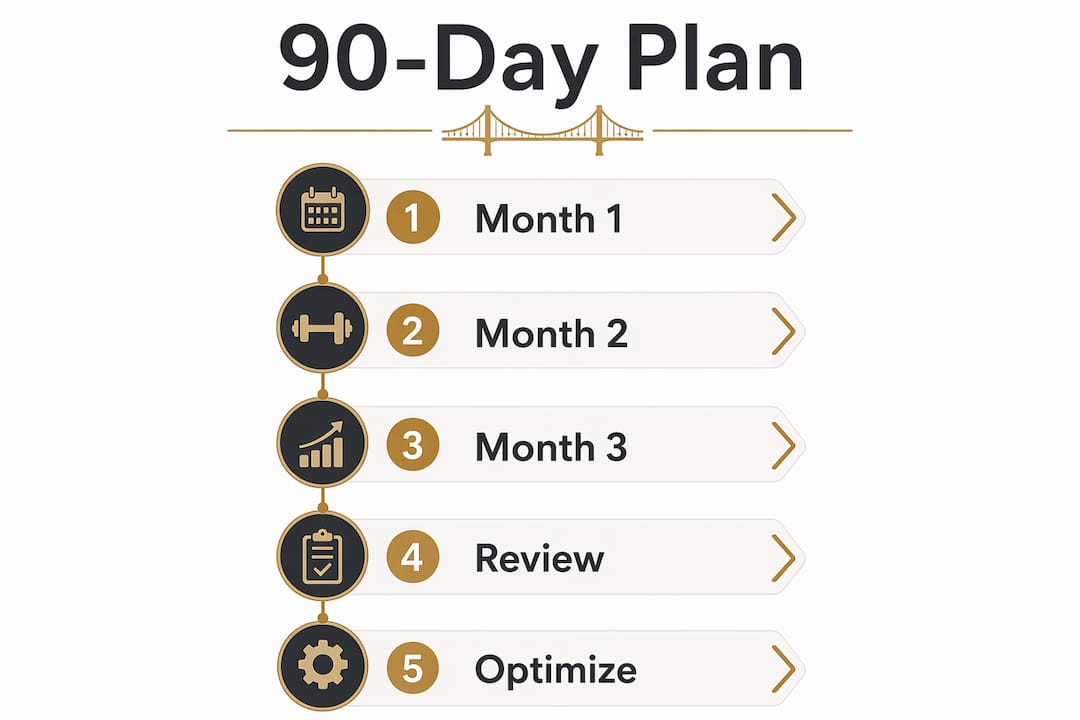
Strategy is not a content calendar. A true studio social media plan starts with a dedicated onboarding month before a single post runs.
90-day timeline
| Month | Focus | Primary goal | Key campaign |
|---|---|---|---|
| Month 1 | Foundation and audit | Baseline and setup | Account audit, pillar definition, tone guide, measurement baseline |
| Month 2 | Rhythm and testing | Consistent posting + first paid test | Weekly content cadence, first Meta lead ad, community engagement |
| Month 3 | Scale and refine | Lead volume and conversion | Optimize top-performing content, scale ad spend, retargeting |
Monthly check-in agenda
- Pull KPIs: leads generated, trial signups, cost per trial, engagement rate on pillar posts.
- Identify the top two performing content types and double down on format.
- Kill or pause the lowest-performing ad set.
- Adjust the next month's content calendar based on data, not gut feel.
- Set one platform goal for the coming quarter with a single KPI attached.
Weekly production checklist
- Monday: Capture content (film WOD highlights, coach tips, member moments — batch 3–5 assets in one session).
- Tuesday: Edit and write captions; schedule posts 2–3 weeks ahead.
- Wednesday: Community management (reply to all comments and DMs within 24 hours).
- Thursday: Ad check (review Meta Ads Manager spend, CTR, and lead form completions).
- Friday: Log weekly numbers in your reporting sheet; flag anything that needs a strategy adjustment.
Pro Tip: Stay 2–3 weeks ahead of your publishing schedule — one missed capture session won't derail your entire month.
What content works best for CrossFit gyms on social media?
High-impact content types for studios: WOD highlights, hero member stories (before/after journeys with permission), coach technique tips, event promos, community milestones (member anniversaries, PR boards), behind-the-scenes gym prep, and class recap clips.
Caption templates for three jobs:
- Authority (coach tip): "Most people [common mistake]. Here's what actually works: [one-sentence fix]. Drop a question below if you want the full breakdown."
- Community (member spotlight): "[Member name] hit [milestone] this week. Six months ago, [brief context]. This is why we show up. Tag someone who needs to hear this."
- Conversion (trial offer): "First week free, no contract. [Specific class time] still has spots. DM us 'START' or hit the link in bio."
Filming checklist for one capture session:
- Film the WOD from two angles (wide + close-up on movement).
- Record a 60-second coach tip to camera.
- Capture 3–5 candid member moments during class.
- Shoot one "behind the scenes" clip (whiteboard, equipment setup, coach prep).
From that single session, you get: a vertical Reel/TikTok (15–30 seconds), a 60-second YouTube Short, a still for the Instagram feed, and a Google Business Profile update post. Adapt captions and hooks for each platform — what works on Instagram rarely translates word-for-word to TikTok.
How do paid media and lead funnels work for local studios?
The funnel architecture for a CrossFit gym is straightforward: awareness content (short video posts, WOD clips) → lead capture (landing page with a trial form) → nurture (email or SMS sequence) → conversion (booked trial class). Each stage needs a specific asset and a tracking mechanism.
Meta Ads (Facebook and Instagram) are the best starting point for most studios. Local radius targeting, interest layering (CrossFit, functional fitness, HIIT), and lookalike audiences built from your member list give you precise reach at manageable cost. TikTok works well for top-funnel brand awareness but converts less efficiently at the local level without a strong organic presence first. YouTube Shorts drives discovery over time, not immediate leads.
Paid media checklist:
- Install the Meta pixel or set up Conversions API on your landing page.
- Tag all ad URLs with UTM parameters so you can track source in your CRM.
- Verify your Google Business Profile link matches your landing page URL exactly.
- Route all form submissions into your CRM with an automated follow-up sequence (email within 5 minutes, SMS within 15).
- Start with a modest local test budget to validate your offer and creative before scaling spend.
For digital campaign rationale specific to gyms, the key principle is this: paid media amplifies a working organic strategy — it does not replace one.
Which KPIs actually matter for a CrossFit studio?
Primary KPIs: qualified leads per month, trial-to-member conversion rate, cost per trial, and member retention at 30, 60, and 90 days. If you can calculate average member lifetime value, track that too — it tells you exactly how much a lead is worth and how much you can afford to spend acquiring one.
Secondary metrics worth watching: engagement rate on posts that drive trial signups (not all posts — just the ones with a CTA), and your Google Business Profile's local search impressions and direction requests.
Stop tracking: raw follower counts, total reach, and impressions unless they directly correlate to a conversion event in your data. A gym with 800 engaged local followers outperforms one with 8,000 passive ones every time.
Reporting cadence: weekly tactical checks (ad spend, lead volume, community response time), monthly performance reviews tied to your 90-day plan, and a quarterly strategy review where you reset goals and pillars based on what the data actually showed.
How should a small gym team run social media operations?
| Role | Responsibility | Time per week |
|---|---|---|
| Owner / GM | Strategy approval, brand voice sign-off, budget decisions | 1–2 hours |
| Content lead | Filming, editing, scheduling, caption writing | 5–8 hours |
| Community manager | Comment replies, DMs, Google Business Profile responses | 3–4 hours |
| Ad manager or agency | Campaign setup, optimization, reporting | 2–4 hours |
The operational workflow runs: content capture → edit and write → 48-hour review window → schedule → community management → weekly reporting. A brand voice brief (2 pages max) covers tone, caption dos and don'ts, and a crisis triage protocol so whoever is managing comments knows exactly when to escalate.
When handing off to an agency, expect: an account audit in week one, a strategy deck by week two, and a monthly deliverables list with clear KPIs. Before granting access, prepare a credentials checklist covering Meta Business Manager, Google Business Profile, your website CMS, and your CRM. A documented workflow prevents the most common agency handoff failures.
What does studio social media management actually cost?
| Approach | Monthly cost range | Time to results | Best for |
|---|---|---|---|
| In-house | — | 60–90 days | Owners with time and content skills |
| Freelancer-managed | — | — | Studios wanting execution without full agency cost |
| Agency-managed | — | 30–60 days | Owners who want speed and a proven system |
The tradeoff is control versus speed versus cost. In-house gives you maximum control and minimum cost, but the learning curve eats time. A freelancer splits the difference. An agency moves fastest but requires trust and clear KPIs from day one. Regardless of approach, validate your paid funnel with a small local test budget before committing to scaled spend.
Your 30/60/90 checklist and quick wins to start this week
By day 30
- Audit all social accounts: profile photos, bios, links, and posting history.
- Claim and fully optimize your Google Business Profile (photos, hours, services, review responses).
- Define your four content pillars and write a one-page brand voice brief.
- Set up Meta Business Manager, install the pixel, and connect your CRM.
- Build a 30-day content calendar with posts scheduled 2 weeks ahead.
By day 60
- Run your first Meta lead ad targeting a 10-mile radius with a free trial offer.
- Publish three member spotlight posts and track engagement versus other content types.
- Post your first YouTube Short and TikTok WOD highlight.
- Review week-4 data and cut any content format that generated zero engagement.
By day 90
- Scale the best-performing ad creative with increased budget.
- Launch a retargeting campaign for landing page visitors who did not convert.
- Conduct a full monthly review: leads, trials booked, conversion rate, cost per trial.
- Reset your next 90-day goals based on what the data showed.
Quick wins you can do this week:
- Optimize your Google Business Profile with five new photos and a weekly post.
- Run a $5/day Meta lead ad for a free trial class — even three days of data tells you something.
- Publish one member spotlight post and tag the member; watch how their network engages.
For a seasonal content calendar that maps these quick wins to the full year, Enochmarketing's blog has a ready-to-use 2026 playbook.
Key Takeaways
A studio social media strategy works when it ties every post, ad, and metric to a measurable studio outcome — leads, trials, and member retention — not follower counts or reach.
| Point | Details |
|---|---|
| Mission-first beats vanity | Nurture base fans and measure resonance; raw reach rarely converts to local memberships. |
| 90-day rhythm with check-ins | Plan quarterly, review monthly, and wait at least 30 days before concluding any content test. |
| Cap promotional content | Keep explicit promotional posts at 15–20% of total content to preserve audience attention. |
| Track the right KPIs | Prioritize qualified leads, trial-to-member conversion rate, and 30/60/90-day retention over follower counts. |
| Enochmarketing as your next step | Enochmarketing offers CrossFit-specific audits, strategy decks, and done-for-you social execution for U.S. gyms. |
The part most gym owners get wrong about social strategy
The conventional wisdom says "post consistently and the members will come." That's half true and half dangerous. Consistency without a strategy just means you're consistently producing content that doesn't convert. The studios that grow fastest aren't the ones posting the most — they're the ones who know exactly who they're talking to, what those people need to hear before they walk in the door, and how to measure whether the content is actually doing that job.
What most owners underestimate is the onboarding phase. Skipping the audit and pillar-definition work to start posting immediately feels productive, but it's the single biggest reason social media efforts stall at month three. You end up with a calendar full of posts and no idea why none of them are generating trials. The 30-day foundation work isn't slow — it's what makes the next 60 days actually move the needle.
One more thing: the 15–20% promotional content rule isn't a suggestion. It's the difference between an audience that trusts you and one that tunes you out. CrossFit members are community-driven by nature. They respond to stories, culture, and belonging — not a daily pitch for a free trial. Earn the right to sell by building the community first.
Ready to hand this plan to a specialist?
Enochmarketing works exclusively with CrossFit gyms and fitness brands across the United States. Where most agencies hand you a generic content calendar, Enochmarketing starts with a full account audit, builds a strategy deck specific to your local market, and executes paid media, lead funnels, and social content as a single integrated system. The result is a predictable pipeline of qualified local leads, not a follower count that looks good on a screenshot.
If you want a done-for-you version of the 90-day plan outlined here, book a free strategy session through the Enochmarketing services page. Owners who want to compare service tiers first can review the pricing options before the call. The session is 30 minutes, no pitch, just a clear picture of what your gym's social presence needs to generate consistent memberships.
Useful sources to read next
- Sprout Social: Social Media Plan Template — The 30-day and 90-day planning frameworks referenced throughout this article, including a six-step goal-setting process and weekly task templates.
- Social Media Examiner: Organic Social Marketing Strategy — Jenny Li Fowler's mission-first, base-fan framework; the source for the resonance-over-reach argument in the strategy sections.
- Studio West Design Co.: What Actually Goes Into a Social Media Strategy — Studio-specific operational guidance on the onboarding month, pillar definition, and batch scheduling.
- Ambrose Marketing: Wellness Studio Social Media — Source for the 15–20% promotional content rule applied to fitness and wellness studios.
- Enochmarketing Blog: Boost Gym Memberships with Social Strategy — CrossFit-specific examples, seasonal planning resources, and a 90-day content approach for U.S. gym owners.