
Running a fitness studio means you already know the workout. But when it comes to the top fitness studio marketing channels worth your time and money, the options feel endless and the wrong choice costs you real members. Most studio owners scatter their budget across platforms, hope something sticks, and wonder why their inquiry-to-member rate stays flat. This article cuts through that noise. You will find a clear framework for evaluating channels, a data-backed breakdown of what actually works in 2026, and a comparison table to make decisions faster.
Table of Contents
- Key takeaways
- 1. How to evaluate fitness studio marketing channels
- 2. Social media platforms
- 3. Google Maps and local SEO
- 4. Email marketing
- 5. SMS and WhatsApp messaging
- 6. Paid advertising: Meta and Google Ads
- 7. Referral and word-of-mouth marketing
- 8. Multi-touch lead follow-up as a channel system
- Comparing the top channels side by side
- Matching channels to your studio size and budget
- My honest take on fitness studio marketing in 2026
- Ready to build a marketing system that actually converts?
- FAQ
Key takeaways
| Point | Details |
|---|---|
| Match channels to lifecycle stages | Using the right channel at the wrong stage kills conversions even with great creative. |
| Speed-to-lead wins memberships | Responding to inquiries within 5 minutes via SMS or WhatsApp dramatically increases conversion. |
| Multi-touch follow-up matters | Trial members who receive 5 or more follow-up touches convert at nearly 3x the rate of those receiving 1 or 2. |
| Local SEO is often undervalued | Optimizing your Google Business Profile can generate consistent, low-cost leads from nearby searchers. |
| Channel mix beats single-channel reliance | Combining social media, email, paid ads, and SMS creates more resilient and higher-converting campaigns. |
1. How to evaluate fitness studio marketing channels
Before you invest in any specific platform, you need a filter. Not every channel fits every studio, and the industry term for this kind of thinking is channel strategy. The idea is to match your marketing tools to where your prospects actually are in their decision process.
The first filter is reach vs. relevance. A TikTok video might reach 10,000 people, but if 9,500 live 30 miles away, the reach is worthless. Local targeting matters more for fitness studios than for almost any other business category. Every channel you consider should answer: Can I target within a 5 to 10-mile radius of my studio?
The second filter is lifecycle stage fit. Channel misalignment by lifecycle stage is the most common reason fitness marketing automation fails. Email works well for long-form onboarding sequences and receipts. WhatsApp performs better for warm, conversational touchpoints and at-risk member interventions. Using email to handle a speed-to-lead response is like using a letter to answer a phone call.
The third filter is conversion potential relative to cost. Here are the core metrics worth tracking for each channel you test:
- Cost per lead (CPL): What you spend to generate one inquiry
- Lead-to-visit rate: How many inquiries actually show up at your studio
- Trial-to-paid conversion rate: How many trial visits become paying members
- Retention impact: Whether the channel contributes to keeping members longer
The fourth filter is operational fit. A solo studio owner running a six-channel marketing operation is a recipe for burnout. Be honest about what your team can actually manage without cutting corners on follow-up quality.
Pro Tip: Before picking new channels, audit what you are already using. Most studios are underutilizing two or three existing channels before they need anything new.
2. Social media platforms
Social media is not a single channel. Instagram, Facebook, TikTok, and YouTube each serve different purposes and attract different behaviors. Treating them as interchangeable is where most studios go wrong.
TikTok leads fitness engagement in 2026 with a 4.2% engagement rate, well above Instagram and Facebook. Short-form video showing real workouts, member transformations, and coach personalities performs consistently. You do not need a production team. A phone, good lighting, and genuine content outperforms polished but generic clips every time.
Instagram and Facebook remain strong for community building and paid promotion. They are where your local audience is most likely to discover you through friends sharing content or through targeted ads. YouTube is better suited for longer tutorials and search-driven discovery, which takes time to build but compounds over months. For most studios, the practical starting point is Instagram and TikTok for organic content, with Facebook and Instagram used together for paid campaigns. A proven gym social media strategy typically builds consistency before expanding to new platforms.
3. Google Maps and local SEO
Organic search delivers 48.2% of global traffic in the fitness category, and a significant portion of that starts with a "gym near me" query on Google Maps. If your Google Business Profile is incomplete or has fewer reviews than your competitors, you are losing warm, high-intent traffic every single day.
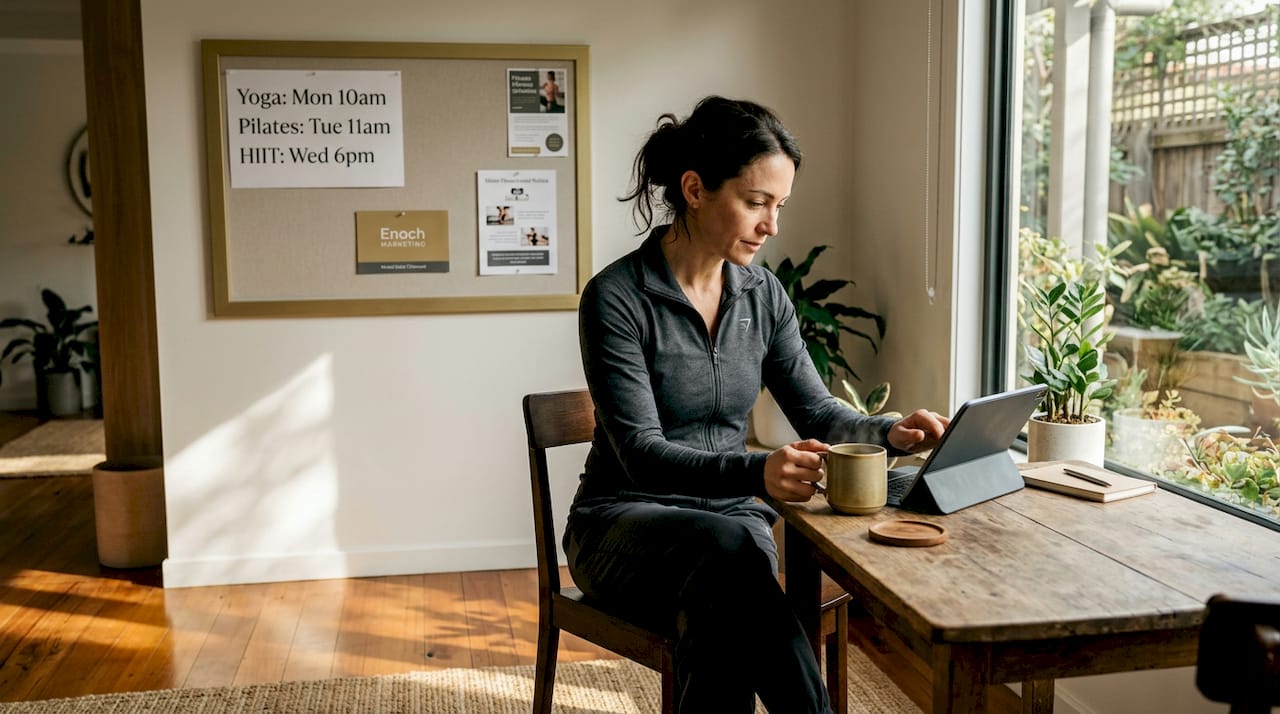
Optimizing your Google Business Profile involves more than adding your hours. Improving your local search prominence requires selecting the right categories, actively requesting photo reviews from happy members, enabling the booking button, and posting updates regularly. Google treats activity as a signal of relevance.
Local SEO, meaning your website's ability to rank for localized search terms, supports this profile work. Pages optimized for phrases like "CrossFit gym in [City]" or "personal training near [Neighborhood]" capture people who are already in buying mode. This is where the cost per acquisition can drop dramatically compared to paid ads.
4. Email marketing
Email is the channel fitness studios most underrate. It does not drive viral discovery, but it is the strongest tool you have for keeping members and upselling existing ones. Fitness email marketing averages a 22.8% open rate and a 2.9% click-through rate, numbers that hold up well against nearly every other digital channel.
The real power of email is in automated sequences. A structured onboarding sequence for new trial members, a re-engagement campaign for lapsed members, and a quarterly upsell campaign can all run without manual effort once built. Email drives gym retention in ways that social media simply cannot replicate, because you own the list and control the timing.
Pro Tip: Do not measure email success by open rates alone. Track what happens after the click. Which emails drive actual bookings, upgrades, or renewals? That is the number worth optimizing.
5. SMS and WhatsApp messaging
When a prospect submits an inquiry form on your website, the clock starts immediately. Responding within 0 to 5 minutes via SMS or WhatsApp is not just helpful. It is the single biggest lever in converting cold inquiries into booked visits.
Most studios respond hours later, by email, and wonder why nobody shows up. Speed beats brand recognition. A fast, personal reply via WhatsApp feels like a real conversation and builds trust before the person has even set foot in your studio. SMS serves a similar role for markets where WhatsApp adoption is lower.
These channels should not replace email. WhatsApp handles warm conversations and time-sensitive interventions. Email handles longer sequences and documentation. They work together as a system, not as alternatives.
6. Paid advertising: Meta and Google Ads
Paid advertising is the fastest way to generate new leads, but also the fastest way to burn budget without a clear system behind it. Effective gym advertising through Meta (Facebook and Instagram) and Google Ads requires three things: a targeted audience, a compelling offer, and a landing page that is actually optimized for conversion.
On Meta Ads, the offer matters more than the creative. Free trials, intro weeks, and challenge programs consistently outperform generic "Join Now" campaigns. When testing landing pages, assign one URL per ad set instead of using redirects. This gives the algorithm accurate signals and prevents testing bias.
Split tests need at least 7 to 14 days and roughly 50 conversions per ad set to produce reliable data. Studios that judge tests after three days and a handful of clicks are drawing conclusions from noise. A deeper breakdown of fitness advertising strategies can help you structure campaigns that actually scale.
7. Referral and word-of-mouth marketing
Referrals are the highest-converting lead source for fitness studios, and most owners treat them as a happy accident rather than a system. A structured referral program turns your existing member base into a consistent acquisition channel.
The mechanics are simple: give members a reason to refer, make the process frictionless, and acknowledge them when someone they sent becomes a member. A discount on their next month, branded merchandise, or a free personal training session all work. What does not work is passively hoping members will mention you to friends.
Community events, charity workouts, and local partnerships extend word-of-mouth reach beyond your current membership. These tactics also build the kind of reputation that shows up in Google reviews, which feeds back into your local SEO.
8. Multi-touch lead follow-up as a channel system
This is not a single platform. It is the system that makes every other channel work. Trial members receiving 5 or more follow-up touches convert at 58%, compared to just 19% for those who receive one or two contacts. That gap represents the difference between a struggling studio and a thriving one.
A multi-touch follow-up system combines SMS for immediate response, WhatsApp for warm conversation, email for longer nurture sequences, and phone calls for high-value prospects. Operational speed and follow-up frequency drive more conversions than any single channel on its own. The platform you use to manage this matters less than whether it actually runs consistently every time a lead comes in.
Comparing the top channels side by side
| Channel | Reach | Engagement | Conversion potential | Cost | Best lifecycle stage |
|---|---|---|---|---|---|
| Social media (organic) | Medium-High | High (TikTok 4.2%) | Low-Medium | Low | Awareness |
| Google Maps / Local SEO | High (local) | High intent | High | Low-Medium | Decision |
| Email marketing | Medium | Medium (22.8% open) | High | Low | Onboarding, retention |
| SMS / WhatsApp | Low-Medium | Very High | Very High | Low | Speed-to-lead, intervention |
| Meta Ads | Very High | Medium | Medium-High | Medium-High | Awareness, acquisition |
| Google Ads | High (local) | High intent | High | Medium-High | Decision |
| Referral / word-of-mouth | Medium | Very High | Very High | Very Low | Acquisition, retention |
The table confirms what the data shows. No single channel dominates across all stages. High-reach channels like Meta Ads are weak at conversion without a follow-up system behind them. High-conversion channels like SMS require the other channels to generate the initial lead.
Pro Tip: Evaluating a landing page split test by click-through rate alone is one of the most common mistakes in paid fitness marketing. Always follow the data downstream to cost per acquisition and actual lead quality before declaring a winner.
Matching channels to your studio size and budget
Not every studio needs the same mix. Here is a practical starting point based on where you are:
Solo practitioners and small studios (under $1,000/month marketing budget):
- Google Business Profile optimization (free and high-impact)
- Instagram and TikTok organic content (2 to 3 posts per week)
- Email list with a basic onboarding sequence
- SMS for lead follow-up via a low-cost automation tool
Mid-size studios ($1,000 to $3,000/month):
- Add Meta Ads with a clear intro offer and tested landing page
- Build a multi-touch follow-up sequence using lead generation automation
- Implement a referral program with trackable incentives
- Run local SEO alongside paid to reduce long-term CPL
Larger clubs and multi-location studios ($3,000+/month):
- Full multi-channel marketing system with automated lifecycle sequences
- Google Ads targeting high-intent local search terms
- Dedicated retargeting campaigns for website visitors and past leads
- Advanced segmentation in email and SMS by member behavior
Your local competitive environment also shapes the decision. In a market with three established gyms already running Meta Ads, standing out on Google Maps with 80 five-star reviews can be more effective than trying to out-spend them on paid social.
My honest take on fitness studio marketing in 2026
I have worked with enough fitness studios to say this plainly: most channel problems are actually follow-up problems.
I see studios spending real money on Meta Ads, generating solid lead volume, then responding to inquiries the next morning with a generic email. That is not a channel problem. That is an operational design failure.
In my experience, the studios that grow fastest are not necessarily using the most sophisticated platforms. They are responding within five minutes, they are making multiple personal contacts before giving up on a lead, and they are treating their email list like an asset instead of an afterthought.
WhatsApp is becoming a genuinely important channel in 2026. I have seen it outperform email for at-risk member interventions by a wide margin, not because email is dead, but because a WhatsApp message feels personal in a way that an automated email sequence no longer does for most people.
The uncomfortable truth about channel selection is that the channel you execute consistently will always beat the channel you use perfectly once a month. If TikTok is not something you can realistically post on three times a week, the best TikTok strategy in the world is useless for your studio.
Pick fewer channels. Work them harder. Measure what happens after the click, not just before it.
— Collin
Ready to build a marketing system that actually converts?
If this article gave you a clearer picture of where your studio's marketing gaps are, Enochmarketing can help you close them. As a fitness-specific marketing agency, Enochmarketing builds and manages the full stack: Meta and Google Ads, local SEO, lead funnel automation, and multi-touch follow-up systems designed specifically for gyms and studios like yours.
This is not generic marketing advice applied to fitness. Every campaign is built around your local market, your offer, and the member lifecycle stages where you are losing leads right now. If you are ready to stop guessing and start growing, explore the full range of gym growth services or take a look at transparent pricing options built for studios at every stage. Book a free strategy call and find out exactly where your biggest opportunities are.
FAQ
What are the most effective marketing channels for fitness studios?
The most effective channels combine Google Maps optimization, Meta Ads, email, and SMS-based follow-up into a system that covers both discovery and conversion across the member lifecycle.
How fast should a fitness studio respond to new leads?
Responding within 0 to 5 minutes via SMS or WhatsApp produces significantly higher conversion rates. Speed matters more than which channel you use for the initial response.
How many follow-up touches does it take to convert a trial member?
Trial members who receive 5 or more follow-up contacts convert at 58%, compared to just 19% for those receiving only 1 or 2 touches.
Is email marketing still worth it for gym retention?
Yes. Fitness email marketing averages a 22.8% open rate and supports the industry's 74% average annual retention rate, making it one of the highest-ROI retention tools available.
Should small studios run paid ads before optimizing organic channels?
Not typically. Optimizing your Google Business Profile and building consistent organic social content first creates a foundation that makes paid ads more cost-effective when you do add them.