
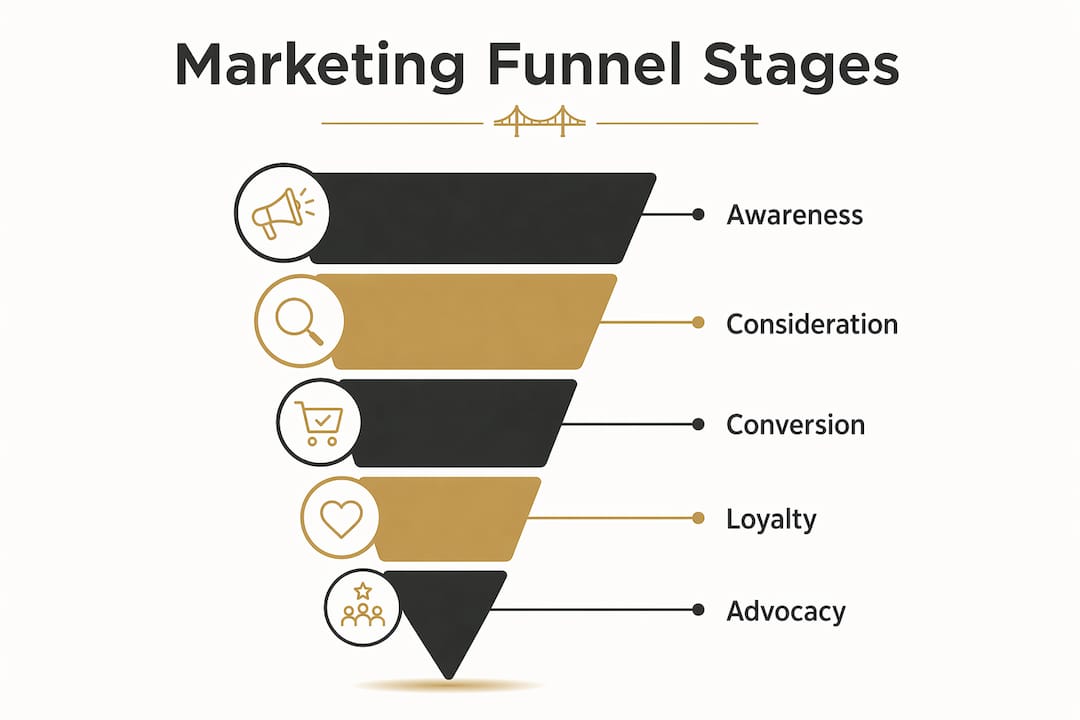
A marketing funnel is a strategic, multi-stage framework that maps a prospect's journey from first discovering your gym to becoming a paying member and loyal advocate. Most models use three to five stages, commonly labeled Awareness, Consideration, Conversion, Loyalty, and Advocacy. The funnel shape is intentional: many people enter at the top, and fewer reach the bottom. Your job as a fitness marketer is to reduce that drop-off at every stage. Understanding funnel marketing is the foundation of every membership growth strategy that actually works.
What is a marketing funnel and why does it matter for fitness businesses?
A marketing funnel is not just a diagram. It is a decision-making tool that tells you what to say, to whom, and when. Funnels help marketers deliver the right message at the right time by addressing the specific questions a prospect has at each stage. A cold lead wondering "Is this gym safe for beginners?" needs a different message than a warm lead comparing your membership price to a competitor's.
For fitness entrepreneurs, this matters more than in most industries. Gym memberships require a high level of trust before someone commits. A prospect might see your Instagram ad on monday, read your blog on thursday, watch a testimonial video the following week, and only then book a free class. Without a funnel, you have no system to guide that person through each step. With one, you can predict and improve that journey.

The TOFU/MOFU/BOFU model (Top of Funnel, Middle of Funnel, Bottom of Funnel) is the most widely used framework in digital marketing. It gives fitness business owners a clear language for organizing their content, ads, and follow-up sequences around real buyer behavior.
What are the main stages of a marketing funnel?
The stages of a marketing funnel each require a different type of content and a different tone. Rushing a cold prospect into a sales pitch is the fastest way to lose them.
Top of funnel: awareness
Top-of-funnel content targets people who do not know your gym exists yet. The goal is visibility, not conversion. Educational content like blogs and social media posts work best here because they answer questions without asking for anything in return. A CrossFit gym might publish a post titled "5 Signs You're Ready to Try CrossFit" to attract curious beginners.
Middle of funnel: consideration
Middle-of-funnel content targets people who know you exist and are weighing their options. Webinars, case studies, email sequences, and behind-the-scenes videos build trust at this stage. A fitness business might share a member transformation story or a coach Q&A to show social proof and reduce hesitation.
Bottom of funnel: conversion
Bottom-of-funnel content targets people who are ready to decide. Free trials, limited-time offers, and direct testimonials close the gap between interest and action. This is where a clear call to action matters most.
- Awareness: Blog posts, short-form social video, paid reach campaigns
- Consideration: Email nurture sequences, webinars, member case studies, coach spotlights
- Conversion: Free class offers, 7-day trial passes, direct response ads with testimonials
- Loyalty: Onboarding sequences, milestone recognition, member check-ins
- Advocacy: Referral programs, community events, user-generated content campaigns
Pro Tip: Track the conversion rate between each stage, not just the final sale. If 200 people click your ad but only 5 book a class, the leak is in your landing page, not your ad.
What types of marketing funnels work best for fitness businesses?
No single funnel type fits every fitness business. The right model depends on your price point, your audience's familiarity with your brand, and whether your primary goal is acquiring new members or retaining existing ones.
Lead magnet funnel
A lead magnet funnel offers something free, like a workout plan or nutrition guide, in exchange for an email address. It builds your list fast and works well for gyms launching in a new market. The trade-off is that lead quality varies. Many people download the freebie and never engage again.
Tripwire funnel
A tripwire funnel offers a low-cost entry point, such as a $20 fitness assessment or a 7-day trial pass, to convert cold traffic before pitching a full membership. Tripwire offers bridge interested prospects to paying customers without the psychological barrier of a high-ticket commitment. This model works especially well for CrossFit gyms where the workout style is unfamiliar to newcomers.
Membership funnel
A membership funnel is built for recurring revenue. It moves prospects from awareness to a subscription commitment through a structured sequence of content, social proof, and offers. This funnel type prioritizes long-term retention over fast acquisition.
| Funnel type | Best for | Primary goal |
|---|---|---|
| Lead magnet | New market entry, list building | Acquisition |
| Tripwire | Converting cold traffic | Acquisition |
| Membership | Established gyms with strong brand | Retention and revenue |
| Webinar | Premium programs or coaching | Consideration and conversion |
Fitness businesses with lower-priced introductory offers benefit most from tripwire and lead magnet funnels. Gyms with established communities and premium pricing get more value from membership and webinar funnels. You can learn more about how these models apply specifically to CrossFit growth in this fitness funnel breakdown.
How do you measure and improve your funnel's performance?
Measurement is where most fitness marketers fall short. They track total leads and total sign-ups but ignore everything in between. Successful funnel optimization requires measuring micro-conversion rates at every step, not just the final sale.
Here is a practical process for improving your funnel:
- Map every step. Write out each action a prospect takes from seeing your first ad to signing a membership agreement. Include every click, form, email, and phone call.
- Assign a conversion rate to each step. If 500 people see your ad, 80 click it, 30 fill out a form, and 10 book a call, you now know where the biggest drop-offs are.
- Run A/B tests on your weakest points. Test two versions of your landing page headline, your email subject line, or your call-to-action button. Change one variable at a time.
- Check your offer alignment. A cold prospect who has never heard of your gym should not see a $150-per-month membership offer first. Match the offer to the stage.
- Review your data monthly. Funnel performance shifts with seasons, ad fatigue, and market changes. A funnel that worked in january may underperform by april.
Pro Tip: Use your gym's booking software data to identify which days and times prospects most often abandon the sign-up process. That pattern usually points to a friction problem, like a form that is too long or a price reveal that comes too early.
For a deeper look at the numbers behind this process, the gym owner's conversion guide covers the specific metrics that matter most for fitness businesses.
How do you extend the funnel into loyalty and advocacy?
The traditional funnel ends at the sale. That is a costly mistake for gym owners. Retention funnels are often more profitable than acquisition funnels for local fitness businesses because keeping a member costs far less than finding a new one.
Modern funnel models like the flywheel and bowtie treat the customer journey as cyclical, not linear. In a flywheel model, happy members generate referrals that feed new prospects back into the top of your funnel. The energy from your existing community powers your growth.
Practical ways to build a loyalty and advocacy funnel for your gym:
- Automate your onboarding. Send new members a welcome email sequence covering what to expect in their first 30 days, who to talk to, and how to track progress.
- Create milestone moments. Celebrate a member's first pull-up, 100th class, or one-year anniversary publicly. Recognition drives retention.
- Build a referral program with real incentives. Offer a free month, branded gear, or a guest pass for every new member a current member brings in.
- Re-engage lapsed members. Set up an automated email or text sequence that triggers when a member misses two weeks of classes. A personal check-in converts more than a generic promotion.
- Turn advocates into content creators. Ask your most engaged members to share their stories on social media. Their authentic posts reach audiences your paid ads cannot.
Referral loops and automated re-engagement lower your acquisition costs over time. They also build the kind of community that makes your gym hard to leave. For more on building this kind of membership culture, the CrossFit membership marketing guide covers retention strategies in detail.
Key takeaways
A marketing funnel is the single most important framework for turning gym prospects into long-term members. Without one, you are spending money on ads with no system to convert that attention into revenue.
| Point | Details |
|---|---|
| Funnel stages require different content | Match educational content to awareness, trust-building to consideration, and direct offers to conversion. |
| Tripwire offers convert cold traffic | A low-cost trial or assessment removes the commitment barrier before pitching a full membership. |
| Measure micro-conversions | Track drop-off rates at every funnel step, not just the final sign-up, to find and fix leaks. |
| Retention funnels drive profit | Keeping existing members through automated nurturing costs less than acquiring new ones. |
| Treat the journey as cyclical | Flywheel and bowtie models turn loyal members into referral sources that feed new prospects. |
The funnel mistake I see fitness businesses make most often
Most gym owners I work with have some version of a funnel. They run Meta ads, they have a landing page, and they offer a free class. What they almost never have is a system for the middle. The awareness stage gets all the budget. The conversion stage gets all the attention. The consideration stage, where trust is actually built, gets ignored.
A prospect who clicks your ad and lands on a page asking them to sign up immediately is not ready. They have questions you have not answered yet. Is this gym for someone like me? Will I embarrass myself? What happens after I sign up? A good middle-of-funnel sequence answers all of those questions before you ever ask for a credit card.
The other mistake I see constantly is treating the funnel as a one-time build. You set it up, run some ads, and assume it will keep working. Funnels decay. Ad creative gets stale. Offers stop converting. The gyms that grow consistently are the ones that review their funnel data every month and make small adjustments. A 5% improvement in your landing page conversion rate compounds significantly over a year.
Retention is where I think the biggest opportunity sits for most fitness businesses right now. Acquisition gets all the glory, but a gym that keeps 90% of its members grows faster than one that signs 30 new members and loses 25 of them. Build the back end of your funnel with the same care you give the front end.
— Collin
How Enochmarketing builds funnels that fill gyms
Enochmarketing builds complete marketing funnels for CrossFit gyms and fitness brands across the United States. The agency handles every stage: paid media on Meta and Google to drive awareness, lead funnel creation to capture and nurture prospects, and retention systems to reduce churn after the sale.
Every funnel Enochmarketing builds starts with an audit of your current marketing, then moves into a custom strategy built around your gym's pricing, audience, and local market. The result is a system designed to grow membership and keep it growing. If you are ready to see what a purpose-built fitness funnel looks like for your gym, explore the full range of gym marketing services or review the agency pricing to find the right fit.
FAQ
What is a marketing funnel in simple terms?
A marketing funnel is a step-by-step framework that guides a prospect from first hearing about your business to becoming a paying customer. Each stage requires different messaging and content to move people forward.
How many stages does a marketing funnel have?
Most funnels use three to five stages. The most common model includes Awareness, Consideration, Conversion, Loyalty, and Advocacy, though simpler TOFU/MOFU/BOFU models work well for smaller fitness businesses.
What funnel type works best for a CrossFit gym?
A tripwire funnel with a low-cost trial offer works well for CrossFit gyms because it removes the commitment barrier for cold prospects before introducing a full membership price.
How do I know if my funnel is working?
Track the conversion rate between every stage, not just the final sale. If large numbers of prospects drop off between your landing page and your booking form, that step needs testing and improvement.
Why is retention part of the marketing funnel?
Retention funnels keep existing members engaged and reduce churn, which costs less than acquiring new members. Referral programs and automated re-engagement sequences turn loyal members into a source of new prospects.