
The fastest way to lift trust and conversions is to systematically generate, centralize, and activate user-generated content (UGC) across product pages, email, social, and paid ads. The top ways to leverage user-generated content: embed reviews on product pages, run branded-hashtag campaigns, build shoppable UGC galleries, use member video in paid ads, collect written testimonials, centralize assets in a digital asset manager (DAM), enforce explicit permissions, and repurpose one asset across three or more placements.
- Embed star ratings and photo reviews directly on service or product pages
- Launch a branded hashtag campaign to generate a steady stream of visual content
- Build a shoppable or scrollable UGC gallery on your homepage or landing pages
- Run paid ads using real member video clips instead of polished brand creative
- Collect short video testimonials after key milestones (first PR, 90-day transformation)
- Centralize every asset in a DAM or structured hub using Adobe Experience Manager or a comparable system
- Capture explicit written permission before reusing any content
- Repurpose each approved asset into email, social, and ad placements
The highest business impact follows this order: trust first, then conversion lift, then content velocity. Tools like Hootsuite and Enochmarketing's member storytelling system make the process repeatable for fitness brands.
Key Takeaways
A UGC program only compounds when collection, permissions, and activation run as a system rather than a series of one-off posts.
| Point | Details |
|---|---|
| Start with one funnel stage | Pick conversion or awareness first; test a review widget or branded hashtag before scaling to all channels. |
| Permissions are non-negotiable | Capture explicit written consent for every asset before reuse; save the DM, form response, or email as your audit trail. |
| Centralize every asset | Store approved content in a DAM or structured hub with consistent tagging so nothing gets lost in screenshots. |
| Measure conversion lift, not just engagement | Run A/B tests on pages and ad sets to isolate UGC's impact on sign-ups and CAC. |
| Enochmarketing for fitness brands | Enochmarketing builds done-for-you UGC programs for CrossFit gyms, covering collection, paid creative, and monthly ROI reporting. |
Table of Contents
- What counts as UGC — and what doesn't
- Why UGC moves the needle on real business metrics
- How to build a repeatable UGC engine
- Collecting UGC and securing rights the right way
- Where and how to activate UGC across channels
- How to measure UGC impact and prove ROI
- Real-world examples that show the mechanics
- Enochmarketing's 30/60/90 UGC playbook for fitness gyms
- What most teams get wrong about UGC
- Enochmarketing runs UGC programs for CrossFit gyms
- Sources
What counts as UGC — and what doesn't
User-generated content is any brand-related content created by customers, fans, creators, or employees rather than the brand itself. That includes organic posts from real members and paid content from briefed UGC creators. The distinction matters because paid UGC requires FTC disclosure; organic UGC does not, though both require permission before reuse.
Common UGC formats:
- Visual (photos, Reels, TikToks): A member's post-workout selfie, a before/after transformation photo, a short Reel showing a PR lift
- Video (unboxings, testimonials, walkthroughs): A 60-second "why I joined" clip, a coach-led challenge video, a member's competition recap
- Text (reviews, forum threads, comments): Google reviews, Yelp ratings, Reddit threads, Facebook group posts
- Social posts and mentions: Tagged posts, story reposts, check-ins, event photos
- Long-form (blog reviews, case studies): A member's personal blog post about their fitness journey, a media feature
Primary sources of UGC:
- Organic customers: The most credible source; no brief, no payment, purely voluntary
- Micro creators and UGC creators: Briefed but not necessarily published on their own channels; paid for content delivery, not reach
- Employees and brand ambassadors: Coaches posting workouts, staff sharing event recaps
- Contest or challenge participants: Members who submit content to win a prize or get featured
Different formats convert differently: text reviews are low-friction and scale well for the consideration stage, while photos and short video clips drive the heaviest conversion lift in e-commerce and awareness campaigns.
Why UGC moves the needle on real business metrics
Peer-validated content cuts through skepticism in a way polished brand advertising rarely does. Modern U.S. consumers have grown accustomed to filtering out promotional messaging, so a real member's photo or review carries weight that a studio-shot ad simply cannot replicate.
The business impacts that matter most:
- Trust and social proof: Authentic content from real people signals that your gym delivers on its promises
- Conversion lift: Reviews and photos on a product or service page give hesitant prospects the final push they need
- Content velocity and cost efficiency: A single member video can become a paid ad, an email header, a story repost, and a website testimonial — four assets from one source
- Organic reach: When members post and tag your gym, their audiences see it without any ad spend
- SEO and discoverability: Review schema markup, keyword-rich testimonials, and tagged photos all contribute to long-tail search visibility
UGC is most valuable when treated as a content engine that feeds product pages, email, social, and paid ads simultaneously. Integrating it into your CMS or DAM is what separates a one-off campaign from a compounding asset library.
A short note on SEO: adding review schema (structured data) to your service pages lets Google display star ratings in search results, which increases click-through rates before anyone even lands on your site. Keyword-rich reviews also surface your gym in long-tail searches like "CrossFit gym with nutrition coaching near me."
How to build a repeatable UGC engine
Ad hoc UGC collection is the norm at most gyms. Someone screenshots a member's post, saves it to their phone, and it disappears into a camera roll. A repeatable engine fixes that.
The core process:
- Discover — Monitor branded hashtags, tagged posts, and review platforms daily or with a social listening tool
- Request permission — Send a direct message or automated email asking for explicit reuse rights
- Ingest — Upload approved assets to your DAM or centralized hub with source metadata
- Tag and curate — Apply a taxonomy (format, channel, campaign, member name, date) so assets are findable
- Store — Keep everything in one place; Shopify's guidance on centralizing UGC confirms that scattered folders and screenshots are where content goes to die
- Activate — Publish across channels according to your content calendar
- Measure — Track engagement, conversion lift, and assisted conversions by channel
Suggested team roles:
- Social/community manager: Daily discovery and permission outreach
- Content curator: Tagging, quality review, and DAM organization
- Legal/permissions owner: Audit trail maintenance and disclosure compliance
- Creative lead: Repurposing assets into ad and email formats
- Analytics: Reporting on KPIs and A/B test results
A practical weekly cadence: scan and capture on Monday, send permission requests midweek, and publish or activate the best pieces by Friday. This weekly loop keeps a steady flow of fresh content without requiring a dedicated full-time role.
Pro Tip: Automate permission capture with a Zapier workflow that triggers a DM template the moment someone tags your gym's handle. Pair it with a Typeform or Airtable submission form linked in your bio for members who want to submit content directly.
Collecting UGC and securing rights the right way
Rights management is the step most brands skip, and it is the one that creates legal exposure. Before you repost, embed, or run any member content as an ad, you need explicit written consent.
Recommended collection methods:
- Branded hashtags (e.g., #YourGymName or a campaign-specific tag)
- Submission forms via Typeform or Airtable linked in your bio or post-purchase email
- QR codes at the front desk or on equipment that link to a submission page
- Post-purchase or post-milestone email prompts (sent 7–14 days after a key event)
- Hashtag contests and challenges with clear entry rules
Permission best practices:
- Ask explicitly in a direct message or email: "We'd love to feature your post on our website and social channels. Do we have your permission?"
- Keep a written record of every "yes" — save the DM thread, form response, or email reply
- For paid UGC creators, use a written contract that specifies usage rights, duration, and platforms
- For any paid or gifted content, require FTC-compliant disclosure language ("ad," "sponsored," or "gifted")
Always capture an explicit permission audit trail — a saved DM, a form response, or an email confirmation. That record protects your brand and builds trust with the creators you work with repeatedly.
Pro Tip: Adobe Experience Manager lets you build UGC intake directly into your CMS workflow, so approved assets move from permission-granted to tagged-and-published without manual file transfers. For gyms not running AEM, a shared Airtable base with a "permissions confirmed" checkbox column achieves the same audit trail at a fraction of the cost.
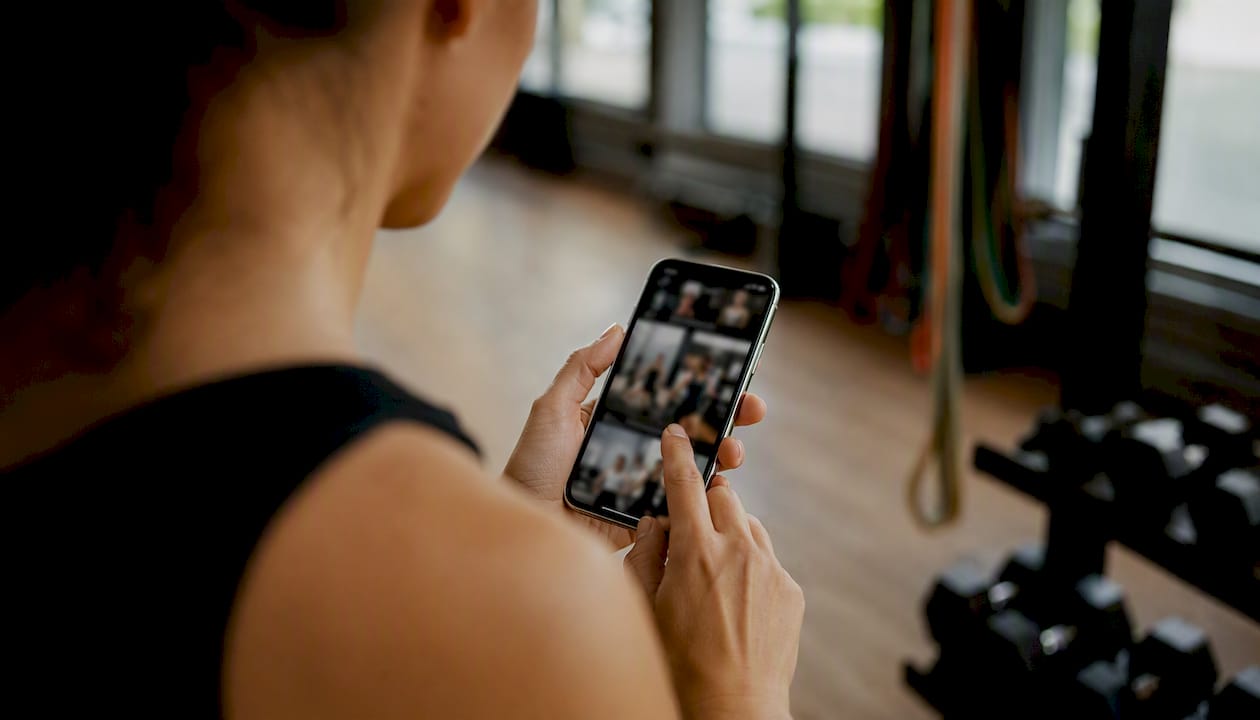
For moderation, tools like Hootsuite let you monitor tagged content, flag inappropriate posts, and queue approved assets for publishing, all from one dashboard.
Where and how to activate UGC across channels
One approved asset can work in at least four places. A member's 30-second transformation video becomes a paid Meta ad, an email header, a website testimonial, and a story repost. That repurposing logic is the whole point.
Channel checklist:
- Product/service pages: Add a review widget above the fold and a photo gallery below the main CTA
- Homepage and landing pages: A scrollable UGC gallery showing real members in action outperforms stock photography
- Email: Drop a testimonial snippet into cart-abandonment flows and welcome sequences
- Paid ads: UGC video creative consistently outperforms polished brand ads in Meta and Google campaigns; see paid media examples for CrossFit gyms for format breakdowns
- Social feed, Stories, and Reels: Reshare tagged posts with a brief context caption; credit the original creator
- OOH and events: Print member photos for in-gym displays or use them on event signage
Activation sequence for a single asset:
- Identify the asset (e.g., a member's 45-second PR video)
- Request and confirm permission
- Tag it in your DAM (format: video; channel: paid, email, social; campaign: Q3 acquisition)
- Resize and caption for each placement
- Schedule across channels with staggered timing to avoid audience fatigue
- Tag each placement with a UTM parameter for attribution
A/B test ideas worth running:
- UGC video creative vs. brand-produced video in the same Meta ad set
- Review widget placed above the fold vs. below the CTA on a landing page
- Short UGC clip (under 30 seconds) vs. longer testimonial (60–90 seconds) for awareness campaigns
UGC activated across product pages, email, social, and ads combines authenticity with reach in a way no single-channel strategy can match.
How to measure UGC impact and prove ROI
Measurement is where most UGC programs fall apart. Teams post member content, see engagement go up, and call it a win. That is not a business case.
Core KPIs by funnel stage:
- Awareness: Reach, impressions, and share rate on UGC social posts vs. brand posts
- Consideration: Click-through rate on UGC email vs. non-UGC email; time on page for pages with review widgets
- Conversion: On-page conversion lift (A/B test: page with UGC vs. control); average order value or trial sign-up rate
- Retention: Repeat engagement from members who were featured (they tend to stay longer)
- Cost efficiency: CAC for campaigns using UGC creative vs. brand creative; content production cost per asset
Measure UGC impact with engagement metrics and conversion lift; Hootsuite recommends aligning measurement to funnel stage and tracking assisted conversions, not just last-click attribution.
Attribution setup:
- Tag every UGC-driven campaign with UTM parameters (source, medium, campaign, content)
- Use split tests to isolate UGC's contribution: same audience, same budget, different creative
- Track assisted conversions in Google Analytics 4 to see how UGC touchpoints influence the path to purchase
Reporting cadence: Weekly check on engagement and CTR; monthly review of conversion lift and CAC impact; quarterly presentation to stakeholders showing UGC's contribution to pipeline.
Real-world examples that show the mechanics
Apple "Shot on iPhone" turned every iPhone owner into a content contributor. Apple curated the best submissions, displayed them on billboards and its website, and credited each photographer. The mechanics: a clear submission prompt, a public gallery, and creator credit as the only incentive. The outcome was a self-sustaining content engine that produced thousands of high-quality assets at near-zero production cost.
Coca-Cola "Share a Coke" replaced its logo with common names and invited consumers to share photos of their personalized bottles. The campaign generated millions of social posts and drove a measurable sales lift in markets where it ran. The key mechanic was personalization as a trigger for sharing — people posted because the product felt like theirs.
For fitness brands, the same mechanic applies at a local level. A gym that runs a "60-day transformation" challenge and features member photos on its website and social channels is running the same playbook at a fraction of the budget. Fitness content ideas that drive membership growth show how gyms have used member milestones to generate consistent UGC without paid creators.
Community events are another underused source. A gym's annual competition or open house produces photos, videos, and social posts that can fuel months of content. Event-based UGC tactics show how to capture and activate that content before the event is over.
Enochmarketing's 30/60/90 UGC playbook for fitness gyms
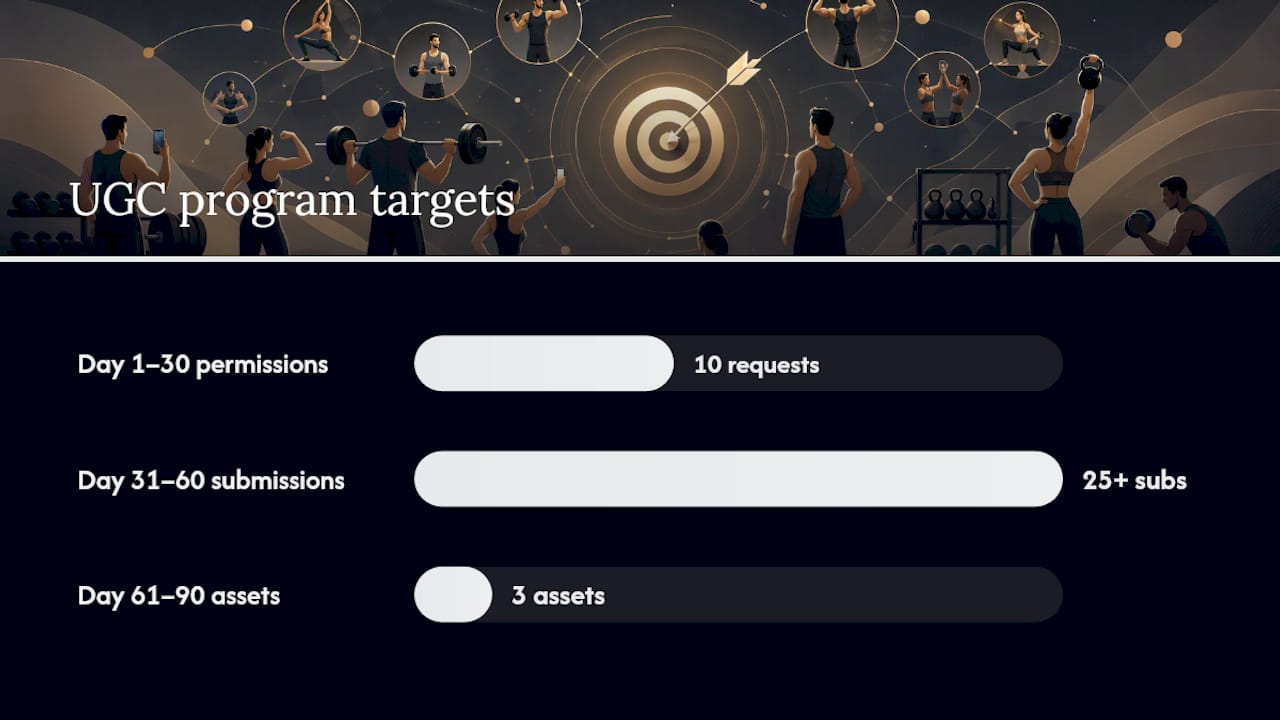
This template is built for CrossFit gyms and fitness studios that want to move from zero to a functioning UGC program in 90 days.
Days 1–30: Foundation
- Audit existing content: collect every tagged post, review, and member photo from the past 6 months
- Set up a centralized hub (Airtable or Google Drive with a consistent folder taxonomy)
- Create a branded hashtag and add it to your bio, front desk signage, and email footer
- Launch a post-class review prompt: a QR code at the exit that links to your Google Business Profile
- Send a permission request to the 10 best existing pieces of member content
Days 31–60: Collection and activation
- Launch a 30-day member challenge with a specific hashtag and a weekly featured-member post
- Build a review widget on your most-visited service page
- Run one paid Meta ad using a real member video (with permission confirmed)
- Set up an automated post-purchase or post-milestone email requesting a review or photo submission
- Track weekly: new submissions, permissions granted, and CTR on the review-page widget
Days 61–90: Optimization and scale
- A/B test UGC ad creative vs. your current brand creative in the same Meta campaign
- Add a UGC gallery to your homepage or a key landing page
- Repurpose the top three performing assets into email, story, and ad placements
- Review CAC for UGC-driven campaigns vs. non-UGC campaigns
- Present a 90-day UGC report to stakeholders: submissions collected, assets activated, conversion lift, CAC delta
Sample messaging prompts for fitness audiences:
- Review request: "You crushed it this month. Would you take 60 seconds to leave us a Google review? It helps other people find a gym that actually works. [Link]"
- Social prompt: "Tag #[YourGymName] in your next PR post. We feature one member every week."
- Contest copy: "Share your 30-day transformation photo with #[ChallengeTag] for a chance to be featured on our homepage and win a free month."
Metrics to hit at each milestone:
- Day 30: 10+ permissions granted, review widget live, branded hashtag active
- Day 60: 25+ new submissions, one UGC paid ad running, CTR baseline established
- Day 90: A/B test complete, CAC comparison available, UGC gallery live
Pro Tip: Use Enochmarketing's gym member storytelling system to systematize milestone capture — it maps member achievements to specific content prompts so your team never has to guess when or how to ask for a story.
What most teams get wrong about UGC
Most brands treat UGC as a social media tactic rather than a content system. That framing is the root cause of every common mistake.
The four mistakes worth avoiding:
Treating UGC as ad hoc. If collection only happens when someone remembers to check Instagram, you will never have enough content. The weekly cadence described earlier is the fix.
Skipping permissions. Reposting without explicit consent is a legal and reputational risk. One creator complaint can undo months of goodwill. Automate the ask so it is never forgotten.
Over-polishing UGC. The moment you add heavy filters, brand overlays, and a studio voiceover to a member's raw video, you have destroyed the thing that made it valuable. Light branding (a logo watermark, a caption) is fine; a full production treatment is not.
Failing to centralize assets. Content saved in a Slack thread or a personal phone is content you cannot find when you need it. A shared Airtable base or a DAM with consistent tagging solves this permanently.
Two practical shortcuts:
Pick one funnel stage to test first. If your biggest gap is conversion, start with a review widget on your top service page. If it is awareness, start with a branded-hashtag campaign. Trying to fix every stage at once produces mediocre results everywhere.
Automate the permission capture step before you scale collection. A Zapier trigger that fires a DM template when someone tags your handle costs nothing to set up and saves hours every month.
The role of storytelling in fitness marketing is a useful companion read for teams that want to understand why authentic member narratives outperform scripted content at every funnel stage.
Enochmarketing runs UGC programs for CrossFit gyms
Running a UGC program well requires consistent execution across collection, permissions, creative production, and measurement. Most gym owners do not have the bandwidth to manage all four.
Enochmarketing builds and runs done-for-you UGC programs for CrossFit gyms and fitness studios across the United States. The agency handles the full stack: campaign setup, member content collection workflows, paid ad creative using real member video, DAM organization, and monthly reporting that ties UGC activity to membership growth and CAC. No guesswork about what to post or whether it is working. Gyms that want to see exactly what a UGC-driven growth program looks like for their market can review the full service offering or book a free strategy session to get a custom audit.
Sources
- User-generated content (UGC) A guide to getting started — Adobe
- UGC Marketing Guide: How to Find, Collect & Amplify User-Generated Content (2026) | Shoutjar
- User-generated content (UGC): what it is and how to use it — Hootsuite
- How to Make User-Generated Content Work for You | WordStream