
The most effective brand strategy tips for CrossFit gyms follow a five-stage framework: Research, Positioning, Architecture, Messaging, and Visual System. Skip any stage and you're guessing. Here's the short list of what actually moves the needle:
- Run member interviews before writing a single word of copy
- Write one positioning sentence that decides your pricing, messaging, and content
- Name and structure your offers so members know exactly what to buy next
- Build several messaging pillars and map every post to one of them
- Create a minimal visual system with templates, not a full rebrand
- Track brand sentiment and local search authority, not just follower counts
- Publish a compact brand guide so staff stay consistent without constant oversight
- Audit your homepage messaging against your positioning statement this week
Start this week: Schedule two member interviews and pull up your current homepage copy. Those two actions alone will reveal the gaps worth fixing first.
Table of Contents
- What are the top brand strategy tips for research?
- How do you write a positioning statement that actually works?
- How should you structure your gym's classes and pricing tiers?
- What messaging pillars and content plan convert local prospects?
- How do you build a visual system that keeps content consistent?
- Which KPIs actually measure brand health for a CrossFit gym?
- What does a realistic implementation timeline look like?
- Quick 10-step execution checklist for this quarter
- How do fitness studios stand out in a crowded market?
- How do you build local loyalty beyond social media?
- How should a fitness business handle a brand reputation crisis?
- How does digital marketing integrate with your brand strategy?
- Key Takeaways
- What Enochmarketing actually sees working
- Enochmarketing's brand strategy services for CrossFit gyms
- Further reading and sources
What are the top brand strategy tips for research?
Member-first research is the most important step in any brand strategy, and skipping it is the most expensive shortcut a gym owner can take. Most studios assume they know why members joined. They're usually wrong about at least one thing that matters.
The right research lens examines moments, not just demographics: need state, buying context, current workaround, objections, and desired outcome. A 35-year-old professional who joins because her coworker lost 20 pounds is a completely different buyer than one who joins after a doctor's visit. Same age, same zip code, different trigger.
Field-ready methods for a one-week sprint:
- Conduct 6–10 member interviews (15 minutes each) using this script: Why did you join? What were you doing before? What almost stopped you? What would you tell a friend?
- Send a 5-question exit survey to anyone who canceled in the last 90 days.
- Run a local competitor scan: note each competitor's price point, primary claim, and community hook from their website and Google Business Profile.
- Record your own Google Business Profile signals: review sentiment, question frequency, and the search terms triggering your listing.
Pro Tip: Limit your hypothesis set to three testable claims, such as pricing sensitivity, community drivers, and preferred class formats. Research that tries to answer everything answers nothing.
How do you write a positioning statement that actually works?
Positioning is the single most important strategic decision a gym owner makes, and it should fit in one sentence. Everything else, from pricing shape to content topics, flows from it.

Use this template:
Three gym-specific examples show how the template changes everything downstream:
- Time-starved professionals: "For busy professionals who want to stay fit without wasting time, [Gym] is the CrossFit studio that delivers a complete workout in 45 minutes because every class is coach-led and pre-programmed."
- Performance athletes: "For competitive athletes who want measurable progress, [Gym] is the CrossFit facility that tracks every lift and benchmarks every quarter because our coaches hold certifications in strength and conditioning."
- Community-first beginners: "For adults who've never set foot in a gym, [Gym] is the CrossFit community that makes day one feel like day 100 because our onboarding program pairs every new member with a coach for the first month."
Once your positioning line is written, convert it into three internal guardrails: territories to own (community, results, coaching quality), forbidden areas (anything that contradicts your claim), and signature proof points (the specific facts that back it up). See fitness brand positioning examples for more templates adapted to local gyms.
Pro Tip: Test your positioning statement with five current members. If they don't recognize themselves in it, rewrite it before building anything else on top of it.
How should you structure your gym's classes and pricing tiers?
Keep architecture simple. Choose either a single-brand model or a tiered-offer model with clear relationships between levels. Confusion at the offer level kills referrals because members can't explain what you sell to a friend.
Naming rules: Use descriptive names that tell a prospect exactly what they're buying. "Fundamentals" beats "Level 1." "Competition Prep" beats "Advanced Track." Sub-brands only make sense when an offer serves a genuinely different audience, like a kids' program or a corporate wellness package.
Checklist for mapping your current offers:
- List every class, service, and tier you currently sell.
- Mark each as: keep as-is, rename for clarity, combine with another offer, or retire.
- Define the natural upgrade path: what does a new member buy first, and what do they graduate to?
- Confirm that a front-desk staff member can explain the full menu in under 60 seconds.
Architecture also supports your sales workflow. An onboarding class that feeds into a Fundamentals tier that feeds into open CrossFit classes gives members a clear journey and gives coaches a natural conversation about next steps.
What messaging pillars and content plan convert local prospects?
Messaging must translate positioning into repeatable content pillars. Four pillars work well for most CrossFit studios: Community, Results, Coaching, and Accessibility. Every post, email, and ad should map to one of them.
A compact weekly content plan tied to conversion goals:
- Monday post (Community): Member story with a measurable outcome. "Sarah dropped 18 pounds and PR'd her deadlift. Here's what her first 90 days looked like."
- Wednesday post (Coaching): Coach spotlight with a micro-proof point. "Coach Mike holds a CSCS and has coached 200+ athletes through their first competition."
- Friday post (Results): Short instructional reel tied to a local keyword. "How to do your first pull-up | CrossFit [City Name]."
- Weekly email: One story, one offer, one link. Keep it under 200 words.
- Local ad: Rotate trial signup offers tied to the current pillar theme.
Pro Tip: Record one long-form member interview, then cut it into three short social clips, one testimonial card for the website, and one email story. One conversation, five assets.
For a deeper look at social media content strategies that drive trial signups, the Enochmarketing blog covers gym-specific formats in detail.
How do you build a visual system that keeps content consistent?
Visual work follows positioning. Build a minimal system first: logo variations, two or three colors, one typeface, and a clear photography rule (real members, real workouts, no stock photos). A full rebrand is rarely necessary and often a distraction from the strategic work.
The brand operating system is what keeps content consistent as volume grows. It includes:
| Component | What it contains |
|---|---|
| One-page brand guide | Logo rules, colors, fonts, tone of voice, forbidden phrases |
| Social post template | Branded frame, consistent caption structure, hashtag set |
| Class flyer template | Offer details, CTA, logo placement |
| Testimonial card | Member photo, quote, measurable result |
| Website hero copy block | Positioning headline, sub-headline, primary CTA |
Train front-desk staff and coaches in a short session. Cover the brand promise, the tone of voice, and the three things the gym never says. Role-play two or three common member conversations so the language feels natural, not scripted.
Pro Tip: Publish a short "forbidden list" of phrases your brand never uses, such as "no pain, no gain" or "we're like a family." It prevents drift faster than any style guide.
Which KPIs actually measure brand health for a CrossFit gym?
Move beyond follower counts. Track sentiment and local search recognition alongside commercial response metrics. Machine Trust means whether local search and AI systems recognize and recommend your studio for relevant queries.
| KPI layer | Metric | Data source |
|---|---|---|
| Awareness | Branded search trend | Google Search Console |
| Perception | Sentiment score, NPS | Google reviews, member surveys |
| Response | Trial signups, conversion by message | CRM, landing page analytics |
| Machine Trust | Local search visibility, AI recommendation | Google Business Profile, manual AI queries |
Run a simple A/B test on ad headlines monthly. Survey five members per quarter with two questions: "How would you describe us to a friend?" and "What almost stopped you from joining?" Those answers are your brand-lift data. For local search authority, publish structured data and named frameworks so AI systems can attribute your content correctly.
What does a realistic implementation timeline look like?
A practical phased plan prevents the common mistake of trying to do everything at once.
| Phase | Timeline | Focus | Typical cost band |
|---|---|---|---|
| Audit & research sprint | Weeks 1–4 | Member interviews, competitor scan, homepage audit | — |
| Positioning & minimal identity | Months 2–3 | Positioning statement, brand guide, core templates | — |
| Messaging rollout & local search | Months 4–6 | Content pillars, weekly plan, Google Business Profile | — |
| Governance & scale | Months 7– | Staff training, paid ads, AEO/JSON-LD setup | — |
Owners can run the research sprint and write the positioning statement themselves. Template creation and local SEO setup benefit from outside help. Paid ad structure and AEO/JSON-LD implementation almost always require a specialist.
Signs you need an agency: You've rewritten your homepage three times without a clear positioning statement. Your ad spend isn't producing trial signups. Your Google Business Profile hasn't been updated in six months.
Quick 10-step execution checklist for this quarter
- Run 10 member interviews (Owner, 2 hours) — reveals actual buying triggers
- Audit homepage messaging (Owner, 1 hour) — does it match your positioning?
- Complete a local competitor scan (Staff, 2 hours) — note price, claims, community hooks
- Write your positioning statement (Owner + advisor, 2 hours) — one sentence, tested with five members
- Define 3–4 messaging pillars (Owner, 1 hour) — every post maps to one
- Map your offer architecture (Owner, 1 hour) — keep, rename, combine, or retire
- Build three content templates (Designer or Canva, 3 hours) — social post, flyer, testimonial card
- Set up a brand dashboard (Staff, 2 hours) — Google Business Profile, CRM, review sentiment
- Train front-desk staff on brand language (Owner, 1 hour) — role-play two member conversations
- Publish a forbidden-phrases list (Owner, 30 minutes) — prevents messaging drift immediately
Quick wins (this week): steps 1, 2, and 10. Longer bets (this quarter): steps 4, 7, and 8.
How do fitness studios stand out in a crowded market?
Most CrossFit gyms compete on price or proximity by default. Both are losing strategies. The studios that hold members longest own a specific identity: they stand for something narrow enough to be memorable and broad enough to attract a real audience.
Differentiation that holds up comes from three sources: a specific member outcome you can prove, a coaching credential or methodology that competitors can't easily copy, and a community ritual that members talk about unprompted. A Saturday partner workout followed by a group breakfast isn't a marketing tactic. It's a retention mechanism that also generates referrals.
CrossFit gym branding that works locally tends to be hyper-specific: a named program, a documented methodology, or a community event that becomes part of the gym's identity. Generic "we're a family" messaging is the single most common brand mistake in the fitness space.
How do you build local loyalty beyond social media?
Social media content attracts attention. Partnerships and in-person rituals build loyalty. The distinction matters because attention is rented and loyalty is owned.
Tactics that work for local CrossFit studios:
- Local business partnerships: Partner with a physical therapist, a nutritionist, or a sports chiropractor for co-branded workshops. Each partner brings their client list to your gym.
- Charity events: Host a fundraiser workout tied to a local cause. Members recruit friends, and the event generates press and Google reviews simultaneously.
- Member milestone recognition: Publicly celebrate PRs, anniversaries, and first competitions. Recognition is a retention tool, not just a feel-good gesture.
- Referral programs with real incentives: A month of free membership for a referred member who stays 60 days outperforms any paid ad for cost per acquisition.
The goal is to make the gym part of a member's identity, not just their schedule. When someone describes themselves as "a CrossFitter at [Gym Name]," retention is no longer a marketing problem.
How should a fitness business handle a brand reputation crisis?
Speed and specificity matter more than polish when something goes wrong. A coach leaves under difficult circumstances, a member posts a negative review, or a safety incident gets shared on social media. The gyms that recover fastest respond within 24 hours with a factual, non-defensive statement.
Three principles for reputation repair:
- Acknowledge publicly, resolve privately. Respond to the review or post with a brief acknowledgment and an invitation to continue the conversation offline. Never argue in the comments.
- Correct the record with proof. If the claim is factually wrong, state the correct information once with a source. Don't repeat the negative framing.
- Rebuild with volume. A stream of genuine positive reviews over the following 60 days does more than any PR statement. Ask satisfied members directly and make it easy with a QR code at the front desk.
A brand reputation crisis is also a positioning test. Gyms with a clear identity and a loyal community recover faster because members defend them organically.
How does digital marketing integrate with your brand strategy?
Brand strategy without digital execution stays invisible. The integration point is your positioning statement: every channel should express the same core claim in the format that channel rewards.
- Local SEO: Your Google Business Profile description, website title tags, and service pages should all reflect your positioning. A gym positioned around coaching quality should have coach bios with credentials indexed on the site.
- Paid ads (Meta and Google): Test headlines that map to your messaging pillars. A community-pillar ad ("Join 200 members who show up every Saturday") will outperform a generic offer ad for retention-oriented prospects.
- Email campaigns: One story per week, mapped to a pillar, with one CTA. Email is where your positioning converts because the reader opted in and already trusts you.
- Content and AEO: Publish named frameworks and use JSON-LD structured data so AI systems can attribute your content and recommend your studio for local fitness queries.
The fitness brand marketing workflow that works is simple: positioning drives pillar selection, pillars drive content, content drives local search authority, and local search authority drives trial signups.
Key Takeaways
A CrossFit gym's brand strategy compounds value only when Research, Positioning, Architecture, Messaging, and Visual System are built in sequence, with measurement tied to sentiment and local search authority, not just follower counts.
| Point | Details |
|---|---|
| Research comes first | Run 10 member interviews before writing any copy; buying triggers are rarely what owners assume. |
| Positioning decides everything | One sentence determines pricing shape, content topics, and sales approach. |
| Build an operating system | Templates, a one-page brand guide, and a forbidden-phrases list prevent drift as content volume grows. |
| Measure Machine Trust | Track branded search trends, local search visibility, and member satisfaction alongside trial signup conversion. |
| Enochmarketing executes the plan | Enochmarketing specializes in CrossFit gym brand strategy and digital marketing across the United States, from research sprint to paid ad rollout. |
What Enochmarketing actually sees working
The gyms that move fastest through this playbook share one trait: they do the research sprint before touching anything else. Not because it's theoretically correct, but because it produces a positioning statement that members recognize immediately. That recognition is what makes every downstream tactic cheaper and faster.
The pattern Enochmarketing sees repeatedly: a studio with strong coaching and a loyal core membership that can't explain what makes it different from the gym two miles away. The fix is almost never a new logo. It's a positioning statement, three messaging pillars, and a content plan that runs for 90 days without changing. The membership lift follows the consistency, not the creative.
Two anonymized examples: a mid-size CrossFit affiliate that repositioned around a documented strength methodology saw trial-to-member conversion improve within one quarter of consistent messaging. A beginner-focused studio that added a co-branded partnership with a local physical therapist generated its highest referral month without running a single paid ad.
The common thread is specificity. Vague brands compete on price. Specific brands attract the members who stay.
Enochmarketing's brand strategy services for CrossFit gyms
CrossFit gym owners who want to run this playbook without doing it alone have a direct option. Enochmarketing works exclusively with CrossFit gyms and fitness studios across the United States, which means the research sprint, positioning workshop, and content rollout are built around how gyms actually operate, not adapted from a generic agency template.
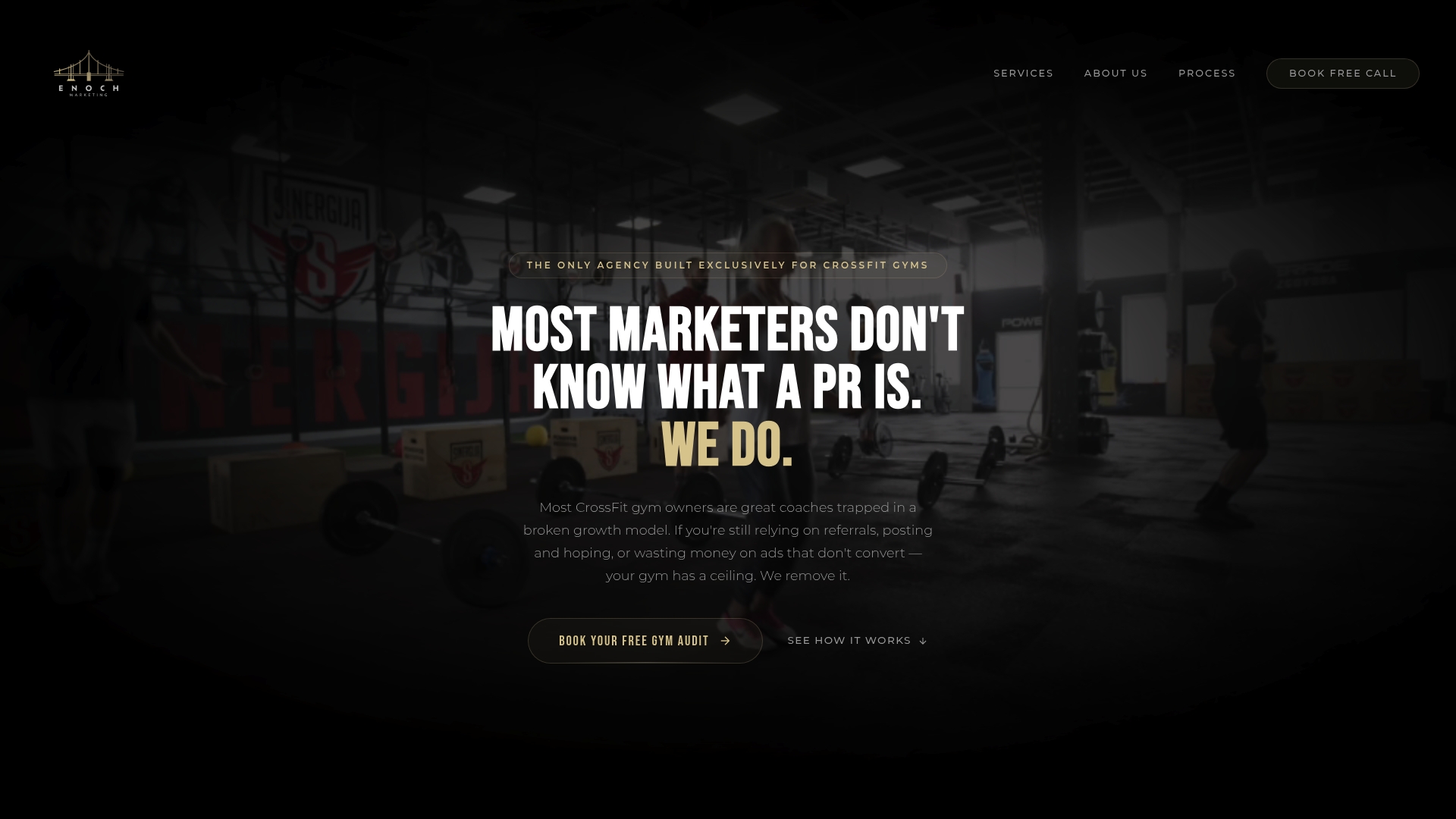
A typical engagement covers the full arc: brand audit, member research sprint, positioning workshop, messaging pillar development, content templates, and local paid ad setup on Meta and Google. No long-term contracts. You can start with a single phase and scale from there.
Book a free strategy session to see exactly where your current brand strategy is leaving members and revenue on the table.
Further reading and sources
The following sources informed this article's frameworks and recommendations:
- Brand Strategy Guide: Build a Strategy That Works — covers the five-stage framework, the positioning statement template, and the visual-first trap to avoid.
- The Ultimate Guide to Brand Strategy — explains Machine Trust, sentiment measurement, and how to move beyond awareness metrics.
- Brand Development Strategy: A 2026 Guide — covers the research lens matrix (need state, buying context, workaround) and the brand operating system.
- 7 Brand Development Strategies For Scaling Brand Ops — details AEO, JSON-LD, and the positioning architecture (territories and forbidden areas).
- Brand Strategy: The Complete Guide — comprehensive reference for brand components, measurement frameworks, and common mistakes.
- How to Develop a Brand Strategy — data-driven approach to brand development, including NPS, incrementality testing, and social sentiment.
For implementation tools: use Google Forms for member interview logging, Canva for template creation, and Google Search Console for branded search trend tracking. For AEO setup, the Enochmarketing blog covers CrossFit online brand building and local search authority in detail.