
Retargeting in fitness marketing is the practice of serving targeted ads to people who visited your gym's website or engaged with your fitness brand but left without signing up, using tracking pixels or cookies on platforms like Meta Ads and Google Ads. The industry term for this is remarketing, though "retargeting" is the more widely used label in paid media circles. Most gym owners run ads to cold audiences and wonder why conversions stay low. The real problem is that most prospects need multiple touchpoints before they commit to a membership. Retargeting solves that by keeping your gym visible through the entire decision process.
What is retargeting in fitness marketing?
Retargeting is a digital marketing technique that tracks website visitors using cookies or pixels to serve personalized follow-up ads, reminding warm leads about your gym after they leave your site. A visitor who checks your pricing page but does not book a free trial is not a lost lead. They are a warm prospect who needs a second, third, or fourth impression before they act.
Fitness businesses use retargeting across three main categories: gyms and CrossFit boxes, supplement brands, and personal training services. Each category has a different sales cycle, but all three share the same core problem. Prospects browse, compare, and delay. Retargeting keeps your brand in front of them during that delay. Platforms like Meta Ads Manager and Google Ads both offer native pixel tools that make setup accessible even for small gym owners without a dedicated marketing team.

The fitness industry is especially well suited to retargeting because membership decisions carry emotional and financial weight. Someone visiting your CrossFit gym's website is not just comparing prices. They are deciding whether they can commit to a lifestyle change. That kind of decision rarely happens on the first visit.
How does retargeting work in fitness campaigns?
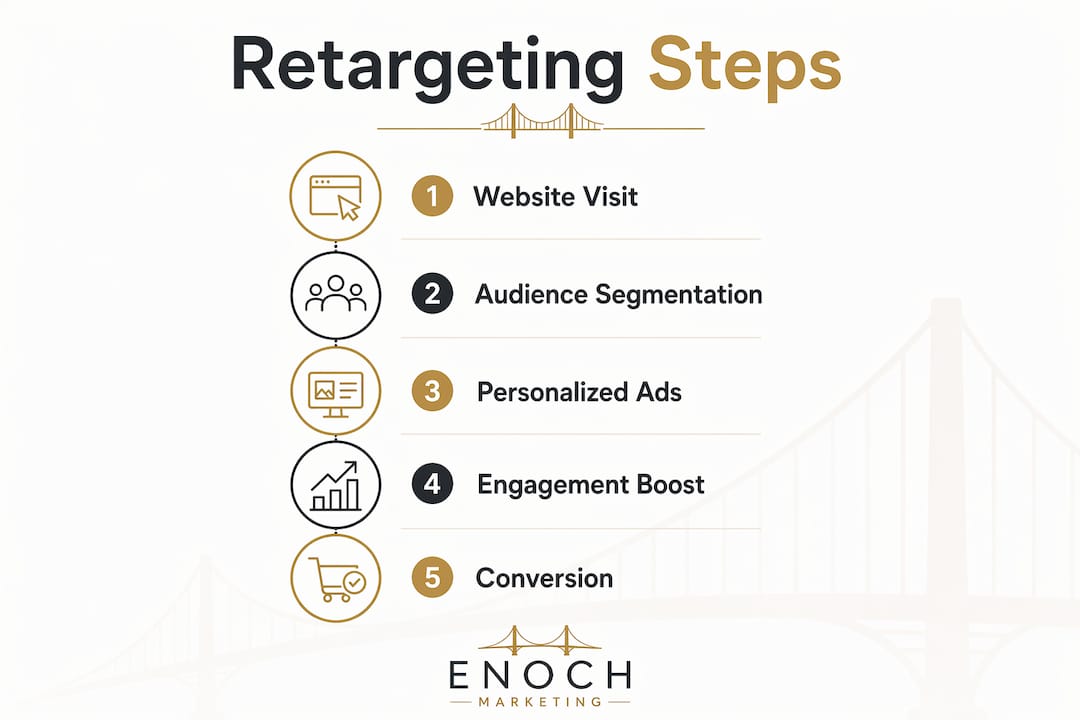
The mechanics of a fitness retargeting campaign follow a clear four-step process. Understanding each step helps you build campaigns that actually convert, rather than just generate impressions.
-
Install a tracking pixel. Place the Meta Pixel or Google Tag on every page of your gym's website. This code fires when a visitor lands on a page and adds them to a custom audience list inside your ad platform. The pixel installation process takes under 30 minutes and is the foundation of every retargeting campaign.
-
Define your audience segments. Not every visitor is the same. Someone who viewed your pricing page is closer to converting than someone who only read your blog. Segment your audiences by behavior: pricing page viewers, class schedule browsers, free trial page visitors, and cart abandoners for supplement brands.
-
Build personalized ad creatives. Each segment needs a different message. Segmented, personalized messaging includes gym facility tours for prospects who viewed your about page, ingredient explainers for supplement viewers, and shipping transparency for cart abandoners. Generic ads waste budget on audiences who already know your brand name.
-
Launch and monitor performance. Set frequency caps to avoid overwhelming your audience, and track click-through rate, cost per conversion, and return on ad spend weekly.
Retargeting works best when it connects to your broader marketing funnel. Combining retargeting with search campaigns and Performance Max generates predictable gym membership growth by capturing high-intent traffic and then staying visible through the decision phase.
Pro Tip: Set up separate retargeting audiences for visitors who spent more than 60 seconds on your pricing page. These prospects are your highest-intent leads and deserve a dedicated ad sequence with a direct offer.
What are the best retargeting strategies for fitness businesses?
The difference between a retargeting campaign that converts and one that drains budget comes down to execution. These are the strategies that consistently produce results for fitness brands.
-
Behavioral segmentation. Advanced fitness brands segment retargeting audiences by specific behaviors such as viewing pricing, browsing class schedules, or abandoning a cart. Each segment receives messaging that addresses its specific objection, not a one-size-fits-all ad.
-
Social proof over features. Shift your retargeting narrative from listing gym amenities to showing member results. Customer testimonials and value-driven touchpoints increase conversion in long sales cycles because they validate the prospect's aspiration rather than just describing your product.
-
Urgency triggers in ad sequences. Use limited-time offers, enrollment deadlines, or class capacity warnings in later-stage retargeting ads. Prospects who have seen your brand three or four times are ready for a push. An offer like "Join this week and waive the enrollment fee" converts warm audiences far better than a generic "Sign up now" call to action.
-
Creative rotation every 2–4 weeks. Effective retargeting creatives refresh every 2–4 weeks to combat fatigue from frequent ad exposure. Retargeted audiences see your ads more often than cold audiences, which means they burn out on the same creative faster.
-
Frequency management. Cap impressions at 3–5 per week per user on Meta. Higher frequency without creative variety does not increase conversions. It increases the chance someone hides your ad or unfollows your page.
Pro Tip: Use personalized fitness creatives that feature real members from your gym rather than stock photography. Authentic visuals outperform polished stock images in fitness retargeting because they feel local and credible.
Why do fitness customers delay membership decisions?
Fitness memberships are not impulse purchases. A prospect visiting your CrossFit gym's website is typically in one of three mental states: inspired but not ready, actively comparing options, or seeking social validation before committing. Retargeting captures these delayed decisions by maintaining brand visibility across all three states.
The psychological journey from awareness to conversion in fitness follows a predictable path. First, the prospect recognizes a problem, usually dissatisfaction with their current fitness level. Then they explore solutions, which is when they visit your site. Then they seek validation, looking for proof that your gym delivers results. Finally, they need a reason to act now rather than next month.
A well-structured retargeting sequence maps to this journey directly. Early-stage ads address pain points and introduce your gym's community. Mid-stage ads deliver social proof through testimonials, shifting the narrative from features to results. Late-stage ads introduce urgency with a specific offer. This three-phase approach mirrors how fitness customers actually make decisions, which is why it outperforms single-message retargeting campaigns.
The table below shows how each decision stage maps to a specific retargeting creative type.
| Decision Stage | Customer Mindset | Retargeting Creative |
|---|---|---|
| Awareness | "I need to make a change" | Facility tour video, community highlights |
| Consideration | "Is this gym right for me?" | Member testimonials, class schedule overview |
| Validation | "Can I trust this gym?" | Before-and-after results, coach credentials |
| Urgency | "Should I join now?" | Limited-time offer, enrollment deadline |
This framework applies equally to supplement brands and personal training services. The stages shift slightly, but the principle holds: match your message to where the prospect is in their decision process.
How do you avoid creative fatigue in fitness retargeting?
Creative fatigue is the single most common reason fitness retargeting campaigns stop performing. Retargeting audiences fatigue faster than cold audiences because they see your ads at a higher frequency. When engagement drops and cost per acquisition rises, most gym owners increase their budget. The correct move is to refresh the creative.
Creative fatigue leads to declining engagement and rising cost per acquisition if not addressed. A campaign that delivered a $15 cost per lead in week one can climb to $45 by week six if the same creative runs without rotation. That is not a budget problem. It is a creative management problem.
The most effective approach to creative rotation is data-driven, not calendar-driven. Rotating creatives based on performance signals leads to superior conversion rates versus fixed timelines. Watch your click-through rate and frequency metrics. When CTR drops by 30% or frequency exceeds five impressions per week, swap the creative regardless of how long it has been running.
Practical ways to rotate without rebuilding from scratch:
- Change the headline while keeping the visual
- Swap the member testimonial featured in the ad
- Test a video format against a static image
- Shift the offer from a free trial to a discounted first month
- Change the call-to-action copy from "Book a Tour" to "Claim Your Free Week"
Fitness marketing systems find greater success by integrating retargeting into a well-structured funnel that supports delayed customer decisions. Creative fatigue management is not optional in that structure. It is the maintenance work that keeps the funnel producing results month after month.
Key takeaways
Retargeting in fitness marketing works because it matches personalized messaging to each stage of the prospect's decision journey, sustaining conversions that cold advertising alone cannot capture.
| Point | Details |
|---|---|
| Pixel installation is the foundation | Install the Meta Pixel or Google Tag on every page before building any retargeting audience. |
| Segment by behavior, not demographics | Separate pricing page visitors from general browsers and serve each group a distinct message. |
| Social proof converts warm audiences | Use member testimonials and results-focused creatives rather than facility feature lists. |
| Rotate creatives every 2–4 weeks | Monitor CTR and frequency; swap creatives when performance drops, not on a fixed calendar. |
| Map ads to the decision stage | Match awareness, validation, and urgency creatives to where each prospect is in their journey. |
Retargeting is the closest thing to a guaranteed second chance
Most gym owners I work with have the same blind spot. They pour budget into top-of-funnel ads, get a wave of website traffic, and then treat every non-converting visitor as a lost cause. That thinking is expensive.
Retargeting is not a secondary tactic. It is where the real conversion work happens. The first ad gets attention. The retargeting sequence earns the membership. I have seen CrossFit gyms cut their cost per lead in half simply by adding a three-stage retargeting sequence to campaigns that were already running. The cold traffic was fine. The follow-up was missing entirely.
The part most fitness marketers underestimate is the storytelling layer. A retargeting ad is not just a reminder. It is a continuation of a conversation that started when the prospect first visited your site. If your retargeting ads feel like generic display banners, you are wasting the warmest audience you have. Build a sequence that moves someone from curious to convinced, and your membership conversion rate will reflect it.
The fitness consumer in 2026 is more skeptical and more distracted than ever. Generic ads get ignored. Personalized, sequenced retargeting that speaks directly to where someone is in their decision process still cuts through. That is the opportunity most gym owners are leaving on the table.
— Collin
Ready to run retargeting that actually fills your gym?
Most fitness brands know retargeting exists. Few implement it with the segmentation, creative strategy, and funnel structure it requires to produce consistent membership growth.
Enochmarketing builds retargeting campaigns specifically for CrossFit gyms and fitness brands across the United States. From pixel installation and audience segmentation to creative strategy and campaign management, the team handles the full setup so you can focus on running your gym. If you are ready to stop losing warm leads and start converting them, explore Enochmarketing's fitness marketing services and book a free strategy session today.
FAQ
What is retargeting in fitness marketing?
Retargeting in fitness marketing is the practice of serving personalized ads to people who visited your gym's website or engaged with your brand but did not convert, using tracking pixels on platforms like Meta Ads and Google Ads. The goal is to re-engage warm prospects across multiple touchpoints until they sign up.
How long should a fitness retargeting campaign run?
A fitness retargeting campaign should run continuously as long as you are generating new website traffic, with creative refreshes every 2–4 weeks to prevent audience fatigue and maintain conversion rates.
What platforms work best for gym retargeting ads?
Meta Ads and Google Ads are the two primary platforms for gym retargeting. Meta excels at visual storytelling and community-driven creatives, while Google Ads captures high-intent prospects through search and display retargeting.
How do i know if my retargeting ads have creative fatigue?
Watch for a 30% or greater drop in click-through rate combined with rising frequency above five impressions per week. Those two signals together indicate your audience has seen the creative too many times and engagement is declining.
Does retargeting work for small gyms with low website traffic?
Retargeting requires a minimum audience size, typically 100–1,000 visitors, to run effectively on most platforms. Small gyms should prioritize driving organic and paid traffic to their site first, then activate retargeting once audience pools reach a workable size.