
PPC, or pay-per-click advertising, is a paid search and social advertising model where gym owners pay only when a prospect clicks their ad. The industry term is paid search advertising, but gym owners and fitness managers widely call it PPC. Google Ads and Facebook Ads are the two dominant platforms for gym PPC campaigns, and both give you direct control over who sees your ads, where they live, and what offer they receive. This guide breaks down what is PPC for gyms, how campaigns work, what they cost in 2026, and how to run them without burning your budget.
What is PPC for gyms and why does it work?
PPC advertising for gyms is a model where you bid on specific search terms, and your ad appears when a local prospect searches for those terms. You pay only when they click. That click-based cost structure makes PPC one of the most measurable forms of gym marketing available.
The core reason PPC works for gyms is intent. A person searching "gym membership near me" is not browsing casually. High-intent searches like that convert up to three times better than informational queries. That gap matters because every dollar you spend on an intent-driven click is far more likely to produce a trial booking or a signed membership than a dollar spent on general brand awareness.

Google Ads captures this intent at the exact moment a prospect is ready to act. Facebook Ads, by contrast, interrupts people while they scroll, which makes it better for retargeting people who already visited your website. Both platforms serve different roles in a gym's paid advertising mix, and understanding that difference is the foundation of a working PPC strategy.
How do gym PPC campaigns drive memberships and trial signups?
A well-structured gym PPC campaign is built around one campaign per location, with multiple ad groups organized by service type. One ad group targets "CrossFit classes," another targets "personal training," and another targets "gym membership." Each ad group uses its own set of keywords, ad copy, and landing page. That specificity is what separates campaigns that convert from campaigns that drain budgets.
Geographic targeting is the single most important structural decision you will make. Geo-radius targeting of 3–7 miles is optimal because prospects beyond 10 miles convert at one-third the rate of those nearby. Most gym owners set their radius too wide, which inflates click costs and drops conversion rates. Tighten your radius to your real service area before you touch anything else.
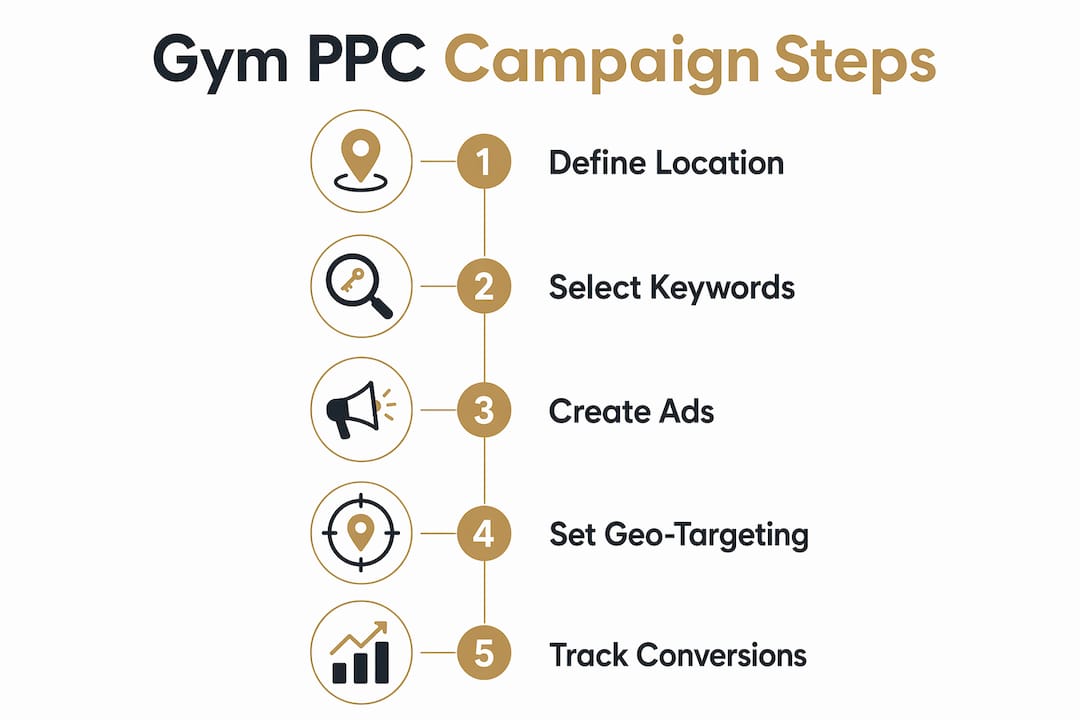
Keyword selection follows the same logic. Focus on high-intent, transactional queries rather than informational ones. "Join a gym in city]" and "CrossFit gym near me" signal purchase readiness. "What is CrossFit" does not. [Effective gym campaigns avoid broad, generic keywords and concentrate spend on queries where the searcher is ready to act.
Landing pages are where most gym PPC campaigns fail. Sending paid traffic to your homepage is one of the most common and costly mistakes in gym marketing. Dedicated landing pages with a single call-to-action, whether that is a free trial booking or a phone call, consistently outperform homepage traffic. Remove the navigation menu, strip out distractions, and make the offer impossible to miss.
- One campaign per gym location keeps budgets and reporting clean
- Ad groups by service type match ad copy to specific member intent
- 3–7 mile geo-radius focuses spend on prospects who will actually show up
- High-intent keywords only filter out browsers and attract buyers
- Dedicated landing pages remove friction and push visitors toward one action
Pro Tip: Set up conversion tracking before you launch. Track phone calls, form fills, and trial bookings separately. If you can only measure cost per click, you cannot measure cost per member, and that is the only number that matters.
What does gym PPC cost, and how should you budget?
The median cost per lead for fitness and gym PPC in the US sits at $18–$45 in 2026, with cost per acquisition ranging from $80–$180 for mainstream gyms and $220–$450 for boutique studios. Boutique studios pay more because their audience is smaller and their keywords are more competitive. That higher CAC is still profitable when member lifetime value is $1,500 or more.
Budget requirements vary significantly by gym size and growth goals. Single-location gyms targeting aggressive membership growth should budget $9,500–$15,000 monthly. Smaller studios with tighter margins can generate consistent leads on $1,500–$3,000 per month, provided the campaign structure is tight and waste is minimized.
Seasonality reshapes these numbers dramatically. January drives 40–55% of annual lead volume for most gyms, but cost-per-click inflation of 35–60% comes with it. Every gym owner and every competing gym is bidding harder in january, which pushes up your costs. The gyms that win january are the ones that planned their budget increase in december, not the ones who react when CPCs spike.
| Period | Budget strategy | CPC trend |
|---|---|---|
| January | Increase budget 40–60% above baseline | Up 35–60% |
| February to March | Maintain elevated budget, test new offers | Stabilizing |
| April to June | Reduce to baseline, focus on retention | Normal |
| July to August | Light spend, retargeting focus | Below average |
| September to October | Ramp up for fall enrollment push | Rising |
| November to December | Prepare january budget, test creative | Low to moderate |
Pro Tip: Build your january budget in november. Waiting until the new year to increase spend means you miss the first two weeks of the highest-intent search volume of the year.
How to optimize gym PPC campaigns to cut waste and improve conversions
The fastest way to improve a gym PPC campaign is to build a negative keyword list before the campaign goes live. Negative keyword lists prevent wasted spend of 20–40% by blocking irrelevant clicks. That is real money. A gym running $3,000 per month in ads could be losing $600–$1,200 on clicks from people searching for home workout equipment, gym bag reviews, or free workout videos.
Terms to add to your negative keyword list from day one:
- "At home" and "home gym" variations
- "DIY," "free," and "cheap" modifiers
- Equipment brand names like "Peloton" or "Bowflex"
- Job-related terms like "gym jobs" or "fitness instructor salary"
- Informational queries like "how to lose weight" or "what is CrossFit"
Ad copy alignment is the next lever. Your ad headline must match the keyword and the landing page offer. If someone searches "CrossFit trial class" and your ad says "Join Our Gym Today," the message mismatch kills trust before they even click. Write ad copy that mirrors the exact intent of the keyword group it serves.
Bidding strategy depends on your conversion volume. Manual CPC bidding is the right choice when your campaign generates fewer than 30 conversions per month. Google's automated Smart Bidding needs data to work. Without enough conversions, the algorithm guesses, and guessing with your ad budget is expensive. Once you cross 30 monthly conversions consistently, transition to Target CPA or Maximize Conversions bidding.
The average conversion rate for fitness PPC ads is 6.8%, but campaigns focused on trial bookings or phone calls reach 8–10%. That difference is not accidental. Phone call conversions and trial bookings require less commitment from the prospect than filling out a long form. Lower the barrier to the first yes, and your conversion rate climbs.
Which PPC platforms work best for gym advertising?
Google Search Ads are the highest-priority platform for gym PPC advertising. They capture demand that already exists. When someone types "gym near me" into Google, they are telling you exactly what they want. Your ad appears at the top of the results, and you pay only when they click. That is the most direct path from prospect intent to gym membership.
Facebook Ads serve a different function. They are best used for retargeting people who visited your website but did not convert, and for reaching lookalike audiences based on your current member list. Facebook does not capture intent the way Google does, but it keeps your gym visible to warm prospects who need a second or third touchpoint before they book. The paid social retargeting layer is what turns browsers into booked trials.
A practical platform budget split for most gyms:
- 60% to Google Search Ads for high-intent lead capture
- 25% to Facebook and Instagram retargeting for warm audience conversion
- 15% to YouTube or display ads for brand awareness once search is performing
YouTube pre-roll ads work well for gyms with strong video content, particularly CrossFit boxes and boutique studios with a clear community identity. Start with Google Search, prove the model, then add Facebook retargeting. Add YouTube only after both primary channels are producing consistent leads. Building your local gym PPC strategy in layers prevents budget fragmentation and keeps your data clean.
Key Takeaways
PPC advertising for gyms works when campaigns are built around geographic precision, high-intent keywords, and dedicated landing pages that push prospects toward a single conversion action.
| Point | Details |
|---|---|
| Intent drives conversions | High-intent searches like "gym near me" convert up to 3x better than informational queries. |
| Geo-targeting radius matters | Keep your targeting within 3–7 miles; prospects beyond 10 miles convert at one-third the rate. |
| January requires a bigger budget | CPCs inflate 35–60% in january, so plan your budget increase in december. |
| Negative keywords protect spend | A proper negative keyword list prevents wasting 20–40% of your monthly ad budget. |
| Platform split maximizes ROI | Allocate 60% to Google Search and 25% to Facebook retargeting for the strongest lead mix. |
Why most gym PPC campaigns fail before they get a fair shot
I have seen gym owners spend $2,000 on Google Ads, get 40 clicks to their homepage, generate zero leads, and conclude that PPC does not work for gyms. PPC did not fail them. Their setup failed them.
The most common mistake is treating PPC like a billboard. You do not pay for impressions in PPC. You pay for clicks. That means every element of your campaign, from the keyword to the ad copy to the landing page, has to be aligned around one outcome. The moment you send paid traffic to a homepage with six navigation options and no clear offer, you have turned a precision tool into a scatter shot.
The second mistake is measuring the wrong thing. Cost per click is not a business metric. Cost per member is. I have worked with gyms that were horrified by a $35 cost per lead until we calculated their member lifetime value and realized they were acquiring members at a 10:1 return. Track what matters.
The third mistake is giving up too early. PPC campaigns need 60–90 days of data before you can make confident optimization decisions. Most gym owners pull the plug at week three. The gyms that stick with a well-structured campaign and make data-driven adjustments consistently see improving returns over time. Patience and a clean Google Ads framework are what separate gyms that grow from gyms that stay stuck.
— Collin
How Enochmarketing helps gyms build PPC campaigns that actually convert
Enochmarketing specializes exclusively in CrossFit gyms and boutique fitness brands across the United States. The agency builds and manages Google Ads and Facebook Ads campaigns designed around the specific conversion goals of fitness businesses, from trial class bookings to full membership signups.
Every campaign Enochmarketing manages includes geo-targeted ad groups, negative keyword lists built from day one, dedicated landing pages for each offer, and seasonal budget planning that accounts for the january surge. The agency also handles conversion tracking setup, so you always know your true cost per member, not just your cost per click. If you want to know exactly what a managed PPC program costs for your gym, the Enochmarketing pricing page breaks down every plan. You can also review the full range of gym growth services to see how paid ads fit into a complete membership growth strategy.
FAQ
What is PPC advertising for gyms?
PPC, or pay-per-click advertising, is a model where gyms pay only when a prospect clicks their ad on platforms like Google Ads or Facebook Ads. It targets local, high-intent searchers who are actively looking for a gym membership or fitness class.
How much does gym PPC cost per month?
Smaller studios can generate leads on $1,500–$3,000 per month with a tight campaign structure, while single-location gyms targeting aggressive growth typically spend $9,500–$15,000 monthly.
What is a good conversion rate for gym PPC ads?
The average conversion rate for fitness PPC ads is 6.8%, but campaigns focused on trial bookings or phone calls regularly reach 8–10%.
Should gyms use Google Ads or Facebook Ads?
Google Ads captures high-intent prospects already searching for a gym, making it the higher-priority platform. Facebook Ads work best for retargeting website visitors and reaching lookalike audiences based on existing members.
When is the best time to increase gym PPC budget?
Plan your budget increase in december to capture the january surge, when lead volume rises 40–55% but cost-per-click also inflates 35–60% due to increased competition.