
Yes, pay-per-member acquisition works, but only if you build a trial-first funnel and judge every channel by retained-member cost per acquisition (CPA) at day 90, not by cheap leads. Start this week by launching one low-friction trial offer, tagging every lead source in your CRM, and tracking that lead through to a paid, still-active member. If your retained-member CPA lands anywhere near a typical membership's monthly value, you're funding growth instead of burning cash.
TL;DR:
- Measuring retained-member CPA at day 90 is crucial, as most churn occurs before this point, making it a reliable indicator of marketing success.
- Meta ads offer the lowest entry cost but require sharp follow-up to convert leads into paying, retained members effectively.
- Highest retention and lowest costs over time are achieved through referrals and optimized Google Business Profiles, which also improve local SEO.
- Building a strong, automated offer with a low-friction trial, clear landing pages, and a phased follow-up sequence significantly boosts conversion rates.
- A proportional marketing budget of 5% to 10% of revenue is typical for established gyms, with higher percentages necessary during launch phases for rapid growth.
Table of Contents
- What Is Pay Per Member Gym Marketing?
- Top Tactics to Acquire Members on a Pay-Per-Member Basis
- How Do You Design an Offer That Converts to Paying Members?
- What Funnel Metrics Actually Prove Pay-Per-Member Success?
- How Much Should a Gym Spend on Pay-Per-Member Marketing?
- A Worked Pay-Per-Member Campaign Example
- How Enoch Marketing Runs Pay-Per-Member Programs for Gyms
- Why Most Gyms Get Pay-Per-Member Math Wrong
- Get a Done-For-You Pay-Per-Member Program
- Sources
- FAQ
What Is Pay Per Member Gym Marketing?
Pay per member gym marketing means measuring and often paying for advertising based on the actual members it produces, rather than clicks, leads, or impressions. Some agencies structure this literally, charging a set fee per new member delivered. Most gym owners use the term more loosely, meaning they judge every dollar spent by how many paying, retained members it generates rather than how many form-fills or phone calls it triggers.
That distinction matters because a campaign can generate hundreds of cheap leads and still lose money if few convert to dues-paying members who stick around. The real question isn't "how do I market a gym" in the abstract. It's "how do I structure gym membership advertising so the cost per acquisition stays below what a member is actually worth?"
Top Tactics to Acquire Members on a Pay-Per-Member Basis
Different channels produce wildly different cost per acquisition (CPA) numbers, and picking the wrong one first wastes months of budget. Here's how the main options stack up.
Meta lead ads remain the fastest way to fill a trial calendar. Lead costs commonly fall between $5 and $25 per lead on Meta, and that low entry cost is exactly why it's the default starting channel for most gyms. The catch: lead quality varies more than on search, so your follow-up speed has to be sharp or you'll drown in unqualified names.
Google Search and Performance Max attract people already typing "gym near me" or "CrossFit trial," which usually means higher intent and better trial show rates, at a higher cost per lead than Meta. Performance Max spreads budget across Search, Display, and YouTube automatically, which works well once you have enough conversion data for the algorithm to optimize against, but it can waste spend during the first few weeks while it learns.
Referrals and Google Business Profile (GBP) optimization cost the least and perform the best over time. Referral-acquired members convert about 30% better and retain roughly 37% higher than the average new member. A tight GBP profile with recent reviews and accurate hours also feeds local SEO rankings, which compounds every month you keep it updated.
Micro-influencer and trainer partnerships work well for boutique and CrossFit-style gyms where community identity sells better than discount pricing. Costs range widely, often a free membership plus a modest flat fee for a local creator with a few thousand engaged followers, and the creative brief should emphasize real workouts over polished studio shots.
Connected TV (CTV), including platforms like Roku, has moved from experimental to proven. A Roku campaign for PureGym generated 963 attributed membership purchases at a $62.23 cost per acquisition over 54 days, while also reaching an estimated 390,000 viewers who weren't captured by the gym's YouTube campaigns. That's a real example of incremental reach, but attribution on CTV requires its own tracking setup since viewers rarely click a streaming ad directly. You need view-through modeling or a dedicated landing page tied to the campaign, or you'll undercount what it's actually doing.
- Meta: fastest to launch, $5 to $25 per lead, best for volume testing
- Google Search/PMax: higher intent, higher CPL, needs conversion history to optimize
- Referrals/GBP: lowest cost, highest retention, slow to scale
- Influencer/trainer partners: moderate cost, strong for community-driven brands
- CTV (Roku): proven incremental reach, requires dedicated attribution setup
Reviewing proven strategies for attracting gym members side by side with your own numbers usually reveals which channel fits your market before you commit real budget.
How Do You Design an Offer That Converts to Paying Members?
The offer is the single biggest lever in your entire funnel, bigger than ad targeting, bigger than creative. A weak offer turns cheap leads into wasted leads no matter how well the ads perform.
- Pick a low-friction trial format. A 7-day or 14-day trial for a flat, low price (not free) tends to attract people who are genuinely considering membership rather than tire-kickers. A free trial pulls in more volume but usually converts worse, because commitment starts at zero.
- Build a landing page with one job. Show the price plainly, put a single call-to-action above the fold, and embed a live booking calendar so a prospect can grab a trial slot without a phone call. Trust signals, real reviews, team photos, a class schedule, matter more on gym pages than almost any other local business category.
- Automate the follow-up cadence. A lead who books a trial and hears nothing for two days is a lead you'll lose. Text confirmation within minutes, a reminder the morning of the session, and a same-day check-in after the first workout materially change trial show rates.
- Sequence the offer to build commitment. Move prospects from a trial to a short paid intro program (say, four weeks) before asking for a full membership commitment. That middle step captures front-end revenue and gives your coaches a longer runway to build the relationship that actually drives retention.
Good landing page design and a strong trial offer structure do more for your pay-per-member economics than almost any targeting tweak.
Pro Tip: Never advertise a free trial and a paid intro program at the same time to the same audience. Prospects will wait for the free option, and you'll quietly train your own market to expect it.
What Funnel Metrics Actually Prove Pay-Per-Member Success?
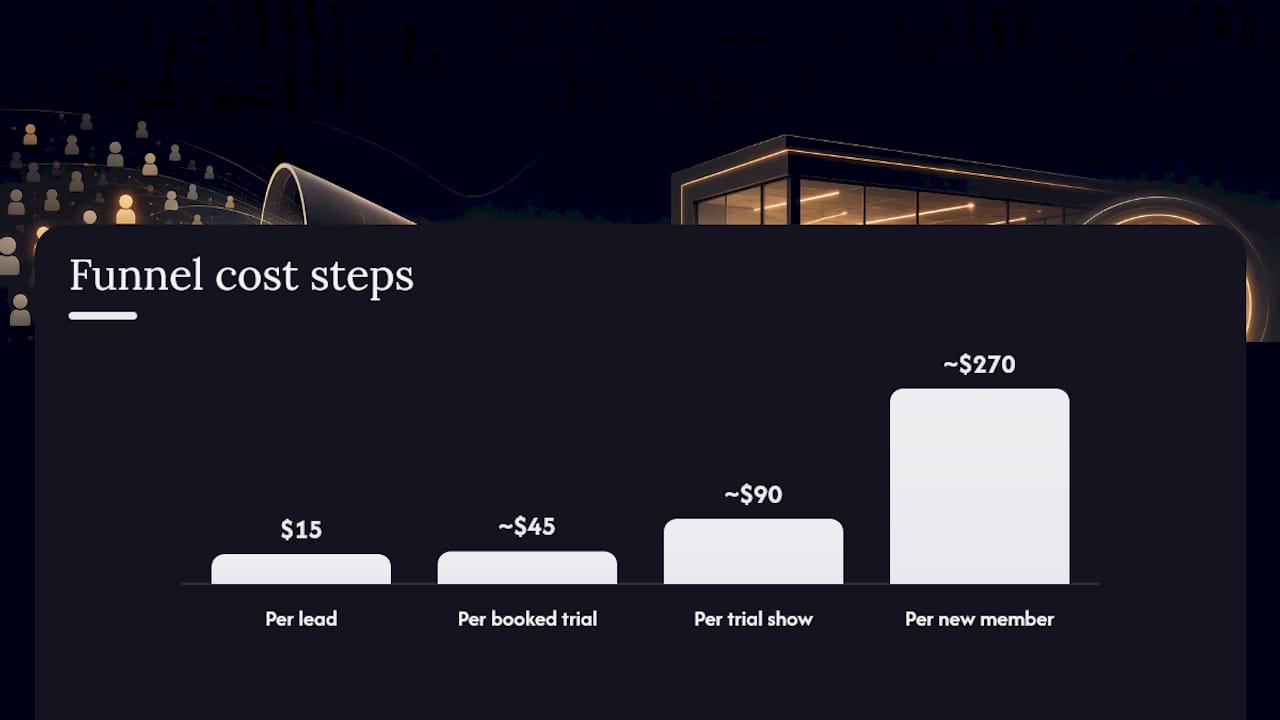
Most gym owners track cost per lead and stop there, which is the fastest way to misjudge a campaign. The number that actually matters is retained-member CPA measured to day 90, because that's the point where most churn-prone members have already left.
The full funnel looks like this: lead → booked trial → trial show → sale (new member) → retained at day 90. Each stage has its own cost, and each one compounds. If your cost per lead is $15, and one in three leads books a trial, you're at roughly $45 per booked trial. If half of those show up, you're near $90 per trial show. If a third of shows convert to paying members, cost per new member lands around $270 before you've even accounted for churn. Industry playbooks recommend measuring cost per booked trial, cost per sale, and 90-day retention as the core metrics, rather than raw lead counts, and using a 10-30-60 funnel split to allocate cold, warm, and hot audience budget.
- Tag every lead source at the ad level, not just the campaign level, so Meta, Google, and referral traffic stay distinguishable in your CRM.
- Pass that source tag through to your point-of-sale or billing system so it survives the actual sale, not just the initial signup.
- Prioritize retained-member CPA over CPL when deciding what to scale, because a channel with a cheap lead cost and poor retention will bankrupt you slower but just as surely as an expensive one.
- Wait for at least 30 to 50 conversions per channel before making scaling decisions. Smaller sample sizes produce numbers that look decisive and are actually noise.
Measuring by retained-member CPA instead of raw cost per lead is the single change that most reliably aligns ad spend with durable revenue, according to industry guidance on gym membership growth.
Retargeting strategies can help rescue the leads who didn't convert on their first pass through the funnel, but they only work if your tagging is clean enough to know who those people actually are.
How Much Should a Gym Spend on Pay-Per-Member Marketing?
Budget as a percentage of revenue, not as a fixed number, because a $30,000-a-month gym and a $150,000-a-month gym need proportionally different spend even at the same growth rate. Most established gyms spend between 5% and 10% of revenue on marketing, while new gyms in launch mode often need 12% to 15% to build initial momentum before referrals and organic search start carrying weight.
- Prelaunch and first 90 days: Spend toward the higher end of the range, since you have no member base to generate referrals yet and no retargeting audience built up. Expect higher CPAs during this window simply because your ad accounts and landing pages lack conversion history.
- Growth stage (months 4 to 12): Pull back slightly as referrals start contributing members at near-zero acquisition cost, and reallocate the savings toward retargeting warm leads who didn't convert the first time.
- Established stage: Settle into the 5% to 10% range, with spend split roughly across paid channels for volume and local SEO or referral incentives for margin.
A budget jump that outruns your booking calendar or coaching capacity just produces no-shows and burned leads. Set frequency caps so the same prospect isn't seeing your ad fifteen times a week, and refresh creative every three to four weeks since gym ad fatigue sets in faster than in most other local categories. A staged budget cadence across the first 30, 90, and 180 days also prevents overspending on cold awareness before you've built warm and hot retargeting audiences worth spending against.
For a deeper breakdown of channel mix by local market conditions, see how to market your gym and win local members.
A Worked Pay-Per-Member Campaign Example
The offer: a 14-day trial for $29, targeting adults 25 to 45 within a 7-mile radius who've shown fitness or nutrition interest.
Using conservative industry assumptions, a $12 average cost per lead across channels, a 40% trial booking rate, a 70% show rate, and a 45% trial-to-member conversion (within the 30% to 60% range typical gyms report), the math plays out like this:
Against a typical membership value of $150 to $180 per month, that $148 retained-member CPA pays for itself inside the first month of dues, with everything after that as margin.
The 12-week calendar: weeks 1 to 2 for setup and tracking, weeks 3 to 6 for initial spend and creative testing, weeks 7 to 10 for scaling the winning channel, weeks 11 to 12 for a full funnel review. Checkpoints at day 30, day 60, and day 90 track show rate, conversion rate, and early retention.
- If show rate is low, fix your follow-up cadence before touching ad spend.
- If leads are cheap but trials are expensive, your booking flow has friction.
- If members join but churn early, the offer sequencing or coaching onboarding needs attention, not the ad budget.
How Enoch Marketing Runs Pay-Per-Member Programs for Gyms
Enochmarketing builds pay-per-member programs around the same funnel logic covered above, combining paid advertising, custom lead funnels, local SEO, and CRM follow-up automation into one connected system rather than separate vendors working from different playbooks.
The process runs in stages: an audit of current channels and conversion data, offer and landing page design, ad launch across Meta and Google, CRM tagging so every lead's source survives through to the sale, retention automation for the first 90 days, then scaling once retained-member CPA proves out. Most failure points Enochmarketing sees are avoidable: slow lead follow-up, offers that don't match the local market, and attribution gaps where nobody can say which channel actually produced a paying member.
Pro Tip: Before hiring anyone to run your acquisition, ask them one question: how do they track a lead all the way to a retained member at day 90? If they can't answer specifically, they're optimizing for leads, not members.
Why Most Gyms Get Pay-Per-Member Math Wrong
The biggest mistake in this entire discipline isn't picking the wrong channel. It's measuring success at the wrong point in the funnel. Owners see a flood of cheap Meta leads and call the campaign a win, then wonder three months later why revenue didn't move. The lead was never the product. A retained member was.
Conventional gym marketing advice spends too much energy on "which platform works best" and not nearly enough on funnel discipline, tagging, follow-up speed, and offer sequencing. Those unglamorous mechanics separate a campaign that pays for itself from one that just generates activity. CTV and influencer tactics get attention because they're novel, but referrals and a tight Google Business Profile often outperform them on a dollar-for-dollar basis over a full year.
If you take one thing from this: build your tracking before you build your ad campaign. A gym that can't trace a lead to a retained member at day 90 is guessing, no matter how sophisticated the targeting looks.
— Collin
Get a Done-For-You Pay-Per-Member Program
Enochmarketing exists specifically for CrossFit and fitness gyms that want member acquisition run as a connected system instead of a pile of disconnected vendors, one team handling paid media, funnels, local SEO, and follow-up automation under a single accountable process. That fits gym owners who want predictable, measurable growth without managing five different freelancers or agencies who don't talk to each other.
Plans start with Get Found at $1,500 per month for gyms building visibility and local presence, scaling up through Fill the Floor and Growth Engine for gyms ready to run full paid-media and funnel programs. Every plan is structured with no lock-in contracts. If your current CPA numbers don't make sense or you're not sure what your retained-member cost actually is, book a free strategy session and get a straight answer on what a working pay-per-member program looks like for your gym.
Sources
- Roku advertising case study — PureGym
- Adscreator — How to advertise a gym (2026)
- JoinBrands — Promoting a gym: 2026 guide to membership growth
- GymRoute — Gym marketing in 2026: the full playbook
- Adwave — Best advertising for gyms & fitness centers (2026)
FAQ
What Is the 3-3-3 Rule in the Gym?
The 3-3-3 rule is a workout and mobility guideline, not a marketing metric. It typically refers to structuring a warmup or cooldown around three movements held or repeated for three rounds of three, and it has no established connection to member acquisition or advertising strategy.
What Companies Pay for Gym Memberships?
Corporate wellness programs, insurance carriers with fitness incentives, and employer benefit platforms commonly subsidize or fully cover gym memberships for employees. Partnering with local businesses on corporate wellness deals can function as a low-cost acquisition channel worth exploring alongside paid advertising.
How Many Members Does a Gym Need to Be Profitable?
It depends entirely on your fixed costs, pricing, and staffing model, so there's no universal number. A gym's profitability comes down to whether retained-member revenue exceeds rent, payroll, and marketing spend, which is exactly why tracking retained-member CPA matters more than a generic member count target.
How Much Can a Gym Owner Make Per Month?
Gym owner income varies widely based on membership count, pricing, location, and overhead, and no single figure applies across the industry. Profitability tends to follow retention and referral rates more closely than raw member acquisition volume, since referral-acquired members retain roughly 37% higher than average.
Is Pay-Per-Member Marketing Better Than Paying for Leads?
Paying based on retained members aligns your spend with actual revenue, while paying for raw leads can reward volume over quality. Most gyms get the best results treating retained-member CPA as the core metric even when working with a flat monthly ad budget, since it's the discipline that matters more than the specific payment structure.
What Does Enoch Marketing Charge for Gym Marketing Services?
Enochmarketing's published plans start at $1,500 per month for the Get Found plan, with Fill the Floor and Growth Engine plans priced higher for gyms needing full paid-media and funnel management. Custom Growth pricing is available on request for gyms with specific or larger-scale needs.