
You're running ads, posting on social media, and maybe even sending emails, yet your membership numbers stay flat. The problem usually isn't effort. It's the absence of a system to evaluate what's actually working. Knowing how to audit gym marketing is the skill that separates gyms that grow predictably from ones that stay stuck guessing. A well-run audit doesn't take weeks. According to research, a structured audit can be completed in 60 minutes or less. This guide walks you through exactly how to do it.
Table of Contents
- Key takeaways
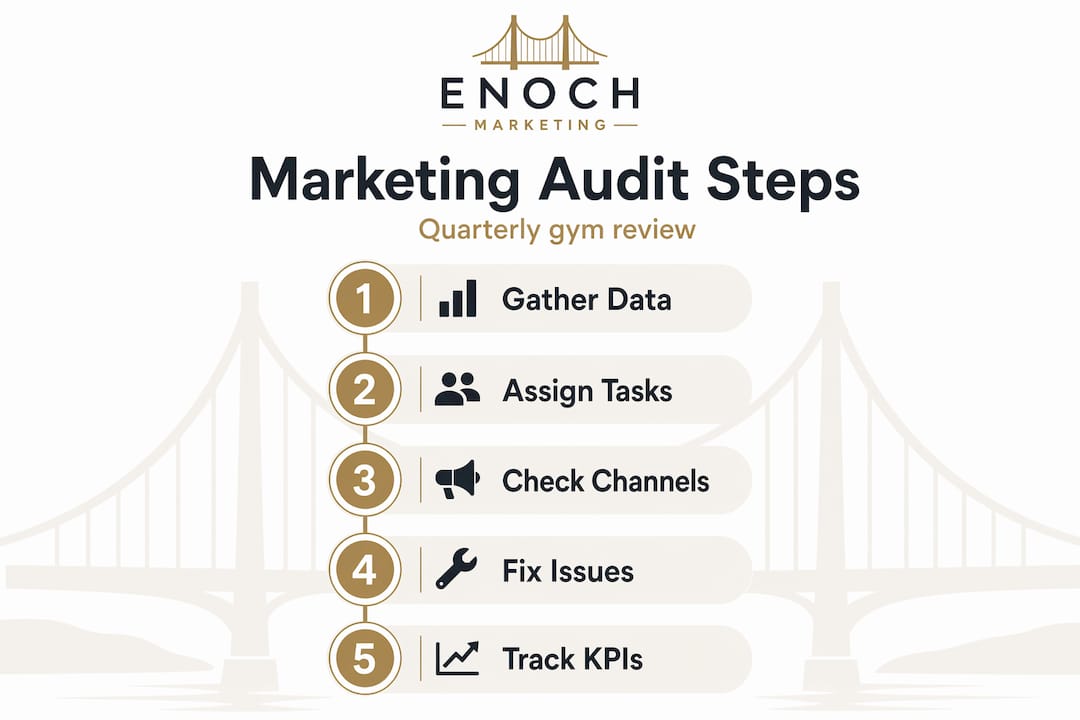
- What you need to prepare before auditing your gym marketing
- Auditing your core marketing channels step by step
- How to identify weaknesses and prioritize fixes
- How to verify results and set up ongoing measurement
- My take on auditing gym marketing
- How Enochmarketing can take your audit further
- FAQ
Key takeaways
| Point | Details |
|---|---|
| Audits find hidden leaks | Most gym marketing inefficiencies go unnoticed without a structured review process. |
| Preparation accelerates results | Gathering KPIs, budgets, and tool access before you start makes the audit faster and sharper. |
| Cover every core channel | Website, paid ads, social media, and local SEO all need evaluation in the same pass. |
| KPIs verify your fixes | Tracking lead volume, cost per acquisition, and conversion rate confirms whether changes are working. |
| Quarterly audits prevent drift | Regular review cycles keep your marketing aligned with growth goals as your gym evolves. |
What you need to prepare before auditing your gym marketing
Jumping straight into an audit without preparation wastes time and produces incomplete findings. Before you review a single ad or analytics report, get clear on why you're running the audit in the first place.
Start by writing down your primary goal. Are you trying to lower your cost per lead? Improve your website conversion rate? Figure out why your Google ads stopped performing? A focused goal keeps the audit from becoming a sprawling, unfocused session that ends with a list of vague observations and no clear next step.
Once your goal is set, pull together the data you'll need:
- Marketing budget breakdown by channel (paid ads, social, email, local)
- Lead source data from your CRM or intake forms
- Conversion rates from lead to trial and trial to paid member
- Current campaign reports from Google Ads and Meta Ads Manager
- Website analytics from Google Analytics 4
- Social media performance metrics from the last 90 days
If you're a solo owner, assigning audit tasks to team members prevents the whole project from sitting on your desk and never getting done. Give someone the job of pulling ad reports. Give another person the job of reviewing your Google Business Profile. Accountability speeds up completion.
Pro Tip: Schedule your audit the same week each quarter. Gyms that audit quarterly avoid the slow, invisible erosion of marketing performance that happens when nobody's watching the numbers.

For budget context, established gyms typically spend 5 to 8 percent of gross revenue on marketing. Newer gyms or those launching new programs often need 10 to 12 percent. If your actual spend looks very different from those ranges, that's your first audit finding before you've reviewed a single campaign.
Auditing your core marketing channels step by step
This is where the real work happens. The goal here is to assess fitness marketing tactics across every channel your gym uses, not just the one you feel most comfortable with.
Website review
- Open your website on a mobile device and check loading speed. Google's benchmark is under 3 seconds. Slow sites kill conversions before a visitor even reads your offer.
- Read your homepage headline out loud. Does it clearly state who you help and what result you deliver? "Lose fat, build muscle, feel confident in 12 weeks" beats "Welcome to our gym."
- Count the steps between landing on your homepage and submitting a contact form. If it takes more than two clicks, leads are dropping off. Check out why your gym website may be losing members silently.
- Test every call-to-action button. Broken links and forms that don't submit are common and surprisingly easy to overlook.
Social media audit
- Check the last 30 days of posts. Are you posting at least three times per week? Top-performing gyms maintain consistent posting schedules combined with email marketing and review generation to stay visible locally.
- Look at your engagement rate. If your follower count is growing but likes and comments are flat, your content isn't resonating. Read more on building a social media strategy that drives actual member signups.
- Check that every post with an offer includes a clear, specific call to action linking back to a landing page.
Paid advertising review
- Log into Meta Ads Manager and Google Ads. Pull performance for the last 30 days. Note your click-through rate, cost per click, and cost per lead for each campaign.
- Review your ad creative. Personalized ad copy consistently outperforms generic calls to action, and bi-weekly A/B testing is the standard practice for serious gym growth. If you're running the same creative for more than two weeks without testing a variation, you're leaving money on the table. For a deeper look at paid media performance, see these CrossFit performance strategies.
- Check audience targeting. Are you reaching people within a realistic driving distance of your location?
Local SEO and Google Business Profile
- Search your gym's name on Google. What appears? Check that your name, address, and phone number are correct and consistent across your website, Google Business Profile, and any directory listings.
- Review your star rating and the recency of your reviews. A gym with 4.6 stars and 12 reviews from three years ago looks less credible than one with 4.4 stars and 40 reviews from the last six months. Use these local gym marketing strategies to build review momentum.
- Walk through your own lead capture process like a stranger would. Submit a form. Call the number. See how long it takes to get a response. This mystery shopper perspective is one of the most revealing steps in the whole audit because familiarity bias hides friction that newcomers feel immediately.
Pro Tip: Use an incognito browser window and a personal email address when testing your own lead funnel. You'll see exactly what a cold prospect experiences, without the logged-in admin shortcuts distorting the picture.
| Channel | What to check | Key benchmark |
|---|---|---|
| Website | Load speed, headline clarity, CTA function | Under 3 seconds load time |
| Social media | Posting frequency, engagement rate, link usage | Minimum 3 posts per week |
| Paid ads | CTR, cost per lead, creative freshness, A/B testing | Test new creative every 2 weeks |
| Local SEO | Google Business Profile accuracy, review recency | Reviews within last 6 months |
| Lead follow-up | Response time after form submission | Under 5 minutes response time |
How to identify weaknesses and prioritize fixes
Once you've completed your channel-by-channel review, you'll have a list of issues. Not all of them deserve equal attention. The goal now is to assess fitness marketing tactics by impact and effort so you fix the right things first.
The most common findings in a gym marketing audit fall into a few clear categories:
- Unclear messaging: Prospects can't quickly tell what your gym offers, who it's for, or what makes it different from the gym down the street.
- Weak follow-up systems: Leads come in through a form or ad, and then nothing happens for 24 to 48 hours. By then, the prospect has moved on.
- Budget misallocation: Spending heavily on channels that produce awareness but not conversions, while underfunding the channels that actually bring in members.
- Vanity metrics masking real problems: High follower counts and lots of impressions can make things look fine while actual lead volume drops. Tracking impressions without tracking conversions is a common and costly mistake.
- Outdated creative and offers: Running the same ad creative or promotion for months without refreshing it causes ad fatigue, which drives up your cost per click while reducing conversion rates.
When you prioritize your fixes, start with anything that directly blocks a lead from becoming a member. A broken form, a slow website, or a 48-hour response time will each cost you more members per month than a slightly imperfect ad headline.
"Marketing audits often reveal that the biggest problem isn't what the gym is spending on advertising. It's what happens after a lead lands. Fix the follow-up first, and everything downstream gets cheaper and faster." — Enochmarketing
For systemic issues like team misalignment or inconsistent messaging across channels, the fix is usually a documented process, not a new campaign. Write down what the response protocol looks like. Clarify who owns each channel. Fixing process gaps costs almost nothing and frequently produces faster results than launching a new ad campaign.
How to verify results and set up ongoing measurement
Completing an audit is one thing. Confirming that your fixes actually worked requires a measurement system you check regularly. This is how a gym marketing audit checklist transforms from a one-time exercise into a repeating growth engine.
The KPIs that matter most for gym marketing are direct and specific:
| KPI | What it measures | Review frequency |
|---|---|---|
| Lead volume | Total new inquiries per week or month | Weekly |
| Lead-to-trial conversion rate | Percentage of leads who book a trial session | Weekly |
| Trial-to-member conversion rate | Percentage of trials who purchase a membership | Monthly |
| Cost per acquisition | Total ad spend divided by new members | Monthly |
| Review count and rating | Local visibility and social proof strength | Monthly |
Tracking these KPIs through Google Analytics 4 and your CRM creates a baseline. Without a baseline, you can't tell if a change made things better or worse. Set up a simple dashboard that shows these numbers in one view. Google Looker Studio connects to most CRM tools and Google Analytics for free.
In the early days after an audit-driven change, daily campaign monitoring is worth the time. You'll catch budget drain or targeting errors before they compound. After the first two to three weeks, weekly reviews are sufficient for most campaigns.
Pro Tip: Build a monthly "marketing health check" into your calendar. Pull your top five KPIs in 20 minutes. If any metric drops more than 15 percent from the prior month, treat it as a trigger to investigate before the next full quarterly audit.
My take on auditing gym marketing
I've worked with enough gym owners to know the most common reason audits don't happen. It's not lack of interest. It's the belief that an audit is a big, separate project that requires a consultant, a spreadsheet, and a week of time. That's not true.
What I've found is that the owners who improve fastest treat auditing as a habit, not an event. They spend 20 minutes a week looking at their numbers and one focused hour every quarter going deeper. That cadence prevents what I'd call "marketing drift." Things slowly degrade between campaigns. Lead response times creep up. Ad creative gets stale. Nobody notices because everyone is focused on running classes and managing staff. Then suddenly, a competitor opens nearby and the phone stops ringing.
The other thing I've learned is that combining data analysis with a mystery shopper approach changes what you find. Data tells you that something is broken. Walking through your own lead funnel as a stranger tells you why. Both perspectives together produce fixes that actually stick.
My honest advice: don't wait until growth stalls to run your first audit. Run one now, while things are still working well enough to give you a clear baseline. That baseline becomes your biggest advantage the next time performance dips.
— Collin
How Enochmarketing can take your audit further
You've done the hard work of identifying what's broken. Now comes the execution. That's exactly where Enochmarketing specializes, handling the paid media, local SEO, lead funnels, and content systems that gym owners consistently identify as their biggest gaps during an audit.

If your audit revealed weak paid ad performance, stale creative, or a lead follow-up process that isn't converting, Enochmarketing's gym marketing services are built to fix those exact problems. Every engagement starts with an audit-style review, so the strategy is built on your actual data, not guesswork. If you're ready to stop patching problems one at a time and want a team that runs your entire marketing system, book a free strategy session and see what a full-stack approach looks like for your gym.
FAQ
What is an audit in gym marketing?
A gym marketing audit is a structured review of all your marketing channels, spend, and performance data to identify what's working and what's wasting budget. It covers your website, paid ads, social media, local SEO, and lead follow-up processes.
How often should gym owners run a marketing audit?
Most gym owners should run a full marketing audit quarterly. Quarterly audits prevent gradual performance erosion and keep your marketing aligned with membership growth goals.
How long does a gym marketing audit take?
A structured gym marketing audit can be completed in 60 minutes or less when you prepare your data in advance and use a channel-by-channel checklist.
What KPIs should I track after a gym marketing audit?
Track lead volume, lead-to-trial conversion rate, trial-to-member conversion rate, and cost per acquisition. Using Google Analytics 4 alongside your CRM gives you the clearest picture of marketing performance.
What is the most common finding in a gym marketing audit?
The most common finding is a breakdown in lead follow-up. Leads come in but receive a delayed or inconsistent response, which kills conversion rates regardless of how well the ad campaigns perform.