
Yes, geofencing ads reliably drive qualified trial signups for local gyms when you pair presence based radius targeting with a clear trial offer and solid tracking. The single best first move is a Presence targeted radius campaign around your gym and two or three nearby landmarks, paired with a 7-day trial pass offer. Expect qualified signups and fewer wasted impressions within the first few weeks. Skip to the setup checklist below if you're ready to launch.
TL;DR:
- The most effective geofencing campaigns focus on a 1 to 5 mile radius around your gym, tailored to your facility's size and target audience.
- Using Presence targeting ensures ads reach only those actually within or frequently near your target zone, avoiding wasteful impressions.
- Legal compliance requires verifying that third-party data sources can document consent, especially when targeting sensitive locations like hospitals or places of worship.
- Combining geofencing with other channels like Meta and Google Ads enhances reach and reduces overall cost per trial, especially during promotions or new location launches.
- Success depends on clear, urgent trial offers, single-call booking flows, and diligent tracking to measure trial signups and conversion rates accurately.
Table of Contents
- Why Geofencing Ads Work for Gym Membership Growth
- How Location Targeting Actually Works (And the Privacy Rules You Can't Skip)
- How to Launch a Geofencing Campaign, Step by Step
- Where to Draw Your Geofences: Tactics That Actually Convert
- Creative and Offers That Turn Clicks Into Trial Signups
- Measuring ROI: KPIs, Budgets, and Realistic Timelines
- How a Specialist Gym Agency Runs This Playbook
- What Actually Moves the Needle (And What Doesn't)
- Let Enochmarketing Run Your Geofencing Campaign
- Sources
- FAQ
Why Geofencing Ads Work for Gym Membership Growth
Gym membership is a local decision. Most members join a facility within a short drive of home or work, which is exactly why tight radius targeting outperforms city-wide campaigns for membership-driven businesses. When you stop paying to reach someone 20 miles away who will never walk through your door, your cost per lead drops and your ad budget stretches further.
Geofencing earns its keep in a few specific situations:
- Launching a new location and needing fast awareness in the immediate footprint
- Running seasonal promotions (January resolutions, summer shred challenges) where urgency matters
- Poaching members from a competing gym whose contract or class schedule is failing them
- Following up after a community event, race, or health fair where prospects already showed interest in fitness
Broader channels still have a role. Meta tends to win on volume and low cost per trial, while Google Ads captures people actively searching with high intent, according to gym advertising benchmarks from Adwave. Geofencing sits between the two: narrower than Meta's interest targeting, more locationaware than a generic Google search campaign.
Pro Tip: Run geofencing alongside your existing channels, not instead of them. Use it to catch the people standing physically close to your gym who haven't seen your Meta ads or searched for you on Google yet.
How Location Targeting Actually Works (And the Privacy Rules You Can't Skip)
A geofence is a virtual boundary drawn around a specific point, like your front door, a competitor's parking lot, or a corporate office park. Radius targeting is the simplest version: you pick a center point and a distance, and the platform serves ads to people inside that circle.
Google Ads defaults to a setting called "Presence or interest," which shows your ads to people physically in the area AND people elsewhere who are searching about that area. For gyms, that second group is close to worthless. You want the Presence setting, which limits delivery to people who are actually located in or regularly present in your target zone.
A few mechanical notes worth knowing before you set a radius:
- Google Ads enforces minimum privacy thresholds on very small radii, so a circle drawn too tight around a single strip mall may simply fail to deliver.
- Location targeting settings vary slightly across Search, Display, and Demand Gen surfaces, per Google's own targeting documentation.
The bigger issue is legal, not technical. The FTC has taken enforcement action against data brokers for misusing location data, and a related case against Kochava resulted in a ban on selling sensitive location data without affirmative express consent. Never build a geofence around a hospital, clinic, place of worship, or similar sensitive location, and confirm any third-party data vendor can document consent.
How to Launch a Geofencing Campaign, Step by Step
- Pick your platform and objective. Use Google Ads for lead-gen intent capture, Meta for lower-cost volume, and layer in Performance Max or Demand Gen surfaces once you have baseline data.
- Draw your geofences with real numbers. Set a 1-mile radius around your own front door, a 3 to 5 mile radius for boutique studios in denser markets, and standalone geofences around two or three competitor locations or a nearby corporate campus.
- Set Presence targeting, not Presence or interest, so spend stays on people who are actually local.
- Build exclusions before you build audiences. Exclude sensitive locations outright, cap ad frequency at 2 to 3 impressions per day, and exclude your existing member list so you're not paying to reach people who already joined.
- Pair each geofence with a matching offer and landing page. A campus geofence might promote a corporate discount; a competitor geofence might promote a no-commitment trial week.
- Set up tracking before launch. Install conversion pixels, tag every ad with UTM parameters, and set up offline conversion imports so a booked tour or signed membership ties back to the exact ad that produced it.
- Start with a modest daily budget and confirm impressions are actually landing inside your geofence before scaling spend.
Pro Tip: Run your QA checklist the day before launch, not the day after. A single wrong radius setting can burn a week of budget before anyone notices the ads aren't reaching the right zip code.
Where to Draw Your Geofences: Tactics That Actually Convert
Radius size should match your gym's format. Boutique studios with a narrow niche (cycling, yoga, boxing) tend to do better with a tighter 1 to 3 mile radius, since their draw area is genuinely small. Big-box gyms and CrossFit-style facilities with broader appeal can often justify a 3 to 5 mile radius without wasting spend, matching what local geotargeting research suggests about realistic member catchment zones.
Beyond your own address, a handful of locations consistently produce strong candidate geofences:
- Competing gyms, especially ones with recent negative reviews or known contract complaints
- Healthy-food cafes, juice bars, and grocery stores with a health-conscious customer base
- Corporate campuses and office parks near your facility
- College campuses, if your pricing or class schedule fits a student budget
- Local 5Ks, sports leagues, or health fairs where attendees have already signaled fitness interest
Once someone enters your geofence and clicks, retarget them for 14 to 30 days with a reminder ad, and cap frequency so the same person doesn't see your ad ten times in a week. Layering in your own first-party lists, like past trial users or newsletter subscribers, sharpens who actually sees the ad. Pairing this with a broader retargeting strategy keeps the same prospect warm across platforms instead of losing them after one impression.
Pro Tip: Geofence the parking lot of the gym down the street during the first week of January. Contract dissatisfaction peaks right when resolution shoppers are already looking.
Creative and Offers That Turn Clicks Into Trial Signups
Short-form video (15 to 30 seconds) showing your actual class floor tends to outperform static images for proximity ads, since it signals real energy fast. Display creatives work as a lower-cost supplement, and native lead-gen forms cut friction by letting someone request a trial pass without leaving the app.
Offer wording matters more than most owners expect:
- Lead with a specific, time-boxed offer ("7-day trial pass," not "come check us out")
- Add urgency without gimmicks ("this week only" beats a permanent discount that never expires)
- Match the offer to the geofence (a class-specific offer for a boutique geofence, a general trial for a broad radius)
Your landing page needs a single, obvious call to action, a local trust signal like a member count or a recognizable review, and instant delivery of the trial pass, whether that's a QR code, a booking link, or a text confirmation. Fast, low-friction booking flows correlate with higher trial conversion than multi-step forms. Test one variable at a time: offer wording first, then creative format, then landing page layout.
Measuring ROI: KPIs, Budgets, and Realistic Timelines
Four numbers matter more than anything else: trial signups, cost per trial, trial-to-member conversion rate, and cost per new member. Everything else is a supporting metric.
Track performance with UTM parameters on every ad, a conversion pixel on your landing page, and offline conversion imports so a phone-booked tour still gets credited to the geofence that generated it.
Budget benchmarks worth starting from:
- A modest daily budget per geofence is enough to gather early signal without overcommitting
- Expect cost per lead to vary widely by market and competition, so treat your first two weeks as a baseline, not a verdict
- Isolate one variable, offer, creative, or audience, per test window and hold it for 7 to 14 days or 200-plus clicks before drawing conclusions
- Scale budget once cost per trial stabilizes and trial-to-member conversion holds steady across at least two consecutive weeks
Meaningful signal usually takes two to four weeks. If cost per trial is climbing and conversion isn't following, pause the geofence and re-test the offer before assuming the tactic itself failed.
How a Specialist Gym Agency Runs This Playbook
A specialist gym marketing agency typically builds its process around one repeated pattern: audit the gym's current funnel, build a geofencing and paid media strategy specific to that market, launch the campaign, then optimize weekly based on real signups.
The cadence that keeps campaigns honest looks like this:
- Weekly creative and offer tests, isolating one variable at a time
- A 30-day checkpoint to decide whether a geofence scales, pauses, or gets reworked
- Ongoing attribution checks tying every trial signup back to the specific ad and geofence that produced it
That structure mirrors the setup checklist above, applied consistently instead of as a one-time launch. For owners who want a deeper look at account structure before committing budget, PPC strategy built specifically for gyms breaks down how paid search and geofencing complement each other, and a step-by-step local ad playbook covers budget pacing in more depth.
What Actually Moves the Needle (And What Doesn't)
The conventional advice on geofencing treats radius size as the whole strategy. It isn't. Two gyms can run identical 3-mile radius campaigns and get wildly different results because one paired it with a genuinely urgent offer and a one-step booking flow, and the other slapped a generic "join now" banner on top of a five-field contact form.
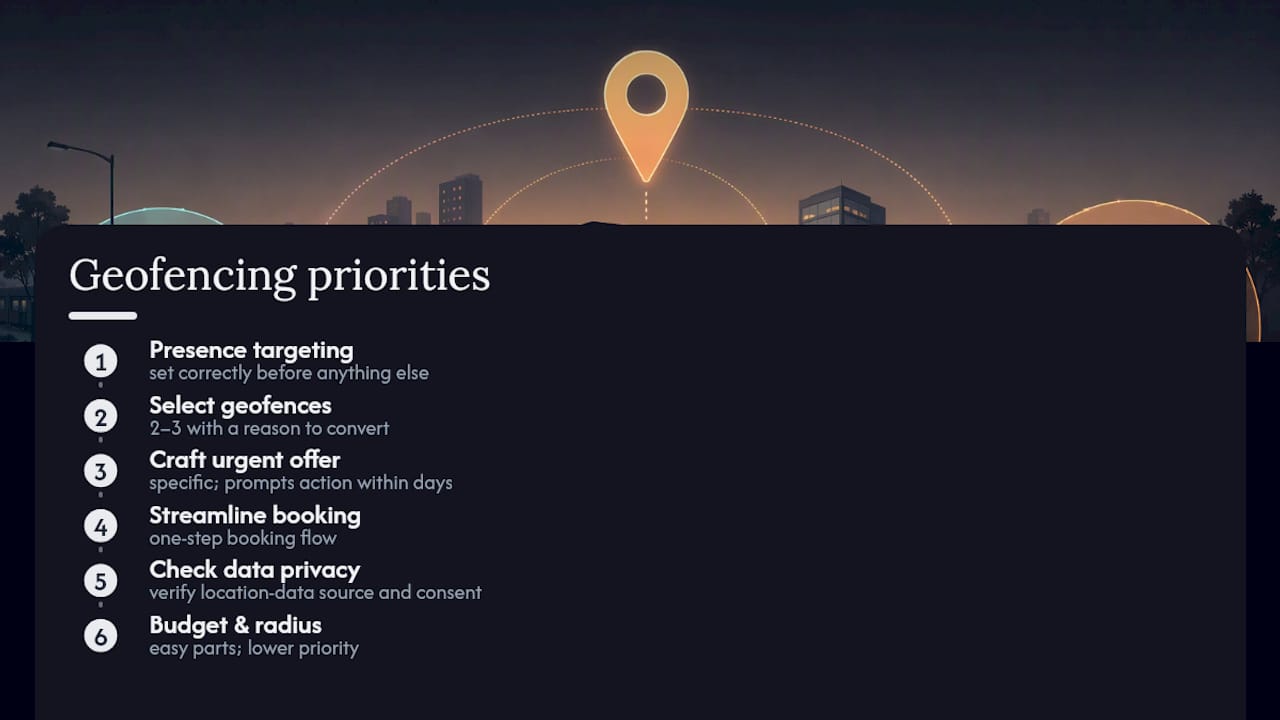
The bigger blind spot is legal exposure. Owners obsess over cost per click and barely glance at where their location data comes from. Given how aggressively the FTC has gone after brokers selling sensitive location data without consent, that's backwards. A gym that skips the privacy homework to save a week of setup time is taking on real liability for a marginal speed gain.
What should come first, in order: nail the Presence targeting setting, pick two or three geofences with a genuine reason to convert (not just proximity), and write an offer specific enough that someone acts on it within days. Budget and radius size are the easy parts. Most campaigns that underperform didn't fail because the radius was wrong. They failed because the offer was forgettable and nobody checked where the audience data actually came from.
— Collin
Let Enochmarketing Run Your Geofencing Campaign
A dedicated gym marketing agency may offer alternatives to generalist agencies for gym-specific geofencing by focusing on CrossFit gyms and fitness studios rather than unrelated small businesses. Such agencies often use radius recommendations, offer templates, and tracking setup similar to those described above when running paid media, funnel creation, and landing pages for gyms.
Before you hand a geofencing budget to any agency, ask three questions: where does their location data come from, how do they document consent, and how often will they report back to you. If those answers are vague, that's a warning sign worth taking seriously given the FTC scrutiny outlined above. Enochmarketing's gym-focused paid advertising service covers Meta and Google campaigns built around Presence targeting, first-party audiences, and full attribution tracking. Plans start with the Get Found package at $1,500 per month, scaling up through Fill the Floor and Growth Engine as your budget and location count grow. Book a strategy session to see which package fits your gym's current membership goals.
Sources
For platform specifics, see Google's location targeting help and FTC guidance on location data.
- Location options let you include or exclude people based on presence or interest - Google Ads Help
- The FTC bars Kochava from selling sensitive data without consent - AdExchanger
FAQ
How Much Does a Geofencing Campaign Cost?
Costs vary by market competition and radius size, so there's no single fixed number. Enochmarketing's bundled packages that include geofencing and other paid media start with Get Found at $1,500 per month, with higher tiers for gyms running multiple locations or larger ad budgets.
What Are the Best Ways to Advertise for Gyms?
The strongest results usually come from combining Meta for low-cost trial volume, Google Ads for high-intent search capture, and geofencing for hyper-local reach around your gym and competitor locations. Pairing these with local SEO and reputation management rounds out the local visibility a paid campaign alone can't cover.
How Do I Set Up Geofencing Advertising?
Choose a platform, draw radius targets around your gym and relevant landmarks, set Presence targeting instead of Presence or interest, and pair each geofence with a matching trial offer and tracked landing page. The full sequence, including exclusions and budget pacing, is covered in the step-by-step setup section above.
How Does Geofencing Work for Ads?
Geofencing draws a virtual boundary around a physical location and serves ads to devices detected inside that boundary. On Google Ads, choosing Presence targeting restricts delivery to people who are physically in or regularly present in that zone, rather than anyone merely searching about the area.
Is Geofencing Advertising Legal for Gyms?
Geofencing itself is legal, but how you source location data isn't unlimited. The FTC has barred data brokers from selling sensitive location data without affirmative express consent, so gyms should avoid third-party audiences without documented consent and never target sensitive locations like medical facilities.