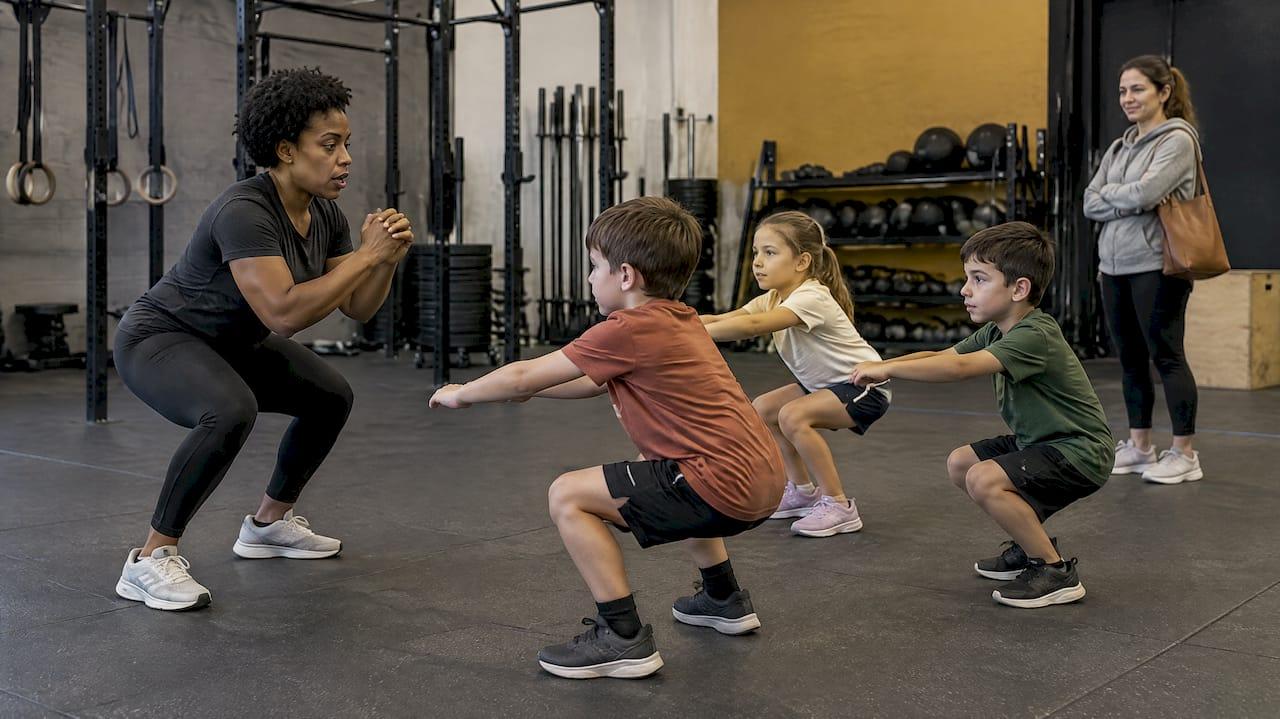
CrossFit Kids marketing works when you market to the parent who writes the check and prove the program to the child who has to want to come back. That means a clear offer built around family schedules, visible safety, local partnerships and a follow-up routine that turns a curious parent into an enrolled family. We build that kind of system for CrossFit gyms, and the same pieces apply whether you run one kids class or a full youth schedule.
TL;DR
- You sell to two people: the child who participates and the parent who pays. Every message has to work for both.
- Package the program like a youth sports season, price it against local youth classes, and schedule around school and parents' own workouts.
- Parents judge safety by what they see: separate programming, capped classes, a calm space and a coach who looks prepared.
- Local partners (schools, pediatric offices, youth organizations) reach families that ads and social posts will not.
- Track inquiries, inquiry-to-enrollment conversion and cost per new member, and handle children's information with the FTC's updated COPPA rule in mind.
Table of Contents
- Why kids marketing is its own channel
- Build the offer parents can say yes to
- Make safety something parents can see
- Reach families through local partners
- Promote the program online
- Follow up and measure
- Handle children's information carefully
- Our perspective
- How we help gyms fill kids classes
- FAQ
- Sources
Why kids marketing is its own channel
Adult CrossFit marketing talks to the person who will sweat. Kids marketing talks to a parent deciding where a child spends an hour, and who is judging you on trust before results. According to a CrossFit Kids program guide, you are selling to two people: the child and the parent, and the families who arrive are often parents of kids who have not found a sport that clicks. Those parents are eager but price-sensitive.
That changes what you put in an ad, on your site and in a first conversation. Reps, PRs and intensity are not the hook. The hook is a child who looks forward to class, a coach who knows the age group, and a schedule that fits a school week.
If you want the wider picture of how gym marketing fits together, our overview of why fitness marketing matters for CrossFit gym owners covers the adult side. Below is what changes for kids.
Build the offer parents can say yes to
Most kids programs stall because the offer is vague, not because the coaching is weak. A parent needs to know the age range, the length of a class, what it costs and what happens if their child misses a session.
Name, price and package the program
Use playful class titles and descriptions and keep the experience fun and age-appropriate. Studio-industry guidance recommends marketing to parents while making classes enjoyable enough that children ask to return.
A real example helps. Blind Faith CrossFit in North Haven, Connecticut, publishes its kids offer in plain terms: a 60-minute class for ages 4 to 12 at $20 per class, a $25 parent-and-child Family Class, a $40-per-child Parents Night Out, sibling discounts, class packs, and a free one-week Friends and Family trial. Whatever your prices, copy the structure: one clear entry point, a family option, a trial and a reward for bringing siblings.
For price, look at what parents already pay for karate, dance, yoga or fencing nearby. The same CrossFit Kids guide suggests pricing against those comparable youth classes and scheduling the program in seasons, like soccer or basketball, rather than as a month-to-month adult membership. A season has a start date, an end date and a total price, which makes the commitment easy to understand.

Schedule around the family
Studio-industry guidance advises evening and weekend kids classes around the school year, a short parent survey on preferred times, and kids' classes coordinated with parents' own workouts. CrossFit's own coaching guidance describes running a kids class and an adult class at the same time on opposite sides of the gym, which lets a parent train while the child trains. That is a marketing line you can put on your homepage: "Train while your kids train."
Add make-up passes for missed classes. Parents who feel a missed session is lost money hesitate to enroll, and a make-up pass answers that in one sentence.
Make safety something parents can see
Parents decide quickly, and they decide on what they observe. A coach writing the workout on the whiteboard minutes before class signals an improvised program, while a posted plan, kid-inclusive photos, displayed achievements and framed letters from happy parents signal a planned one. The same source argues that a written parent procedure, covering the path from first impression to signup, is a marketing tool, not only an operations document.
What to show and say
- Separate programming. Kids need their own programming, not modified adult workouts, and coaches should tell parents that classes are capped for safety, instruction and personal attention.
- A prepared space. CrossFit's coaching guidance calls for age-appropriate, safely spaced equipment, padded rig uprights, a clean, well-lit room and controlled music.
- Noise management. Its second design guide recommends staggering kids and adult classes by 10 to 15 minutes, using 30 to 45 minute kids classes and turning down the music so dropped barbells do not startle younger athletes.
- Parent rules at signup. The same guide suggests a marked waiting area for parents and siblings, with cones, tape or racks, and rules such as only saying "good job" to prevent sideline coaching.
- Open communication. One CrossFit gym's guide recommends discussing program goals, coaching experience and safety steps openly, inviting parents to watch a session, and using progress charts or parent stories to show growth.
Put these on a single "Kids at [Your Gym]" page and repeat them in every ad landing page. If you hold childcare-style certifications such as CPR and AED, show them. A guide to childcare CPR documentation lists the paperwork inspectors expect, which is a useful checklist for what a parent might ask to see.
Turn trust into proof
Gathering proof is easier than it sounds. After a season, ask parents for a two-sentence note and a photo release. Post short progress stories (a child's first unassisted pull-up, a first jump rope streak). These become your testimonials, your Google reviews prompts and your social content. Our guide to content marketing for CrossFit gyms shows how to turn this kind of member material into a steady posting routine.
Reach families through local partners
Ads find parents who are already searching. Partnerships find the ones who are not. A peer-reviewed study of an at-risk youth CrossFit program documented partnerships with an afterschool organization, a local CrossFit box, a pediatric office and a youth-focused foundation. They contributed recruitment and transport, coaches and space, free evening physicals, and funding and scholarships.
Two lessons from that study apply to any gym. The most important factors were personal contact, with a single liaison per organization, and fit, meaning partners with similar youth-focused missions. It also found that partnerships worked best when planning and funding were secured before contacting partners. Translated for a gym owner: pick one person to own each relationship, approach organizations whose mission matches yours, and arrive with a defined offer.
CrossFit 7220 in Laramie, Wyoming, shows what that offer can look like. Its community outreach includes free weekly PE classes for local school children, free team training for athletic teams, youth nutrition education and no-cost youth class invitations. A 2025 peer-reviewed study of a family-based CrossFit program also notes that partnerships with schools, community centers and local sponsors can offset participation costs and reach families who may not otherwise visit a CrossFit facility.
A practical starting list:
- A school PE teacher or athletic director for a free demo class.
- A youth sports club that needs off-season conditioning.
- A pediatric or physical therapy office willing to display your class flyer.
- A local family business willing to sponsor scholarship spots.
Also build a kids-specific referral program. Studio guidance suggests rewarding existing clients for recommending the gym to friends. Parents talk to parents at school pickup, and that conversation is your best channel. Our walkthrough of a member referral campaign for gyms explains how to structure one.
Promote the program online
Your website, local search profile, social accounts and reviews are where a referred parent verifies you, and where a searching parent finds you.
Website and landing page
Give kids their own page with the age range, class length, schedule, price, safety points, coach introductions and one action: book a free trial or a visit. Keep the form short. Parents are often on a phone in a car line.
Local search and reviews
Parents search for things like "kids fitness classes near me." A complete Google Business Profile, kids-specific service pages and recent parent reviews help you appear for those searches. Ask for reviews that mention the child's age and what changed (confidence, coordination, enjoying class). Our local SEO playbook for gym owners walks through the setup.
Social media
Social media is the program's public face. The CrossFit Kids guide recommends a dedicated program manager who meets coaches, neighbors, teachers and sports-team organizers, talks to parents in and outside the gym, and keeps social accounts active. Show kids having fun, coaches interacting well and parents engaged. Parent-focused groups can also be a useful place to answer questions, as one marketing guide notes about busy-parent Facebook groups. For a deeper look, see why social media marketing matters for CrossFit gyms.
Paid ads aimed at parents
Paid campaigns on Meta and Google should speak to the parent: a local radius around your gym, a clear seasonal offer and a free trial. Send every click to the kids page, never the adult homepage. Our examples of paid media campaigns for CrossFit gyms show how offers are framed.
Follow up and measure
A kids inquiry goes cold quickly if nobody answers. Every staff member should be able to tell a parent what the youth program is and how it solves their problem, and your process should include follow-up when a parent does not sign up. Text and email work well here, and our guide to email marketing for CrossFit gyms covers the sequence.
Then track three numbers, using the approach CrossFit HQ gives affiliates in its marketing guidance: inquiries, the conversion rate of inquiries to members, and customer acquisition cost. Cost is marketing spend divided by new members. Its example is $5,000 spent for 25 new members, which is $200 per new member.

For kids, keep a simple sheet by source (referral, school demo, Google, Meta, social) and by stage (inquiry, trial, enrolled, re-enrolled next season). After two seasons you will know which partner or ad pays back. Our piece on how data drives CrossFit gym marketing explains how to read those numbers.
Handle children's information carefully
If your site, forms or ads collect information tied to children, the FTC's amended COPPA Rule matters. The rule took effect on June 23, 2025, with compliance for most provisions due by April 22, 2026. According to the Federal Register document, it defines "mixed audience" websites, counts mobile phone numbers as online contact information, adds government-issued and biometric identifiers to personal information, and requires separate parental consent before sharing children's data with third parties for targeted advertising. The FTC may also weigh marketing materials when deciding whether a site is directed at children.
In practice: aim your forms and ads at parents, collect only what you need, and do not share children's data with ad platforms or other third parties without parental consent. For your specific forms, tracking pixels and waivers, confirm the setup with your attorney.
Our perspective
Most CrossFit owners we talk to treat kids as an add-on: a class on the schedule and a post on Instagram. The gyms that grow the program treat it as a separate funnel with its own offer, its own landing page, its own follow-up and its own numbers.
The reason is simple. A parent will not find you through a workout of the day. They find you through a search, a neighbor or a school, and they decide on a page, a review and a first visit. If those three touchpoints do not agree with each other, the family is gone.
That is why we build the pieces as one system: paid ads on Meta and Google, local SEO and reputation, a landing page, lead follow-up and booking, and content. One accountable partner means a parent who clicks an ad lands on a page that matches it, gets a fast reply and a booked visit, and you see which source produced the enrollment.
Collin
How we help gyms fill kids classes
We work only with CrossFit gyms and fitness brands. For a kids program, the relevant pieces are paid advertising, local SEO, website and landing page design and lead generation that books visits. Packages on our pricing page are Get Found at $1,500 per month, Fill the Floor at $2,500 per month and Growth Engine at $4,500 per month, with a Custom Growth option, and our model has no lock-in contracts. You can also book a free strategy session from our site.
FAQ
How much should I charge for CrossFit Kids classes?
Start with what parents near you already pay for karate, dance or yoga, and price in that range. Packaging classes as a season, with a start date and total price, makes the commitment clear. One gym publishes $20 per drop-in class with class packs and sibling discounts, which is one reference point, not a rule.
What is the best way to get the first kids enrolled?
Combine a free trial week with one local partner, such as a school PE demo or a youth team. Studies of youth CrossFit programs found that one personal liaison per partner was among the most important factors. Then ask your first families for referrals.
How do I reassure parents about safety?
Show it. Post your class caps, separate kids programming, coach experience and equipment setup, and invite parents to watch a class. CrossFit's design guidance also recommends a marked parent waiting area and parent rules set at signup.
Does COPPA apply to my gym's website?
It can, if you collect personal information from children under 13 online or your site is directed at them. Aim forms and ads at parents and collect only what you need. The amended rule added requirements, so review your forms with your attorney.
What should I track?
Track inquiries, inquiry-to-enrollment conversion and cost per new member by source. Divide marketing spend by new members to get that cost.
Sources
- Starting a Kids Program at Your Fitness Studio
- Starting a CrossFit Kids Program?
- CrossFit Kids Program, Blind Faith CrossFit
- CrossFit for Kids, Young Teenagers, and Families
- CrossFit Kids Part 2: Designing a Space
- Raising the Next Generation: A Safe CrossFit Kids Program
- Five Steps to Launch a Successful Youth Fitness Program
- Partnerships between an At-Risk Youth CrossFit Program and Community Organizations
- Community Outreach, CrossFit 7220
- Lion Hearts: Intervention Mapping Framework
- More Members, Better Members, CrossFit HQ
- Children's Online Privacy Protection Rule