
The highest-impact content syndication ideas fall into eight formats: original research reports, benchmark data, whitepapers, case studies, on-demand webinars, practical playbooks, infographics, and gated templates or checklists. Not every format deserves the same investment, though. If your budget is tight, start with one asset you already have that performs well organically, then pair it with a case study, since research shows mapping content to buyer stage improves lead relevance more than volume does.
Here's the fast version, before we get into the mechanics:
- Research reports and benchmark data — awareness stage, hardest to replicate, best for earning links and AI citations
- Whitepapers — consideration stage, gate them, use for account capture
- Case studies with quantified outcomes — decision stage, keep them ungated on partner sites
- On-demand webinars — consideration to decision, gate the recording, not the teaser clip
- Practical playbooks — consideration stage, excerpt one section, link to the full version
- Infographics — awareness stage, always ungated, built for visual platforms
- Gated templates and checklists — decision stage, strong for direct MQL generation
- Long-form blog pillars — awareness stage, republish in full with a canonical tag back to your site
If you only have bandwidth to test two things this quarter, test a benchmark report (because original research performs across every distribution channel — owned, earned, paid, and AI engines) and one quantified case study. That combination covers both ends of the funnel with minimal production lift.
Key Takeaways
Matching each syndicated asset to its correct buyer stage, paired with a disciplined technical checklist, is what separates a syndication program that generates qualified leads from one that just generates traffic.
- Pick one flagship asset this week. Choose either a benchmark report or a quantified case study, since both formats perform strongly across every distribution channel without requiring new production budget.
- Build a three-partner shortlist and send outreach. Target one paid network and two newsletter or publication partners with genuine audience overlap, and confirm canonical tag support before you send anything.
- Set up UTM tracking and lead verification before launch. Tag every syndicated link individually and decide upfront how you'll validate leads coming back from paid placements.
| Point | Details |
|---|---|
| Match format to buyer stage | Awareness assets stay ungated; decision-stage templates and whitepapers get gated for lead capture. |
| Canonical tags are non-negotiable | Confirm rel="canonical" support in writing before signing any syndication partner. |
| Prioritize owned-audience capture | Route every syndicated CTA back to an email signup or content upgrade, not just a page view. |
| Test for 90 days before reallocating | Give each partner a full quarter of data before deciding whether to scale or drop the placement. |
| Get expert help scaling the program | Enochmarketing runs full syndication programs for fitness brands, from partner outreach to lead verification. |
Table of Contents
- What Are the Best Content Syndication Ideas for Lead Generation?
- Which Content Types Should You Syndicate First?
- Where Should You Syndicate Your Content?
- Should You Pay for Syndication or Stick With Organic Placements?
- How Do You Prepare Content for Syndication?
- What KPIs Actually Matter for Syndication Performance?
- What Are the Most Common Syndication Mistakes?
- Does Matching Content to Buyer Stage Really Improve Lead Quality?
- How Should You Sequence a Syndication Program?
- How Enochmarketing Runs Syndication for Fitness Brands
- Sources
What Are the Best Content Syndication Ideas for Lead Generation?
Content syndication is the practice of republishing or distributing a piece of content across third-party platforms, either as a full copy, an excerpt, or an edited version, with the goal of reaching audiences you don't already own. Semrush's guidance on the topic is worth internalizing before you touch a single partner outreach email: partners should credit the original source and link back to it, which protects your SEO and gives you a built in retargeting funnel every time someone reads the syndicated copy.
That definition covers the "what." The "how" splits into five practical models.
Unpaid republish or contributed content. You write a piece specifically for a third-party publication, or you let an existing post run on their site with attribution. No money changes hands. This works when the publication's audience genuinely overlaps with your buyer.
Paid placement and syndication networks. You pay a network like Outbrain or a CPL provider like NetLine to place your content in front of a filtered audience, often with lead-capture built into the placement itself.
Newsletter swaps. Two brands with adjacent, non-competing audiences trade a mention or a full feature in each other's newsletter. Cheap, fast, and underused by most B2B marketers.
Distribution networks and publisher marketplaces. Aggregators that place your whitepaper or report in front of a pool of publications simultaneously, usually with some kind of intent-targeting layer.
Self-publishing on owned-adjacent platforms. Medium, LinkedIn Articles, Substack, and SlideShare aren't technically third-party syndication partners in the traditional sense, but they function the same way: you're borrowing someone else's built-in audience and discovery algorithm.
Every one of these models runs into the same technical snag eventually.
Cross-domain canonical tags aren't optional paperwork. They're the single control that tells search engines which version of a page is the "real" one, and skipping this step is the fastest way to watch your own content outrank you in search results.
Marketricka's guidance on this is blunt: rel="canonical" tags are a non-negotiable technical control for any syndication partnership, and any partner who won't agree to add one to their side of the deal should be treated as a red flag, not a formality.
Which Content Types Should You Syndicate First?
Not all content survives syndication equally well. A dense 40-page whitepaper works on a gated landing page and dies on LinkedIn. A punchy infographic works everywhere except a whitepaper library. Here's how the main formats break down, matched to buyer stage.
-
Research reports and benchmark data. Best for awareness and early consideration. Never gate the summary, but you can gate the full data set. Adaptation tip: pull the three most surprising numbers into a one-page executive summary formatted for newsletter inclusion. The mistake most teams make is burying the interesting finding on page 12 instead of leading with it.
-
Whitepapers. Consideration stage. Gate these behind a form, since the reader has already decided the topic matters to them. Adaptation tip: strip the intro fluff and lead with the problem statement, because syndicated readers arrive cold and won't tolerate three paragraphs of throat-clearing before you get to the point.
-
Ebooks. Awareness to consideration. Gate longer ones (20+ pages), excerpt shorter ones. Common mistake: treating an ebook like a whitepaper with a nicer cover. The format should read more conversationally since it's competing with a reader's leisure attention, not their work-research attention.
-
Case studies with quantified outcomes. Decision stage, almost always. Keep these ungated on partner sites. A gated case study signals you don't trust the content to sell itself, which undercuts the entire point of using social proof. Adaptation tip: lead with the number, not the client name.
-
On-demand webinars. Consideration through decision. Gate the full recording; leave a two-minute highlight reel ungated as the teaser. Mistake to avoid: routing every registrant into the same generic nurture sequence regardless of what topic they registered for.
-
Long-form blog pillars. Awareness stage workhorses. Republish in full on Medium or as a LinkedIn Article with a canonical tag pointing back to your domain. Adaptation tip: add a platform-specific intro paragraph so it doesn't read like a copy-paste job.
-
Infographics and visual assets. Pure awareness. Always ungated, built specifically for platforms like Flipboard and SlideShare where visual scanning drives the click. Mistake: cramming too much data into one graphic, which kills shareability.
-
Videos and podcasts. Awareness through consideration, depending on the episode topic. Syndicate through YouTube and podcast networks natively rather than just linking out; native hosting keeps you inside each platform's own discovery algorithm.
-
Templates and checklists. Decision stage, strong direct-MQL generators. Gate these. The person downloading a "vendor evaluation checklist" is close to a buying decision, and it's fair to ask for their information in return.
-
Interactive tools and demos. Consideration to decision. Never gate access to try the tool itself, but gate the results or a saved report the tool generates.
The single most common mistake across all ten: mismatching an awareness-stage asset with a decision-stage gate, or vice versa.
Where Should You Syndicate Your Content?
Picking the right partner type matters more than picking a lot of partners. A publisher with a small but tightly relevant audience will outperform a mass-reach network with weak targeting almost every time.
HubSpot's breakdown of distribution channels groups options into owned, earned, and paid categories, and that framework maps cleanly onto the specific platforms marketers actually use for syndication today.
| Platform type | Best for (buyer stage) | Format supported | Cost model | Lead quality support | SEO/link attributes |
|---|---|---|---|---|---|
| Industry newsletters | Awareness/consideration | Long-form, excerpts | Free swap or flat sponsorship fee | Editorial context builds trust; no native forms | Standard link, occasional nofollow |
| LinkedIn Articles | Awareness | Long-form, native | Free | None (comments/DMs only) | No canonical control; treat as separate content |
| Medium | Awareness | Long-form, essays | Free or Medium Partner Program | None native | Canonical tag available and recommended |
| Substack | Awareness/consideration | Long-form, newsletter | Free or paid subscription tiers | Subscriber list building | Standard link, self-hosted domain option |
| Awareness | Visual, curated snippets | Free | None | Standard link back | |
| SlideShare | Awareness/consideration | Visual, slide decks | Free | Lead capture forms available (paid tier) | Standard link, embeds well |
| YouTube | Awareness/consideration | Video | Free, or paid promotion | Cards and end screens link to landing pages | No canonical needed; native platform |
| Podcast networks | Awareness/consideration | Audio | Free or sponsorship fee | Show notes links only | Standard link |
| Outbrain (discovery network) | Awareness | Any, native ad units | Paid CPC | Minimal; traffic-focused | rel="sponsored" required |
| NetLine (CPL network) | Consideration/decision | Whitepapers, gated assets | Paid CPL | Strong; includes intent filtering and lead verification | Not typically indexed |
Choosing between these comes down to three questions: does the partner's audience actually overlap with your buyer, does their traffic convert historically (ask for proof, not promises), and do they hold to editorial or technical standards you can verify. A publication that will run anything for a fee tells you something about the quality of the audience reading it.
For fitness and wellness brands specifically, local partnership marketing and community partnership strategies open up newsletter swap opportunities that a generic B2B distribution network simply can't replicate. A gym's marketing manager syndicating a nutrition guide to a local sports league's newsletter will often outperform the same content on a national discovery network, because the audience overlap is nearly perfect.

Should You Pay for Syndication or Stick With Organic Placements?
Paid networks buy you reach and speed. Organic placements buy you credibility and durability. Most effective programs use both, but for different jobs.
Paid networks like Outbrain and NetLine work best when you already have a proven, converting asset and want volume fast. The tradeoff is lead quality variance. You're often paying for clicks or form-fills without much control over intent, unless the network offers ICP filtering.
Organic and newsletter-swap placements work best when the asset itself needs credibility signals, like a case study or a benchmark report you want cited elsewhere. The tradeoff is speed. Building relationships with editors and newsletter operators takes months, not days.
When you're evaluating a paid vendor, run through this checklist before signing anything:
- Audience fit. Ask for a breakdown of the audience by industry, title, and company size, not just raw reach numbers.
- Targeting controls. Confirm whether they offer ICP filters (industry, employee count, technographic data) or if it's a broad blast.
- Lead verification. Ask whether leads go through any tele-verification or email validation before they land in your CRM.
- Canonical and SEO policy. Get written confirmation they'll add a rel="canonical" tag pointing to your original URL.
- SLA on lead quality. A vendor confident in their product will offer some form of replacement guarantee for invalid leads.
- Historical conversion benchmarks. Ask for anonymized client conversion rates from MQL to SQL, not just cost-per-lead.
- Pricing model transparency. Understand whether you're paying CPL, CPC, or a flat placement fee, and what happens if volume underdelivers.
- Reporting cadence and access. Confirm you get raw lead-level data, not just a summary dashboard.
Pricing shapes vary widely. A CPL network placement might run anywhere from a modest per-lead fee for a broad audience to a much higher one for tightly filtered, high-intent segments. A newsletter sponsorship in a niche vertical newsletter is often flat-fee and cheaper per impression than paid discovery, but the total reach ceiling is lower.
Pro Tip: Ask any paid vendor for three reference clients in your exact industry, not just any three references. A network that performs well for SaaS buyers won't necessarily deliver quality leads for a niche vertical like fitness or wellness, and a vendor unwilling to share vertical-specific proof is telling you something.
How Do You Prepare Content for Syndication?
Preparation splits into two buckets: technical and editorial. Skip either one and you either lose SEO value or lose the lead.
On the technical side, confirm every partner will add a cross-domain rel="canonical" tag pointing back to your original URL before you send them the content. Marketricka recommends waiting 48 to 72 hours after your original piece is indexed before the syndicated version goes live, which gives search engines time to establish your version as the source of record. Tag every syndicated link with UTM parameters so you can track performance by partner, not just in aggregate.
A sample UTM pattern that works cleanly: ?utm_source=partnername&utm_medium=syndication&utm_campaign=assetname_2026. Keep the naming convention consistent across every partner so your reporting dashboard doesn't turn into a mess of inconsistent labels three months in.
On the editorial side, decide upfront whether each placement will be a full republish, an excerpt with a "read more" link, or a heavily edited version tailored to that platform's tone. Decide your gating policy before you're mid-negotiation with a partner, not during. And make sure every syndicated version includes a clear call to action that routes back to something you own, whether that's a newsletter signup or a related content upgrade.
| Checklist item | Technical or editorial | Why it matters |
|---|---|---|
| Cross-domain canonical tag confirmed with partner | Technical | Prevents duplicate-content penalties and preserves search ranking on the original |
| 48 to 72 hour indexing delay before syndication | Technical | Establishes your version as the authoritative source before partners publish |
| UTM parameters on every syndicated link | Technical | Enables partner-level performance tracking in analytics |
| Full republish vs. excerpt decision made in advance | Editorial | Sets reader expectations and protects gated conversion paths |
| CTA present and routed to owned asset | Editorial | Converts a rented audience into a subscriber or lead |
| Gating rules defined per asset type | Editorial | Prevents mismatched friction on awareness-stage content |
The goal of every syndicated placement isn't the placement itself. It's the moment a stranger on someone else's platform decides to hand you their email address.
What KPIs Actually Matter for Syndication Performance?
Vanity reach numbers feel good in a report and tell you almost nothing about whether the program is working. Track these instead.
Primary lead KPIs:
- Validated leads (post tele-verification or email confirmation, not raw form-fills)
- Cost-per-lead (CPL) by partner, not blended across the whole program
- Conversion rate from lead to marketing-qualified lead (MQL)
- Conversion rate from MQL to sales-qualified lead (SQL)
- Cost-per-opportunity, calculated once a lead reaches pipeline
- Net new subscriber or list growth attributable to each placement
Secondary engagement KPIs:
- Time on page and scroll depth for long-form syndicated content
- Webinar watch percentage for on-demand video assets
- Pages per session after arriving from a syndicated link (a proxy for genuine interest)
Beehiiv's research on distribution strategy makes a point worth repeating here: owned assets convert better than rented traffic over time, which is exactly why list growth deserves a permanent line in your syndication reporting, not just an afterthought metric.
One newer signal worth tracking alongside the traditional funnel: how often your research assets get cited by AI answer engines like ChatGPT or Perplexity. Flux.LA's portfolio data found that AI-engine referral traffic converted at roughly 2.7 times the rate of Google organic traffic in a recent quarter, which suggests structuring your research reports for clean extraction and citation isn't just an SEO nicety anymore. It's turning into its own referral channel.
For attribution, rely on UTM discipline first, then layer in partner-level SLAs that specify what counts as a valid lead. Where possible, ask paid vendors for human verification on leads above a certain price point, since automated form-fills from bot traffic are a real and underreported problem in this space.
What Are the Most Common Syndication Mistakes?
Most syndication programs don't fail because the content was bad. They fail because of avoidable operational mistakes that compound over a few months.
- Duplicate-content and canonical errors. Publishing a syndicated version before your original is indexed, or partnering with a site that refuses canonical tags, can tank your own search rankings for your own content.
- Mismatching asset to buyer stage. Gating an awareness-stage blog post kills its reach potential; leaving a decision-stage template ungated wastes an obvious capture point.
- Over-gating everything. Treating every asset like it needs a form is a fast way to suppress the top-of-funnel reach that syndication is supposed to generate in the first place.
- Skipping lead verification. Accepting every form-fill from a paid network at face value inflates your lead count and quietly poisons your CRM with junk contacts.
- Weak or generic follow-up sequences. A syndicated lead who downloaded a benchmark report deserves a different nurture path than one who watched a product demo.
- Partnering with low-editorial-quality sites. A placement on a content farm might deliver clicks, but it does nothing for credibility and can actively hurt how search engines view your domain.
The fix for most of these is contractual, not just operational. Require canonical tags in writing before you sign a partner agreement. Build a staging window into your publishing calendar so the original always goes live first. Set a gating policy per content type before launch, not asset by asset in the moment.
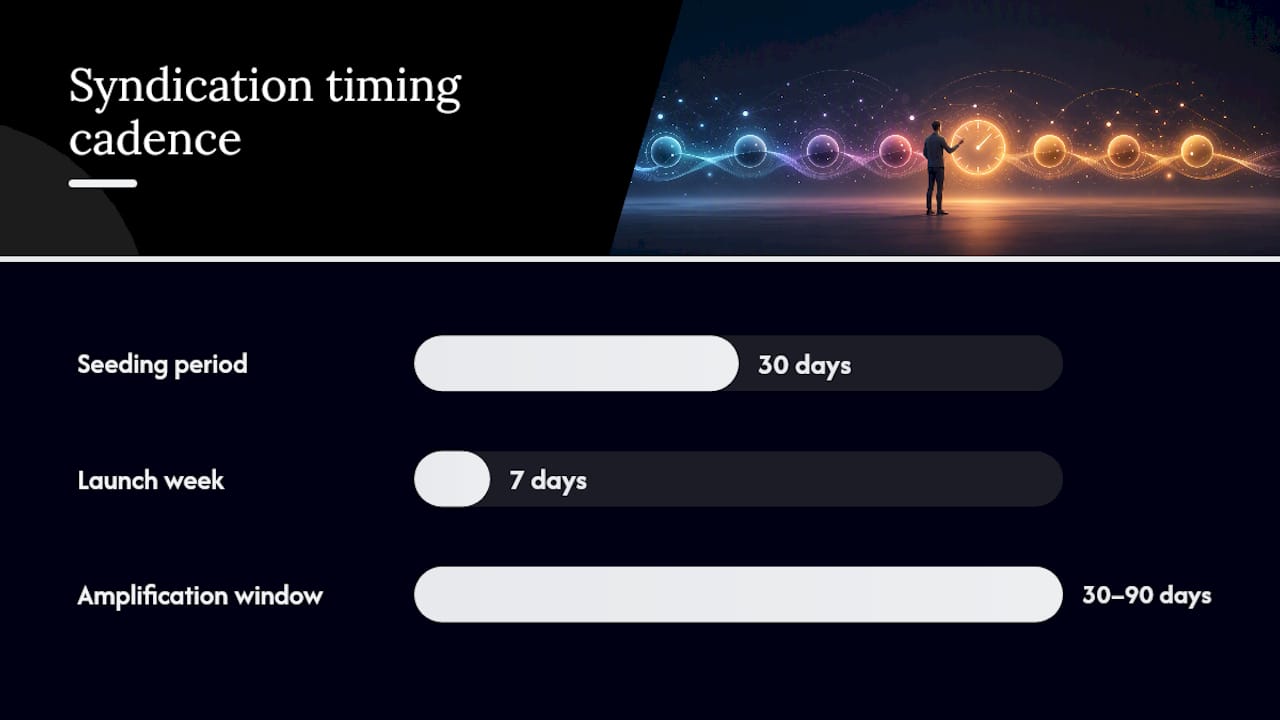
On timing: a reasonable cadence is a seeding period of about 30 days before a major asset launches, a full-send launch week where the piece goes out through every planned channel simultaneously, and a 30 to 90 day amplification window where you repurpose the original into five to seven channel-specific formats. Running syndication campaigns back to back without that amplification window is the fastest way to burn out an audience and muddy your own measurement data.
Does Matching Content to Buyer Stage Really Improve Lead Quality?
The evidence points in one clear direction: yes, and the effect is large enough to change how you allocate production budget.
Analyst guidance on B2B buyer behavior consistently supports mapping content type to where a buyer sits in their research process, rather than producing a single asset and syndicating it everywhere regardless of stage. An early-stage prospect skimming a discovery network wants a benchmark statistic or an educational framework, not a vendor comparison sheet. A late-stage prospect already evaluating options wants the case study with the number attached, not another "introduction to the category" blog post.
- Original research and benchmark reports perform across every distribution channel because they're non-replicable and inherently citable, which means they compound in value over months as other sites and AI engines reference them.
- Practitioners who layer intent data into their syndication targeting report better lead quality, simply because the content lands where accounts are already actively researching the category rather than being blasted broadly.
- The strategic priority industry voices keep returning to is converting rented traffic into owned contacts, since a syndicated visitor who never gives you their email is a visitor you'll likely never reach again.
If you're running a test program, keep it narrow. Pick one research asset, syndicate it through two or three well-matched partners, gate the follow-up whitepaper (not the summary), and measure list growth alongside lead volume. That combination tells you more in 90 days than a scattershot campaign across a dozen platforms ever will.
How Should You Sequence a Syndication Program?
Running syndication well isn't about picking more platforms. It's about sequencing a small number of moves in the right order and giving each one enough time to actually produce a signal.
Start with one flagship asset, either an original research or benchmark piece, or a case study with a hard number attached. Trying to syndicate five assets simultaneously in month one just splits your attention and your budget across too many variables to learn anything useful.
Seed that asset through owned channels first: your email list, your own blog, your LinkedIn page. This builds initial engagement signals and gives partners something to point to when you pitch them. Then amplify through one paid network (to get volume and speed) and two newsletter or publication partners (to get credibility and audience overlap). Running one of each type, rather than three of the same type, gives you a real comparison of channel performance instead of three data points that all behave the same way.
Measure for a full 90 days before making a go or no-go call on any single partner. Syndication data takes time to mature, especially for longer sales cycles where a lead from a benchmark report might not convert to a sales conversation for six to eight weeks.
Internally, four roles matter for this to run smoothly: a content owner who adapts the asset per platform, a campaign manager who tracks partner performance against KPIs, someone doing partner outreach and relationship management, and a lead verifier checking incoming contacts before they hit your CRM or sales team's queue. Skipping the verification role is one of the more common gaps in smaller marketing teams, and it's usually the first thing that breaks down when volume increases.
How Enochmarketing Runs Syndication for Fitness Brands
Most gyms and fitness brands don't have a content syndication problem. They have a distribution problem: solid content that never leaves their own website. Enochmarketing built its syndication approach specifically around fitness businesses, which means skipping the generic B2B playbook in favor of local newsletter swaps, wellness-adjacent publications, and community channels where gym owners' actual prospects spend time.
A managed syndication engagement typically starts with an audit of what content already exists and which pieces are strong enough to syndicate versus which need a rebuild first. From there, Enochmarketing handles partner outreach, sets up the canonical and technical requirements with each placement, and manages any paid network spend alongside lead verification so a gym owner isn't stuck manually checking whether a form-fill is a real prospect or a bot.
This fits gym owners and studio operators who have content sitting idle, who've tried posting on social without a distribution plan, or who want client success stories and case studies actually reaching new local audiences instead of just their existing followers. If that describes where your marketing is stuck, book a strategy session through Enochmarketing's services page and get a specific plan for the content you already have sitting on your website.
Sources
A handful of resources are worth bookmarking before you build out a full syndication calendar, since vendor claims in this space vary widely and it pays to check the fundamentals yourself.
Semrush's guide to content syndication basics is the clearest starting point for understanding republishing versus guest posting and the canonical tag mechanics behind both. HubSpot's breakdown of distribution channels is useful if you're still deciding how to split budget between owned, earned, and paid efforts. For anyone building a technical checklist, Marketricka's 2026 syndication strategy guide has the most implementation-level detail on canonical tags and publish timing. And Flux.LA's piece on getting content seen through AI engines is worth reading before you finalize how you structure any research report meant to earn citations.
Download or archive any original research piece before syndicating it widely. Once a benchmark statistic gets picked up by a dozen partner sites, tracing back which version search engines and AI tools treat as the canonical source gets a lot harder to untangle after the fact.
What is the difference between content syndication and guest posting? Syndication republishes existing content, often word for word, on a third-party platform with attribution back to the original. Guest posting means writing new, original content specifically for that publication, and it usually doesn't exist anywhere else first.
How many syndication partners should I start with? Start with two or three well-matched partners rather than a dozen loosely relevant ones. Audience overlap and editorial quality matter more than raw partner count, especially in the first 90 days when you're still establishing which channels convert.
Should I gate every piece of syndicated content? No. Gate decision-stage assets like whitepapers and templates, where the reader has already shown strong intent. Leave awareness-stage content like blog pillars and infographics ungated so they can spread and build reach.
How long before I see results from a syndication campaign? Give any new partner or placement a full 90 days before judging performance, since lead quality and conversion to opportunity often take several weeks to mature, especially for longer B2B sales cycles.
Do I need a canonical tag if the partner only publishes an excerpt? Yes, in most cases. Even an excerpt with a "read more" link benefits from a canonical tag or at minimum a clear attribution link back to the original, which protects your search rankings and directs engaged readers to your site.
- What Is Content Syndication? The Basics + How to Do It
- Content syndication: what it is & how to do it successfully (HubSpot)
- Flux
- The Best and Worst Content Distribution Strategies in 2026 | beehiiv Blog
- Content Syndication Strategy 2026 Guide | Marketricka
- How to market to B2B technology buyers | Gartner